
Breed profile · Sporting Group · the versatile gun dog
German Shorthaired Pointer
The German Shorthaired Pointer is the all-purpose gun dog — pointer, retriever, and water dog in one package, bred to hunt all day and then come home and be the family dog. It points with style, retrieves on land and in water, and works close to the gun, and it does it with an enthusiasm that is hard to miss. The breed is friendly, intelligent, and willing to please, and it has been one of America's most popular Sporting dogs for decades. The AKC recognized the breed in March 1930, and the German Shorthaired Pointer Club of America is the parent club.
Help us improve it. This is one of ThePetAdvisor’s breed profiles, built from public sources with generous links to the people who actually own this breed’s knowledge. If something’s off or missing, the parent club can claim the page and set it straight — see the bottom of the page.
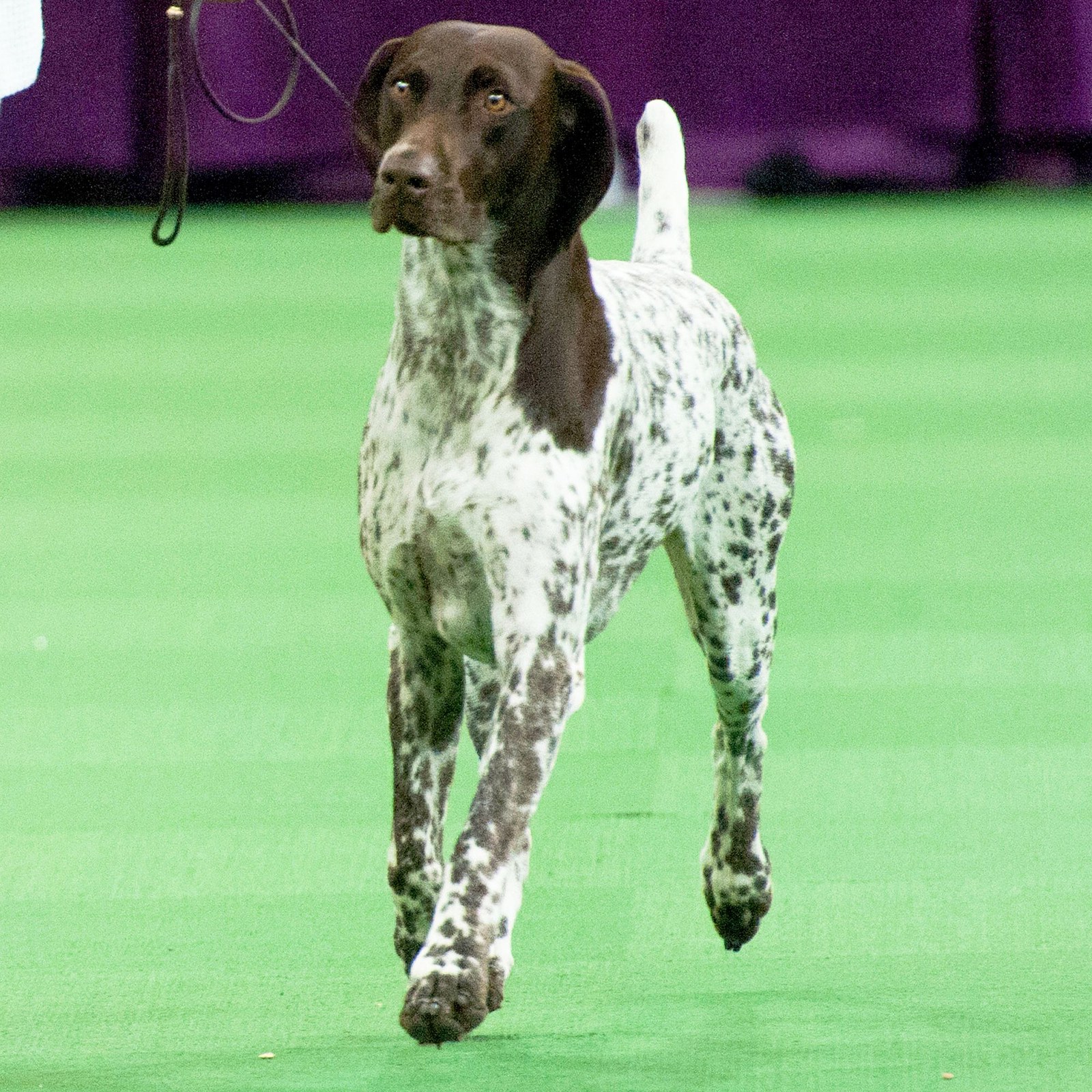

Do you have a better photo of a German Shorthaired Pointer in the American show ring? If you have a show photo you’d let us use, email it to [email protected] — tell us the dog’s name and the show, and it may be featured here. Please only send photos you took yourself or have the photographer’s permission to share, and tell us the photographer’s name.
1. Breed at a glance
Sporting Group; recognized by the AKC in March 1930
Dogs 23–25 in at the withers, 55–70 lb; bitches 21–23 in, 45–60 lb
Short, thick, tough coat; solid liver or liver-and-white (ticked, patched, roan), or solid black or black-and-white (since 2023); dark brown preferred
10–12 years
Friendly, intelligent, willing to please, enthusiastic
The German Shorthaired Pointer is a medium-sized gun dog built to do everything in the field: point, retrieve on land and in water, and work all day over rough ground. It is an athlete first — strong, fast, and tireless — and a companion second, though it takes the second job just as seriously. The coat is short, thick, and tough to the hand, made to shed burrs and water rather than to be groomed. The classic look is liver or liver-and-white ticked, though black coats have been accepted since 2023. Underneath it all is a dog that wants to be with its people and wants something to do. (Sources: AKC, Illustrated Standard of the German Shorthaired Pointer; AKC, German Shorthaired Pointer.)
2. History
The German Shorthaired Pointer was made in Germany in the 19th century, from old German pointing dogs crossed with pointers and hounds, to produce one dog that could do the whole job — find game, point it, retrieve it, and work in water. The German parent club, the Klub Kurzhaar, was formed in 1890, and the first Kurzhaar studbook appeared in 1897.
- First dogs in America. Dr. Charles R. Thornton of Missoula, Montana, made the first documented import — Senta v Hohenbruck, an Austrian-bred bitch — whose litter was whelped on July 4, 1925. The pups were registered in the Field Dog Stud Book in early 1926.
- AKC recognition. The AKC recognized the breed in March 1930; the first dog in the AKC Studbook was Greif v.d. Fliegerhalde. (One secondary source says 1935; the parent club's Judges' Education material and multiple other sources say March 1930.)
- Parent club. Nine owners applied to form the German Shorthaired Pointer Club of America in December 1938, and the charter was granted. The first breed standard was approved in May 1946; the club reorganized into its present structure in 1962, and the standard was revised in 1972 and 1992.
- Black coats admitted. In 2022 the club membership voted by 75 percent to admit solid black and every black-and-white pattern; the revised standard took effect January 1, 2023.
- At Westminster. German Shorthaired Pointers have won Best in Show at Westminster three times — 1974, 2005, and 2016. The 2016 winner was GCHP VJK-Myst Garbonita's California Journey, known as CJ, pictured at the top of this page.
From a handful of imports in the 1920s, the breed grew into one of America's most popular Sporting dogs — a field dog first, and a family dog a close second. (Sources: German Shorthaired Pointer Club of America, Judges' Education — GSP Breed History (January 1, 2023); AKC, German Shorthaired Pointer.)
3. The standard and why it is written that way
The standard describes a dog built for all-day field work, and every part of it follows from that job. The German Shorthaired Pointer is a versatile gun dog, and the standard is written around versatility: it must point, retrieve, and swim, so it needs the build, coat, and temperament to do all three.
- Size. Dogs 23 to 25 inches at the withers and 55 to 70 pounds; bitches 21 to 23 inches and 45 to 60 pounds. A deviation of one inch in height is severely penalized — the breed is meant to be medium-sized, not big.
- Coat. Short, thick, and tough to the hand, somewhat longer under the tail and on the back of the haunches. It is a working coat: it sheds water and burrs and needs almost no grooming.
- Color. Solid liver, or liver-and-white ticked, liver patched and white ticked, or liver roan — or, since January 1, 2023, solid black or black-and-white in the same patterns. Dark brown is the preferred color. The nose is brown on liver dogs and black on black dogs.
- Disqualifications. China or wall eyes; a flesh-colored nose; an extreme overshot or undershot bite; any area of red, orange, lemon, or tan; and a solid white dog.
- Movement. The gait is smooth and ground-covering, with a strong rear drive — the dog is meant to cover rough ground all day without tiring, and the standard judges it on the move as much as standing still.
- Temperament in the standard. The standard calls for an intelligent, friendly, willing dog — a temperament that makes it trainable in the field and livable in the house.
The black-coat change is the most important thing to know about the modern standard: a black German Shorthaired Pointer is not a fault and not a cross — it has been a fully accepted color since January 1, 2023, after the club membership voted it in. (Sources: AKC, Illustrated Standard of the German Shorthaired Pointer; German Shorthaired Pointer Club of America, Judges' Education — GSP Breed History (January 1, 2023).)
4. Temperament & living with one
German Shorthaired Pointers are friendly, intelligent, and eager to please — and they are also among the highest-energy dogs in the Sporting Group. They bond hard to their people and want to be where the action is, whether that is the field, the trail, or the couch after a long day.
- Exercise is not optional. Plan on an hour or two of active exercise a day, plus training and mental work. A German Shorthaired Pointer that does not get enough work will find its own — usually by running, digging, or redecorating your house.
- A job helps. Field work, agility, scent work, dock diving, and long hikes all suit the breed. Training is usually easy — they want to work with you — but they are sensitive, so harsh methods backfire.
- With children and other dogs. Usually good with children and with other dogs, especially when socialized young. They are exuberant, so small children can get knocked over in the excitement.
- Prey drive is real. This is a pointing breed with a strong hunting instinct. Small pets need supervision, and off-leash reliability takes training — a bird in the bush will always be more interesting than a recall.
- Not a kennel dog. German Shorthaired Pointers want to live in the house with their people. Left alone in a yard all day, they get bored, lonely, and destructive.
The honest summary: this is a wonderful family dog for an active household that can give it real work every day, and a poor fit for a quiet household that wants a dog to lie around. (Source: AKC, German Shorthaired Pointer.)
5. Grooming
Grooming a German Shorthaired Pointer is about as easy as grooming gets. The short, thick coat needs a weekly brushing with a rubber curry or hound glove to remove loose hair, and a bath only when the dog is dirty — the coat is wash-and-wear and dries fast.
The ears need regular checking: the long, pendant ears trap moisture, and a dog that swims or hunts in water is prone to ear infections if the ears are not dried and cleaned. Nails should be trimmed regularly — a dog that runs hard on rough ground wears them down, but a house dog may not. Teeth should be brushed, and the tail and coat checked for burrs and ticks after field work. Shedding is moderate and year-round; the hairs are short and easy to clean up. (Source: AKC, German Shorthaired Pointer.)
6. Health testing
The German Shorthaired Pointer Club of America's CHIC program sets the health testing a responsible breeder should do — and the results should be registered with the Orthopedic Foundation for Animals, where anyone can look them up.
- Cardiac. An exam by a board-certified cardiologist, at a minimum age of 24 months.
- Hips. An OFA hip evaluation or a PennHIP evaluation, at a minimum age of 24 months.
- Elbows. An OFA elbow evaluation, at a minimum age of 24 months.
- Eyes. An eye exam by a board-certified ACVO ophthalmologist, repeated annually until age 6, with results registered with OFA.
- Cone degeneration. A DNA test for cone degeneration, with results registered with OFA.
- Permanent identification. A microchip or tattoo is required for a CHIC number, so the test results are tied to the right dog.
Also worth asking about: a DNA test for von Willebrand's disease, a bleeding disorder found in the breed. The parent club is also funding research into lupus — exfoliative cutaneous lupus erythematosus — which affects some German Shorthaired Pointers. A CHIC number confirms the testing was done and published; it is not a guarantee of health, and it does not replace asking the breeder what they know about the health of their own lines. (Sources: German Shorthaired Pointer Club of America, Health Statement; AKC, Sporting Group Health Testing Requirements.)
7. The annual German Shorthaired Pointer specialty dog show
A specialty is the breed’s All-Star show — its Super Bowl. Once a year, the best German Shorthaired Pointers from across the country, and often from around the world, come together in one place.
The German Shorthaired Pointer Club of America's national specialty: one national event each year, with conformation, sweepstakes, futurity, obedience, rally, agility, and junior showmanship, usually a multi-day week in May. The 2026 national: May 22–23, at The Founders Inn and Spa in Virginia Beach, Virginia, with 226 dogs and 265 entries in conformation. The 2027 national: to be held in Peoria, Illinois — dates not yet announced as of November 7, 2026.
The standard, in brief: a medium-sized, versatile gun dog, 23 to 25 inches at the shoulder for dogs and 21 to 23 for bitches, with a short, thick, tough coat. The accepted colors are solid liver or liver-and-white — ticked, patched, or roan — and, since January 1, 2023, solid black or black-and-white in the same patterns. Dark brown is the preferred color.
The 2026 National Specialty — Friday, May 22–Saturday, May 23, 2026, at The Founders Inn and Spa, 5641 Indian River Rd, Virginia Beach, Virginia 23464, as part of National Specialty Week, May 16–24, 2026, per the GSPCA Shorthair Journal. Entries opened Sunday, March 1, 2026, and closed Wednesday, April 15, 2026, at 12:00 p.m. Event Chair: Jane Handschumaker. Superintendent: BaRay Event Services, Inc. The national drew 226 dogs and 265 entries (226 Ent — 98d — 128b; 225 competitors). AKC event 2026149816. (Sources: AKC event search, event 2026149816; Westminster Kennel Club, 2027 Westminster Invitees.)
National specialty judge: L A Estes (Leita Estes) — conformation and junior showmanship. Best Junior Handler: Jemma Panzarino; Reserve Best Junior Handler: Julia Salabert. A 4-to-6-month beginner puppy competition was held Friday, May 22, 2026. (Source: AKC event search, event 2026149816.)
Results (2026 national). Best of Breed: GCHG Quietstorm Designer Genes OHP CA BCAT DM CGC TKI. Best of Opposite Sex, Best of Winners, Winners Dog, and Winners Bitch were not confirmed in an official source as of November 7, 2026.
The 2027 National Specialty is to be held in Peoria, Illinois, according to the German Shorthaired Pointer Club of America — but the dates had not been announced as of November 7, 2026. The club's futurity page lists the 2027 futurity as “To be held in Peoria, IL” with no dates, and the AKC's Upcoming National Specialties list carries no German Shorthaired Pointer Club of America entry. Judges, venue, AKC event number, and entries will be added here when they are announced. (Sources: German Shorthaired Pointer Club of America, Futurity Show; AKC, Upcoming National Specialties.)
Past national specialties: 2025 · 2024 · 2023
German Shorthaired Pointer Club of America — gspca.org
8. Regional specialties through the year: smaller regional shows
The national is the anchor, but the breed’s year also runs through regional specialties — smaller regional shows, not the national — held around the country, including the regional specialty that runs with the national. These are the 2026 regionals verified from club and AKC sources so far:
No regional specialty in national specialty week was confirmed in an official source as of November 7, 2026. The national-week rally trial on Saturday, May 16, 2026, in Hampton, Virginia (AKC event 2026149810), is a rally trial, not a regional specialty.
Past regional specialties: 2025 · 2024 · 2023
More regional specialties will be added here as their programs are verified — this section is built from show data, not guesswork. Browse upcoming show weekends →
9. Clubs
The parent club is the German Shorthaired Pointer Club of America (GSPCA), at gspca.org — the club that runs the national specialty, publishes the breed's health guidance, and holds the Judges' Education material the standard is taught from. The 2026 president is Karen Rooks Nauer.
Regional specialty clubs verified in club and AKC sources during this build:
- German Shorthaired Pointer Club of Washington
- German Shorthaired Pointer Club of Oregon
- German Shorthaired Pointer Club of Wisconsin
- Mason-Dixon German Shorthaired Pointer Club
- Eastern German Shorthaired Pointer Club
- Nutmeg German Shorthaired Pointer Club
- German Shorthaired Pointer Club of the Finger Lakes
- German Shorthaired Pointer Club of Reno
- Heart of America German Shorthaired Pointer Club
- Schuylkill Valley German Shorthaired Pointer Club
Regional clubs run the regional specialties listed in section 8 and are the best first contact for anyone looking for a breeder, a field contact, or a local event. (Sources: German Shorthaired Pointer Club of America; AKC event records for the regional specialties in section 8.)
10. Rescue
German Shorthaired Pointers come into rescue because their energy outruns their owner's life — a dog bred to hunt all day does not settle into a quiet apartment. Breed-specific rescue groups take these dogs in, foster them, and place them with people who understand what the breed needs. Groups verified for this page:
- Illinois Shorthair Rescue. Based in Gurnee, Illinois, serving Illinois, Indiana, and Michigan. shorthairrescue.com
- NorCal GSP Rescue, Inc. Based in Menlo Park, California. norcalgsprescue.org
- Wisconsin German Shorthaired Pointer Rescue, Inc. Based in Cottage Grove, Wisconsin. wgspr.com
- California GSP Rescue. Based in Beaumont, California. gsp-rescue.org
- GSP Rescue of New Jersey. Based in Oak Ridge, New Jersey; part of the National GSP Rescue network.
- Ohio Shorthair Rescue, Inc. Based in Canfield, Ohio, serving Ohio, Indiana, and Kentucky. ohioshorthairrescue.org
Most of these groups place dogs on an application with references, and many will transport within their region. A rescue German Shorthaired Pointer is usually an adult, so you know its size, temperament, and energy level before you commit — a real advantage with a breed this driven. (Sources: the rescue groups' own sites, verified November 7, 2026.)
11. Breeder vs. rescue: honest guidance
Both routes can end with a great dog. The honest difference is what you know going in.
- Choose a breeder if you want a puppy for field work, showing, or a specific purpose, and you want the health testing, pedigree, and early socialization that come with a careful breeding program. Ask for the CHIC health results in section 6, meet the dam if you can, and be ready to wait — good breeders have waiting lists.
- Choose rescue if you want an adult dog whose temperament and energy level you can see before you commit, and you are comfortable with a dog that may need training and patience. Rescue is also the right route if you want to give a home to a dog that needs one.
- Either way, verify. Ask for health testing, ask what the dog's lines are known for, and meet the dog before you commit. A breeder who will not show you health results and a rescue that will not let you meet the dog are both telling you something.
A German Shorthaired Pointer is a ten-to-twelve-year commitment to a high-energy dog. The right question is not breeder or rescue — it is whether your life has room for a dog that needs real work every day.
12. Claim this page
This page was built from public sources — the AKC standard, the parent club's own material, AKC event records, and the rescue groups' sites — and it is a starting point, not the last word. If you are with the German Shorthaired Pointer Club of America or a regional club and something here is wrong or missing, you can claim this page and set it straight: email [email protected] and tell us what needs fixing. Corrections from the people who own the breed's knowledge are always welcome.
Sources
- AKC, Illustrated Standard of the German Shorthaired Pointer
- AKC, German Shorthaired Pointer
- AKC, Sporting Group Health Testing Requirements
- German Shorthaired Pointer Club of America, Health Statement
- German Shorthaired Pointer Club of America, Judges' Education — GSP Breed History (January 1, 2023)
- German Shorthaired Pointer Club of America
- German Shorthaired Pointer Club of America, Futurity Show (2027 national site: Peoria, Illinois; dates not announced)
- AKC, Upcoming National Specialties
- AKC event search, event 2026149816 (2026 national)
- AKC event search, event 2025149819 (2025 national)
- AKC event search, event 2025149813 (2025 regional)
- AKC event search, event 2024149816 (2024 national)
- AKC event search, event 2024149810 (2024 regional)
- AKC event search, event 2023149814 (2023 national)
- AKC event search, event 2023151514 (2023 regional)
- 2025 premium list (BaRay Event Services)
- 2024 premium list (BaRay Event Services)
- Westminster Kennel Club, 2027 Westminster Invitees (2026 national specialty winner)
- German Shorthaired Pointer Club of America, Shorthair Journal, July/August 2023 (2023 national results)
- Wikimedia Commons, File: CJ Westminister Winner 2016 Garbonita.jpg (hero photo, CC0)