
Breed profile · Sporting Group · recognized 1946
English Cocker Spaniel
The English Cocker Spaniel is the merry one of the spaniel world — an active, affectionate sporting dog with a silky, feathered coat, long low-set ears, and a soft, melting expression. Bred as a flushing spaniel and still a worker at heart, the English Cocker is compact and balanced, standing well up at the withers, and always, as the standard says, alive with energy. This page covers the breed's history, the standard, temperament, grooming, health testing, the national specialty, clubs, and rescue.
Help us improve it. This is one of ThePetAdvisor’s breed profiles, built from public sources with generous links to the people who actually own this breed’s knowledge. If something’s off or missing, the parent club can claim the page and set it straight — see the bottom of the page.
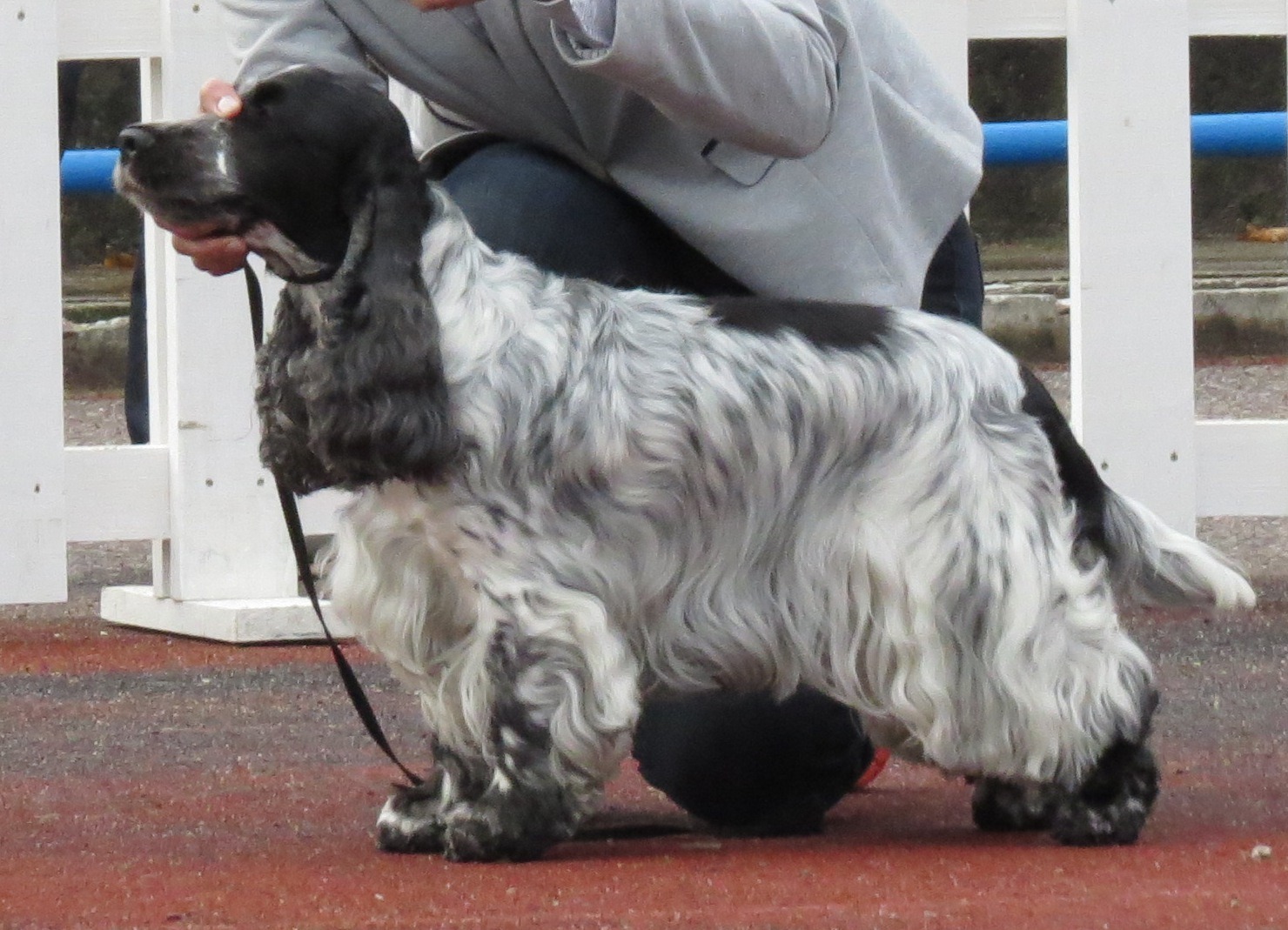
Do you have a better photo of an English Cocker Spaniel in the American show ring? If you have a show photo you’d let us use, email it to [email protected] — tell us the dog’s name and the show, and it may be featured here. Please only send photos you took yourself or have the photographer’s permission to share, and tell us the photographer’s name.
1. Breed at a glance
At a glance:
- Group: Sporting; recognized as a separate breed by the AKC in 1946.
- Size: males 16–17 inches at the withers, 28–34 pounds; females 15–16 inches, 26–32 pounds. Compactly built and short-coupled — height slightly greater than length from withers to tail set-on.
- Coat: medium length on the body, short and fine on the head; flat or slightly wavy, silky, with feathering on the legs, chest, and belly. Colors: solid black, liver, or shades of red; parti-colors of white with black, liver, or shades of red; and roans. Tan markings may appear with blacks, livers, and parti-colors.
- Ears: long and low-set, lying close to the head, with fine leather reaching to the nose and long, silky, straight or slightly wavy hair.
- Temperament: merry and affectionate, of equable disposition — neither sluggish nor hyperactive; a willing worker and a faithful, engaging companion.
- Life expectancy: 12–14 years.
- Best suited to: active owners who want a sporting companion in the house and the field — and who are ready for regular grooming and ear care.
The English Cocker is the English type of the Cocker Spaniel — taller and more athletic than the American Cocker, with a stronger working influence and less coat. The two were one breed in the AKC until 1946, when the English type was recognized as a separate breed and the formal split was completed in 1947.
2. History
The English Cocker Spaniel's story starts with the spaniels of Spain — the family of flushing dogs that gave the breed its name — and runs through the English countryside, where the Cocker was developed as the small flushing spaniel of the spaniel family, working close in cover to spring game for the gun. The Kennel Club in England recognized the Cocker as a distinct breed from the Springer in 1892, and the English Cocker was brought to America and Canada in the 1870s.
In America the type began to diverge in the 1920s and 1930s: the American-bred Cocker grew smaller, with a shorter muzzle and more coat, while the English type kept its taller, more athletic, working outline. Breeders who preferred the English type organized the English Cocker Spaniel Club of America in 1935 — its first president was Geraldine R. Dodge, who published The English Cocker Spaniel in America in 1942 and drove the pedigree research that defined the breed in this country. The AKC recognized the English type as a separate variety in 1936, the Canadian Kennel Club followed in 1940, and the AKC approved a breed standard in 1945 and recognized the English Cocker Spaniel as a separate breed in 1946, completing the formal split in 1947. The American variety kept the name Cocker Spaniel.
Eng. Ch. Obo is regarded as the foundation sire of the Cocker family. The Giralda Challenge Trophy, awarded for Best of Breed at the national specialty only, was first won in 1956 by Giralda Farm's Ch. On Time Amanda under judge Anne Hone Rogers (Clark). The national specialty has been held annually for decades — the 83rd was held in 2025 and the 84th in 2026.
3. The standard and why it's written that way
The AKC standard, approved August 8, 2023 and effective November 1, 2023, describes the English Cocker Spaniel as an active, merry sporting dog, standing well up at the withers and compactly built, alive with energy — a dog of balance, both standing and moving, without exaggeration in any part. The head is especially characteristic. Here is what the standard asks for, and why:
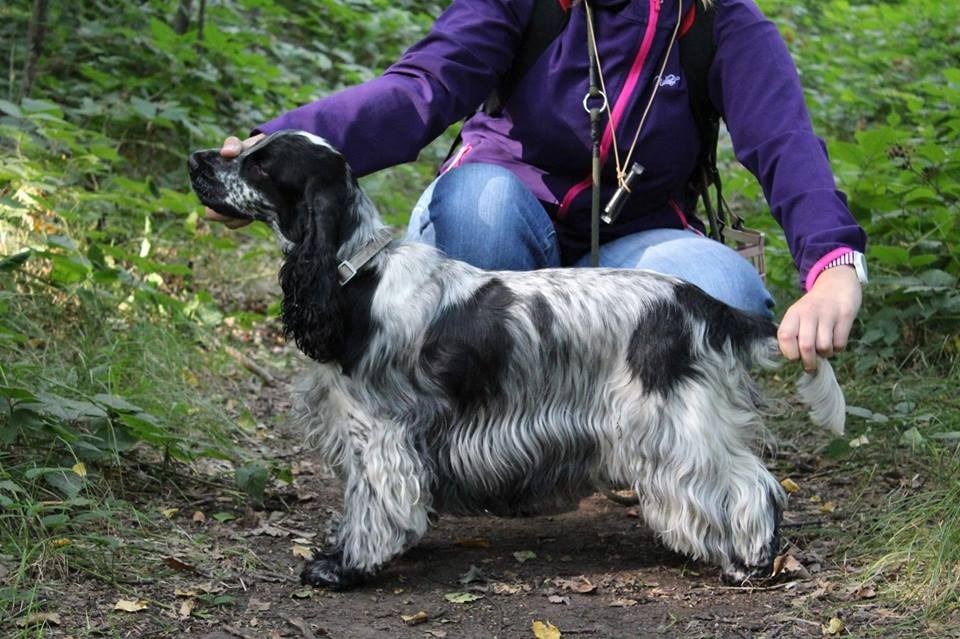
- General appearance — a compact, balanced worker: the English Cocker is compactly built and short-coupled, with height slightly greater than length from withers to tail set-on. The standard's picture is of a dog that can work all day in cover: powerful and frictionless in gait, with drive and power over great speed, moving in a straight line without crabbing or rolling. Exaggeration in any part breaks the balance the breed is built on.
- Head and expression — soft, melting, yet dignified: the head is strong, free from coarseness, and softly contoured. The expression is soft, melting, yet dignified, alert, and intelligent. Eyes are medium, full, and slightly oval, set wide apart, dark brown — hazel permitted in livers and liver parti-colors, the darker the better — with inconspicuous haws. The bite is scissors; a level bite is not preferred, and overshot or undershot is severely penalized.
- Ears — long, low-set, and silky: the ears are set low and lie close to the head, with fine leather extending to the nose, well covered with long, silky, straight or slightly wavy hair. The ears are one of the breed's most recognizable features, and they are also the part that needs the most care — long ears trap moisture, so ear checks are part of weekly life with an English Cocker.
- Coat — silky, medium length, feathered but workable: the coat is short and fine on the head and medium length on the body, flat or slightly wavy, silky, and well feathered — but not so profusely as to interfere with field work. Trimming is permitted to remove overabundant hair and enhance the true lines, and should appear as natural as possible. The coat is a working coat: enough feathering to show the breed, never so much that it stops the dog working.
- Color — solids, parti-colors, and roans: parti-colors are clearly marked, ticked, or roaned — white with black, liver, or shades of red. Solid colors are black, liver, or shades of red. Tan markings are clearly defined and rich in shade, and may appear with black, livers, and parti-color combinations; black and tans and liver and tans are considered solid colors. White feet on a solid are undesirable, and a little white on the throat is acceptable — neither makes the dog a parti-color.
- Tail and gait — carried horizontally, always moving: the tail is docked or undocked, set on to conform to the croup, and ideally carried horizontally and in constant motion while the dog is in action. The gait is the test of the build: drive and power over great speed, covering the ground effortlessly, head carried proudly in the ring.
- Temperament — the merry worker: the standard's temperament paragraph is short and to the point — merry and affectionate, of equable disposition, neither sluggish nor hyperactive, a willing worker and a faithful and engaging companion. That is the whole breed in one sentence.
4. Temperament & living with one
The English Cocker is a merry dog — the word the standard uses, and the word every owner reaches for. Affectionate and of equable disposition, neither sluggish nor hyperactive, the breed is a willing worker and a faithful, engaging companion. In the house that means a dog that wants to be with its people: English Cockers are happiest as part of the family, not kennelled away from it, and they tend to be gentle and good with children and with other dogs. In the field that means a flushing spaniel that still works — the breed's instincts are intact, and an English Cocker with nothing to do will invent its own work, usually involving something it can carry in its mouth.
Exercise needs are real but moderate: daily walks, play, and training, plus a chance to use the nose and the retrieving instinct. The breed is biddable and trainable, responding best to positive, consistent training — harsh handling shuts a soft-natured Cocker down. Because the breed is a working spaniel, mental work matters as much as miles: scent games, retrieving, and field training or dog sports keep an English Cocker satisfied in a way a walk around the block does not.
The breed's softness is part of its charm and part of the bargain: English Cockers are sensitive dogs, and they do best with owners who are steady, kind, and consistent. Left alone for long hours, a bored or lonely English Cocker can become vocal or destructive — this is a breed that wants company and a job.
5. Grooming
The English Cocker's silky, medium-length coat with feathering needs regular attention — not the daily marathon the American Cocker's heavier coat can become, but a steady weekly routine. Brush the coat and feathering two or three times a week to keep mats from forming, especially behind the ears, under the legs, and on the belly where the feathering is longest. A bath every few weeks, or when the dog has been working in cover, keeps the coat clean and the feathering silky; trim the feathering and the feet as needed to keep the outline tidy and the dog comfortable, and keep the hair between the pads trimmed so the dog moves cleanly.
The ears need the most attention of any part of the dog. Long, low-set ears trap moisture and air, so check the ears weekly, clean them as needed, and watch for redness, odor, or head-shaking — early signs of an ear infection. Dry the ears after baths and swimming. The breed's eye area should be kept clean, and the nails trimmed regularly. Most owners learn the routine quickly, and a good groomer who knows the breed is worth finding — the trim should look natural, never sculpted.
6. Health testing
Before buying an English Cocker Spaniel puppy, ask the breeder for the health-test results behind the litter. The English Cocker Spaniel Club of America participates in the AKC Canine Health Information Center (CHIC) program, and the tests below are the breed's CHIC requirements — a dog earns a CHIC number only when all of them are recorded with the Orthopedic Foundation for Animals (OFA). Ask to see the results on the OFA website, not just a breeder's word.
CHIC requirements for the English Cocker Spaniel:
- Hip dysplasia: OFA evaluation (PennHIP and OVC results are accepted when registered with OFA).
- prcd-PRA: Optigen DNA test for progressive retinal atrophy, results registered with OFA.
- Patellar luxation: OFA evaluation.
Plus two of the following: OFA thyroid evaluation; Optigen familial nephropathy DNA test; BAER hearing test; or a CERF eye examination (now the CAER exam).
Conditions to watch in the breed include prcd-PRA, familial nephropathy — a fatal kidney disease that can appear before the age of two and is inherited as an autosomal recessive — hip dysplasia, patellar luxation, cataracts, autoimmune thyroiditis, and ear infections. A breeder who tests, and who can show you the results, is doing the work that keeps the breed healthy. A breeder who cannot, or will not, is not.
7. The annual English Cocker Spaniel specialty dog show
A specialty is the breed’s All-Star show — its Super Bowl. Once a year, the best English Cocker Spaniels from across the country, and often from around the world, come together in one place.
The English Cocker Spaniel Club of America's national specialty: the annual English Cocker Spaniel specialty dog show. The 2027 national: Tuesday, May 18, 2027, at the South Sioux City Marriott Riverfront in South Sioux City, Nebraska, superintendent Patricia Shaw. The 2026 national: May 7–8, 2026, at Purina Farms in Gray Summit, Missouri, 186 dogs in the entry. Best of Breed: GCHS Majestic Sweet Apple Friends In Low Places. The 2025 national: May 29, 2025, at the Sturbridge Host Hotel in Sturbridge, Massachusetts, 167 dogs in the entry. Best of Breed not confirmed in an accessible official source. The 2024 national: May 1–3, 2024, at the Crowne Plaza Asheville in Asheville, North Carolina, 199 dogs in the entry. Best of Breed not confirmed.
The 2026 National Specialty, the 84th National Specialty Events of the English Cocker Spaniel Club of America, Inc.: national week Tuesday, May 5 – Friday, May 8, 2026, at Purina Farms, 300 Checkerboard Drive, Gray Summit, Missouri 63039. National Specialty conformation Thursday, May 7 – Friday, May 8, 2026: Suzanne Dwelly (186 entries — 81 dogs, 105 bitches; 207 total entries, 186 competitors; AKC event number 2026133232). Regional Specialty Tuesday, May 5, 2026: Douglas A. Johnson (171 entries; AKC event number 2026133234). Sweepstakes and Veteran Sweepstakes Wednesday, May 6, 2026: Sally Rosenthal (81 sweepstakes entries, 19 veteran sweepstakes entries; AKC event number 2026133252). 4–6 Month Beginner Puppy Thursday, May 7, 2026: Suzanne Dwelly (16 entries; AKC event number 2026133233). Obedience Thursday, May 7, 2026: Leslye Pinnell (25 entries; AKC event number 2026133231). Rally Thursday, May 7, 2026: Leslye Pinnell (37 entries; AKC event number 2026133225). Junior Showmanship: Marissa Shepherd (4 junior entries, 2 competitors; 1 Pee-Wee). Agility Tuesday, May 5 – Wednesday, May 6, 2026 (AKC event number 2026133228); barn hunt and CGC/Trick Dog testing during the week. Entries opened Saturday, February 28, 2026, 6:00 a.m.; closed Wednesday, April 8, 2026, 12:00 p.m. Event chair: Cynthia Anderson. Show secretary: Patricia Shaw, PO Box 2806, Belfair, WA 98528, [email protected]. Dedicated to the memory of Eileen Weston (Bobwhite) and Eugene Phoa (Wittersham). (Sources: AKC event search, event number 2026133232; ECSCA 2026 Judging Program; ECSCA 2026 Premium List; ECSCA 2026 marked catalog of results.)
Best of Breed: GCHS Majestic Sweet Apple Friends In Low Places (bitch). Best of Opposite Sex: GCHB Brandilyn's Time Travler (dog). Winners Dog and Best of Winners: Edgewood On Occasion (dog; also Best Puppy from the Regular Classes). Winners Bitch: Foxwoods QuinnTessential (bitch). Best in Veteran Sweepstakes: GCH Ashbrook Hot Tamale NA NAJ NF. Best in 4–6 Month Beginner Puppy: Majestic Spring Run's Take “It” To The Limit. Best Junior Handler: Brooke Boeske; Reserve Best Junior Handler: David Harmon.
The 2027 National Specialty: conformation Tuesday, May 18, 2027 (1 day), at the South Sioux City Marriott Riverfront, South Sioux City, Nebraska. National week Sunday, May 16 – Saturday, May 22, 2027, at the same hotel. Superintendent: Patricia Shaw. Hotel rate $139/night, 4 dogs maximum per room, RV hookups nearby; last day to book Saturday, April 17, 2027. National-week events: hunt test, working dog test, tracking, national performance test, scent work, obedience, rally, agility, conformation (including PeeWees, juniors, and 4–6 month beginner puppy), boutique, education seminars, parade of champions, raffles, and live auctions. AKC event number, premium, judges, entry fees, entries opening and closing not yet published as of November 7, 2026. (Sources: AKC Upcoming National Specialties list; ECSCA 2027 National page.)
Past national specialties: 2025 · 2024
English Cocker Spaniel Club of America
8. Regional specialties through the year: smaller regional shows
The national is the anchor, but the breed's year also runs through regional specialties — smaller regional shows, not the national — held by the English Cocker Spaniel Club of America and its regional clubs around the country, usually as independent specialties or as designated specialties with all-breed shows. These are the 2026 regionals verified from club and AKC sources so far:
- Regional specialty — Tuesday, May 5, 2026, Purina Farms, Gray Summit, Missouri (held with the national; AKC event number 2026133234). Judge: Douglas A. Johnson. 171 entries. Best of Breed: CH Golden Gait's Dance The Night Away (bitch). Best of Opposite Sex: GCH Edgewood Knock Knock (dog; also Best Veteran). Winners Dog: Istari Bellamy War At Dawn. Winners Bitch and Best of Winners: Bluestone N' Mijeans Perfect Fit. Best Puppy from the Regular Classes: armband 12. Best Bred By Exhibitor: armband 94. (Source: ECSCA 2026 Regional Results, marked catalog.)
- Regional specialty — Saturday, January 10, 2026, World's Fair Exhibition Hall, 935 World's Fair Park Drive, Knoxville, Tennessee (ECSCA regional specialty; AKC event number 2026133202). Judge: S Kaul. 44 entries (19 dogs, 25 bitches). Results not confirmed in an accessible official source.
- Heart of Michigan English Cocker Spaniel Club independent specialties — Saturday, September 5 – Sunday, September 6, 2026, Ann Arbor, Michigan. Judges and results not confirmed in an accessible official source.
Past regional specialties: 2025
Regional specialties are listed here only when the details check out against the club or AKC — a date and a judge from a premium, a judging program, or the AKC event search.
9. Clubs
The parent club is the English Cocker Spaniel Club of America, Inc. (ECSCA), founded in 1935 to promote the English type of Cocker in America. The club runs the national specialty, publishes breed standard education, and operates health and rescue through the ECSCA Health and Rescue Organization. ECSCA's regional clubs hold regional specialties around the country — among them the Heart of Michigan English Cocker Spaniel Club, which describes itself as the oldest continuously active regional specialty club for English Cockers in the United States; the Liberty English Cocker Spaniel Fanciers of Pennsylvania; the Star of the North English Cocker Spaniel Fanciers of Minnesota; the Tennessee Valley English Cocker Spaniel Fanciers; and the Chesapeake English Cocker Spaniel Association of Delaware and Maryland. If you are looking for a breeder, a regional club, or the national specialty, the parent club is the place to start: englishcocker.org.
10. Rescue
The English Cocker Spaniel Club of America established its own rescue program in 1989 to rescue English Cockers at risk in shelters, in other rescues, or from private owners. The program is now run through the ECSCA Health and Rescue Organization (ecscahealthandrescue.org), which places English Cockers that need new homes across the country. The process is an application, an interview, references, a home visit, and a signed adoption contract. Adoption fees are up to 18 months $500; 18 months to 8 years $400; 8 years and up $250; and over 12 years or for special-needs dogs (deaf, blind, or with a serious medical problem) a $150 donation is suggested. The adopter pays travel expenses. Dogs are never re-homed for breeding and never resold. If you are considering an English Cocker, a rescue dog can be a wonderful way in — and the rescue can help you find the right match. Contact the ECSCA Health and Rescue Organization through ecscahealthandrescue.org.
11. Breeder vs rescue
Both routes can lead to a wonderful English Cocker — the right one depends on what you need. A breeder is the right choice if you want a puppy with a known pedigree and health-tested parents, or if you plan to show or breed. Look for a breeder who health-tests to the CHIC standard and can show you the OFA results, who raises puppies in the home, who asks you as many questions as you ask them, and who takes the dog back at any point in its life if you cannot keep it. A breeder who does none of those things is not a breeder worth buying from.
Rescue is the right choice if you are open to an adult dog, if you want to give a home to a dog that needs one, or if you are not sure a puppy fits your life right now. Rescue dogs come with known temperaments and often with training, and the rescue's home visit and matching process is designed to get the fit right. Either way, take your time, ask questions, and meet the dog — the English Cocker you bring home will be with you for 12 to 14 years.
12. Claim this page
If you are a breeder, an owner, or a club member with better photos or corrections for this page, we would love to hear from you. Send a photo you took yourself, or one you have the photographer's permission to share, and tell us the photographer's name — the best American show photos may be featured here. Corrections to dates, judges, results, or breed facts are always welcome: the page is only as good as the records behind it. Contact us through ThePetAdvisor and tell us what needs fixing.
Sources
- AKC Official Standard for the English Cocker Spaniel (approved August 8, 2023; effective November 1, 2023)
- AKC breed page: English Cocker Spaniel
- AKC: Cocker Spaniel History
- AKC: English Cocker Spaniel History
- AKC: Cocker Spaniel vs. English Cocker Spaniel
- English Cocker Spaniel Club of America
- ECSCA 2027 National Specialty
- AKC Upcoming National Specialties list
- AKC event search: ECSCA 2026 National Specialty (event 2026133232)
- ECSCA 2026 National Specialty Judging Program
- ECSCA 2026 National Specialty Premium List
- ECSCA 2026 National Specialty Results (marked catalog)
- ECSCA 2026 Regional Specialty Results (marked catalog)
- AKC event search: ECSCA 2025 National Specialty (event 2025133226)
- ECSCA 2025 Regional Specialty Results (marked catalog)
- AKC event search: ECSCA 2024 National Specialty (event 2024133219)
- ECSCA 2024 National Specialty Premium List
- ECSCA Health and Rescue Organization: Health Testing (CHIC requirements)
- ECSCA Health and Rescue Organization: Rescue Information
- Hero photo: English Cocker Spaniel in Tallinn (Wikimedia Commons, CC BY-SA 3.0)
- Body photo: English cocker spaniel 2 (Wikimedia Commons, CC BY-SA 4.0)

