
Breed profile · Working Group · the sleek protection dog
Doberman Pinscher
The Doberman Pinscher is sleek and powerful, with a magnificent physique and keen intelligence — one of dogkind's noblemen, and one of the world's finest protection dogs. It is incomparably fearless and vigilant, loyal to its own people and watchful of everyone else, and it carries itself with a proud, elegant carriage that is hard to miss. The breed was made in Germany in the late 19th century as a guard and protection companion, and it has been an American favorite ever since the AKC recognized it in 1908. The Doberman Pinscher Club of America is the parent club.
Help us improve it. This is one of ThePetAdvisor’s breed profiles, built from public sources with generous links to the people who actually own this breed’s knowledge. If something’s off or missing, the parent club can claim the page and set it straight — see the bottom of the page.
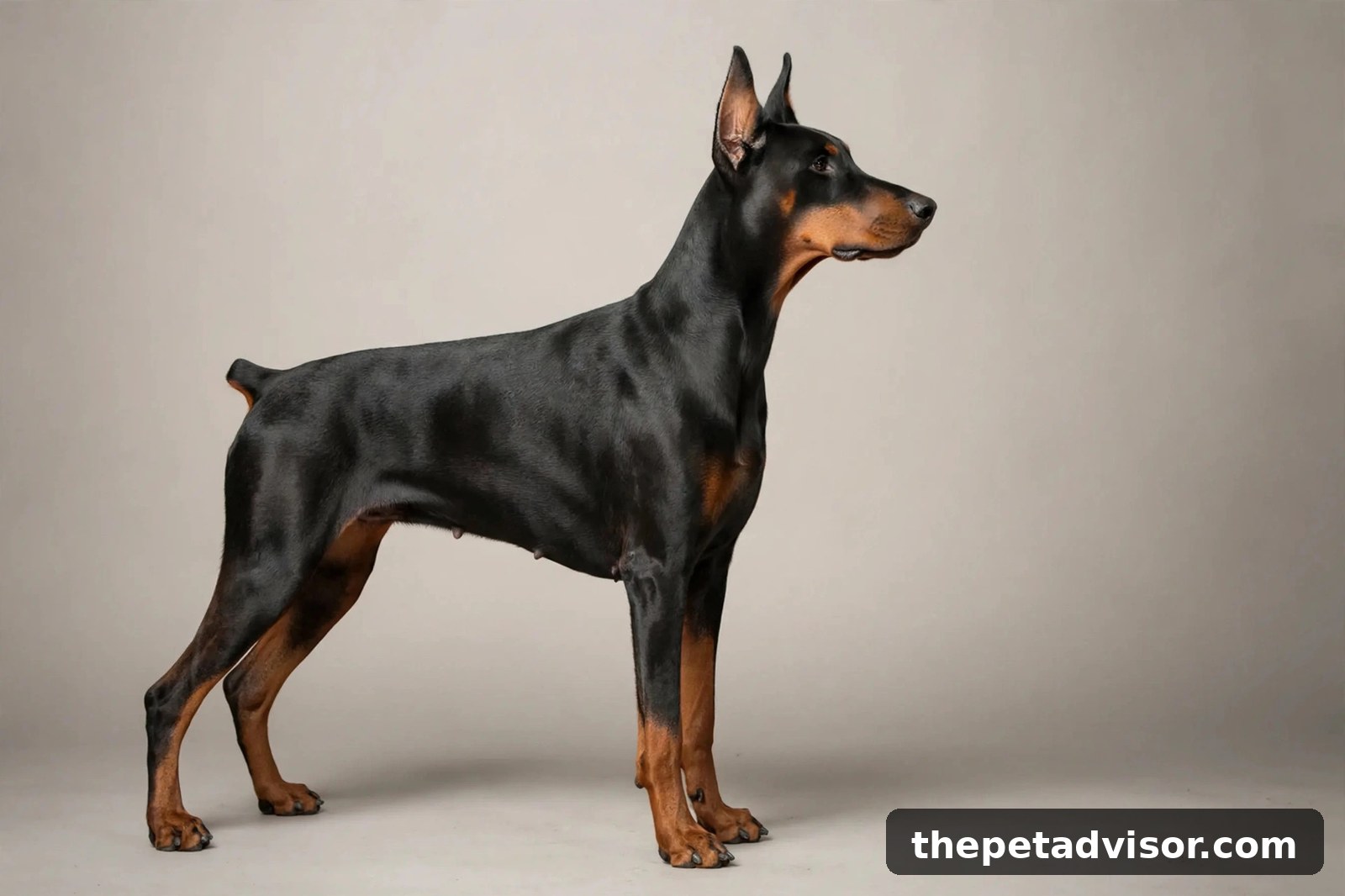
Do you have a photo of a Doberman Pinscher in the American show ring? We’d love this page to lead with one. If you have a show photo you’d let us use, email it to [email protected] — tell us the dog’s name and the show, and it may be featured here. Please only send photos you took yourself or have the photographer’s permission to share, and tell us the photographer’s name. We couldn’t find a public photo of a Doberman Pinscher in the American show ring that we were free to share, so the photo leading this page was made with AI. We’d much rather lead with a real one — if you’re a club member with an approved photo, we’d love to feature it.
1. Breed at a glance
Working Group; recognized by the AKC in 1908
Dogs 26–28 in at the withers, 75–100 lb; bitches 24–26 in, 60–90 lb
Short, smooth, hard coat; black, red, blue, or fawn, all with sharply defined rust markings
10–12 years
Energetic, watchful, determined, alert, fearless, loyal, obedient
The Doberman Pinscher is a medium-sized dog of square, compact build — muscular and powerful, for great endurance and speed — and elegant in appearance, with heavy bone and a proud carriage. The coat is short, smooth-haired, hard, thick, and close-lying, made to be wash-and-wear rather than groomed. The classic look is black with rust markings, though red, blue, and fawn are equally accepted. Underneath it all is a dog bred to guard: fearless, vigilant, and deeply loyal to its own people. (Sources: AKC, Doberman Pinscher; AKC, Official Standard of the Doberman Pinscher.)
2. History
The Doberman Pinscher was made in Apolda, in Thuringia, Germany, in the late 19th century, by Karl Friedrich Louis Dobermann — a tax collector, night watchman, and dog pound keeper who wanted a loyal dog to protect him on his rounds. With access to dogs of many breeds at the pound, he set out to breed one dog that would be an ideal guard and protection companion: strong, fast, intelligent, and fearless.
- Foundation breeds. The exact mix is not documented, but the AKC lists the possible foundation breeds as the old shorthaired shepherd, the Rottweiler, the Black and Tan Terrier, and the German Pinscher. The German club was formed in 1899, the first standard was written in 1900, and the first registered Doberman was Graf Belling v. Grönland, in 1898.
- AKC recognition. The breed came to the United States around 1908, and the AKC recognized it in 1908; the first AKC-registered Doberman dates to that year. The Doberman Pinscher Club of America was founded in 1921, and the first DPCA national specialty was held in 1924, in Philadelphia. The national has been held annually since, with only three exceptions — 1942, 1945, and 2020.
- War dogs. During World War II the United States Marine Corps used Doberman Pinschers alongside German Shepherds as war dogs, and the breed's popularity in America grew sharply after the war.
- At Westminster. Doberman Pinschers have won Best in Show at Westminster five times — 1939, back-to-back in 1952 and 1953, 1989, and 2026. The 1952 and 1953 winner was Ch. Rancho Dobe's Storm. The 1989 winner was CH Royal Tudor's Wild As The Wind, known as Indy, handled by Andy Linton. In 2026, Linton handled another Doberman to the top prize — GCHP CH Connquest Best Of Both Worlds, known as Penny — 37 years after Indy, at the 150th Westminster. Penny was also the 2024 national specialty Best of Breed and the 2025 national Best of Opposite Sex.
- Recent nationals. The national has traveled in recent years: Kingsport, Tennessee in 2021; Topeka, Kansas in 2022; Springfield, Missouri in 2023; Kingsport again in 2024; Wichita Falls, Texas in 2025; and Topeka again in 2026, for the 100th National Convention.
From a tax collector's protection dog in a German town, the Doberman grew into one of America's most recognizable Working breeds — a guard dog first, and a family dog a close second. (Sources: Wikipedia, Dobermann; Doberman Pinscher Club of America, National History and Results; AKC, Doberman Pinscher ‘Penny’ Wins Westminster Best in Show.)
3. The standard and why it is written that way
The standard describes a dog built for protection work, and every part of it follows from that job. The Doberman Pinscher is a medium-sized, square, compactly built dog, muscular and powerful, for great endurance and speed — and elegant in appearance, with heavy bone and a proud carriage.
- Size. Dogs 26 to 28 inches at the withers, ideal about 27½ inches; bitches 24 to 26 inches, ideal about 25½ inches. Typical weights are 75 to 100 pounds for dogs and 60 to 90 pounds for bitches. The standard gives heights, not weights, by number.
- Coat. Short, smooth-haired, hard, thick, and close-lying. It is a working coat: it sheds water and dirt and needs almost no grooming.
- Color. Black, red, blue, and fawn (Isabella), all with sharply defined rust markings — above each eye, on the muzzle, throat, and forechest, on all legs and feet, and below the tail. A white patch on the chest not exceeding half a square inch is permissible.
- Ears and tail. Ears normally cropped and carried erect, with the upper attachment on a level with the top of the skull. The tail is docked at approximately the second joint. The Doberman Pinscher Club of America affirms that the Doberman is a cropped and docked breed in the United States, and judges are to evaluate every exhibit against the AKC standard, not against practices in other countries.
- Disqualifications. Overshot more than 3/16 of an inch; undershot more than 1/8 of an inch; four or more missing teeth; and dogs not of an allowed color.
- White Dobermans. White — albino — Dobermans are not an allowed color and are disqualified. They are tyrosinase-positive albinos, first born in 1976, and the parent club has long discouraged breeding them.
- Movement. The gait is free and balanced, with good reach in front and strong drive behind — the dog is built to cover ground fast and keep going, and the standard judges it on the move as much as standing still.
- Temperament in the standard. Energetic, watchful, determined, alert, fearless, loyal, and obedient — a temperament that makes it a protection dog in the field and a devoted companion in the house.
The most important thing to know about the modern standard is the crop and dock: the American Doberman is presented with cropped ears and a docked tail, and a dog shown with natural ears and a full tail is not the American presentation, even though neither is a disqualification. (Sources: AKC, Official Standard of the Doberman Pinscher; Doberman Pinscher Club of America, Judges Education.)
4. Temperament & living with one
Doberman Pinschers are energetic, watchful, determined, alert, fearless, loyal, and obedient — the standard's own words — and they live up to every one of them. They bond hard to their people and want to be where the action is, whether that is the yard, the trail, or the couch after a long day.
- Protection instinct is real. This is a guard dog by design. Early and thorough socialization — people, places, sounds, other dogs — is not optional; without it, watchfulness turns into suspicion. A well-socialized Doberman is confident and discerning, not indiscriminately aggressive.
- Exercise is not optional. Plan on an hour or two of active exercise a day, plus training and mental work. A Doberman that does not get enough work will find its own — usually by running, digging, or redecorating your house.
- Highly trainable. The breed ranks among the most intelligent in obedience work — psychologist Stanley Coren ranks the Doberman fifth in obedience command training — and it wants to work with you. Training is usually easy, but the breed is sensitive, so harsh methods backfire.
- With children and other dogs. Usually good with children they are raised with, and with other dogs when socialized young. They are strong and exuberant, so small children can get knocked over in the excitement, and same-sex dog aggression is not uncommon.
- Not a kennel dog. Doberman Pinschers want to live in the house with their people. Left alone in a yard all day, they get bored, lonely, and destructive — and a bored guard dog is a problem.
The honest summary: this is a wonderful family dog for an owner who will train and socialize it and give it real work every day, and a poor fit for a quiet household that wants a dog to lie around. (Sources: AKC, Doberman Pinscher; Wikipedia, Dobermann.)
5. Grooming
Grooming a Doberman Pinscher is about as easy as grooming gets. The short, smooth coat needs a weekly brushing with a rubber curry or hound glove to remove loose hair, and a bath only when the dog is dirty — the coat is wash-and-wear and dries fast.
The ears need regular checking and cleaning, and a dog that swims is prone to ear trouble if the ears are not dried. Nails should be trimmed regularly — a dog that runs hard on rough ground wears them down, but a house dog may not. Teeth should be brushed, and the coat checked for burrs and ticks after outdoor work. Shedding is moderate and year-round; the hairs are short and easy to clean up. Blue and fawn Dobermans need extra coat and skin care: color dilution alopecia can thin the coat and leave the skin vulnerable, so watch for patchy hair loss and protect the skin from sun. (Source: AKC, Doberman Pinscher.)
6. Health testing
The Doberman Pinscher Club of America's CHIC program sets the health testing a responsible breeder should do — and the results should be registered with the Orthopedic Foundation for Animals, where anyone can look them up.
- Hips. A hip evaluation, registered with OFA.
- Cardiac. A cardiac exam, registered with OFA.
- Eyes. An eye exam by a board-certified ophthalmologist, registered with OFA.
- Thyroid. A thyroid evaluation, registered with OFA.
- Von Willebrand's disease type I. A DNA test, with results registered with OFA.
Also worth asking about: dilated cardiomyopathy (DCM), the leading cause of premature death in the breed — some estimates put lifetime risk at roughly half of all Dobermans — so ask whether the breeder does an annual echocardiogram by a board-certified cardiologist, a 24-hour Holter monitor, and DCM1/DCM2 DNA testing on top of the CHIC cardiac exam. A DNA test alone is not enough: an echocardiogram and a Holter show what the heart is actually doing. Hip dysplasia is comparatively uncommon in the breed, but it is still tested; hypothyroidism and progressive retinal atrophy are also on the list. A CHIC number confirms the testing was done and published; it is not a guarantee of health, and it does not replace asking the breeder what they know about the health of their own lines. (Sources: AKC, Working Group Health Testing Requirements; Doberman Pinscher Club of America.)
7. The annual Doberman Pinscher specialty dog show
A specialty is the breed’s All-Star show — its Super Bowl. Once a year, the best Doberman Pinschers from across the country, and often from around the world, come together in one place.
The Doberman Pinscher Club of America’s national specialty: one national event each year, with conformation, sweepstakes, futurity and maturity, obedience, rally, agility, working aptitude, and junior showmanship, usually a multi-day week in late September and early October. The 2026 national: October 1–3, at the Stormont Vail Events Center in Topeka, Kansas, with 306 dogs and 361 entries in conformation. The 2027 national: announced for September 25–October 2 in Springfield, Missouri — venue, judges, and entries not yet announced as of November 7, 2026.
The standard, in brief: a medium-sized, square, compactly built dog, muscular and powerful, elegant in appearance. Dogs stand 26 to 28 inches at the withers and bitches 24 to 26, with a short, smooth, hard coat. The allowed colors are black, red, blue, and fawn, all with sharply defined rust markings.
The 2026 National Specialty — the 100th National Convention — Thursday, October 1–Saturday, October 3, 2026, at the Stormont Vail Events Center, One Expocentre Drive, Topeka, Kansas 66612, as part of national week, September 26–October 3, 2026. Entries closed Wednesday, September 9, 2026. Event Chair: Ann Wulbrecht. Superintendent: Jack Onofrio Dog Shows, L.L.C. The national drew 306 dogs and 361 entries (306 Ent — 132d — 174b; 306 competitors). AKC event 2026075926. (Sources: AKC event search, event 2026075926; 2026 judging program (Jack Onofrio Dog Shows).)
National specialty judges: Dana Cline — dogs (Thursday, October 1; 56 class dogs and 17 veterans); Adrian Woodfork — bitches (Friday, October 2; 124 class bitches and 18 veterans); Vicki Seiler-Cushman — intersex, junior showmanship, and pee wee (Saturday, October 3; 150 Best of Breed). Karin Fox judged futurity and maturity (Tuesday, September 30; 95 futurity and 51 maturity entries), and Janice McGerr judged owner-handled sweepstakes (Thursday, October 1; 121 entries). Best Junior Handler: Jemma Panzarino; Reserve Best Junior Handler: Isabelle Muir. The 2026 national also marked the 50th anniversary of the Register of Merit program and the Rescue Committee, and it was nominated for Purina Specialty Show of the Year. (Sources: 2026 judging program (Jack Onofrio Dog Shows); AKC event search, event 2026075926.)
Results (2026 national). Best of Breed: GCH Masterrock N Kalora’s Mr. Brainwash. Best of Opposite Sex, Winners Dog, and Winners Bitch were not confirmed in an official source as of November 7, 2026.
The 2027 National Specialty is announced for September 25–October 2, 2027, in Springfield, Missouri, according to the Doberman Pinscher Club of America: “2027 National Details Coming Soon! Join the celebration in Springfield, Missouri — September 25 to October 2, 2027.” The venue, judges, AKC event number, entries, and the conformation days within that week had not been announced as of November 7, 2026, and the AKC’s Upcoming National Specialties list carries no Doberman Pinscher Club of America entry yet. Details will be added here when they are announced. (Sources: Doberman Pinscher Club of America; AKC, Upcoming National Specialties.)
Past national specialties: 2025 · 2024 · 2023
Doberman Pinscher Club of America — dpca.org
8. Regional specialties through the year: smaller regional shows
The national is the anchor, but the breed’s year also runs through regional specialties — smaller regional shows, not the national — held around the country, including the regional specialty that runs with the national. These are the 2026 regionals verified from club and AKC sources so far:
The DPCA regional specialty ran Saturday, September 26–Sunday, September 27, 2026, at the Stormont Vail Events Center in Topeka, Kansas, opening national week (AKC event 2026075912). Judges: Dogs Nikki Riggsbee, Bitches Sandy Gelinas, Intersex and Juniors Doug Johnson, Sweepstakes Kelly Marquis. Entry: 310 dogs and 451 entries (judging program). Best of Breed: GCH Holly Woods Don’t Fear The Reaper. Best of Opposite Sex: GCH Masterrock N Kalora’s Mr. Brainwash. Winners Dog: Fandola’s Express Warrior Jeffrey. Winners Bitch: Allettare Destiny Awaits.
Past regional specialties: 2025 · 2024 · 2023
More regional specialties will be added here as their programs are verified — this section is built from show data, not guesswork. Browse upcoming show weekends →
9. Clubs
The parent club is the Doberman Pinscher Club of America (DPCA), at dpca.org — the club that runs the national specialty, publishes the breed's health guidance and judges' education material, and keeps the national results history. Ann Wulbrecht served as president for 2025–2026 and chaired the 2026 national specialty.
Regional specialty clubs verified in the AKC club search index during this build:
- Doberman Pinscher Club of Northern California
- Doberman Pinscher Club of Reno
- Doberman Pinscher Club of Greater Kansas City, Inc.
- Doberman Pinscher Club of Sacramento
- Metropolitan Baltimore Doberman Pinscher Club
- Doberman Pinscher Club of Greater Milwaukee
- Doberman Pinscher Club of the Indian Nation, Inc.
- Desert Valley Doberman Pinscher Club
- Mount Hood Doberman Pinscher Club
- Puget Sound Doberman Pinscher Club
Regional clubs run the regional specialties listed in section 8 and are the best first contact for anyone looking for a breeder, a training contact, or a local event. (Sources: Doberman Pinscher Club of America; AKC, Club Search Index.)
10. Rescue
Doberman Pinschers come into rescue because their protection instinct and energy outrun their owner's life — a dog bred to guard does not settle into a home that cannot train and exercise it. Breed-specific rescue groups take these dogs in, foster them, and place them with people who understand what the breed needs. The parent club's rescue arm is the first place to look:
- Doberman Pinscher Club of America Rescue. The parent club's rescue program, with a state-by-state list of rescue organizations. Rescue Chair: Pam Gray ([email protected]). dpca.org/rescue/by-state.php
- AKC Rescue Network. The AKC's breed rescue listing for Doberman Pinschers, pointing to the DPCA rescue program. akc.org/akc-rescue-network/rescue-network-d-breeds/
- Doberman Rescue Unlimited, Inc. Serving New England and eastern New York.
- Doberman Rescue League, Inc. Serving South Florida (Miami, Fort Lauderdale, and Palm Beach).
- Doberman Rescue of North Texas. Serving the Dallas–Fort Worth area and North Texas.
- Doberman Rescue Minnesota. An all-volunteer nonprofit serving Minnesota.
- Illinois Doberman Rescue. Serving Illinois and the surrounding region.
- Doberman Assistance, Rescue and Education (D.A.R.E.). Serving Maryland, Virginia, Washington D.C., Delaware, and parts of West Virginia and Pennsylvania.
- Doberman Rescue of North Carolina, Inc. A nonprofit serving North Carolina.
- Doberman Rescue Alliance of Wisconsin, Inc. Serving Wisconsin.
Most of these groups place dogs on an application with references, and many will transport within their region. A rescue Doberman is usually an adult, so you know its size, temperament, and guarding instinct before you commit — a real advantage with a breed this protective. Ask what the dog's health testing history is, and whether it has had a cardiac workup: a rescue that cannot tell you anything about the heart is a rescue to question. (Sources: Doberman Pinscher Club of America, Rescue by State; AKC, Rescue Network D Breeds.)
11. Breeder vs. rescue: honest guidance
Both routes can end with a great dog. The honest difference is what you know going in — and with a Doberman, what you know about the heart and the temperament matters more than usual.
- Choose a breeder if you want a puppy for showing, performance, or a specific purpose, and you want the health testing, pedigree, and early socialization that come with a careful breeding program. Ask for the CHIC health results in section 6, ask what the breeder does about dilated cardiomyopathy, meet the dam if you can, and be ready to wait — good breeders have waiting lists.
- Choose rescue if you want an adult dog whose temperament, guarding instinct, and energy level you can see before you commit, and you are comfortable with a dog that may need training and patience. Rescue is also the right route if you want to give a home to a dog that needs one.
- Either way, verify. Ask for health testing, ask what the dog's lines are known for, and meet the dog before you commit. A breeder who will not show you health results and a rescue that will not let you meet the dog are both telling you something.
A Doberman Pinscher is a ten-to-twelve-year commitment to a powerful, protective dog that needs real work and real training every day. The right question is not breeder or rescue — it is whether your life has room for a dog that was bred to guard you.
12. Claim this page
This page was built from public sources — the AKC standard, the parent club's own material, AKC event records, and the rescue groups' sites — and it is a starting point, not the last word. If you are with the Doberman Pinscher Club of America or a regional club and something here is wrong or missing, you can claim this page and set it straight: email [email protected] and tell us what needs fixing. Corrections from the people who own the breed's knowledge are always welcome.
Sources
- AKC, Doberman Pinscher
- AKC, Official Standard of the Doberman Pinscher
- AKC, Working Group Health Testing Requirements
- Doberman Pinscher Club of America
- Doberman Pinscher Club of America, National History and Results
- Doberman Pinscher Club of America, National Results – 2025
- Doberman Pinscher Club of America, National Results – 2024
- Doberman Pinscher Club of America, National Results – 2023
- Doberman Pinscher Club of America, Regional Results – 2024
- Doberman Pinscher Club of America, 2025 National
- Doberman Pinscher Club of America, Judges Education
- Doberman Pinscher Club of America, Rescue by State
- AKC, Rescue Network D Breeds
- AKC, Upcoming National Specialties
- AKC event search, event 2026075926 (2026 national)
- AKC event search, event 2026075912 (2026 regional)
- 2026 judging program (Jack Onofrio Dog Shows)
- Westminster Kennel Club, 2027 Westminster Invitees (2026 national specialty winner)
- AKC, Doberman Pinscher ‘Penny’ Wins Westminster Best in Show
- Wikipedia, Dobermann
- AKC, Club Search Index (regional clubs)