
Breed profile · Non-Sporting Group · recognized 1888
Dalmatian
The Dalmatian is the spotted coach dog — a dignified, smart, outgoing dog that once ran beside horse-drawn carriages, clearing the way and guarding the horses at rest, and that still rides with firefighters as their mascot. The American Kennel Club recognized the breed in 1888, and the Dalmatian Club of America has guarded the standard since 1905. This page covers the breed's history, the standard, temperament, grooming, health testing, the national specialty, clubs, and rescue.
Help us improve it. This is one of ThePetAdvisor’s breed profiles, built from public sources with generous links to the people who actually own this breed’s knowledge. If something’s off or missing, the parent club can claim the page and set it straight — see the bottom of the page.
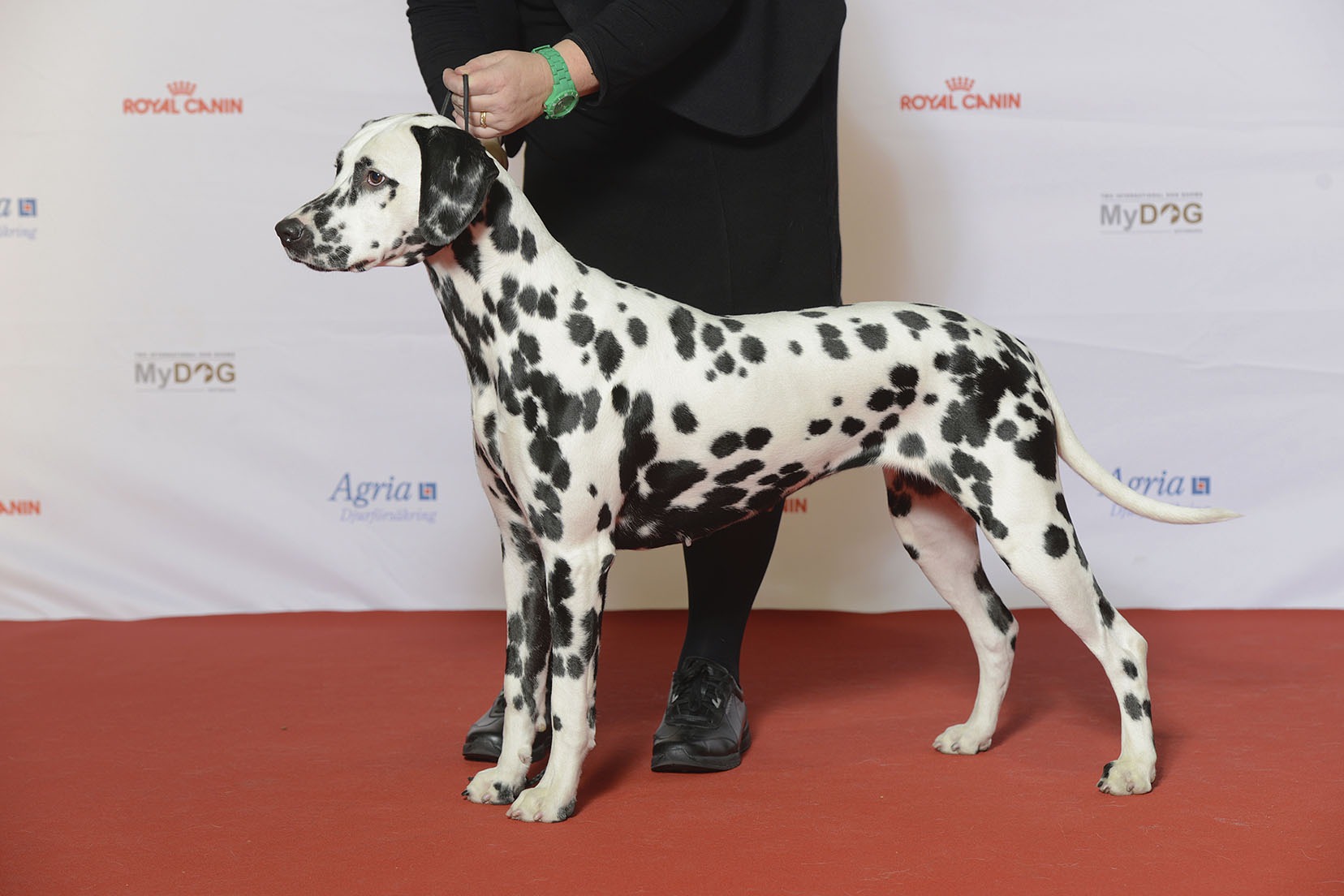
Do you have a better photo of a Dalmatian in the American show ring? If you have a show photo you’d let us use, email it to [email protected] — tell us the dog’s name and the show, and it may be featured here. Please only send photos you took yourself or have the photographer’s permission to share, and tell us the photographer’s name.
1. Breed at a glance
At a glance:
- Group: Non-Sporting; recognized by the AKC in 1888.
- Size: desirable height at the withers 19–23 inches; any dog or bitch over 24 inches is disqualified. The overall length of the body from forechest to buttocks is approximately equal to the height at the withers.
- Weight: 45–70 pounds.
- Coat: short, dense, smooth, and glossy. Ground color pure white, with dense black spots or liver-brown spots — round, well defined, and evenly distributed, from the size of a dime to the size of a half dollar.
- Temperament: dignified, smart, and outgoing — a loyal, high-energy companion that was bred to run all day beside a carriage.
- Life expectancy: 11–13 years.
- Best suited to: active owners who run, hike, or ride and want a dog that can keep up — and who can give a smart, strong-willed dog consistent training and a job to do.
The Dalmatian is one of the most recognizable dogs in the world, and one of the most misunderstood. The spots are the advertisement; the dog underneath is an athlete — strong, muscular, and built for endurance, with a temperament that is outgoing and loyal but never fawning. Everything in the standard is written to keep it that athlete.
2. History
The Dalmatian's origins are genuinely unclear, and the honest histories say so. The name points to Dalmatia, the Adriatic coastal region now in Croatia, and spotted dogs of this type appear in paintings and records across Europe for centuries — but no one has proved a single line of descent. What is certain is the job: the Dalmatian became the coach dog, the dog that ran beside horse-drawn carriages, clearing the road ahead, keeping pace for miles, and guarding the horses and carriage at rest. The breed's endurance, its distinctive spotting (easy to see at a distance), and its loyalty to the horses and the household all come from that work.
In England the breed was established by the early nineteenth century, and the first written breed standard is credited to Vero Shaw in 1882. English fanciers refined the spotting and the elegant outline, and the breed crossed to America, where the American Kennel Club recognized it in 1888. In the United States the coach dog found a second career with the fire service: Dalmatians ran with horse-drawn fire wagons, guarded the horses and equipment at the fire, and stayed on as the firehouse mascot long after the horses were gone — a tradition that still puts a Dalmatian in fire stations across the country.
The parent club, the Dalmatian Club of America, was formed in 1905 and has held the standard ever since. The breed's modern fame came from Dodie Smith's children's book The Hundred and One Dalmatians (1956) and the Disney film One Hundred and One Dalmatians (1961) — and each film release brought a surge of people wanting a spotted puppy, followed by a wave of Dalmatians in rescue when the reality of a high-energy, strong-willed dog set in. The club's rescue network exists in large part because of those surges, and the breed's history is a standing warning: buy the dog, not the movie.
3. The standard and why it's written that way
The AKC standard for the Dalmatian, approved July 11, 1989 and effective September 6, 1989, describes a distinctively spotted dog — poised, alert, strong, muscular, and active; free of shyness; intelligent in expression; symmetrical in outline; and without exaggeration or coarseness. Here is what the standard asks for, and why:
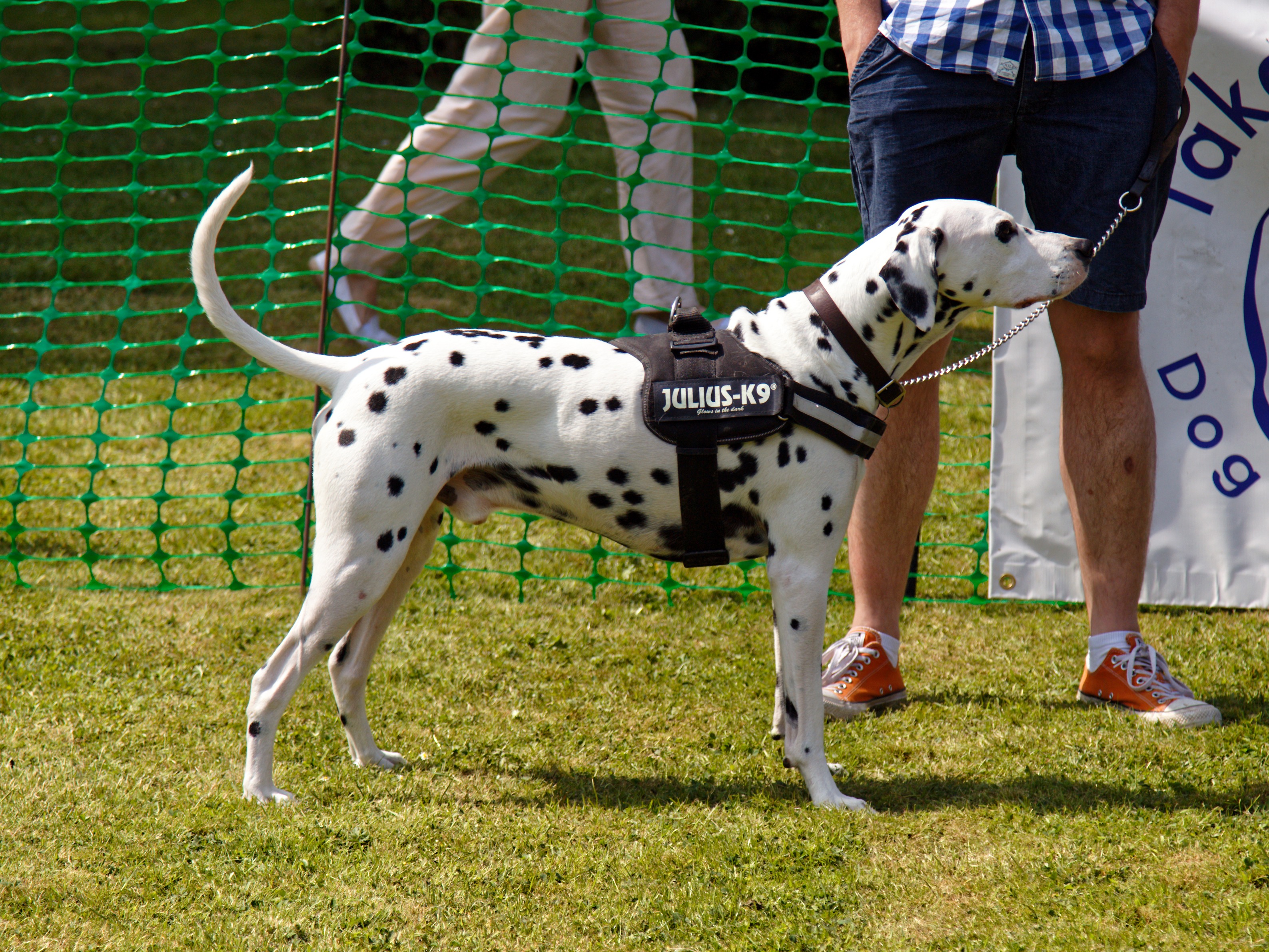
- General appearance — a symmetrical athlete: poised, alert, strong, muscular, and active, symmetrical in outline, without exaggeration or coarseness. The Dalmatian is strong and sturdy in bone but never coarse, and the overall length of the body is approximately equal to the height at the withers — a square dog, built to run.
- Size — medium, with a hard ceiling: desirable height at the withers 19 to 23 inches; undersize or oversize is a fault, and any dog or bitch over 24 inches is disqualified. The ceiling matters: a Dalmatian too big for its frame loses the endurance the breed was built for.
- Head — long, clean, and intelligent: the head is of fair length, with a flat, fairly broad skull and a powerful, straight muzzle of good length. The eyes are set moderately well apart, medium in size, somewhat rounded, and set well into the skull; eye color is brown or blue, or any combination, the darker the better, and usually darker in black-spotted than in liver-spotted dogs. The ears are of moderate size, set rather high, carried close to the head, and gradually narrowing to a rounded tip. The nose is completely pigmented on the leather — black in black-spotted dogs, brown in liver-spotted dogs. The bite is scissors; overshot or undershot is a disqualification.
- Neck, body, and tail — built for the road: the neck is fairly long, nicely arched, light and tapering, and entirely free from throatiness. The chest is deep, with good spring of rib; the back is strong and level; the loins are strong and slightly arched. The tail is a natural extension of the topline, carried with a slight upward curve, never curled over the back, and reaches approximately to the hock. The feet are round and compact, with well-arched toes, and the nails are black and/or white in black-spotted dogs, brown and/or white in liver-spotted dogs.
- Gait — smooth, effortless, and enduring: the gait is smooth and effortless, with powerful reach and drive — the Dalmatian moves with a steady, rhythmic stride that it can hold for miles. The standard judges the dog moving, because the coach dog's whole purpose was to keep going.
- Coat — short, dense, and glossy: short, dense, smooth, and glossy. The short coat is part of the working design: it sheds burrs, dries fast, and needs little care — and it shows the spotting clearly.
- Color and markings — the point of the breed: color and markings and their overall appearance are very important points to be evaluated. The ground color is pure white. In black-spotted dogs the spots are dense black; in liver-spotted dogs the spots are liver brown. Any color markings other than black or liver are disqualified. Spots are round and well defined — the more distinct the better — varying from the size of a dime to the size of a half dollar, pleasingly and evenly distributed, and the less they intermingle the better. Spots on the head, tail, and extremities are smaller than those on the body.
- Disqualifications — the hard lines: any dog or bitch over 24 inches at the withers; overshot or undershot bite; any color markings other than black or liver; tri-color (tan markings on the head, neck, chest, leg, or tail of a black- or liver-spotted dog); and patches — a solid mass of black or liver hair containing no white hair, appreciably larger than a normal spot. Patches are present at birth, and a patched puppy is disqualified from the conformation ring even though the patch has no effect on the dog as a pet. Lemon spotting is also a disqualification.
- Why the standard is written this way: every point serves the carriage road. The square, muscular body and the smooth, effortless gait are for running all day beside horses; the short, dense coat is for weather and burrs; the pure-white ground with distinct, evenly distributed spots is so the dog can be seen at a distance — and so the spots, the breed's signature, read clearly. Nothing in the standard is decoration: it is a working dog's specification, written down.
One honest note on spotting: the standard describes black-spotted and liver-spotted Dalmatians only, and dogs of any other spotting color are disqualified. Low uric acid (LUA) Dalmatians — descendants of a 1973 Pointer outcross that reintroduced the normal uric acid gene — are registered with the AKC and compete in conformation; their spotting is judged to the same standard as any other Dalmatian. See section 6 for the health story behind the LUA dogs.
4. Temperament & living with one
The AKC's three words for the Dalmatian are dignified, smart, and outgoing, and they are the right three. A Dalmatian is a loyal, people-bonded dog that wants to be in the middle of family life, and it is also an independent-minded one: this is a breed that thinks, and a Dalmatian that has decided something is worth doing will need a reason to do otherwise. Training works best with consistency, patience, and reward — a Dalmatian trained with harsh methods stops trusting the trainer, and a Dalmatian that stops trusting stops listening.
Exercise is not optional and it is not a walk around the block. A Dalmatian was bred to run beside a carriage for miles, and a modern Dalmatian needs an hour or two of real activity a day — running, hiking, biking alongside, agility, or the breed's own road trial, in which the dog runs beside a horse or a carriage. A Dalmatian that runs is a calm, happy house dog; one that never gets to run is a frustrated, destructive one, and the breed's reputation for hyperactivity is almost always a story about an under-exercised dog.
With people, Dalmatians are generally good with children, especially when raised with them, but they are big, strong, and exuberant — play with small children should be supervised, and puppies need training and socialization like any large, energetic breed. They can be reserved with strangers and make alert watchdogs, though they are not guard dogs. Early socialization matters, and so does company: a Dalmatian left alone for long hours is a lonely, bored dog. One practical point that shapes daily life: a Dalmatian that is deaf in one or both ears — and a significant minority are — needs visual signals and a securely fenced yard, because recall you cannot hear is recall you cannot trust.
5. Grooming
The short coat is easy to care for and hard to live with, both at once. A weekly brush with a rubber curry or bristle brush, a bath when the dog is actually dirty, and the coat takes care of itself — but the Dalmatian sheds heavily and constantly, year-round, and the short white hairs with black tips get into everything. Owners call it Dalmatian glitter, and it is not a joke: if white hair on dark clothing bothers you, this is not your breed.
What needs attention instead:
- Shedding: heavy, year-round, with seasonal peaks. Regular brushing keeps it manageable and the coat glossy, and it will not stop it.
- Ears: check weekly and clean as needed — the folded ears trap moisture, and ear infections are one of the breed's routine problems.
- Nails and feet: round, compact feet with well-arched toes; keep the nails trimmed — a running dog with long nails strains its feet and pasterns.
- Teeth: brush regularly; the bite is scissors, and a Dalmatian's mouth is worth protecting.
- Skin: the short coat offers little protection, so watch for sunburn on thinly haired areas and for skin irritation, and keep the dog out of prolonged midday sun.
6. Health testing
Before buying a Dalmatian puppy, ask the breeder for the health-test results behind the litter — and ask for the puppy's own hearing result, not just the parents'. The breed's CHIC requirements — the tests a dog needs recorded with the Orthopedic Foundation for Animals to earn a CHIC number — are two mandatory tests plus one elective, and the mandatory pair tells you what the breed's health story is about.
- Congenital deafness — BAER testing (mandatory for CHIC): hearing evaluated by brainstem auditory evoked response (BAER) testing, registered with OFA. Deafness is the breed's most common inherited problem: the Dalmatian Club of America's Hearing 101 guidance lists representative figures for pre-weaned puppies of about 70 percent bilateral hearing, about 22 percent unilateral hearing (deaf in one ear), and about 8 percent totally deaf. Puppies can be BAER-tested as early as five weeks. Ask for the BAER result for the puppy itself — a puppy that hears in only one ear can live a full life, but its owner needs to know, because training and recall depend on it.
- Hip dysplasia (mandatory for CHIC): OFA evaluation, or OVC or PennHIP evaluation registered with OFA.
- Elective — one of the following: an OFA thyroid evaluation from an approved laboratory, or an ACVO eye examination by a board-certified veterinary ophthalmologist, with results registered with OFA. Eye diseases in the breed include progressive retinal atrophy and iris sphincter dysplasia (also called iris hypoplasia), in which the pupil stays dilated and the dog is sensitive to light.
The breed's second great health issue has no place in the CHIC list because it is fixed in the breed: hyperuricosuria. Almost every Dalmatian except the LUA dogs carries two copies of a mutation in the SLC2A9 gene that makes the dog excrete high levels of uric acid, which can form urate crystals and bladder stones — painful and potentially life-threatening, especially in males, whose narrower urethra can block. A DNA test for the SLC2A9 mutation is available, and a breeder should be able to tell you whether the litter is LUA (low uric acid) or HUA (high uric acid). The LUA dogs descend from a single 1973 outcross in which Dr. Robert Schaible bred a champion Pointer to a Dalmatian to reintroduce the normal gene; after generations of backcrossing to purebred Dalmatians, the AKC agreed in 2011, after a vote of the Dalmatian Club of America's membership, to register the LUA descendants. For a high uric acid Dalmatian, management is diet and water: a low-purine diet, plenty of fresh water, and frequent chances to urinate — and any sign of straining to urinate is a veterinary emergency.
Other conditions to watch include hip dysplasia, hypothyroidism, epilepsy, and bloat, and the breed's short coat and sensitive skin deserve routine attention. The Dalmatian Club of America Foundation funds research into the breed's two defining problems — deafness and uric acid stones — and a breeder who tests, and who can show you the results on the OFA database, is doing the work that keeps the breed healthy. A breeder who cannot, or will not, is not.
7. The annual Dalmatian specialty dog show
A specialty is the breed’s All-Star show — its Super Bowl. Once a year, the best Dalmatians from across the country, and often from around the world, come together in one place.
The Dalmatian Club of America's national specialty: the annual Dalmatian specialty dog show. The 2027 national: May 19–21, 2027, at the Hendricks County Fairgrounds in Danville, Indiana. The 2026 national: May 5–7, 2026, at the MeadowView Conference Resort and Convention Center in Kingsport, Tennessee, 228 dogs in the entry. Best of Breed not confirmed in an accessible official source. The 2025 national: June 19–21, 2025, at Purina Farms in Gray Summit, Missouri, 213 dogs in the entry. Best of Breed not confirmed. The 2024 national: June 18–20, 2024, at the Georgia National Fairgrounds & Agricenter in Perry, Georgia, 211 dogs in the entry. Best of Breed not confirmed.
The 2026 National Specialty of the Dalmatian Club of America: national week May 3–7, 2026, at the MeadowView Conference Resort and Convention Center, 1901 Meadowview Parkway, Kingsport, Tennessee. Conformation May 5–7, 2026: Mrs. Patricia Trotter (regular bitch classes, Best of Breed, and Junior Showmanship) and Mrs. Dianne Wright (regular dog classes and non-regular classes); 228 dogs in the entry (271 entries — 107 dogs, 121 bitches; AKC event number 2026188913). Puppy and Veteran Sweepstakes and Futurity Monday, May 4, 2026 (sweepstakes judge SarahAnne Vancleeve; futurity judge Michael Deer; AKC event number 2026188924). 4–6 Month Beginner Puppy Wednesday, May 6, 2026 (judge Mary Miller; AKC event number 2026188926). Obedience Monday, May 4, 2026 (judge Karen Wrey; AKC event number 2026188914) and Rally Monday, May 4, 2026 (judge Nanci Hayes; AKC event number 2026188915). Two days of agility, three days of Fast CAT and CABT, two days of scent work, barn hunt, and a road trial during the week. Entries opened Wednesday, January 21, 2026; closed Wednesday, April 1, 2026, at noon EDT. Event chair: John Cramer. Superintendent: Executive Dog Shows, LLC. Dalmatian Club of the Piedmont regional specialty Sunday, May 3, 2026, at the same site (judge Mrs. Faye Strauss; AKC event number 2026498315). (Sources: AKC event search, event numbers 2026188913, 2026188924, 2026188926, 2026188914, 2026188915, and 2026498315; DCA 2026 National Specialty premium list.)
Best of Breed, Best of Opposite Sex, Winners Dog, and Winners Bitch not confirmed in an accessible official source. Best Junior Handler: Rylee Menard; Reserve Best Junior Handler: Johanna Lambert.
The 2027 National Specialty: conformation May 19–21, 2027 (3 days), at the Hendricks County Fairgrounds in Danville, Indiana. Superintendent: Executive Dog Shows, LLC. AKC event number, premium, judges, entry fees, and entries opening and closing not yet published as of November 7, 2026. (Sources: AKC Upcoming National Specialties list.)
Past national specialties: 2025 · 2024 · 2022
8. Regional specialties through the year: smaller regional shows
The national is the anchor, but the breed's year also runs through regional specialties — smaller regional shows, not the national — held by the Dalmatian Club of America's regional clubs around the country, usually as independent specialties or alongside all-breed shows. These are the 2026 regionals verified from club and AKC sources so far:
- Regional specialty — Sunday, May 3, 2026, MeadowView Conference Resort and Convention Center, Kingsport, Tennessee (Dalmatian Club of the Piedmont, held with the national; AKC event number 2026498315). Judge: Mrs. Faye Strauss. Results not confirmed in an accessible official source.
- Regional specialties — Friday, August 7, 2026, Lorain County Kennel Club Park, Oberlin, Ohio (Western Reserve Dalmatian Club 82nd and 83rd specialties, two shows; AKC event numbers 2026189503 and 2026189504). Morning show judge: Ms. Mary A. Miller; sweepstakes judge Kate Holmes. Afternoon show judge: Ms. Helene Nietsch; sweepstakes judge Rebecca Dubbink. Results not confirmed in an accessible official source.
- Regional specialty — Sunday, September 6, 2026, NC State Fairgrounds, Raleigh, North Carolina (Central Carolina Dalmatian Club). Judge: Dr. J. Dandridge (27 entries). Best Junior Handler: Caroline McElyea. Best of Breed not confirmed in an accessible official source.
- Regional specialty — Friday, October 23, 2026, Dixon May Fairgrounds, Dixon, California (Dalmatian Club of Northern California 54th Independent Specialty; AKC event numbers 2026189108 and 2026189109). Saturday designated specialty breed judge: Kathi Brown; sweepstakes judge Bonnie Money. Sunday supported entry breed judge: Phillip Booth. Friday breed judge not confirmed in an accessible official source.
Past regional specialties: 2025 · 2024
Regional specialties are listed here only when the details check out against the club or AKC — a date and a judge from a premium, a judging program, or the AKC event search.
9. Clubs
The parent club is the Dalmatian Club of America, Inc. (DCA), formed in 1905 to preserve the breed and hold its standard — one of the older parent clubs in the American Kennel Club. The club runs the national specialty, publishes the quarterly Spotter, supports judges education, and, through the Dalmatian Club of America Foundation, funds research into deafness and uric acid stones. Club officers per the 2025 and 2026 national specialty premiums: President Michele Wrath, Vice President Kris Benoit, Recording Secretary Dr. Ginger Iwaoka, Corresponding Secretary Toni Linstedt, Treasurer Vickie Mooney, AKC Delegate Dr. Charles Garvin. If you are looking for a breeder, a litter, or the national specialty, the parent club is the place to start: dalmatianclubofamerica.org.
Regional clubs carry the breed's specialty year across the country, and the DCA's regional clubs include the Dalmatian Club of the Piedmont, the Central Carolina Dalmatian Club, the Mid Florida Dalmatian Club, the Dalmatian Club of Greater Atlanta, the Greater Washington Dalmatian Club, the Delaware Valley Dalmatian Club, the Western Reserve Dalmatian Club, the Chicagoland Dalmatian Club, the Dalmatian Club of Greater St. Louis, the Heartland Dalmatian Club of Greater Kansas City, the Dalmatian Club of Northern California, the Puget Sound Dalmatian Club, the Mt. Hood Dalmatian Club, the Dalmatian Club of San Diego County, the Dalmatian Club of Greater Detroit, the Greater Pittsburgh Dalmatian Club, and the Greater Denver Dalmatian Club. Most hold an annual specialty; several hold theirs during national week.
The breed's working side is the road trial — the Dalmatian's own performance event, in which the dog runs beside a horse (or, in the modern version, a carriage) over a set course, judged on pace, endurance, and manners. Road trials run at the national specialty, and the club also offers obedience, rally, agility, Fast CAT, scent work, barn hunt, and tracking at national week.
10. Rescue
The Dalmatian Club of America runs its rescue work through the Dalmatian Club of America Foundation (DCAF) Rescue network — a nationwide network of regional rescue contacts and volunteers who take in Dalmatians in need and place them in approved homes. Start at dalmatianclubofamerica.org for the rescue contacts in your region.
Regional breed rescues also place Dalmatians across the country, including Dalmatian Rescue of South Florida (dalmatianrescue.com), a no-kill organization in North Miami Beach, Florida; Dalmatian Rescue of Colorado (dalmatianrescueco.org); Dalmatian Rescue of North Texas; Willing Hearts Dalmatian Rescue; and Dalmatian Rescue Illinois. Expect an application, an interview, a home visit, and reference checks — and expect questions about exercise, fencing, and how many hours the dog will be alone, because those are the questions that decide whether a Dalmatian thrives.
Rescue Dalmatians are usually adults whose temperament is already known — a real advantage with a high-energy, strong-willed breed — and some are deaf in one or both ears. A deaf Dalmatian can be a wonderful companion in a home that trains with hand signals and visual cues and keeps the dog on leash or in a fenced yard, but it is not a first dog for a household that wants an off-leash running partner. Be honest about what you can offer, and the rescue will match you with the dog that fits.
11. Breeder vs rescue
Both routes can lead to a wonderful Dalmatian — the right one depends on what you need, and on how honest you are about the exercise and training this breed demands. The breed is popular enough that both good breeders and rescue have dogs available, but the wrong match is how Dalmatians end up back in rescue.
From a breeder: expect a breeder who shows or competes with their dogs, health-tests every breeding dog, and takes a dog back for life. Ask for the CHIC number — hip evaluation and BAER hearing testing are mandatory, with thyroid or an eye examination as the elective — and verify it on the OFA database. Ask for the puppy's own BAER result, and ask whether the litter is LUA or HUA and what that means for diet and stone risk. Ask how the puppies are raised in the home, what the parents compete in, and what the breeder expects of you. A breeder who won't answer, or who always has puppies available, is a warning sign.
From rescue: expect an application, a phone interview, and often a home visit. Rescue dogs are usually adults, spayed or neutered, temperament-tested, and placed by people who know the breed's needs — which means the rescue will ask hard questions about exercise, fencing, and work hours. That scrutiny is a feature: a Dalmatian in a home with no outlet for its energy is a miserable dog, and the rescue would rather say no now than take the dog back later.
Either way: the right question is not “breeder or rescue?” but “does this dog, and this source, fit a life with a smart, strong, high-energy dog that needs miles every day, consistent training, and a family that is home enough to give it?” A Dalmatian that runs and lives with its people is one of the great companions in the dog world. A Dalmatian bought for its spots and left alone in a yard is a tragedy in slow motion.
12. Claim this page
This page is maintained by ThePetAdvisor and built from public sources — the AKC standard, the Dalmatian Club of America's publications, and AKC event records. If you are an officer of the Dalmatian Club of America, a regional club officer, a rescue coordinator, or a breeder, and you spot an error or have a correction, we would rather hear it from you than from a search result.
Send corrections, specialty dates, or photos to [email protected] with “Dalmatian” in the subject line. We check every message.
Sources
- AKC breed page: Dalmatian
- Dalmatian Club of America: The Illustrated Standard — The Official Standard for the Dalmatian (approved July 11, 1989; effective September 6, 1989)
- AKC: Non-Sporting Group Health Testing Requirements (Dalmatian: hip evaluation, BAER testing)
- Dalmatian Club of America: CHIC Health Testing Requirements for the Dalmatian (October 30, 2014)
- Purina Pro Club: CHIC Certification Tool for Dalmatians Breeding
- Vetstreet: Dalmatian Breed Information (AKC recognition 1888; Dalmatian Club of America formed 1905)
- Whole Dog Journal: An Update on “Low Uric Acid” Dalmatians
- Canine Chronicle: Another Year, Another Wrap-Up (2011 AKC registration of LUA Dalmatians)
- AKC Upcoming National Specialties list
- AKC event search: DCA 2026 National Specialty (event 2026188913)
- DCA 2026 National Specialty premium list
- AKC event search: DCA 2025 National Specialty (event 2025188912)
- DCA 2025 National Specialty premium list
- DCA 2025 National Specialty judging program
- AKC event search: DCA 2024 National Specialty (event 2024188909)
- Dalmatian Club of America: 2024 National Specialty schedule
- AKC event search: DCA 2022 National Specialty (event 2022188918)
- DCA 2022 National Specialty judging program
- AKC event search: Western Reserve Dalmatian Club specialties, August 7, 2026 (event 2026189503)
- AKC event search: Dalmatian Club of Northern California specialty, October 23, 2026 (event 2026189108)
- Petfinder: Dalmatian Rescue of South Florida
- Hero photo: BIR Grupp 6 Dalmatiner, Mellanmöllan Honey Pie (Wikimedia Commons, CC BY 2.0)
- Body photo: Dalmatian at Easton Lodge Gardens open day (Wikimedia Commons, CC BY-SA 4.0)

