
Breed profile · Herding Group · the large, gentle herder of Scotland
Collie
The Collie — the Lassie dog — is a large, lithe, strong, responsive, active herding dog from the Scottish Highlands: dogs 24 to 26 inches at the shoulder and 60 to 75 pounds, bitches 22 to 24 inches and 50 to 65 pounds, with a long, blunt wedge head, almond-shaped dark eyes, ears carried about three-fourths erect with the tips breaking forward, and an expression the standard calls one of the most important points in the breed. It comes in two varieties, Rough and Smooth — the full-coated Rough is the familiar one, the sleek Smooth its short-coated twin — in sable and white, tri-color, blue merle, or white. The AKC calls it devoted, graceful, and proud, and notes that a hundred years as a pop-culture star have made it among the world’s most recognizable and beloved dog breeds.
One breed, two varieties: the AKC registers the Collie as a single breed with Rough and Smooth varieties, judged by the same standard except for coat, and judged together for Best of Breed. This page covers both varieties.
Help us improve it. This is one of ThePetAdvisor’s breed profiles, built from public sources with generous links to the people who actually own this breed’s knowledge. If something’s off or missing, the parent club can claim the page and set it straight — see the bottom of the page.
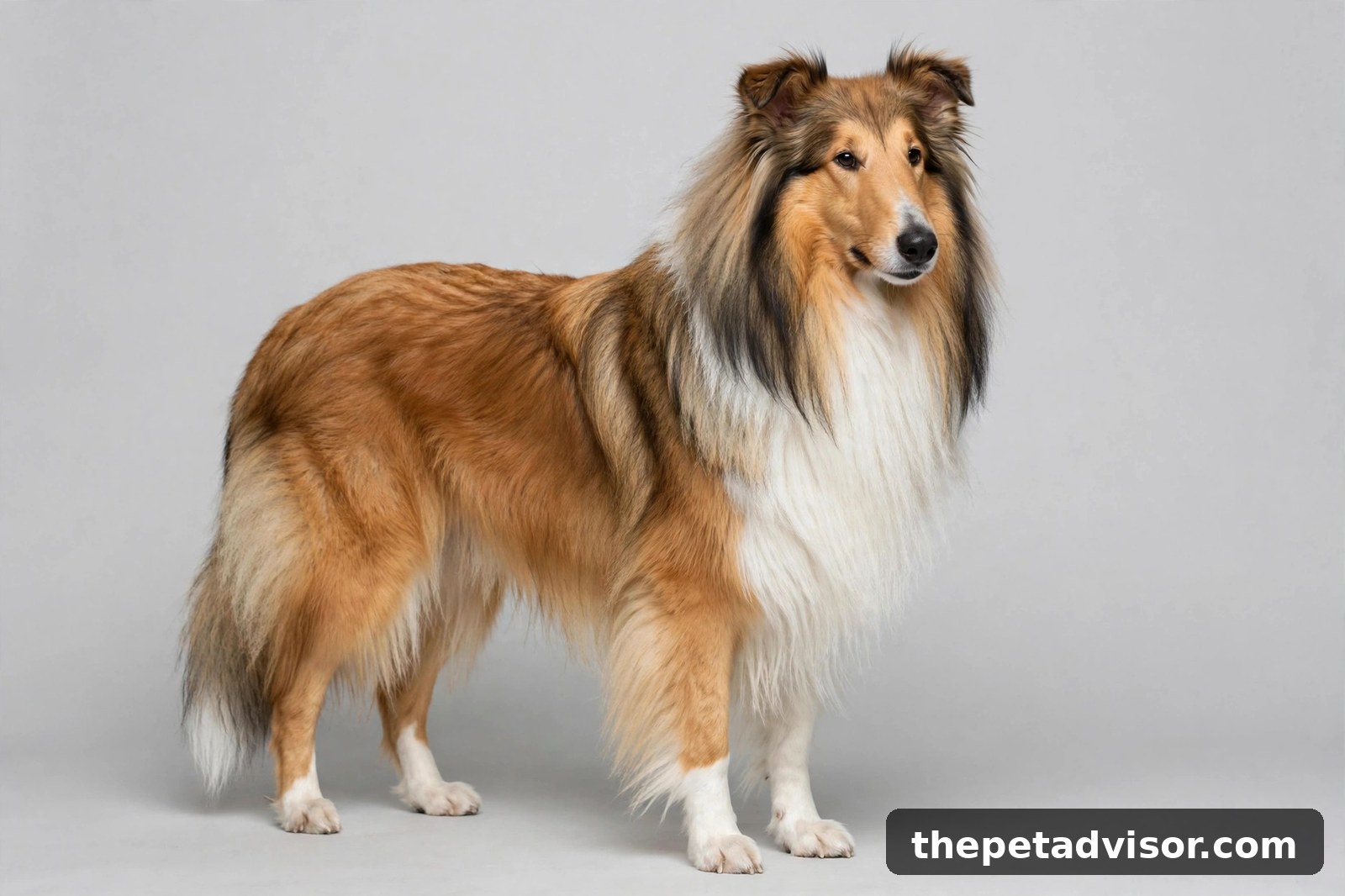
Do you have a photo of a Collie in the American show ring? We’d love this page to lead with one. If you have a show photo you’d let us use, email it to [email protected] — tell us the dog’s name and the show, and it may be featured here. Please only send photos you took yourself or have the photographer’s permission to share, and tell us the photographer’s name. We couldn’t find a public photo of a Collie in the American show ring that we were free to share, so the photo leading this page was made with AI. We’d much rather lead with a real one — if you’re a club member with an approved photo, we’d love to feature it.
1. Breed at a glance
Herding — recognized by the AKC in 1885; in the Working Group until the Herding Group was established in 1983
Dogs 24–26 in, 60–75 lb; bitches 22–24 in, 50–65 lb at the shoulder.
Two varieties: Rough — long, abundant double coat with mane and frill; Smooth — short, hard, dense, flat coat. Sable and white, tri-color, blue merle, or white.
Devoted, graceful, and proud. Gentle, loyal, and intelligent; famously good with children.
12 to 14 years.
Size, coat, and temperament facts are from the AKC standard (approved May 10, 1977) and the AKC Collie breed page. Lifespan (12 to 14 years) is from the AKC breed page.
2. History
The Collie’s ancestors worked the Scottish Highlands and the Southern Uplands for centuries as the stock dogs of Scottish and English farmers and shepherds — herding sheep and driving cattle to market. The Rough was the sheep herder; the Smooth, the drover’s dog. The name itself is disputed, but the work is not: these were tough, intelligent farm dogs long before anyone wrote a standard for them. (Sources: Chewy, Collie Breed; Wyndlair Collies, Collie FAQs.)
The breed’s rise from farm dog to show dog began in the second half of the nineteenth century. Collies were first exhibited in 1860 at the Birmingham dog show, and Queen Victoria’s enthusiasm for the Collies she saw at Balmoral Castle in Scotland in the 1860s — several soon joined her Royal Kennels — gave the breed enormous social cachet. The Collie Club was founded in England in 1881; the first Collie was imported to the United States in 1879, the AKC recognized the breed in 1885, and the Collie Club of America was organized in 1886, the second parent club to join the AKC. Its first show was held in New York in 1894, where J. P. Morgan’s imported English sable, Hero, went Winners Dog. (Sources: Chewy, Collie Breed; Vetstreet, Collie; American Collie Club of Switzerland, History.)
The twentieth century made the Collie the most famous dog in the world. Albert Payson Terhune’s books about his Collies — Lad, a Dog and the Sunnybank stories — and Eric Knight’s novel Lassie Come Home (1940) gave the breed its reputation for bravery, loyalty, and intelligence; the film Lassie Come Home followed in 1943, with the Rough Collie Pal playing Lassie, and the television series Lassie ran from 1954 to 1973, carrying the sable-and-white Rough Collie into living rooms for nearly two decades. (Sources: Chewy, Collie Breed; Vetstreet, Collie.)
3. The standard and why it’s written that way
- General character — lithe, strong, responsive, active. The standard opens with the whole dog: “The Collie is a lithe, strong, responsive, active dog, carrying no useless timber, standing naturally straight and firm. The deep, moderately wide chest shows strength, the sloping shoulders and well-bent hocks indicate speed and grace, and the face shows high intelligence. The Collie presents an impressive, proud picture of true balance, each part being in harmonious proportion to every other part and to the whole.” Timidity, frailness, sullenness, viciousness, lack of animation, cumbersome appearance, and lack of over-all balance all impair the general character. (Source: AKC standard.)
- The head: a well-blunted lean wedge. “Both in front and profile view the head bears a general resemblance to a well-blunted lean wedge, being smooth and clean in outline and nicely balanced in proportion. On the sides it tapers gradually and smoothly from the ears to the end of the black nose.” The top of the backskull and the top of the muzzle lie in two approximately parallel, straight planes of equal length, divided by a very slight but perceptible stop. A heavy-headed dog lacks the bright, alert, full-of-sense look the breed needs, and head faults are very severely penalized. (Source: AKC standard.)
- Expression is one of the most important points in the breed. “Expression is one of the most important points in considering the relative value of Collies.” It is the combined product of the shape and balance of skull and muzzle, the placement, size, shape, and color of the eyes, and the position, size, and carriage of the ears. The eyes are almond-shaped, of medium size, dark, set obliquely, with a clear, bright appearance expressing intelligent inquisitiveness. The ears are in proportion to the head, carried about three-quarters erect with about one-fourth of the ear tipping or breaking forward when the dog is alert; in repose they fold lengthwise and are thrown back into the frill. A dog with prick ears or low ears cannot show true expression and is penalized accordingly. (Source: AKC standard.)
- Size — dogs 24 to 26 inches, 60 to 75 pounds; bitches 22 to 24 inches, 50 to 65 pounds. An undersize or oversize Collie is penalized according to the extent of the departure. The body is firm, hard, and muscular, a trifle long in proportion to the height, with a deep chest extending to the elbows, a strong level back, and a croup sloped to give a well-rounded finish. (Source: AKC standard.)
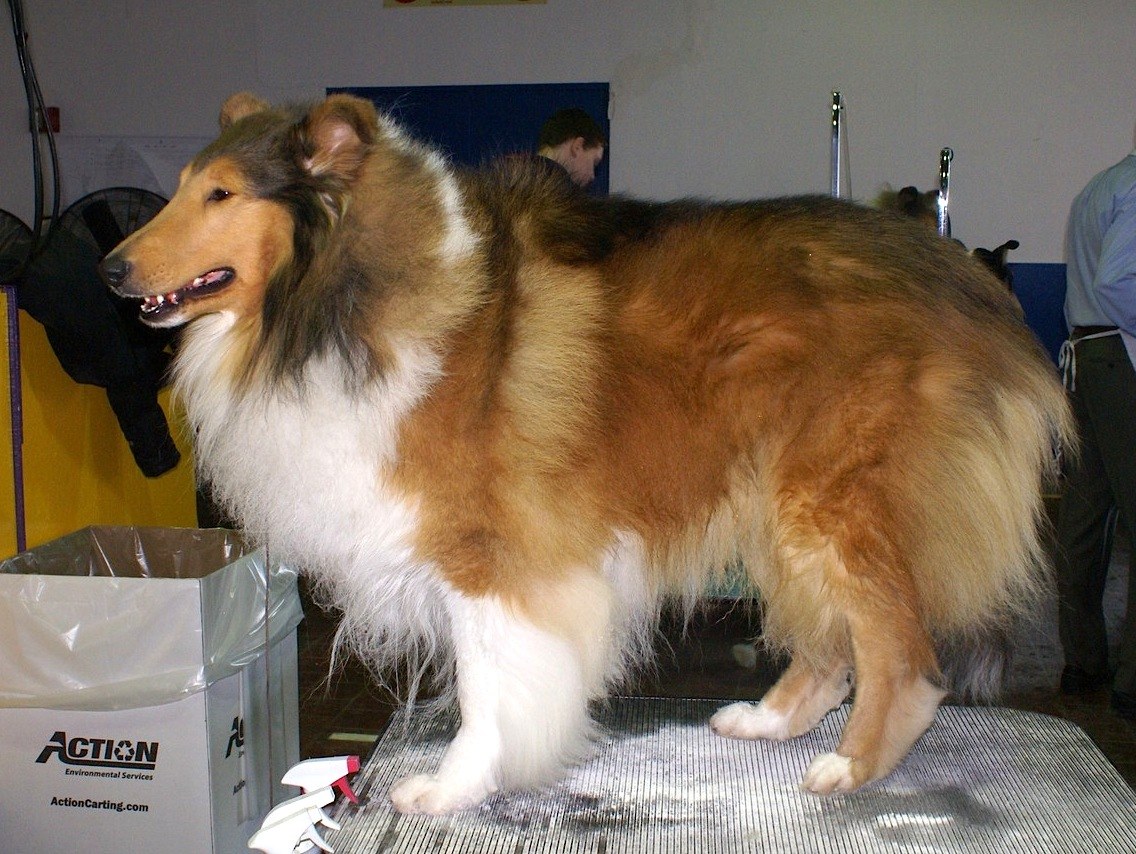
- Coat — the crowning glory of the Rough, the short dense coat of the Smooth. “The well-fitting, proper-textured coat is the crowning glory of the Rough variety of Collie. It is abundant except on the head and legs. The outer coat is straight and harsh to the touch,” with a soft, furry undercoat so close together that it is difficult to see the skin when the hair is parted, and very abundant on the mane and frill. The Smooth variety is judged by the same standard except for coat: a short, hard, dense, flat coat of good texture, with an abundance of undercoat. (Source: AKC standard.)
- Color — four recognized colors, no preference among them. “Sable and White,” “Tri-color,” “Blue Merle,” and “White.” Sable runs from light gold to dark mahogany, with white markings usually on the chest, neck, legs, feet, and the tip of the tail. Tri-color is predominantly black with white markings and tan shadings on and about the head and legs. Blue merle is mottled or marbled, predominantly blue-grey and black, with white markings and usually tan shadings. White is predominantly white, preferably with sable, tri-color, or blue merle markings. (Source: AKC standard.)
- Gait — effortless speed, single-tracking at speed. “When the dog is moved at a slow trot toward an observer its straight front legs track comparatively close together at the ground” — no crossing over, no choppy, pacing, or rolling gait. At a moderate trot the hind legs are powerful and propelling, and the reasonably long, reaching stride is smooth and even, keeping the back line firm and level. As speed increases the Collie single tracks, bringing front and hind legs inward toward the center line. “The gait suggests effortless speed combined with the dog’s herding heritage, requiring it to be capable of changing its direction of travel almost instantaneously.” (Source: AKC standard.)
- The tail: moderately long, carried low at rest. The bone reaches to the hock joint or below. It is carried low when the dog is quiet, the end having an upward twist or swirl; when gaited or excited it is carried gaily but not over the back. (Source: AKC standard.)
4. Temperament & living with one
The AKC sums the breed up in three words: devoted, graceful, and proud — and adds that the full-coated Rough is the more familiar variety, but there is also a sleek Smooth. Collies are famously good with children and make wonderful family pets: gentle, loyal, and intelligent, with a sterling character that the breed’s own literature calls the stuff of legend. (Sources: AKC Collie breed page; NW Collies, Breed Standard.)
That devotion is sensitive, not indiscriminate. The standard penalizes timidity, sullenness, and viciousness alike, and a Collie that is poorly socialized can turn shy. Collies read their household and bond deeply with their people — often with one person most of all — and they are protective of small children, usually as a visual deterrent and a bark rather than anything more. (Sources: AKC standard; Your Pet Facts, Collie.)
The herding instinct is still in there, and it shows up as voice and motion. As herding dogs, Collies use their voice to communicate — at family, at other dogs, and at moving objects they want to herd, such as vehicles, lawnmowers, and bikes. They are bright and eager to please, so they learn happily and rapidly with gentle, positive training, and they thrive on companionship and regular exercise: about an hour a day of walking and play, plus something to do with their brain. A bored Collie invents its own jobs, and the ones it invents are usually loud. (Sources: Wyndlair Collies, Collie FAQs; NW Collies, Breed Standard.)
5. Grooming
- Rough: brush 2 to 3 times a week; Smooth: once a week. Both varieties are double-coated and shed seasonally, but the Rough’s long coat needs the work: brush 2 to 3 times weekly with a pin brush, working section by section down to the skin, and daily during shedding season. The Smooth needs a weekly brushing with a slicker brush, daily while shedding. Never brush a Collie’s coat dry — mist it first — or the hair breaks. (Sources: Dog-Learn, Collie Grooming; Streetdirectory, Grooming your Collie.)
- The Rough sheds once a year, all at once. A Rough Collie typically sheds once each year, completing the shed within 1 to 2 months — undercoat first, then outer coat — and a fresh, healthy Rough coat has essentially no shedding the rest of the year. Smooth Collies also do an annual shed but keep shedding a little through the rest of the year. A non-spayed bitch sheds 2 to 3 months after her cycle or a litter. Remove loosening coat as it comes out, or it mats and can cause hot spots. (Source: Wyndlair Collies, Collie FAQs.)
- Check the mat-prone spots. Mats form first behind the ears, underneath the front legs, and on the underbelly — check those spots every time you brush, and work mats out with your fingers or a comb rather than cutting them out. Feet, nails, hocks, and pasterns should be trimmed short to keep feet from picking up dirt and mud. (Sources: Streetdirectory, Grooming your Collie; Wyndlair Collies, Collie FAQs.)
- Do not shave a Collie. The double coat protects against sunburn and heat as well as cold, and shaving it takes that protection away. Baths are needed only every 2 to 3 months unless the dog gets dirty, and ears should be cleaned about once a week. (Sources: Dog-Learn, Collie Grooming; Streetdirectory, Grooming your Collie.)
6. Health testing
- Four DNA tests for a CHIC number. For a CHIC number, the Collie needs four DNA tests: Progressive Retinal Atrophy, Rod-Cone Dysplasia 2 (PRA-rcd2); Multidrug Resistance 1 (MDR1); Dermatomyositis (DMS); and Collie Eye Anomaly (CEA, CH). That is the parent club’s list on the AKC’s Herding Group health-testing page. Breeders must agree to have all test results, positive or negative, published in the CHIC database. (Source: AKC Herding Group Health Testing Requirements.)
- Collie eye anomaly — check puppies at 5 to 8 weeks. CEA is a developmental defect of the eye, inherited recessively, that can cause improper development and possible blindness. It can be seen on a puppy eye exam between 5 and 8 weeks of age; after 8 weeks the developing eye makes it impossible to detect until it affects vision. A DNA test is also available. (Sources: Desert Kennels, Collie Health Issues and Testing; UC Davis Veterinary Genetics Laboratory, Collie Health Panel.)
- MDR1 — tell every veterinarian. The MDR1 mutation makes Collies sensitive to ivermectin, loperamide (Imodium), and almost 20 other drugs. Up to 70% of Collies either carry the mutation or are affected by it. A dog with two copies shows multidrug sensitivity, and some with one copy do too. A cheek-swab DNA test identifies normal, carrier, and affected dogs — get it done and tell every veterinarian who treats your dog. (Sources: Desert Kennels, Collie Health Issues and Testing; UC Davis Veterinary Genetics Laboratory, Collie Health Panel.)
- PRA-rcd2 — night blindness in young puppies. Rod-cone dysplasia type 2 is an early-onset retinal degeneration: night blindness is typically apparent by the time pups are 6 weeks of age, and in most cases the affected dog is completely blind by about 1 year. The DNA test identifies normal, carrier, and affected dogs with complete accuracy. (Sources: Desert Kennels, Collie Health Issues and Testing; Chelsea Collies, DNA Testing.)
- Dermatomyositis — a risk test, not a yes-or-no. DMS is an immune-mediated disorder affecting skin and muscle in Collies and Shetland Sheepdogs. The DNA test measures genetic risk across three loci (PAN2, MAP3K7CL, and DLA-DRB1) and indicates risk from high to low; environment, diet, sunlight, and pollution are also risk factors and triggers. (Sources: Desert Kennels, Collie Health Issues and Testing; UC Davis Veterinary Genetics Laboratory, Collie Health Panel.)
- Also on the watch list. Hip dysplasia is a potential concern, as in most larger breeds; canine cyclic neutropenia (gray Collie syndrome) is a cyclic blood disorder, usually fatal to affected puppies, with a DNA test available; and epilepsy affects the breed. The Collie Health Foundation funds research into all of these and subsidizes testing for its members. (Sources: Wikipedia, Rough Collie; UC Davis Veterinary Genetics Laboratory, Collie Health Panel.)
- Lifespan: 12 to 14 years. The commonly published lifespan is 12 to 14 years. (Source: AKC Collie breed page.)
7. The annual Collie specialty dog show
A specialty is the breed’s All-Star show — its Super Bowl. Once a year, the best Collies from across the country, and often from around the world, come together in one place.
The Collie Club of America’s national specialty: one national event each year, covering both the Rough and the Smooth varieties, with the two varieties judged separately for Best of Variety and then together for a single Best of Breed. The 2026 national: April 1–4, at the SageNet Center at Expo Square in Tulsa, Oklahoma, with 409 conformation competitors. The 2025 national: April 9–12, at the New York State Fairgrounds in Syracuse, New York, with 396 conformation competitors. The 2027 national: April 7–10, at the Mountain America Expo Center in Sandy, Utah. National week, April 3–10, 2027, also includes herding, agility, obedience, rally, and scent work.
The standard, in brief: a lithe, strong, responsive, active dog, standing naturally straight and firm, with a long, blunt wedge head, almond-shaped dark eyes, ears carried about three-fourths erect with the tips breaking forward, and expression the most important point of all. Dogs 24 to 26 inches at the shoulder, 60 to 75 pounds; bitches 22 to 24 inches, 50 to 65 pounds. Four colors: sable and white, tri-color, blue merle, and white. The Rough variety carries the long, abundant double coat; the Smooth variety the short, hard, dense, flat coat.
The 2026 National Specialty — national week March 28–April 4, 2026, with conformation judging Wednesday, April 1, through Saturday, April 4, 2026, at the SageNet Center at Expo Square, 4145 East 21st Street, Tulsa, Oklahoma. One national event covering both varieties, Rough and Smooth: the two varieties are judged separately for Best of Variety and then together for Best of Breed, with a single Best of Breed for the breed. Herding ran March 28–29 at Latigo Farm, Broken Arrow, Oklahoma; agility March 30–31 at K-9 Manners, Broken Arrow; obedience and rally trials April 1–2; scent work April 3. Entries opened Wednesday, January 28, 2026, and closed Wednesday, March 11, 2026, at 9:00 p.m. EST. Superintendent: Executive Dog Shows (Nina Fetter). Event Chair: Lis Johnston. (Sources: Collie Club of America, National Specialty; 2026 premium list.)
National specialty judges: Ms. Phyllis Autrey — intersex competition, Best of Variety (Rough and Smooth), Best of Breed, Best Puppy, Best American-Bred, and Best Bred-By-Exhibitor. Ms. Candace Ardizzone — dogs. Ms. Amy Gau — bitches and junior showmanship. Obedience and rally: Ms. Janice Anthes and Mr. Terry Thornton. Herding: Ms. Kelly Fonkalsrud and Dr. Jennifer Patton. Agility: Mr. David J. Nauer. Scent work: Ms. Khara Schuetzner. (Sources: Collie Club of America, National Specialty; 2026 premium list.)
Results (2026 national). Best of Breed: GCH CH Ennismoor Captivation, a Rough Collie, judged Saturday, April 4, 2026, with 409 total conformation competitors. Best of Opposite Sex, Best of Variety (Smooth), Winners Dog, and Winners Bitch not confirmed in an official source as of November 2026. (Source: Collies Online, national specialty results.)
The 2027 National Specialty: national week April 3–10, 2027, with conformation Wednesday, April 7, through Saturday, April 10, 2027 (four days, per the AKC Upcoming National Specialties list), at the Mountain America Expo Center, 9575 State Street, Sandy, Utah. One national event covering both varieties, Rough and Smooth, judged together for Best of Breed, as in 2026. Agility and herding at the Salt Lake County Equestrian Park, 2051 West 11400 South, South Jordan, Utah. Superintendent: Executive Dog Shows, LLC. Herding and agility judges, AKC event number, entries, and closing date not yet published as of November 2026. (Sources: Collie Club of America, National Specialty; AKC Upcoming National Specialties.)
2027 national specialty judges: Ms. Deborah Falk — intersex. Ms. Jennifer A. Weiner — dogs and junior showmanship. Mr. Harry H. (Butch) Schulman — bitches. Mrs. Linda Bianco — obedience. Ms. Karen D’Augusta — rally and utility. Herding and agility judges to be announced. (Source: Collie Club of America, National Specialty.)
Past national specialties: 2025 · 2024
Collie Club of America — thecollieclub.org
8. Regional specialties through the year: smaller regional shows
The national is the anchor, but the breed’s year also runs through regional specialties — smaller regional shows, not the national — held by regional Collie clubs around the country. These are the 2026 regionals verified from club sources so far:
Two regional Collie specialties verified for 2026 so far:
- Mason-Dixon Collie Club specialty — Saturday, January 10, 2026, Point of Rocks, Maryland: judge E. Goto-Tamae, 35 entries (32 competitors), at the Catoctin Kennel Club Training Facility, 4016 Rock Hall Road. Best of Breed (Rough): GCH CH Ennismoor One Particular Harbour. (Source: AKC event search, event 2026165301.)
- Panhandle Collie Club of West Virginia specialty — Saturday, April 25, 2026, Morgantown, West Virginia: judges Ms. Renee Wallace and Ms. Michelle Esch-Brooks, 30 dogs (34 entries) across the Rough and Smooth varieties, at the Hazel and J. W. Ruby Community Center, 500 Mylan Park Lane, held with the South Hills Kennel Club show. (Source: InfoDog judging program, event 2026121701.)
More regional specialties will be added here as their programs are verified — this section is built from show data, not guesswork. Browse upcoming show weekends →
9. Clubs
- Collie Club of America (parent club) — the AKC parent club for the breed in the United States, organized in 1886 and the second parent club to join the AKC. It maintains the breed standard, runs the national specialty each year, and publishes the rescue contacts list through its Committee for Welfare and Rescue. (Sources: Collie Club of America; Vetstreet, Collie.)
- Collie Health Foundation — the nonprofit founded by the parent club in 1986 (incorporated separately in 2002) to fund medical research for the breed and educate breeders and the public about health issues. It subsidizes DNA testing for its members and was the model for many parent-club health foundations, including the AKC’s own Canine Health Foundation. (Source: Collie Club of America Health Statement, October 1, 2022.)
- Regional Collie clubs. Regional clubs around the country hold their own specialties through the year — see section 8 — including the Mason-Dixon Collie Club, the Panhandle Collie Club of West Virginia, the Chicago Collie Club, and the Illiana Collie Fanciers, all of which held specialties in 2026.
If you are new to the breed, the national specialty itself is the better first stop than a breeder’s website: the people there have owned, shown, and worked Collies, and they will tell you the truth about the coat, the shedding, and the barking before you fall for a puppy.
10. Rescue
- Collie Rescue Foundation. The national 501(c)(3) that exists to promote and assist in the rescue of purebred Collies: it provides emergency funding to local rescues, education on responsible ownership, and guidelines for adoption. It was founded in 2005, after the seizures of 2002, 2003, and 2005 — the 2002 Montana seizure alone involved 171 Collies — left local groups without the money to cope. Since then it has provided more than $400,000 in financial assistance to rescues across the country, with over 97% of donations going to the mission. (Sources: Collie Rescue Foundation, Helping to Save the Innocent; NorCal Collie Rescue.)
- The parent club’s rescue contacts. The Collie Club of America publishes a listing of Collie rescue contacts, issued by the club’s Committee for Welfare and Rescue and organized by state, covering the United States and England. Start there if you do not know which local group covers your area. (Source: Rocky Mountain Collie and Sheltie Rescue, resources.)
- Local Collie rescues. Groups like NorCal Collie Rescue, Southland Collie Rescue, Collies Florida Rescue, and Cascade Collie Rescue take in Collies from shelters, owners whose health changed, breeders, and divorces, and rehome them in their own regions — most do not ship dogs or place out of state. Collies Florida Rescue, for one, has placed well over 200 Collies. (Sources: NorCal Collie Rescue; Collies Florida Rescue.)
- Adults, usually. A rescued Collie is usually an adult, and it will arrive with its temperament visible before you commit. What you get in return is a dog whose character you can see before you commit and a lower price. Either way, be honest with yourself first: a Collie needs daily exercise and something to do with its brain, regular brushing if it is a Rough, and an owner who understands a sensitive, watchful herding dog that barks at moving things rather than expecting a dog that stays quietly in the yard.
11. Breeder vs. rescue: honest guidance
- If you buy: start with the parent club, the Collie Club of America, and its breeder referral. Ask for the parents’ health results — the four DNA tests (PRA-rcd2, MDR1, DMS, and CEA) plus the puppy eye exam at 5 to 8 weeks — and look the results up in the OFA database yourself. Expect to wait for a puppy from a careful breeder: a good breeder will have the answers, will ask you as many questions as you ask them, and will take the puppy back for its whole life if you cannot keep it. One longtime breeder lists pet-quality puppies at $900 to $1,500 with limited registration, and top-quality puppies at $2,500 or more. (Sources: Collie Club of America; Wyndlair Collies, Collie FAQs.)
- If you rescue: a rescued Collie is usually an adult, and it will arrive with its temperament visible before you commit. What you get in return is a dog whose character you can see before you commit and a lower price. Either way, be honest with yourself first: a Collie needs daily exercise and something to do with its brain, regular brushing if it is a Rough, and an owner who understands a sensitive, watchful herding dog that barks at moving things rather than expecting a dog that stays quietly in the yard.
- One breed, two varieties — and not a big Sheltie. The Collie is one breed with Rough and Smooth varieties, judged by the same standard except for coat and together for Best of Breed. The Shetland Sheepdog looks like a Collie in miniature and the standard itself notes the resemblance — but the Sheltie is its own breed, 13 to 16 inches and 15 to 25 pounds, with its own parent club and its own national specialty. Judge the dog in front of you against the Collie standard, not against a Sheltie — and not against Lassie, either: the television dog was a character, and real Collies shed, bark, and need work.
12. Claim this page
This page belongs to the breed, and the people who know the breed best are the Collie Club of America and its members. If you are with the parent club — or you are a breeder, a judge, a handler, or a rescue volunteer who spotted something wrong, missing, or out of date — this page is yours to set straight. Tell us what needs fixing and where the correction is documented, and we will fix it and credit the source. Contact the site through the About page, and mention “Collie breed profile.”
Sources
- AKC Collie breed page — akc.org/dog-breeds/collie
- AKC Official Standard of the Collie (approved May 10, 1977) — images.akc.org/pdf/breeds/standards/Collie.pdf
- AKC Herding Group Health Testing Requirements — akc.org/breeder-programs/breed-health-testing-requirements/herding-group-health-testing-requirements
- AKC Upcoming National Specialties — apps.akc.org/apps/events/conformation/national_specialties.cfm
- Collie Club of America — thecollieclub.org
- Collie Club of America, National Specialty — thecollieclub.org/national-specialty
- 2026 national premium list — dogshowwon.blob.core.windows.net (2026 premium)
- 2025 national, AKC event search, event 2025115211 — apps.akc.org/apps/events/search/index_results.cfm
- 2026 Mason-Dixon specialty, AKC event search, event 2026165301 — apps.akc.org/apps/events/search/index_results.cfm
- 2026 Panhandle specialty judging program — pdf.infodog.com/jps/094/jpg094.pdf
- Collies Online, national specialty results — colliesonline.com/contents.php
- Wyndlair Collies, 2025 national results — wyndlaircollies.com/collie-club-of-america-national-specialty-show-winners
- Wyndlair Collies, Collie FAQs — wyndlaircollies.com/collie-faq
- Collie Club of America Health Statement, October 1, 2022 — files.constantcontact.com (CCA health statement)
- Collie Health Foundation — colliehealth.org
- Collie Rescue Foundation, Helping to Save the Innocent — calcollierescue.org/CRF-Helping-Save-the-Innocent.pdf
- NorCal Collie Rescue — calcollierescue.org
- Collies Florida Rescue, About Us — colliesflorida.org/about-us.html
- UC Davis Veterinary Genetics Laboratory, Collie Health Panel — vgl.ucdavis.edu/breed/collie
- Desert Kennels, Collie Health Issues and Testing — m.desertkennels.com/collie-health-issues-and-testing.html
- Chelsea Collies, DNA Testing — chelsea-collies.com/dna.html
- Chewy, Collie Breed — chewy.com/education/dog-breeds/collie
- Vetstreet, Collie — vetstreet.com/dogs/collie
- American Collie Club of Switzerland, History — americancollie.ch/index.php/en/the-collie/history
- Dog-Learn, Collie Grooming — dog-learn.com/dog-breeds/collie/grooming
- Streetdirectory, Grooming your Collie — streetdirectory.com/travel_guide/30393/pets/grooming_your_collie.html
- NW Collies, Breed Standard — nwcollies.com/breed-standard
- Your Pet Facts, Collie — yourpetfacts.com/collie
- Wikipedia, Rough Collie — en.wikipedia.org/wiki/Rough_Collie
- Rocky Mountain Collie and Sheltie Rescue, resources (CCA rescue contacts) — rmcsr.rescuegroups.org/info/display?PageID=16924
- Pets Adviser, Rough Collie at Westminster 2014, CC BY 2.0 via Wikimedia Commons — commons.wikimedia.org/wiki/File:2014_Westminster_Kennel_Club_Dog_Show_(12452128984).jpg
