
Breed profile · Sporting Group · the smallest member of the Sporting Group
Cocker Spaniel
The Cocker Spaniel is the smallest member of the Sporting Group — a merry, compact sporting dog with a cleanly chiseled head, long lobular ears, and a silky coat, shown in three varieties: Black, ASCOB, and Parti-Color. The AKC registered its first Cocker in 1878, and the American Spaniel Club, founded in 1881, is the oldest breed club in America. Cockers were the most popular breed in the country from the late 1930s through the early 1950s, and again in the mid-1980s — and they have won Best in Show at Westminster four times.
Help us improve it. This is one of ThePetAdvisor’s breed profiles, built from public sources with generous links to the people who actually own this breed’s knowledge. If something’s off or missing, the parent club can claim the page and set it straight — see the bottom of the page.
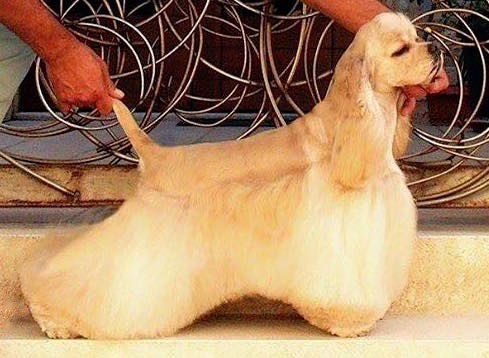

Do you have a better photo of a Cocker Spaniel in the American show ring? If you have a show photo you’d let us use, email it to [email protected] — tell us the dog’s name and the show, and it may be featured here. Please only send photos you took yourself or have the photographer’s permission to share, and tell us the photographer’s name.
1. Breed at a glance
Sporting Group; first Cocker registered by the AKC in 1878
Ideal 15 in at the withers (dogs), 14 in (bitches); about 25–30 lb (dogs), 20–25 lb (bitches)
Silky, flat or slightly wavy coat with feathering; three varieties — Black, ASCOB, Parti-Color
10–14 years (AKC)
Equable, with no suggestion of timidity; free and merry
The Cocker Spaniel is a sporting dog first and a companion second — but it is very good at both. The standard calls it the smallest member of the Sporting Group and describes a sturdy, compact dog with a cleanly chiseled and refined head, long lobular ears, and a silky coat, shown in three color varieties. Above all, the standard says, the dog “must be free and merry, sound, well balanced throughout and in action show a keen inclination to work.” The breed ranked 33rd in AKC registrations in 2025. (Sources: AKC, Official Standard of the Cocker Spaniel; AKC, Cocker Spaniel.)
2. History
Spaniels are an old family, and the Cocker is one of its oldest working forms. The dogs that became Cocker Spaniels flushed woodcock from cover for the gun — the job that gave the breed its name. The first Cocker registered with the AKC was a liver-and-white dog named Captain, in 1878. Three years later, in 1881, American spaniel fanciers founded the American Spaniel Club — the oldest breed club in America. The club’s first task was to write a standard that separated the Cocker from the other land spaniels; that work took more than twenty years and was only completed in 1905.
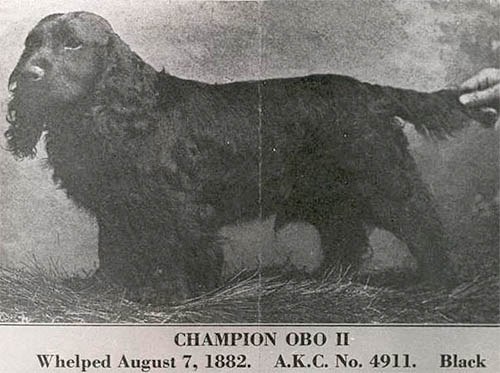
The dog that made the American Cocker was Ch. Obo II. His dam, Ch. Chloe II, was shipped pregnant from England; his sire was Ch. Obo, the father of the English Cocker. Obo II was born in America in 1882, stood only about ten inches tall, and had a long body — very different from the modern dog — but he was a popular sire, and he is considered the father of the modern American breed. The American and English varieties were shown as one breed for another sixty years. The Canadian Kennel Club recognized the English Cocker as a separate breed in 1940, and the AKC followed in 1946, with separate stud-book registrations from January 1947. In the United States the American variety kept the name “Cocker Spaniel.”
The breed’s popularity peaked twice. Cockers were the most popular breed in America from the late 1930s through the early 1950s — sixteen consecutive years at the top — and again in the mid-1980s, when they returned to number one. They have won Best in Show at Westminster four times: Ch. Midkiff Seductive, a Parti, in 1921; Ch. My Own Brucie, a Black, in 1940 and again in 1941 — the only dog to win Westminster Best in Show twice in a row, bred and owner-handled by Herman Mellenthin, who became known as the most photographed dog in the world; and Ch. Carmor’s Rise and Shine, an ASCOB, in 1954. An American Cocker won Best in Show at Crufts in 2017. The breed’s most famous owner was a president: Richard Nixon’s black-and-white Cocker, Checkers, gave its name to his 1952 “Checkers speech.” And the Lady in Disney’s 1955 Lady and the Tramp is an American Cocker Spaniel. (Sources: AKC, Cocker Spaniel history; Wikipedia, American Cocker Spaniel; American Spaniel Club.)
3. The standard and why it is written that way
The AKC standard for the Cocker Spaniel was approved May 12, 1992, and effective June 30, 1992. It opens with a sentence that sets the whole breed: “The Cocker Spaniel is the smallest member of the Sporting Group. He has a sturdy, compact body and a cleanly chiseled and refined head, with the overall dog in complete balance and of ideal size.” And it closes the general appearance paragraph with the breed’s ruling idea: “Above all, he must be free and merry, sound, well balanced throughout and in action show a keen inclination to work.”
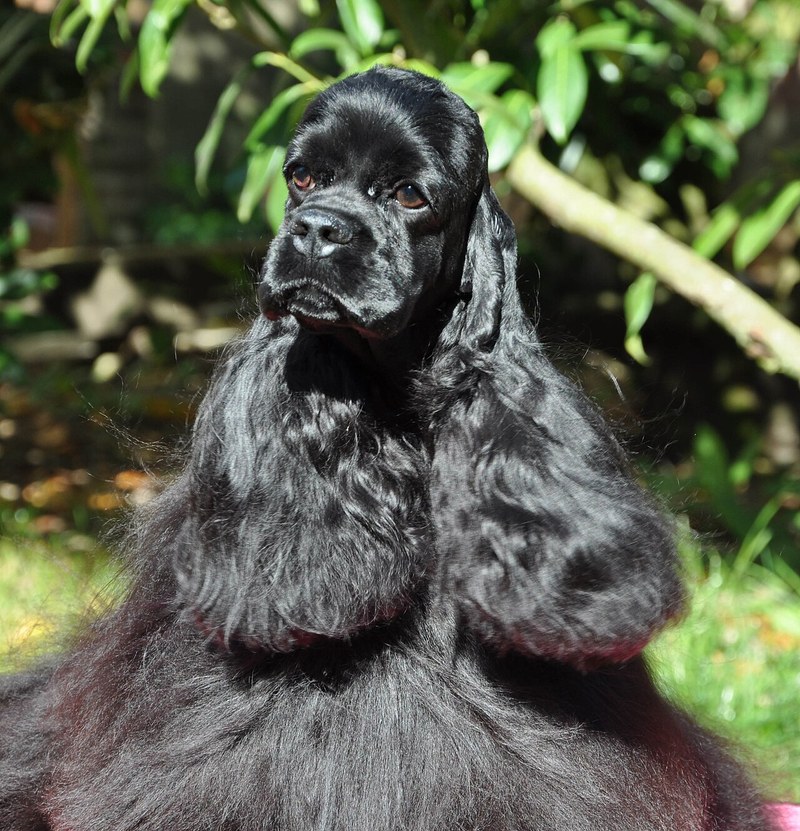

Size. Ideal height is 15 inches at the shoulder for dogs and 14 for bitches, with half an inch either way allowed. Dogs over 15½ inches and bitches over 14½ are disqualified; dogs under 14½ and bitches under 13½ are penalized. The body, measured from the breast bone to the back of the thigh, is slightly longer than the height at the withers — never long and low.
Head. The expression should be intelligent, alert, soft, and appealing. The eyes are round and full, looking directly forward, with an iris of dark brown — the darker, the better. The ears are lobular, long, of fine leather, well feathered, and set no higher than a line to the lower part of the eye. The skull is rounded but not exaggerated, with a pronounced stop; the muzzle is broad and deep, and the distance from the stop to the nose is half the distance from the stop over the crown to the base of the skull. The bite is scissors.
Body and tail. The neck is long and muscular, arching slightly; the topline slopes slightly toward muscular quarters; the chest is deep, its lowest point no higher than the elbows. The tail is docked, set on and carried on a line with the topline or slightly higher — never straight up like a Terrier, never so low as to indicate timidity — and its action is merry.
Coat. The head is short and fine; the body coat is medium length with enough undercoating; the ears, chest, abdomen, and legs are well feathered but not excessively so. The coat is silky, flat or slightly wavy. Excessive coat, or a curly or cottony texture, is severely penalized, and electric clippers on the back coat are not desirable.
Color — three varieties. Cockers are judged in three varieties, and the color rules are the heart of the standard. Black: solid black, including black with tan points; a small amount of white on the chest or throat is allowed, white elsewhere is a disqualification. ASCOB — Any Solid Color Other than Black: cream to darkest red, including brown and brown with tan points; a small amount of white on the chest or throat is allowed. Parti-Color: two or more solid, well-broken colors, one of which must be white; roans are classified as Parti-Color, and a primary color of 90 percent or more is a disqualification. In any variety, tan points must not exceed 10 percent of the color, and the absence of tan markings in the specified locations in an otherwise tan-pointed dog is a disqualification. (Source: AKC, Official Standard of the Cocker Spaniel, approved May 12, 1992; effective June 30, 1992.)
4. Temperament & living with one
The standard’s temperament sentence is short and exact: “Equable in temperament with no suggestion of timidity.” Everything else about the breed follows from that and from the general-appearance paragraph’s “free and merry.” A Cocker is a cheerful, affectionate, people-oriented dog that was bred to work close to the hunter all day, and it wants to be where its people are. Cockers are usually good with children and with other dogs, and they are quick to learn and eager to please — but they are sensitive dogs, and they do not do their best with harsh handling or with long stretches alone. They bond hard, and a Cocker left alone and under-exercised will get bored, noisy, and destructive, and can develop separation anxiety.
What a Cocker needs is ordinary and non-negotiable: daily exercise and training, a job to do (even a job as small as a retrieve or a scent game), company through the day, and consistent, gentle handling. Give it that and you get one of the sweetest family dogs there is — a dog that greets you like you have been gone for a year, every time you come back from the mailbox. (Sources: AKC, Official Standard of the Cocker Spaniel; AKC, Cocker Spaniel.)
5. Grooming
The Cocker’s coat is its glory and its upkeep. The standard calls for a silky, flat or slightly wavy coat of medium length, with feathering on the ears, chest, abdomen, and legs — well feathered but not excessive. In practice that means brushing two or three times a week, more when the feathering is long, because the feathering mats quickly, especially behind the ears and on the legs and belly. Show coats are kept long; many pet Cockers wear a shorter sporting clip, which is far easier to live with and does not change the dog.
The ears are the part of grooming that is really health care. The long, pendulous, heavily feathered ears trap moisture and limit airflow, so check them weekly, clean them as your veterinarian advises, and keep the hair under the ear leather trimmed so air can circulate. A head-shake, a smell, or redness inside the ear is a reason to call the veterinarian rather than wait. Trimming is legitimate about the head, ears, neck, and feet; the standard penalizes overtrimming in the ring, and electric clippers on the back coat are not desirable. Nails, teeth, and the hair between the toes need regular attention like any sporting breed. (Sources: AKC, Official Standard of the Cocker Spaniel; AKC, Cocker Spaniel.)
6. Health testing
The American Spaniel Club’s health-registry program names two core screens for Cocker breeding stock over two years old: a hip evaluation (OFA or PennHIP) and an annual eye examination by a board-certified veterinary ophthalmologist (ACVO/CAER; the OFA eye certification is valid for twelve months). Also recommended in American lines are DNA tests for progressive retinal atrophy (prcd-PRA) and phosphofructokinase (PFK) deficiency. Ask a breeder for the CHIC numbers for both parents — a CHIC number means the required tests were done and the results published, not that the dog passed them. Do not use the English Cocker Spaniel’s CHIC requirements for this breed: the English Cocker’s list is different, and it is a different breed.
Conditions the breed is watched for include PRA (prcd), cataracts, glaucoma, hip dysplasia, ear infections, hypothyroidism, immune-mediated hemolytic anemia (IMHA), and dilated cardiomyopathy. Lifespan is 10 to 14 years (AKC). A Cocker that is health-tested, kept lean, exercised daily, and has its ears checked weekly is a dog set up for a long, merry life. (Sources: Our American Cocker Network, American Cocker Spaniel health (American Spaniel Club health-registry program); AKC, Cocker Spaniel.)
7. The annual Cocker Spaniel specialty dog show
A specialty is the breed’s All-Star show — its Super Bowl. Once a year, the best Cocker Spaniels from across the country, and often from around the world, come together in one place.
The American Spaniel Club’s national specialty: one national event each year, usually a multi-day week in July at Purina Farms, with the three varieties — Black, ASCOB, and Parti-Color — judged separately and brought together for Best of Breed, plus the Futurity, four sweepstakes, a grooming competition, obedience, rally, agility, scent work, and junior showmanship. The 2026 national: July 16–18 in Gray Summit, Missouri, with 155 dogs and 167 entries in conformation on the national days. The 2027 national: not yet announced as of November 7, 2026.
The standard, in brief: the smallest member of the Sporting Group, sturdy and compact, standing 15 inches at the shoulder for dogs and 14 for bitches, with a cleanly chiseled and refined head, long lobular ears, and a silky, flat or slightly wavy coat, shown in three varieties — Black, ASCOB, and Parti-Color. Above all, the dog must be free and merry, sound, and well balanced throughout.
The 2026 National Specialty — the 49th National Cocker Spaniel Specialty Show — Thursday, July 16–Saturday, July 18, 2026, at the Purina Farms Event Center, 300 Checkerboard Loop, Gray Summit, Missouri 63039, under the theme “once upon a time.” The week opened Thursday with the ASC Grooming Competition, AKC Temperament Test (ATT) evaluations, a Cockers-only agility trial, the ASC Futurity, and the Cut-Down, Bred-by-Exhibitor, Veteran, and Owner-Handled sweepstakes, plus a welcome party hosted by Purina and Tonya Higdon in honor of CH CloverCreek’s Goddess of the Hunt, the 2025 Futurity winner. Conformation judging ran Friday, July 17 (all regular classes through Winners Bitch) and Saturday, July 18 (non-regular classes, inter-variety, and Best of Breed), with junior showmanship, a Parade of Champions and Title Holders, and the Top Dog Awards Dinner on Saturday evening. Entries closed Wednesday, June 24, 2026. Event Chair: Linda Bennett. Event Secretary: David Roberts, c/o Rau Dog Shows, Ltd. The national drew 155 dogs and 167 entries in conformation. AKC event 2026110714. (Sources: 2026 revised judging program (American Spaniel Club, via AKC); AKC event search, event 2026110714; American Spaniel Club, 2026 ASC National Cocker Spaniel Specialty Show.)
National specialty judges: April Stich — Black variety and ASCOB variety (Friday, July 17, 2026; Black 46 entries, ASCOB 49 entries). Kyle Robinson — Parti variety and Best of Breed and inter-variety (Saturday, July 18, 2026; Parti 60 entries). Junior Showmanship judge: Mrs. Linda Pitts (2 entries). Sweepstakes judges (Thursday, July 16): Tom Dowell (Veteran sweepstakes, 7 entries; Bred-by-Exhibitor sweepstakes, 23 entries; Owner-Handled sweepstakes, 33 entries) and Maureen Jewett (Cut-Down sweepstakes, 4 entries; Futurity, 28 entries). Obedience judge: Mrs. Leslye Pinnell. Rally judge: Christine Ward. Agility judge: Mary Mullen. Best Junior Handler was Kalli Dobmeier. (Sources: 2026 revised judging program (American Spaniel Club, via AKC); AKC event search, event 2026110714.)
Results (2026 national). Best of Breed: GCHB CH Laurent’s High Tech CGC (“London”), a black-and-tan dog of the Black variety, bred by Laura Moline Heidrich and owned by L. Heidrich, Jeffrey Hanlin Jr., and Mackensie Murphy. Best of Opposite Sex: GCH CH Dune’s Let’s Dance CGC, a Parti variety bitch owned by D. Burke. Best Junior Handler: Kalli Dobmeier. Best of Winners, Winners Dog, and Winners Bitch in each variety were not confirmed in an official source as of November 7, 2026. (Sources: AKC event search, event 2026110714; Jeffrey Hanlin, Best of Breed winner’s photo, 49th National Specialty (Facebook, July 19, 2026); Jeffrey Hanlin, “Introducing London” (Facebook, July 2, 2026).)
The 2027 National Specialty had not been announced as of November 7, 2026. The AKC’s Upcoming National Specialties list carries no American Spaniel Club entry, and no date, venue, or judge had been published by the club. Dates, venue, and judges will be added here when they are announced. (Source: AKC, Upcoming National Specialties.)
Past national specialties: 2025 · 2024
American Spaniel Club — americanspanielclub.org
8. Regional specialties through the year: smaller regional shows
The national is the anchor, but the breed’s year also runs through regional specialties — smaller regional shows, not the national — held around the country, including the regional specialty that runs with the national. These are the 2026 regionals verified from club and AKC sources so far:
Regional Cocker Spaniel specialties verified for 2026, including the regional specialty that ran with the national in Gray Summit, Missouri:
- Zone II Regional Specialty — Sunday, July 19, 2026, Gray Summit, Missouri: hosted by the Cocker Spaniel Specialty Club of Georgia, at the Purina Farms Event Center (AKC event 2026110719). Judge: Mr. Kevin Flinn (Black 43 entries, ASCOB 45 entries, Parti 51 entries). The specialty drew 139 dogs and 155 entries. Best of Breed: GCHB CH Silhouette Normandy Full Circle, a Parti variety dog owned by E. Charles, R. Beinhauer, M. Feltenstein, J. Davis, and L. Pitts. Best of Opposite Sex: CH Silver Star’s Lady In Red, a Parti variety bitch owned by L. Berger. Best Junior Handler: Kalli Dobmeier; Reserve Best Junior Handler: Stella Keimon.
Past regional specialties: 2025 · 2024
The American Spaniel Club also holds a second annual event, the Flushing Spaniel Show, each January in Knoxville, Tennessee — a multi-breed spaniel show that includes an ASC regional specialty day for Cockers. More regional specialties will be added here as their programs are verified — this section is built from show data, not guesswork. Browse upcoming show weekends →
9. Clubs
The parent club is the American Spaniel Club, Inc. (ASC), at americanspanielclub.org — founded in 1881, the oldest breed club in America, and the club that runs the national specialty, publishes the breed’s health guidance, and stewards the standard in the United States. Its Corresponding Secretary is David Roberts.
Regional specialty clubs verified in club and AKC sources during this build:
- Cocker Spaniel Specialty Club of Georgia — hosted the 2026 Zone II Regional Specialty in Gray Summit, Missouri
- Detroit Cocker Spaniel Club — hosted the 2025 Zone III Regional Specialty in Gray Summit, Missouri
- Mission Valley Cocker Spaniel Club — hosted the 2024 Zone IV Regional Specialty in Colorado Springs, Colorado
Regional clubs run the regional specialties listed in section 8 and are the best first contact for anyone looking for a breeder, a local event, or a rescue contact. The club also holds a second annual event, the Flushing Spaniel Show, each January in Knoxville, Tennessee — a multi-breed spaniel show that includes an ASC regional specialty day for Cockers. (Sources: American Spaniel Club; American Spaniel Club, Board and Directors.)
10. Rescue
Cockers come into rescue for the usual spaniel reasons — a family that underestimated the grooming and the ear care, a dog that could not be left alone all day, an owner who died or moved. Rescue groups that work with the breed, verified in public sources:
- Cocker Spaniel Rescue of New England, Inc. (CSRNE, csrne.org) — founded in 1987, one of the oldest and largest Cocker rescue groups in the country, based in Greenfield, New Hampshire.
- Oldies But Goodies Cocker Rescue — founded in 1996, foster-based in the mid-Atlantic (Washington, D.C., Maryland, Virginia), with a focus on senior Cockers.
- Camp Cocker Rescue — based in Sherman Oaks, California, saving Cockers from high-kill shelters.
- Columbus Cocker Rescue (columbuscockerrescue.org) — foster-based in the Columbus, Ohio area.
- DFW Cocker Spaniel Rescue — based in Texas; more than 1,000 dogs rescued over two decades.
- Second Chance Cocker Rescue — all-volunteer and foster-based in Jamestown, California.
Other groups verified in public listings include AZ Cocker Rescue, Cherished Cockers Inc. (Ohio), Cockers & More Inc. (Georgia), Cockers Across PA, Cocker Nation Rescue of Michigan, Charlotte Cocker Rescue of North Carolina, Rockstar Cocker Rescue, Cocker and Friends Rescue (Colorado, with foster homes across New Mexico, Wyoming, Kansas, and Missouri), Wisconsin Cocker Rescue, and Midwest Cocker Rescue. The American Spaniel Club also lists rescue contacts through its site. A rescue Cocker is usually an adolescent or an adult, often already house-trained, and the group will usually know its temperament, its ear history, and whether it can live with children or other dogs. (Sources: Cocker Spaniel Rescue of New England; American Spaniel Club.)
11. Breeder vs. rescue: honest guidance
Both paths can work; the right one depends on what you need to know before you commit.
If you buy from a breeder, look for one who does the American Spaniel Club’s core health screens and can show you the results: a hip evaluation (OFA or PennHIP) and an annual eye examination by a board-certified veterinary ophthalmologist (ACVO/CAER) on breeding stock over two years old, plus DNA tests for prcd-PRA and PFK deficiency in American lines. Ask for the CHIC numbers for both parents — a CHIC number means the required tests were done and published, not that the dog passed. Meet the dam if you can, see where the puppies live, and ask which variety you are buying and why: Black, ASCOB, and Parti-Color are judged separately, and a breeder who knows the varieties knows the breed. A good breeder will also ask about your day — Cockers do not do well left alone for long stretches — and will take the dog back at any point in its life if things go wrong.
If you adopt, a rescue group will usually know the dog’s temperament, its ear history, and whether it can live with children or other dogs, and will match you to a dog rather than letting you pick on looks. Expect an application, a home check, and an adoption fee — typically $150 to $400 depending on the dog’s age — and expect to budget for grooming and ear care from day one. An adult rescue Cocker is often the honest choice for a first-time Cocker owner: you can see the coat, the ears, and the temperament you are actually getting.
Either way, the questions that matter are the same: has the dog been health-tested, can you meet it (or its dam) before you commit, and does the person placing it care where it ends up? (Sources: Our American Cocker Network, American Cocker Spaniel health (American Spaniel Club health-registry program); Cocker Spaniel Rescue of New England.)
12. Claim this page
This page was built from public sources — the AKC standard, the parent club’s own material, AKC event records, and the rescue groups’ sites — and it is a starting point, not the last word. If you are with the American Spaniel Club or a regional club and something here is wrong or missing, you can claim this page and set it straight: email [email protected] and tell us what needs fixing. Corrections from the people who own the breed’s knowledge are always welcome.
Sources
- AKC, Cocker Spaniel
- AKC, Official Standard of the Cocker Spaniel (approved May 12, 1992; effective June 30, 1992)
- AKC, Cocker Spaniel history
- American Spaniel Club
- American Spaniel Club, 2026 ASC National Cocker Spaniel Specialty Show
- AKC, Upcoming National Specialties
- American Spaniel Club, 2026 revised judging program (via AKC)
- AKC event search, event 2026110714 (2026 national)
- American Spaniel Club, 2025 judging program (via Rau Dog Shows)
- AKC event search, event 2025110717 (2025 national)
- American Spaniel Club, 2024 premium list (via Patricia Shaw Show Services)
- American Spaniel Club, 2024 judging program (via Patricia Shaw Show Services)
- AKC event search, event 2024110715 (2024 national)
- American Spaniel Club Bulletin, September 2025, 2025 National Specialty recap
- Our American Cocker Network, American Cocker Spaniel health (American Spaniel Club health-registry program)
- Wikipedia, American Cocker Spaniel
- Cocker Spaniel Rescue of New England
- PickADogBreed, image credits (hero photo license)