
Breed profile · Sporting Group · the dignified, mellow hunting companion of kings
Clumber Spaniel
The Clumber Spaniel is a long, low, substantial dog — the largest of the AKC flushing spaniels and the stockiest of all the spaniels: dogs 18 to 20 inches at the withers and 70 to 85 pounds, bitches 17 to 19 inches and 55 to 70 pounds, wrapped in a dense, straight, flat white coat with lemon or orange markings, with a massive head, a heavy brow, and the slow, deliberate, rolling gait of a dog built to plow through dense underbrush all day. One of the nine breeds the AKC first recognized, in 1878, the Clumber is a dignified, mellow hunting companion — and a rare one, with fewer than 200 puppies registered in the United States each year.
Help us improve it. This is one of ThePetAdvisor’s breed profiles, built from public sources with generous links to the people who actually own this breed’s knowledge. If something’s off or missing, the parent club can claim the page and set it straight — see the bottom of the page.
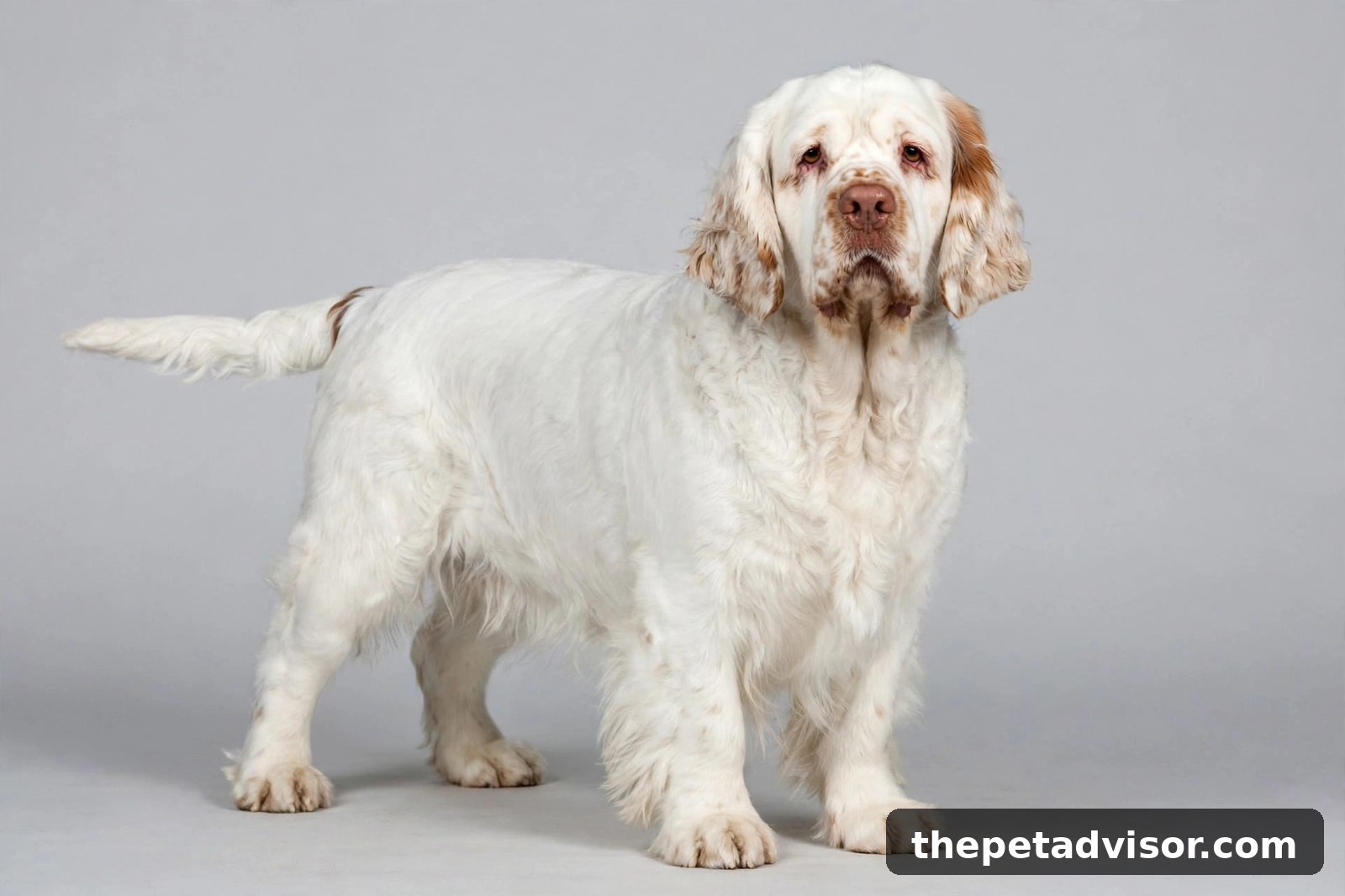
Do you have a photo of a Clumber Spaniel in the American show ring? We’d love this page to lead with one. If you have a show photo you’d let us use, email it to [email protected] — tell us the dog’s name and the show, and it may be featured here. Please only send photos you took yourself or have the photographer’s permission to share, and tell us the photographer’s name. We couldn’t find a public photo of a Clumber Spaniel in the American show ring that we were free to share, so the photo leading this page was made with AI. We’d much rather lead with a real one — if you’re a club member with an approved photo, we’d love to feature it.
1. Breed at a glance
Sporting — one of the nine breeds the AKC first recognized, in 1878
18–20 in at the withers (dogs); 17–19 in (bitches). Weight 70–85 lb (dogs); 55–70 lb (bitches). Rectangular, 11 to 9.
Dense, straight, flat double coat, soft to the touch. Primarily white, with lemon or orange markings.
Gentle, loyal, and affectionate; dignified, with an intrinsic desire to please. Aloof with strangers at first.
10 to 12 years.
Size, coat, and temperament facts are from the AKC standard (approved January 8, 2001; effective March 28, 2001) and the AKC Clumber Spaniel breed page. Lifespan (10 to 12 years) is from Adopt-a-Pet and PetGOV.
2. History
No one is sure where the Clumber came from. There is a theory that the breed began in France and was smuggled to England during the French Revolution, but there is no evidence that it is true. The prevailing theory is that the Clumber resulted from crosses between Basset Hounds and early Alpine Spaniels, now extinct — a mix that gave the breed its low, long body and heavy head. Wherever it originated, the breed got its name from a large estate in England called Clumber Park, which belonged to the Duke of Newcastle, and many aristocratic families in that area hunted with Clumber Spaniels and bred them. (Source: AKC, Facts About the Clumber Spaniel.)
Clumbers first appear in art in Francis Wheatley’s 1788 painting, “The Return From Shooting,” which depicts the Duke of Newcastle with his hunting party, accompanied by several Clumber Spaniels — and the dogs in it have not changed much over the past two centuries. The breed was extremely popular with the British upper class and British royalty during the 19th century: Queen Victoria’s husband, Prince Albert, was a big fan, and so was King Edward VII. (Source: AKC, Facts About the Clumber Spaniel.)
The AKC first recognized nine breeds in 1878, and the Clumber Spaniel was one of them. Today the breed is rare even in its home country: the UK Kennel Club has designated the Clumber a vulnerable native breed, with less than 300 new dogs registered each year, and in the United States less than 200 puppies are registered each year. A Clumber has won Crufts twice — in 1991, Raycrofts Socialite, and in 2026, “Bruin” Sh Ch Vanitonia Soloist, owned by Mr. Lee Cox. (Source: AKC, Facts About the Clumber Spaniel.)
In the United States, the Clumber spent 87 years with the American Spaniel Club as its theoretical parent club. On Monday, February 14, 1972, around 1 P.M. in a hallway of Madison Square Garden, the Clumber Spaniel Club of America became the breed’s own parent club — its golden anniversary was marked in the AKC Gazette in April 2022. The club’s mission is to support Clumbers and their owners in conformation, obedience, rally, agility, hunting, tracking, and other events the breed is eligible for, backed by education and by its support of health research and rescue. (Sources: Clumber Spaniel Club of America, Bulletin Board; Clumber Spaniel Club of America, Standing Rules.)
3. The standard and why it’s written that way
- A long, low, substantial dog. The standard opens with the whole dog: “The Clumber Spaniel is a long, low, substantial dog. His heavy brow, deep chest, straight forelegs, powerful hindquarters, massive bone and good feet all give him the power and endurance to move through dense underbrush in pursuit of game. His white coat enables him to be seen by the hunter as he works within gun range. His stature is dignified, his expression pensive, but at the same time he shows great enthusiasm for work and play.” (Source: Clumber Spaniel Club of America, Official AKC Standard.)
- Size — 18 to 20 inches for dogs, 17 to 19 for bitches. “The Clumber is rectangular in shape possessing massive bone structure and has the appearance of great power. The ideal height for dogs is 18 to 20 inches at the withers and for bitches is 17 to 19 inches at the withers. The ideal length to height is 11 to 9 measured from the withers to the base of the tail and from the floor to the withers. Dogs weigh between 70 and 85 pounds and bitches weigh between 55 and 70 pounds.” (Source: Clumber Spaniel Club of America, Official AKC Standard.)
- The head: massive, with a marked stop and heavy brow. The top skull is flat with a pronounced occiput, and a slight furrow runs between the eyes and up through the center of the skull. The muzzle is broad and deep, to facilitate retrieving many species of game. The nose is large, square, and colored shades of brown — beige, rose, and cherry. The eyes are dark amber, large, soft in expression, and deep set; some haw may show, but excessive haw is undesirable, and prominent or round eyes are penalized. The ears are broad on top with thick ear leather, triangular with a rounded lower edge, set low and attached to the skull at approximately eye level. (Source: Clumber Spaniel Club of America, Official AKC Standard.)
- Neck, topline, and body. The neck is long, with some slackness of throat or dewlap not to be faulted, strong and muscular, fitting into a well laid back shoulder. The back is straight, firm, long, and level; the brisket is deep, the ribs well sprung, the chest deep and wide, and the loin arches slightly. The tail is well feathered and set on just below the line of back, carried level with the topline or slightly elevated, never down between the rear legs; it may be docked or left natural, both of equal value. (Source: Clumber Spaniel Club of America, Official AKC Standard.)
- Forequarters and hindquarters. The forelegs are short, straight, and heavy in bone, with elbows held close to the body, and the front feet are large, compact, with thick pads that act as shock absorbers. The thighs are heavily muscled, and when viewed from behind the rear is round and broad; hock to heel is short and perpendicular to the ground, and lack of angulation is objectionable. (Source: Clumber Spaniel Club of America, Official AKC Standard.)
- Coat — dense, straight, and flat. The body coat is dense, straight, and flat, of good weather-resistant texture, soft to the touch, not harsh. The ears are slightly feathered with straight hair, feathering on the legs and belly is moderate, and the Clumber has a good neck frill — and “on no condition should his throat be shaved.” Evidence of shaving is penalized. The hair on the feet is trimmed neatly to show their natural outline; the rear legs may be trimmed up to the hock, and tail feathering may be tidied. (Source: Clumber Spaniel Club of America, Official AKC Standard.)
- Color — primarily white, with lemon or orange markings. Markings are frequently seen on one or both ears and the face, including color around one or both eyes, freckling on the muzzle, and a spot on top of the head; a head with lemon or orange markings and an all-white head are of equal value. Freckles on the legs and a spot near the root of the tail are also frequently seen and acceptable. The body should have as few markings as possible. (Source: Clumber Spaniel Club of America, Official AKC Standard.)
- Gait — the Clumber roll. “The Clumber moves easily and freely with good reach in front and strong drive from behind, neither crossing over nor elbowing out.” Because of his wide body and short legs, he tends to roll slightly: the proper Clumber roll occurs when the dog, with the correct proportion, reaches forward with the rear leg toward the centerline of travel and rotates the hip downward while the back remains level and straight. The gait is comfortable and can be maintained at a steady trot for a day of work in the field without exhaustion. (Source: Clumber Spaniel Club of America, Official AKC Standard.)
- Temperament, in the standard’s own words. “The Clumber Spaniel is a gentle, loyal and affectionate dog. He possesses an intrinsic desire to please. An intelligent and independent thinker, he displays determination and a strong sense of purpose while at work. A dog of dignity, the Clumber Spaniel may sometimes seem aloof with people unknown to him, but in time will display his playful and loving nature. The Clumber Spaniel should never be hostile or aggressive; neither is acceptable and should not be condoned.” That is the whole temperament section — and it is the sentence every Clumber owner recognizes. (Source: Clumber Spaniel Club of America, Official AKC Standard.)
4. Temperament & living with one
The AKC sums the breed up in a sentence: “A dignified and mellow hunting companion of kings, the Clumber Spaniel is the largest of the AKC flushing spaniels. For those who can handle some shedding and drooling, the amiable Clumber is an amusing best friend and a gentlemanly housemate.” The standard says the same thing in plainer terms — gentle, loyal, and affectionate, with an intrinsic desire to please, an intelligent and independent thinker with determination and a strong sense of purpose while at work. (Sources: AKC Clumber Spaniel breed page; Clumber Spaniel Club of America, Official AKC Standard.)
That dignity reads as reserve at first: the Clumber may seem aloof with people unknown to him, but in time displays his playful and loving nature. He is a dog of dignity, not a dog that fawns over strangers, and the standard is blunt that he should never be hostile or aggressive. Early and ongoing socialization matters, because the dog that greets strangers politely as a puppy is the dog that greets them politely as an adult. (Source: Clumber Spaniel Club of America, Official AKC Standard.)
The Clumber is a working dog that still wants work and steady exercise — at least a nice walk or 20 to 30 minutes of playtime a day — and a gait built to hold a steady trot for a day in the field. He is also, by every account, a dog that will eat anything: one breed guide calls the tendency to eat literally anything the biggest threat to a Clumber’s health, so food, trash, and pantry access need managing from day one. (Sources: PetGOV, Clumber Spaniel; Clumber Spaniel Club of America, Official AKC Standard.)
5. Grooming
- Two to three times a week, brushing to the skin. The dense, flat double coat sheds year-round and needs brushing two to three times a week to prevent tangles and manage shedding, working through the feathering on the ears, chest, belly, and legs where tangles develop fastest. A slicker brush works well on the body coat, and a wide-tooth metal comb is what gets through the feathering. (Sources: United Pet Club, Clumber Spaniel; PetGOV, Clumber Spaniel.)
- Shedding is a fact of life. “Clumbers shed — a lot. Twenty-four seven, 365 days a year.” Daily brushing helps keep it somewhat under control, but white hair on dark clothing and furniture is a daily reality with this breed, and heavier coat drops come seasonally. (Source: PetGOV, Clumber Spaniel.)
- Never shave the throat. The standard is absolute on this point: the Clumber has a good neck frill and “on no condition should his throat be shaved,” and evidence of shaving is penalized. Feet are trimmed neatly to show their natural outline, the rear legs may be trimmed up to the hock, and tail feathering may be tidied — but the coat is shown natural, not shaped. (Source: Clumber Spaniel Club of America, Official AKC Standard.)
- Ears, nails, and teeth are part of grooming. The long, pendulous ears are prone to infection and need watching closely for redness, tenderness, or a bad smell. Otherwise, bathe the dog when needed, keep the nails and the fur between the toe pads trimmed, and brush the teeth regularly. (Source: PetGOV, Clumber Spaniel.)
6. Health testing
- Four tests for a CHIC number. For a CHIC number, the Clumber needs four evaluations: a Hip Evaluation, an Elbow Evaluation, an Ophthalmologist Evaluation, and a Pyruvate Dehydrogenase Phosphatase 1 Deficiency (PDP1) DNA Test. That is the parent club’s list on the AKC’s Sporting Group health-testing page. Breeders must agree to have all test results, positive or negative, published in the CHIC database. (Source: AKC Sporting Group Health Testing Requirements.)
- The parent club’s own health statement agrees — and adds cardiac as optional. The Clumber Spaniel Club of America’s health statement, signed by the club secretary in March 2015, recommends that parents of puppies be tested for PDP1, hips and elbows, and eyes, and notes that breeders may also choose cardiac screening to rule out cardiac disease. (Source: Clumber Spaniel Club of America, Health Statement, March 28, 2015.)
- PDP1 deficiency: the breed-specific test. PDP1 (pyruvate dehydrogenase phosphatase 1) deficiency is a metabolic disorder known in the breed, and its DNA test is the one test on the Clumber’s list that no other Sporting breed shares in quite this form. Ask a breeder for the parents’ results — and look them up in the OFA database yourself. (Source: AKC Sporting Group Health Testing Requirements.)
- The watch list: hips, elbows, eyes, and ears. Hip and elbow dysplasia, entropion and ectropion, and ear infections are the conditions the breed is prone to, and the standard itself penalizes excessive tearing and evidence of entropion or ectropion. The parent club’s health foundation, the Clumber Spaniel Health Foundation, supports breed health research — a health seminar from the foundation ran at the 2026 national specialty. (Sources: Clumber Spaniel Club of America, Official AKC Standard; 2026 judging program.)
- Lifespan: 10 to 12 years. The commonly published lifespan is 10 to 12 years. (Sources: Adopt-a-Pet, Clumber Spaniel; PetGOV, Clumber Spaniel.)
7. The annual Clumber Spaniel specialty dog show
A specialty is the breed’s All-Star show — its Super Bowl. Once a year, the best Clumber Spaniels from across the country, and often from around the world, come together in one place.
The Clumber Spaniel Club of America’s national specialty: a multi-day national week in late April, with sweepstakes, obedience, rally, a regional specialty, a 4–6 Month Beginner Puppy event, and hunt tests around the national itself. The 2026 national week: April 28–30, at the Central Wisconsin Convention & Expo Center in Rothschild, Wisconsin, with 69 dogs and 76 entries in the specialty. The 2025 national week: April 29–May 1, at the Cowlitz County Event Center in Longview, Washington, with 57 dogs and 64 entries. The 2027 national: March 19, at the Crowne Plaza Asheville in Asheville, North Carolina.
The standard, in brief: a long, low, substantial dog, rectangular in shape with massive bone, 18 to 20 inches at the withers for dogs and 17 to 19 inches for bitches, primarily white with lemon or orange markings, a massive head with a heavy brow, a dense, straight, flat coat, and the comfortable, steady trot the standard calls for — with the slight roll that comes from a wide body on short legs.
The 2026 National Specialty — a one-day show, Thursday, April 30, 2026, at Central Wisconsin Convention & Expo Center, 10101 Market St, Rothschild, Wisconsin, in the middle of a national week running April 28–30. Entry: 69 dogs (30 dogs, 39 bitches); whole event 76 entries / 69 competitors. Entries closed Wednesday, April 8, 2026. Event Chair: Ron Porras. Superintendent: BaRay Event Services, Inc. The week around the national: sweepstakes, obedience, and rally Tuesday, April 28; a regional specialty Wednesday, April 29; a 4–6 Month Beginner Puppy event Thursday; plus FastCAT, tracking, and hunt tests around the week, a Top 10 Gala Wednesday evening, and a banquet with awards Thursday evening. (Sources: AKC event search, event 2026131115; 2026 judging program; 2026 preliminary breed counts (BaRay).)
National specialty judges: Mr. James M. Fankhauser — regular and non-regular classes, Beginner Puppy, and Junior Showmanship. Ellen Hardin — all Sweepstakes. Ms. Loretta C. Lazzara — Obedience & Rally. Best Junior Handler: Emily McGuire; Reserve Best Junior Handler: Easton Munster. (Sources: 2026 judging program; AKC event search, event 2026131115.)
Results (2026 national). Best of Breed: not confirmed in an official source as of November 2026.
The 2027 National Specialty: a one-day show, Friday, March 19, 2027, at the Crowne Plaza Asheville, Asheville, North Carolina. Superintendent: Emerald Coast Dog Shows. Judges, AKC event number, entries, and closing date not yet published as of November 2026. (Source: AKC Upcoming National Specialties.)
Past national specialties: 2025
Clumber Spaniel Club of America — clumbers.org
8. Regional specialties through the year: smaller regional shows
The national is the anchor, but the breed’s year also runs through regional specialties — smaller regional shows, not the national — held by regional Clumber clubs around the country. These are the 2026 regionals verified from club sources so far:
One regional specialty at Central Wisconsin Convention & Expo Center, Rothschild, Wisconsin, during the national week, with BaRay Event Services, Inc. as superintendent; entries closed Wednesday, April 8, 2026.
- Regional specialty, Central Wisconsin Convention & Expo Center, Rothschild, WI — Wednesday, April 29, 2026: judge Ms. Pluis Davern. Entry: 71 dogs (31 dogs, 40 bitches); whole event 74 entries / 71 competitors. Best Junior Handler: Emily McGuire; Reserve Best Junior Handler: Easton Munster. Event Chair: Ron Porras. (Sources: AKC event search, event 2026131108; 2026 judging program.)
Past regional specialties: 2025
More regional specialties will be added here as their programs are verified — this section is built from show data, not guesswork. Browse upcoming show weekends →
9. Clubs
- Clumber Spaniel Club of America (parent club) — the AKC parent club for the breed in the United States. It became the breed’s parent club on February 14, 1972, after 87 years under the American Spaniel Club, and its mission is to support Clumbers and their owners in conformation, obedience, rally, agility, hunting, tracking, and other events the breed is eligible for, backed by education and by support of health research and rescue. President Milford Cole; AKC delegate Kelly Lease; Rescue & Placement chair Sue Carr. The club runs the national specialty each year and supports the Clumber Spaniel Health Foundation and the Clumber Spaniel Rescue Charitable Trust. (Sources: Clumber Spaniel Club of America; Clumber Spaniel Club of America, Standing Rules; 2026 judging program.)
- Regional Clumber clubs. Regional clubs around the country include the Clumber Spaniel Club of Southern California, the Clumber Spaniel Club of Carolinas, and the Pacific Northwest Clumber Spaniel Fanciers, a new local club working toward AKC accreditation that held its own specialty alongside the 2025 national. The 2026 regional specialty was held by the parent club at the national week; see section 8.
If you are new to the breed, the national specialty itself is the better first stop than a breeder’s website: the people there have owned, shown, and worked Clumbers, and they will tell you the truth about the shedding, the drool, and the sheer bulk of the dog before you fall for a puppy.
10. Rescue
- The Rescue & Placement Committee. The Clumber Spaniel Club of America’s Rescue & Placement Committee, chaired by Sue Carr, takes in Clumbers in need and re-homes them; its annual Rescue & Placement calendar is a fundraiser for the work. The club’s brochure points anyone interested in adding a rescued Clumber to the family to a member of the Rescue and Placement committee. (Sources: Clumber Spaniel Club of America, Bulletin Board; Clumber Spaniel Club of America brochure.)
- Clumber Spaniel Rescue Charitable Trust. The charitable arm behind the club’s rescue work — a charitable organization that takes donations in support of rescued Clumbers. (Source: Clumber Spaniel Club of America, In Memoriam.)
- Adults and seniors. A rescued Clumber is usually an adult, often one whose owner underestimated the shedding, the drool, and the sheer bulk of the dog, and it will arrive with its temperament visible before you commit. What you get in return is a dog whose character you can see before you commit and a lower price. Either way, be honest with yourself first: a Clumber needs brushing two to three times a week, an owner who accepts white hair and drool as part of the package, and early and ongoing socialization for a dog that is dignified and aloof with strangers at first.
11. Breeder vs. rescue: honest guidance
- If you buy: start with the parent club, the Clumber Spaniel Club of America, and its breeder referral list. Referral-list breeders must have been members in good standing for at least three years and must agree to cooperate with CSCA Rescue & Placement if a dog they placed ever needs help. Ask for the parents’ health results — hip, elbow, eyes, and the PDP1 DNA test — and look the results up in the OFA database yourself. Expect to wait for a puppy from a careful breeder: a good breeder will have the answers, will ask you as many questions as you ask them, and will take the puppy back for its whole life if you cannot keep it. (Source: Clumber Spaniel Club of America, Standing Rules.)
- If you rescue: a rescued Clumber is usually an adult, often one whose owner underestimated the shedding, the drool, and the sheer bulk of the dog, and it will arrive with its temperament visible before you commit. What you get in return is a dog whose character you can see before you commit and a lower price. Either way, be honest with yourself first: a Clumber needs brushing two to three times a week, an owner who accepts white hair and drool as part of the package, and early and ongoing socialization for a dog that is dignified and aloof with strangers at first. It is not a dog for a household that wants a light, low-shedding, instantly friendly pet.
- One breed, one color — and color is not value. The Clumber is shown under one standard in a single color: primarily white, with lemon or orange markings. A head with lemon or orange markings and an all-white head are of equal value, and the body should have as few markings as possible — but the standard judges the whole dog, and a Clumber’s quality is in how closely it approximates the standard, not in its markings.
12. Claim this page
This page belongs to the breed, and the people who know the breed best are the Clumber Spaniel Club of America and its members. If you are with the parent club — or you are a breeder, a judge, a handler, or a rescue volunteer who spotted something wrong, missing, or out of date — this page is yours to set straight. Tell us what needs fixing and where the correction is documented, and we will fix it and credit the source. Contact the site through the About page, and mention “Clumber Spaniel breed profile.”
Sources
- AKC Clumber Spaniel breed page — akc.org/dog-breeds/clumber-spaniel
- AKC Official Standard of the Clumber Spaniel (approved January 8, 2001; effective March 28, 2001) — images.akc.org/pdf/breeds/standards/ClumberSpaniel.pdf
- AKC, Facts About the Clumber Spaniel That You May Not Know — akc.org/expert-advice/lifestyle/fun-facts-clumber-spaniel
- AKC Sporting Group Health Testing Requirements — akc.org/breeder-programs/breed-health-testing-requirements/sporting-group-health-testing-requirements
- Clumber Spaniel Club of America, Health Statement (March 28, 2015) — cdn.akc.org/Marketplace/Health-Statement/Clumber-Spaniel.pdf
- Clumber Spaniel Club of America — clumbers.org
- Clumber Spaniel Club of America, Official AKC Standard — clumbers.org/clumber-101/akc-standard
- Clumber Spaniel Club of America, Standing Rules — clumbers.org/wp-content/uploads/2021/10/CSCA-Standing-Rules_vMay-_2020.pdf
- Clumber Spaniel Club of America, Bulletin Board — clumbers.org/category/bulletin-board
- Clumber Spaniel Club of America brochure — cdn.akc.org/ClumberSpaniel-club-flier.pdf
- Clumber Spaniel Club of America, In Memoriam — clumbers.org/in-memoriam
- AKC Upcoming National Specialties — apps.akc.org/apps/events/conformation/national_specialties.cfm
- 2026 National Specialty, AKC event search, event 2026131115 — apps.akc.org/apps/events/search/index_results.cfm
- 2026 judging program — apps.akc.org/apps/eventplans/eventsearch/blocks/dsp_generate_pdf.cfm
- 2026 preliminary breed counts (BaRay) — baray-production-storage.s3.us-west-2.amazonaws.com/websiteinfo_pdf
- 2026 regional specialty, AKC event search, event 2026131108 — apps.akc.org/apps/events/search/index_results.cfm
- 2025 National Specialty, AKC event search, event 2025131111 — apps.akc.org/apps/events/search/index_results.cfm
- 2025 premium list (BaRay) — baray-production-storage.s3.us-west-2.amazonaws.com/premium_list
- 2025 Knoxville regional specialty, AKC event search, event 2025131101 — apps.akc.org/apps/events/search/index_results.cfm
- PetGOV, Clumber Spaniel — petgov.com/dog-breeds/clumber-spaniel
- Adopt-a-Pet, Clumber Spaniel — adoptapet.com/dog-breeds/clumber-spaniel
- United Pet Club, Clumber Spaniel — unitedpetclub.com/en-US/animals/Dog/Clumber-Spaniel