Breed profile · Non-Sporting Group · the lion-maned aristocrat of ancient China
Chow Chow
The Chow Chow is an all-purpose dog of ancient China: a powerful, sturdy, squarely built dog of Arctic type, 17 to 20 inches at the withers and 45 to 70 pounds, wrapped in a profuse double coat — rough or smooth — with a lion-like ruff framing the head, a blue-black tongue, deep-set almond eyes, and the dignified, scowling expression the standard sums up as lordly, discerning, sober, and snobbish.
Help us improve it. This is one of ThePetAdvisor’s breed profiles, built from public sources with generous links to the people who actually own this breed’s knowledge. If something’s off or missing, the parent club can claim the page and set it straight — see the bottom of the page.
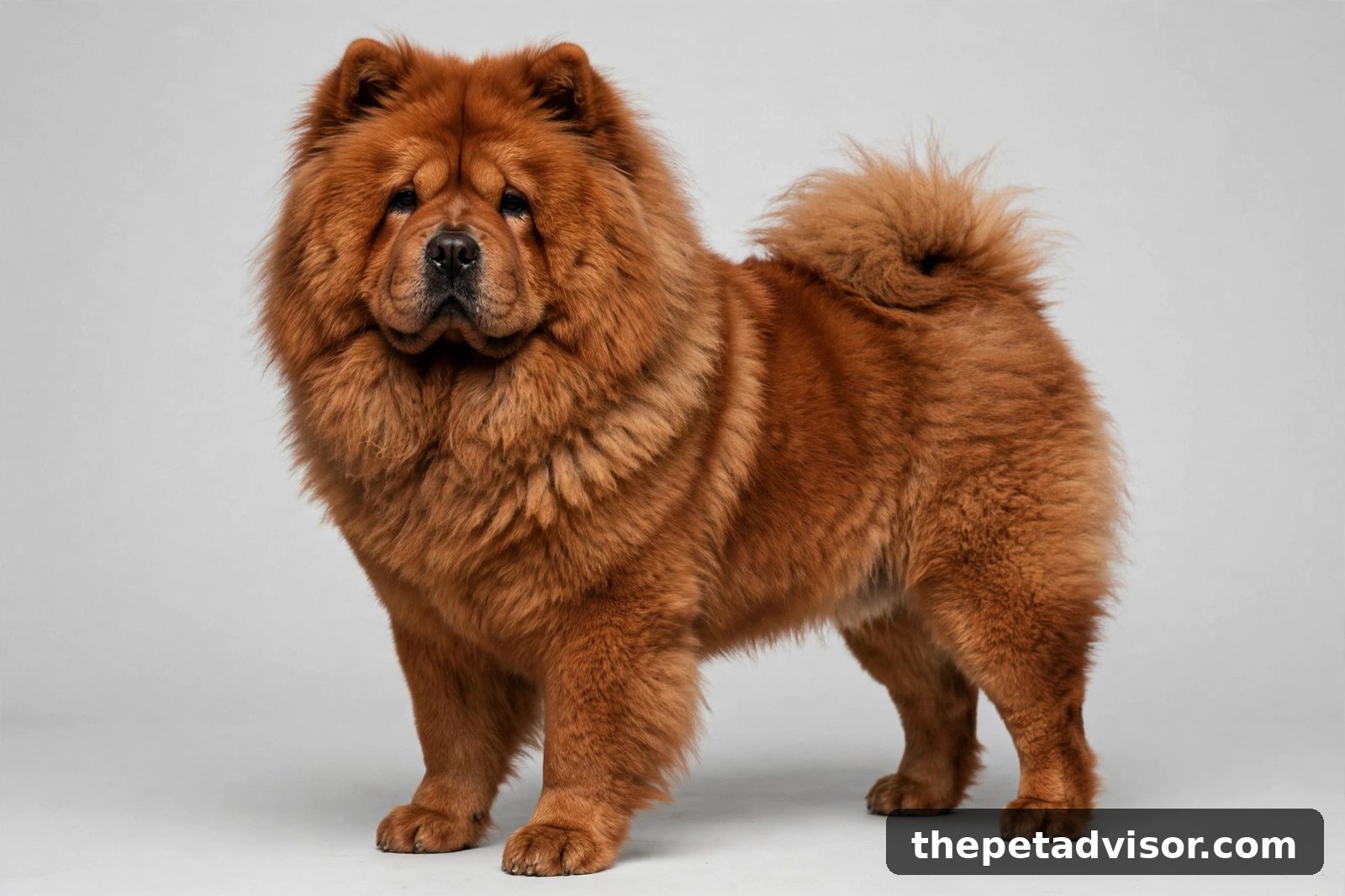
Do you have a photo of a Chow Chow in the American show ring? We’d love this page to lead with one. If you have a show photo you’d let us use, email it to [email protected] — tell us the dog’s name and the show, and it may be featured here. Please only send photos you took yourself or have the photographer’s permission to share, and tell us the photographer’s name. We couldn’t find a public photo of a Chow Chow in the American show ring that we were free to share, so the photo leading this page was made with AI. We’d much rather lead with a real one — if you’re a club member with an approved photo, we’d love to feature it.
1. Breed at a glance
Non-Sporting — recognized by the AKC in 1903
17–20 in at the withers. Weight 45–70 lb. Square in profile — as long as it is tall.
Profuse double coat in two types — rough (long, straight, offstanding) and smooth (short, hard, dense). Five colors: red, black, blue, cinnamon, cream.
Dignified, bright, and serious-minded. Aloof with strangers and eternally loyal to loved ones. AKC: dignified, serious-minded, aloof.
8 to 12 years.
Size, coat, and temperament facts are from the AKC standard (approved May 11, 2020; effective July 29, 2020) and the AKC Chow Chow breed page. Lifespan (8 to 12 years) and weight (45 to 70 pounds) are from the AKC Chow Chow breed page.
2. History
The Chow’s true origin is unknown and lost deep within Chinese antiquity. The breed as it is known today is easily recognizable in pottery and sculptures of China’s Han Dynasty (206 B.C. to 22 A.D.), and other artifacts indicate it was an even older breed, possibly coming originally from the Arctic Circle and migrating through Mongolia and Siberia into China. Some scholars claim the Chow was the original ancestor of the Samoyed, Norwegian Elkhound, Pomeranian, and Keeshond. In the T’ang Dynasty (7th century A.D.), one Chinese emperor is reported to have kept 2,500 of these “Chow Dogs” to accompany his ten thousand hunters. (Source: The Chow Chow Club, Inc., “An Oriental Masterpiece”.)
The Chow came to America by way of England, where it had been brought from China in the late 1700s. Sailors returning from the east brought the dogs back in the cargo holds of trade ships, and “Chow Chow” was a slang term for the large variety of items carried by those ships — like a nickname, the term stuck to the dogs. Chows first appeared at AKC dog shows in the late 1800s, and the Chow Chow Club, Inc. (CCCI) was formed in 1906. The breed first knew general popularity in the 1930s, when President Calvin Coolidge kept a Chow in the White House, and soared to popularity again in the 1980s. (Sources: The Chow Chow Club, Inc., “An Oriental Masterpiece”; AKC Chow Chow breed page.)
The AKC recognized the breed in 1903, and the parent club has been its steward ever since: it maintains the standard by which Chows are judged, oversees the regional Chow clubs, promotes the exhibition of quality Chows, and runs the national specialty each spring. (Sources: AKC Chow Chow breed page; Chow Chow Club, Inc..)
3. The standard and why it’s written that way
- A powerful, sturdy, squarely built dog of Arctic type. The standard opens with the whole dog: “An ancient breed of northern Chinese origin, this all-purpose dog of China was used for hunting, herding, pulling and protection of the home. While primarily a companion today, his working origin must always be remembered when assessing true Chow type.” The body is compact, short coupled, broad and deep, the tail set high and carried closely to the back, all supported by four straight, strong, sound legs. Elegance and substance must be combined into a well balanced whole — never so massive as to outweigh the dog’s ability to be active, alert, and agile. (Source: AKC standard.)
- Size — 17 to 20 inches, square in profile. “The average height of adult specimens is 17 to 20 inches at the withers but in every case consideration of overall proportions and type should take precedence over size.” The profile is square and close coupled: distance from forechest to point of buttocks equals height at the withers, and a profile other than square is a serious fault. (Source: AKC standard.)
- The head: broad, flat, and scowling. “Expression essentially scowling, dignified, lordly, discerning, sober and snobbish, one of independence.” The scowl comes from a marked brow with a padded button of skin above the inner, upper corner of each eye, frowning brows, and a distinct furrow between the eyes — plus the correct eye shape and placement and the correct ear shape, carriage, and placement. The eyes are dark brown, deep set, wide apart, oblique, and almond-shaped, giving an Oriental appearance. The ears are small, moderately thick, triangular with a slight rounding at the tip, carried stiffly erect with a slight forward tilt — a drop ear is a disqualification. (Source: AKC standard.)
- The blue-black tongue — essential to true Chow type. “Essential to true Chow type are his unique blue-black tongue, scowling expression and stilted gait.” The top surface and edges of the tongue are a solid blue-black, the darker the better, and a tongue that is red or pink on top or edges, or spotted with red or pink, is a disqualification. The nose is large, broad, and black — except blue Chows, which may have solid blue or slate noses, and cream Chows, which may have a range of nose colors. (Source: AKC standard.)
- Coat — rough or smooth, both double-coated. “There are two types of coat; rough and smooth. Both are double coated.” The rough coat is abundant, dense, straight, and offstanding, rather coarse in texture, with a soft, thick, wooly undercoat, forming a profuse ruff around the head and neck that frames the head. The smooth coat is hard, dense, and smooth with a definite undercoat, and has no obvious ruff or feathering. The smooth Chow is judged by the same standard as the rough Chow except for coat quantity and distribution. Obvious trimming or shaping is undesirable. (Source: AKC standard.)
- Color — five colors, judged on an equal basis. “There are five colors in the Chow: red (light golden to deep mahogany), black, blue, cinnamon (light fawn to deep cinnamon) and cream. Acceptable colors to be judged on an equal basis.” Red is the most common; cinnamon is a dilution of red and blue a dilution of black. (Sources: AKC standard; The Chow Chow Club, Inc., “An Oriental Masterpiece”.)
- Gait — the stilted action is the point. The hind legs have little apparent angulation, with the hock joint and metatarsals directly beneath the hip joint, and that structure produces the characteristic shorter, stilted gait unique to the breed. “The rear leg moves up and forward from the hip in a straight, stilted pendulum-like line with a slight bounce in the rump.” Proper movement is the crucial test of proper conformation and soundness. (Source: AKC standard.)
- Judged on a ramp. Chow Chows are on the AKC’s list of breeds that must be judged on a ramp through all levels of conformation competition — a practical detail of the standard’s demand for sound, straight movement, and one more reason the gait matters. (Source: Kettle Moraine Kennel Club premium list, ramp policy.)
- Temperament, in the standard’s own words. “Keen intelligence, an independent spirit and innate dignity give the Chow an aura of aloofness. It is a Chow’s nature to be reserved and discerning with strangers. Displays of aggression or timidity are unacceptable. Because of its deep set eyes the Chow has limited peripheral vision and is best approached from the front.” That is the whole temperament section — and it is the sentence every Chow owner recognizes. (Source: AKC standard.)
4. Temperament & living with one
The AKC sums the breed up in three words: dignified, bright, serious-minded. The standard says the same thing in a sentence: keen intelligence, an independent spirit, and innate dignity give the Chow an aura of aloofness. A Chow is cat-like in its attitudes — aloof, reserved with affection, independent, dignified, and stubborn — and it saves its affections for those it loves most dearly, finding little reason to seek attention from anyone else. It minds its own business and simply does not care what strangers think of it. (Sources: AKC Chow Chow breed page; The Chow Chow Club, Inc., “An Oriental Masterpiece”; AKC standard.)
That reserve is the charm and the work. The Chow is naturally suspicious of strangers and territorial, taking its home and family seriously — on its own property and without its owner present, it may appear quite fierce, and it will seldom let a stranger pass unchallenged. Once greeted by the owner and accepted into the home, it should accept the stranger but may stay reserved. Socialization has to start at birth with the breeder and continue for life: new people, other dogs, and new places, introduced politely and calmly, with puppy kindergarten classes an excellent start. The strong-willed, stubborn Chow needs an equally strong-willed, stubborn owner — training is not optional, because an untrained Chow reaching adolescence may refuse to accept authority. (Source: The Chow Chow Club, Inc., “An Oriental Masterpiece”.)
The Chow adjusts well to being alone during working hours but prefers to be at its owner’s side at home, not kept as an “outside” dog — tied up or confined away from regular contact with people, a Chow may become very antisocial. Its independent nature sometimes gets in the way of obedience: Chows are well known for not coming when called and should never be allowed off leash outside of a fenced yard. Most Chows have strong hunting instincts, may not be compatible with cats or smaller dogs, and do not make good “pack” dogs — if you plan on a second dog, the parent club recommends one of the opposite sex. And because the deep-set eyes limit peripheral vision, a Chow is best approached from the front. (Sources: The Chow Chow Club, Inc., “An Oriental Masterpiece”; AKC standard.)
5. Grooming
- One to two hours a week, brushing to the skin. The parent club’s guide is exact: expect to spend one to two hours a week thoroughly brushing your Chow’s coat to the skin. A clean, well-groomed Chow is the most beautiful of all dogs, and regular grooming is essential to keep the dog comfortable and looking its best. (Source: The Chow Chow Club, Inc., “An Oriental Masterpiece”.)
- The seasonal undercoat blow. Chows shed their undercoats on a seasonal basis, and regular grooming and bathing will minimize loose hair in the home as well as maintain the coat’s good condition. The rough coat’s long, straight, coarse guard hairs over a soft, thick undercoat mat if they are not worked through; the smooth coat is shorter and denser but still carries a definite undercoat that sheds. (Sources: The Chow Chow Club, Inc., “An Oriental Masterpiece”; AKC standard.)
- No obvious trimming or shaping. The standard is clear that obvious trimming or shaping is undesirable — the Chow is shown in its natural coat, with the ruff framing the head. Trimming of the whiskers, feet, and metatarsals is optional. (Source: AKC standard.)
- Eyes are part of grooming. Runny, red, inflamed eyes or crusty eyelids are not normal for a Chow and should be treated by a veterinarian as soon as possible — they can be the first sign of entropion, the eyelid condition the breed is known for. (Source: The Chow Chow Club, Inc., “An Oriental Masterpiece”.)
6. Health testing
- Five tests for a CHIC number. For a CHIC number, the Chow Chow needs five evaluations: a Patella Evaluation, a Hip Evaluation, an Elbow Evaluation, an Ophthalmologist Evaluation, and a Thyroid Evaluation. That is the parent club’s list on the AKC’s Non-Sporting Group health-testing page. Breeders must agree to have all test results, positive or negative, published in the CHIC database. (Source: AKC Non-Sporting Group Health Testing Requirements.)
- The parent club’s guide adds cardiac. The Chow Chow Club, Inc.’s breed guide lists the pre-breeding health certifications as hip and elbow radiographs, thyroid, patella, and cardiac evaluations, and eye certification submitted to the Orthopedic Foundation for Animals (OFA). Ask a breeder for the parents’ results — and look them up in the OFA database yourself. (Source: The Chow Chow Club, Inc., “An Oriental Masterpiece”.)
- The watch list: entropion first. Entropion is the health condition the parent club’s guide explains in full: the eyelids turn inward toward the eyeball, causing irritation, and if left untreated it can lead to blindness. It can be inherited but may also develop after an eye injury or infection, and it is not always apparent in young puppies. Runny, red, inflamed eyes or crusty eyelids are not normal for a Chow. Hip and elbow dysplasia, thyroid disease, and eye disease are the other conditions the testing list is built around. (Sources: The Chow Chow Club, Inc., “An Oriental Masterpiece”; AKC Non-Sporting Group Health Testing Requirements.)
- Lifespan: 8 to 12 years. The commonly published lifespan is 8 to 12 years — a shorter life than many breeds its size, and one more reason to buy from a breeder who tests. (Source: AKC Chow Chow breed page.)
7. The annual Chow Chow specialty dog show
A specialty is the breed’s All-Star show — its Super Bowl. Once a year, the best Chow Chows from across the country, and often from around the world, come together in one place.
The Chow Chow Club, Inc.’s national specialty: a one-day conformation show in the spring, with puppy and veteran sweepstakes, junior showmanship, obedience, rally, and a Parade of Title Holders around it. The 2026 show: Thursday, April 23, at Tulsa Expo Square in Tulsa, Oklahoma, with 26 dogs and 44 entries in the specialty. The 2025 show: Thursday, May 1, at the Roberts Centre in Wilmington, Ohio, with 37 dogs and 71 entries. The 2027 show: Thursday, March 11, at the Kentucky Fair & Exposition Center in Louisville, Kentucky.
The standard, in brief: a powerful, sturdy, squarely built dog of Arctic type, 17 to 20 inches at the withers, with the broad flat skull, the small triangular ears carried stiffly erect, the deep-set dark almond eyes, the blue-black tongue, the profuse rough or smooth double coat — red most commonly — the high-set tail carried closely to the back, and the stilted gait from the straight rear assembly.
The 2026 National Specialty — a one-day show, Thursday, April 23, 2026, at Tulsa Expo Square, Tulsa State Fairgrounds, 4101 E 21st Street, Tulsa, Oklahoma, in the middle of a national week running April 22–26. Entry: 44 entries (26 dogs, 18 bitches); whole event 55 entries / 44 competitors. Entries closed Wednesday, April 8, 2026. Event Chair: Jan Reed. Superintendent: Onofrio Dog Shows, L.L.C. The week around the national: parent-club obedience and rally on Thursday, a 4–6 Month Beginner Puppy event, and parent-club designated specialties Friday, April 24 and Saturday, April 25 at the Mid-Continent Kennel Club shows, plus the Greater Tulsa Non-Sporting Dog Club specialty and a supported entry Sunday, April 26. (Sources: AKC event search, event 2026124009; Chow Life, Fall 2025, national specialty schedule.)
National specialty judges: Mrs. L Brantley (Linda Brantley) — regular and non-regular classes. Ms. Anna Wallace — Junior Showmanship. Ms. Lynette White — Puppy & Veterans Sweepstakes. Mr. Rick Garvin — Obedience and Rally. (Sources: AKC event search, event 2026124009; Chow Life, Fall 2025, national specialty schedule.)
Results (AKC event search, event 2026124009). Best of Breed and Best Owner-Handled: CH Pendleton Life Of The Party At Chowmania (bitch), H McKay. Best of Opposite Sex: GCHG CH Asans Twilight’s Taha Aki I Am The First (dog), A Sanders / L Ellison. Select Dog: CH Rising Star Dark Night In Berlin, H Tobar / M Regnier. Select Bitch: GCHB CH Rio Cincere’s In A Ny State Of Mind, A Frick / P Romano / C Stone. Best of Winners and Winners Bitch: Southern Skies My Sharona, J Sedillos / R Sedillos. Winners Dog: Southern Skies Red Ruckus, J Sedillos / R Sedillos. Reserve Winners Dog: Graystone’s Heartbeat Of America @ V I P’S, K Watson / B Walden. Reserve Winners Bitch: Pinchou’s Girl’s Night Out, M Oosterman. Best Junior Handler: Faith McKee. Reserve Best Junior Handler: Jayla Sikes. (Source: AKC event search, event 2026124009.)
The 2027 National Specialty: a one-day show, Thursday, March 11, 2027, at the Kentucky Fair & Exposition Center, 937 Phillips Lane, Louisville, Kentucky, during the Kentuckiana Cluster. Entries close Wednesday, February 24, 2027, at noon Eastern. Entry limit 100; entry fee $38.00. Event Chair: Chawnecy Vaughn. Superintendent: MB-F Inc. Conformation judge: Ms. Mary L Wuest. Junior Showmanship judge: Ms. Mary L Wuest. Sweepstakes judge: not yet published as of November 2026. (Sources: AKC Upcoming National Specialties; AKC event search, event 2027124003.)
Past national specialties: 2025
Chow Chow Club, Inc. — chowclub.org
8. Regional specialties through the year: smaller regional shows
The national is the anchor, but the breed’s year also runs through regional specialties — smaller regional shows, not the national — held by regional Chow Chow clubs around the country. These are the 2026 regionals verified from club sources so far:
- Wisconsin Chow Chow Club designated specialties, Washington County Fair Park, West Bend, WI — Saturday, June 27 and Sunday, June 28, 2026: the Wisconsin club’s designated specialties with the Kettle Moraine Kennel Club shows. Conformation judges David B Swartwood (Saturday) and Kathleen Ronald (Sunday). Entries closed Wednesday, June 10, 2026. Event Chair: Vicki DeGruy. Superintendent: BaRay Event Services, Inc. Results for designated specialties are recorded on the host event. (Sources: AKC event search, event 2026188801; Kettle Moraine Kennel Club premium list.)
- North Florida Chow Chow Club specialties, Orange County Convention Center, Orlando, FL — Thursday, December 10 and Friday, December 11, 2026: a designated specialty with sweepstakes on Thursday (event 2026647301, with the Central Florida Kennel Club show) and an independent specialty with junior showmanship on Friday (event 2026647302). Friday conformation judge Michael Brantley; Friday Junior Showmanship judge Mrs. Morgan Brooks. Entries close Wednesday, November 11, 2026. Event Chair: Mary Wuest. Superintendents: MB-F Inc. (Thursday) and Onofrio Dog Shows, L.L.C. (Friday). (Sources: AKC event search, event 2026647301; AKC event search, event 2026647302.)
More regional specialties will be added here as their programs are verified — this section is built from show data, not guesswork. Browse upcoming show weekends →
9. Clubs
- Chow Chow Club, Inc. (parent club) — the AKC parent club for the breed in the United States. It was formed in 1906, is incorporated in the state of New York, and is the national organization for the breed: it maintains the standard by which Chows are judged, oversees the regional Chow clubs, promotes the exhibition of quality Chows, produces a quarterly magazine about the Chow, and runs the national specialty each spring. President Michael Brantley (2025); AKC delegate Margaret DiCorleto. (Sources: Chow Chow Club, Inc.; The Chow Chow Club, Inc., “An Oriental Masterpiece”; Chow Chow Club, Inc., Information.)
- Regional Chow clubs. Regional clubs around the country include the Chow Chow Club of Greater Chicago, the Chow Chow Club of Greater New York (chow.us), the Southern Chow Chow Club, the New England Chow Chow Club, the North Florida Chow Chow Club, the North Texas Chow Chow Club, the Wisconsin Chow Chow Club, the Chow Chow Fanciers of Atlanta, the Chow Fanciers Association of Southern California, and the Redwood Coast Chow Chow Club. The Wisconsin and North Florida clubs’ 2026 specialties are in section 8.
If you are new to the breed, the national specialty itself is the better first stop than a breeder’s website: the people there have owned, shown, and worked Chows, and they will tell you the truth about the aloofness, the grooming, and the guarding instinct before you fall for a puppy.
10. Rescue
- The parent club’s Welfare Committee. The Chow Chow Club, Inc.’s Welfare Committee (CCCI Welfare) is the central contact point for placing abandoned or unwanted Chows and for people who want to adopt one, and it keeps a directory of Chow rescue volunteers across the country. Its website is chowwelfare.com, and its hotline is 608-756-2008. The Welfare Fund, running since 1994, gives grants to rescue volunteers toward the medical costs of making a rescued Chow healthy and ready for adoption — spaying or neutering, vaccinations, heartworm testing and treatment, and entropion correction. (Sources: Chow Chow Club, Inc., Chow Welfare; Chow Chow Club, Inc., Committees.)
- Rescue groups named by the parent club. The club names three rescue groups run by its members: Chow Chow Rescue of Central New York, West Texas Chow Chow Rescue, and Pacific Northwest Chow Chow Rescue. The club is clear about the limit: the groups are operated by club members but are not supervised or endorsed by the club, and the club itself does not foster or place rescued Chows. Do the same homework on a rescue group that you would on a breeder. (Source: Chow Chow Club, Inc., Committees.)
- Wisconsin Chow Chow Rescue. The Wisconsin Chow Chow Club runs its own rescue, with adoption guidance on its site at wischowclub.org. Its advice is blunt and useful: most rescued Chows do not have papers or a known pedigree, and if your heart is set on a puppy, the parent club’s Breeder Directory is the route. (Source: Wisconsin Chow Chow Club, adoption FAQ.)
- Adults and seniors. A rescued Chow is usually an adult, often one whose owner underestimated the aloofness, the grooming, and the guarding instinct, and it will arrive with its temperament visible before you commit. What you get in return is a dog whose character you can see before you commit and a lower price. Either way, be honest with yourself first: a Chow needs thorough weekly brushing, early and ongoing socialization, and an owner who respects a reserved, independent dog rather than expecting a dog that fawns over strangers.
11. Breeder vs. rescue: honest guidance
- If you buy: start with the parent club, the Chow Chow Club, Inc., and its Breeder Directory. Ask for the parents’ health results — patella, hip, elbow, eyes, and thyroid — and look the results up in the OFA database yourself. Expect to wait for a puppy from a careful breeder: a good breeder will have the answers, will ask you as many questions as you ask them, and will take the puppy back for its whole life if you cannot keep it. The parent club’s guide puts it plainly: breeding good Chows costs money, and a responsible breeder takes the dogs back if their owners cannot keep them.
- If you rescue: a rescued Chow is usually an adult, often one whose owner underestimated the aloofness, the grooming, and the guarding instinct, and it will arrive with its temperament visible before you commit. What you get in return is a dog whose character you can see before you commit and a lower price. Either way, be honest with yourself first: a Chow needs thorough weekly brushing, early and ongoing socialization, and an owner who respects a reserved, independent dog rather than expecting a dog that fawns over strangers. It is not a dog for a household that wants an instantly friendly, low-maintenance pet.
- One breed, two coats — and color is not value. The Chow is shown under one standard in two coat types, rough and smooth, judged by the same standard apart from coat length. And the parent club is blunt about color: it has absolutely nothing to do with a Chow’s value. Red is the most common color, blue, cinnamon, and cream are less common but not rare and not more valuable — a Chow’s worth depends on how closely it approximates the standard, not on its color.
12. Claim this page
This page belongs to the breed, and the people who know the breed best are the Chow Chow Club, Inc. and its members. If you are with the parent club — or you are a breeder, a judge, a handler, or a rescue volunteer who spotted something wrong, missing, or out of date — this page is yours to set straight. Tell us what needs fixing and where the correction is documented, and we will fix it and credit the source. Contact the site through the About page, and mention “Chow Chow breed profile.”
Sources
- AKC Chow Chow breed page — akc.org/dog-breeds/chow-chow
- AKC Official Standard of the Chow Chow (approved May 11, 2020; effective July 29, 2020) — images.akc.org/pdf/breeds/standards/ChowChow.pdf
- AKC Non-Sporting Group Health Testing Requirements — akc.org/breeder-programs/breed-health-testing-requirements/non-sporting-group-health-testing-requirements
- The Chow Chow Club, Inc., “An Oriental Masterpiece” (breed guide) — cdn.akc.org/ChowChow-club-flier.pdf
- Chow Chow Club, Inc. — chowclub.org
- Chow Chow Club, Inc., Information (officers and board) — chowclub.org/ccci/?view=category&id=13
- Chow Chow Club, Inc., Chow Welfare — chowclub.org/ccci/chow-welfare-home/who-we-are
- Chow Chow Club, Inc., Committees (Welfare Committee and rescue organizations) — chowclub.org/ccci/homepage/committees/ways-means
- Wisconsin Chow Chow Club, adoption FAQ — wischowclub.org/chow-information/85-chow-chow-adoption-frequently-asked-questions-faq
- AKC Upcoming National Specialties — apps.akc.org/apps/events/conformation/national_specialties.cfm
- 2026 National Specialty, AKC event search, event 2026124009 — apps.akc.org/apps/events/search/index_results.cfm
- 2025 National Specialty, AKC event search, event 2025124005 — apps.akc.org/apps/events/search/index_results.cfm
- 2027 National Specialty, AKC event search, event 2027124003 — apps.akc.org/apps/events/search/index_results.cfm
- Chow Life, Fall 2025 — CCCI National Specialty schedule (p. 15) — online.flipbuilder.com/pccs/hnlp/files/basic-html/page15.html
- 2026 Wisconsin Saturday designated specialty, AKC event search, event 2026188801 — apps.akc.org/apps/events/search/index_results.cfm
- 2026 North Florida designated specialty, AKC event search, event 2026647301 — apps.akc.org/apps/events/search/index_results.cfm
- 2026 North Florida independent specialty, AKC event search, event 2026647302 — apps.akc.org/apps/events/search/index_results.cfm
- Kettle Moraine Kennel Club premium list (Wisconsin Chow Chow Club judges; ramp policy) — apps.akc.org/apps/eventplans/eventsearch/blocks/dsp_generate_pdf.cfm