
Breed profile · Toy Group · the fine-boned toy dog in two varieties
Chinese Crested
The Chinese Crested is a toy dog, fine-boned, elegant and graceful — and it comes in two varieties, Hairless and Powderpuff, born in the same litter and shown together under one standard. The Hairless, with hair only on its head, tail, and feet, is the breed’s iconic look; the Powderpuff is completely covered in a soft, silky double coat. Beneath either coat is the same dog: gay and alert, playful and devoted, a loving companion that has been charming owners since the 19th century. The AKC recognized the breed in 1991, and the American Chinese Crested Club is the parent club.
Two varieties, one breed: the Hairless and the Powderpuff are varieties of a single breed, born in the same litter and judged by the same standard. This page covers the breed as one — there is no separate page for either variety.
Help us improve it. This is one of ThePetAdvisor’s breed profiles, built from public sources with generous links to the people who actually own this breed’s knowledge. If something’s off or missing, the parent club can claim the page and set it straight — see the bottom of the page.
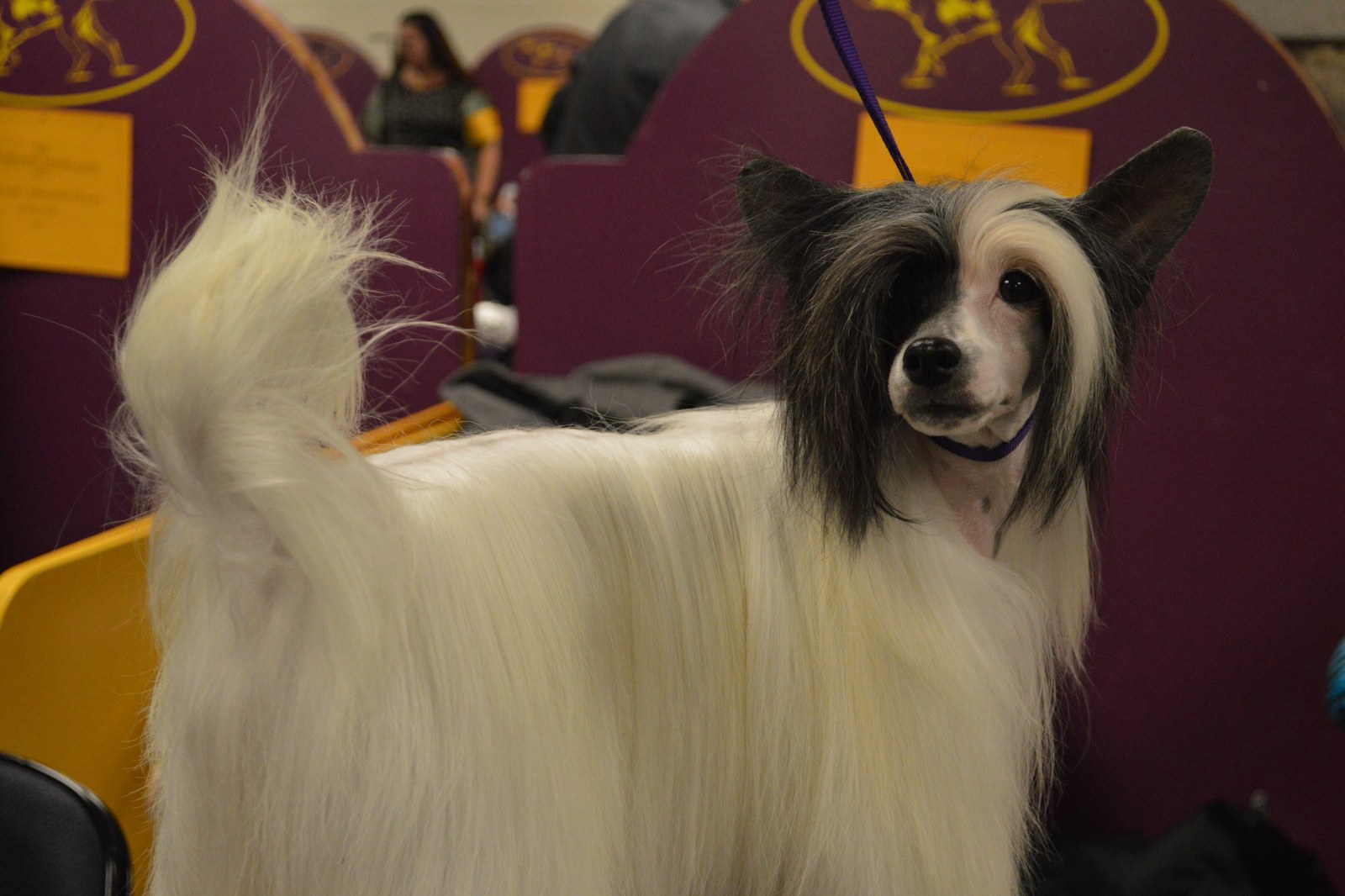

Do you have a better photo of a Chinese Crested in the American show ring? If you have a show photo you’d let us use, email it to [email protected] — tell us the dog’s name and the show, and it may be featured here. Please only send photos you took yourself or have the photographer’s permission to share, and tell us the photographer’s name.
1. Breed at a glance
Toy Group; recognized by the AKC in 1991
Height 11–13 in at the shoulder; weight 8–12 lb
Two varieties: Hairless (hair only on head, tail, feet) and Powderpuff (completely covered with a double soft, silky coat); any color or combination of colors
13–18 years
Affectionate, lively, alert, playful, devoted
The first thing to understand about the Chinese Crested is that it is one breed in two coats. The Hairless and the Powderpuff are born in the same litter, are shown together, and are judged by the same standard — the variety is a coat difference, not a different dog. The Hairless is the look most people picture: a mostly bare, fine-boned little dog with a crest of hair on its head, a plume on its tail, and socks on its feet. The Powderpuff wears the same dog under a full fall of soft, silky hair. Either way, the standard’s first words are the same — “gay and alert” — and the AKC’s summary is short: affectionate, lively, and sweet-tempered, a loving companion that is playful and entertaining. It is a toy dog by size and a companion by calling, and the whole breed is built around one thing: being close to its people. (Sources: AKC, Official Standard of the Chinese Crested; AKC, Chinese Crested.)
2. History
The Chinese Crested’s origins are obscure, and the name is misleading: the breed is believed to descend from African hairless dogs, not from China, and the “Chinese” in the name reflects the trading ships that carried these dogs around the world, where they were kept as ratters and curiosities. What is documented is the breed’s long presence in the show world. Three Cresteds were shown in 1878 at Gilmore Garden in New York, the predecessor to Madison Square Garden, and the breed appeared at the Westminster Kennel Club’s 9th Annual Bench Show, April 28–May 1, 1885, at Madison Square Garden — one entry by some accounts, two dogs by others. (Sources: Delaware Valley Chinese Crested Club, Breed Information; All Ireland Chinese Crested Association, A Brief History of the Chinese Crested.)
The breed in America owes its survival to two women. Ida Garrett, a New York journalist, became interested in the breed around 1880 and promoted it for more than sixty years. In the 1920s she befriended Debra Wood of Homestead, Florida, founder of the American Hairless Dog Club, a registry for hairless breeds that kept a log and studbook from the 1930s. When Wood died in 1969, her records passed to Jo Ann Orlik, and from Orlik to the American Chinese Crested Club. A generation later the breed found its most famous promoter in Gypsy Rose Lee, who got her first Crested from her sister June Havoc in the early 1950s — a dog called Fu Man Chu, from a Connecticut animal shelter — and showed the breed off wherever she went. (Sources: Delaware Valley Chinese Crested Club, Breed Information; All Ireland Chinese Crested Association, A Brief History of the Chinese Crested.)
The road to AKC recognition was long and interrupted. The breed entered the Miscellaneous Class in 1955, but was dropped in 1965 — there was no acceptable registry, no national specialty club, and no reliable standard, and only about 200 dogs were registered. It returned to the Miscellaneous Class in September 1985, became eligible for full AKC registration on February 1, 1991, and was fully recognized on April 1, 1991, in the Toy Group. The American Chinese Crested Club, founded in 1979, became the breed’s parent club in the United States when recognition came, and the FCI had recognized the breed in 1987. (Sources: Delaware Valley Chinese Crested Club, Breed Information; American Chinese Crested Club, Judges’ Education Presentation.)
3. The standard and why it is written that way
- General appearance — a toy dog, fine-boned, elegant and graceful. “A toy dog, fine-boned, elegant and graceful. The distinct varieties are born in the same litter. The Hairless with hair only on the head, tail and feet and the Powderpuff, completely covered with hair. The breed serves as a loving companion, playful and entertaining.” The standard opens with the varieties because they are the first thing anyone notices — and because the standard is one standard for both. The standard was approved June 12, 1990, and took effect April 1, 1991, the day the breed was fully recognized. (Source: AKC, Official Standard of the Chinese Crested.)
- Size, proportion & substance — small, rectangular, and fine-boned but not fragile-looking. Ideally 11 to 13 inches at the shoulder, though dogs slightly larger or smaller may be given full consideration. The body is rectangular — length from withers to base of tail slightly longer than height at withers — and the dog is fine-boned and slender, but not so refined as to appear breakable, and not a robust, heavy structure. The size range is a target with tolerance, not a hard cutoff, which is why the standard says slightly larger or smaller dogs may still be given full consideration. (Source: AKC, Official Standard of the Chinese Crested.)
- Head — alert and intense, wedge-shaped, with big erect ears. Expression alert and intense. Eyes almond-shaped and set wide apart; dark-colored dogs have dark eyes and lighter dogs may have lighter eyes, with eye rims matching the dog’s coloring. Ears uncropped, large and erect, placed so the base of the ear is level with the outside corner of the eye. The skull is arched gently over the occiput, the head wedge-shaped viewed from above and the side, the stop slight but distinct, and the bite scissors or level in both varieties. Missing teeth in the Powderpuff are to be faulted; the Hairless variety is not to be penalized for absence of full dentition — the standard writes the breed’s dentition the way it is, rather than pretending the Hairless has a full mouth. (Source: AKC, Official Standard of the Chinese Crested.)
- Neck, topline, body & tail — a high-carried neck and a plumed tail. Neck lean and clean, slightly arched and carried high. Topline level to a slightly sloping croup. The tail is slender, tapers to a curve, and is long enough to reach the hock; carried gaily in motion and down with a slight upward curve at rest. In the Hairless, two-thirds of the end of the tail is covered by long, flowing feathering — the plume; the Powderpuff’s tail is completely covered with hair. (Source: AKC, Official Standard of the Chinese Crested.)
- Forequarters & hindquarters — long, slender, straight legs and hare feet. Shoulders clean and narrow with 45-degree layback for good reach; elbows close to the body; legs long, slender and straight; pasterns upright, fine and strong. Feet are hare foot — narrow with elongated toes — in front and behind, and nails are trimmed to moderate length. Dewclaws may be removed. (Source: AKC, Official Standard of the Chinese Crested.)
- Coat — crest, plume, and socks on the Hairless; a double coat on the Powderpuff. The Hairless has hair on the head (the crest), the tail (the plume), and the feet from the toes to the front pasterns and rear hock joints (the socks); the texture of all hair is soft and silky, flowing to any length, and wherever the body is hairless the skin is soft and smooth. The Powderpuff is completely covered with a double soft and silky coat — long thin guard hairs over a short silky undercoat — straight, of moderate density and length. An excessively heavy, kinky, or curly coat is to be penalized. Grooming, the standard says, is minimal — presenting a clean and neat appearance. (Source: AKC, Official Standard of the Chinese Crested.)
- Color — any color or combination of colors. There is no disqualified color in the breed and no color worth a premium — a white Powderpuff, a black-and-white Hairless, a spotted dog, and a solid dog are all equally acceptable, and the standard says so in a single line. (Source: AKC, Official Standard of the Chinese Crested.)
- Gait & temperament — lively, agile, smooth, gay and alert. The gait is lively, agile, and smooth without being stilted or hackneyed, moving in a straight line at the trot. The temperament is two words: gay and alert. (Source: AKC, Official Standard of the Chinese Crested.)
4. Temperament & living with one
The AKC’s summary is short: affectionate, lively, and sweet-tempered. The parent club’s version is shorter still: gay and alert, with an enjoyment of human companionship. Both are describing the same dog — a small companion that forms intense bonds with its people, plays with enthusiasm, and wants to be wherever its people are. (Sources: AKC, Chinese Crested; American Chinese Crested Club.)
- With its own people: devoted and intensely bonded, often to one person above all. A Crested leans on its people, follows them from room to room, and expects to be part of whatever is happening — on a lap, in a chair, or at the foot of the bed. It is a velcro dog by design, and it is happiest included in as many of its people’s activities as possible.
- With strangers: reserved at first rather than openly friendly. The breed may be a little wary of strangers, but it is never snappy or bad-tempered, and it will bark to announce a visitor. Early and thorough socialization is what turns that wariness into confidence instead of shyness.
- Training: intelligent and sensitive, quick to learn tricks and to read its owner’s mood. A Crested responds to gentle, consistent training and to praise, and it notices tension and frustration in the household. It does not respond well to rough handling or to being babied — overindulgence is what turns a sensitive dog timid.
- Exercise: small but not sedentary. A Crested needs daily walks and play, and it is quick and agile for its size — it loves to climb, jump, and dig, and it will invent games to play by itself if no one volunteers. What it does not need is a yard: it is an indoor dog that goes out, not an outdoor dog that comes in, and it chills easily in cold weather.
- Separation anxiety: the breed’s one significant temperament concern. Cresteds do not like being left alone for long periods, and a dog allowed to develop an overly dependent attachment can become anxious and destructive when left. It does best in a home where someone is around most of the day.
- Children & other pets: good with gentle older children and generally good with other dogs and pets, and it is normally approachable with strangers once it knows them. The size that makes the breed portable also makes it breakable, and the Hairless variety’s bare skin has no coat to protect it — children must be taught to be gentle, and rough play is out.
- Barking: an alert barker rather than a noisy one. A Crested will announce visitors and unusual noises, but it is generally not overly vocal — and it is not particularly territorial or protective.
5. Grooming
Grooming a Chinese Crested depends entirely on which variety you have — and the two varieties ask for opposite things. The Powderpuff needs coat care; the Hairless needs skin care. Both need the same dental attention, and both are shown clean and neat rather than elaborately groomed — the standard says grooming is minimal. (Source: AKC, Official Standard of the Chinese Crested.)
- Hairless skin care: the bare skin is the grooming job. Bathe regularly, moisturize, and protect it: bare skin sunburns, so a Hairless needs dog-safe sunscreen and shade in strong sun, and it chills easily, so most owners keep sweaters and coats on hand for cold weather. The skin is prone to blackheads and acne, and it has no coat to protect it from scrapes — check it often and keep it clean.
- Powderpuff coat care: the double soft, silky coat needs regular brushing — several times a week — to keep it from matting, and a bath when it is dirty. The show coat is long and flowing; a pet Powderpuff is often kept in a shorter clip, which is a practical choice, not a fault.
- Crest, plume & socks: the Hairless variety’s crest, tail plume, and socks are real hair and need the same brushing and combing as a Powderpuff’s coat. Hair on the ears and face is permitted on the Hairless and may be trimmed for neatness in both varieties.
- Teeth: the Hairless variety is prone to missing, irregular, and thinly enameled teeth, and tooth loss is common — the standard does not penalize a Hairless for missing teeth, but the owner still has to care for the teeth that are there. Brush regularly and have the vet check the mouth at every visit; untreated dental disease shortens a small dog’s life.
- Nails, ears & eyes: trim the nails regularly — the hare foot’s elongated toes make overgrown nails obvious and uncomfortable — clean the ears, and wipe the corners of the eyes. The breed’s dark, almond-shaped eyes should be bright and clear.
- The “hairy hairless”: some Hairless Cresteds grow more body hair than others. They are still the Hairless variety, not a third variety, and the extra hair is groomed the same way — brushed, kept clean, and trimmed for neatness if the owner wishes.
6. Health testing
The parent club’s recommended health tests, as published by the AKC, are a patella evaluation, a cardiac exam, an ophthalmologist evaluation, a Primary Lens Luxation (PLL) DNA test, and a Progressive Retinal Atrophy rod-cone dysplasia 3 (PRA-rcd3) DNA test. The American Chinese Crested Club participates in the OFA Canine Health Information Center (CHIC) program, which records test results publicly so a buyer can check a puppy’s parents. A CHIC number confirms the testing was done and published — it is not a guarantee of health. (Sources: AKC, Toy Group Health Testing Requirements; OFA, CHIC Program: Chinese Crested.)
- Patella evaluation — the big one. Patellar luxation — slipping kneecaps — is the most common joint problem in the breed, as in most toy breeds, and the OFA evaluation grades it from normal to Grade IV. Dogs must be at least 12 months old for an official OFA patella evaluation. (Source: AKC, Toy Group Health Testing Requirements.)
- Ophthalmologist evaluation. The eye exam by a board-certified ACVO ophthalmologist (CAER) screens for hereditary eye disease, including cataracts and progressive retinal atrophy. Eye clearances are renewed annually, because some eye diseases develop later in life. (Source: AKC, Toy Group Health Testing Requirements.)
- Cardiac exam. The OFA cardiac evaluation screens for congenital heart disease. (Source: AKC, Toy Group Health Testing Requirements.)
- Primary Lens Luxation (PLL) DNA test. PLL is a heritable eye condition caused by a mutation in the ADAMTS17 gene, in which the ligaments supporting the lens deteriorate and the lens dislocates — a painful condition that can lead to glaucoma and blindness. It is autosomal recessive, so a DNA test tells a breeder whether a dog is clear, a carrier, or affected. (Sources: AKC, Toy Group Health Testing Requirements; Laboklin, Chinese Crested Genetic Tests.)
- Progressive Retinal Atrophy, rod-cone dysplasia 3 (PRA-rcd3) DNA test. PRA-rcd3 is an early-onset form of progressive retinal atrophy: affected puppies show night blindness by about six weeks of age, and most are completely blind by one to two years. The prcd form of PRA also occurs in the breed, so ask whether the breeder tests for that as well. (Sources: AKC, Toy Group Health Testing Requirements; Laboklin, Chinese Crested Genetic Tests.)
- Also ask about Legg-Calve-Perthes disease. Legg-Calve-Perthes is a hip-joint disease of young small dogs, in which the head of the femur loses blood supply, weakens, and collapses, causing limping and hip pain. It is an optional OFA evaluation for the breed, and worth asking about. (Source: Furry Critter, Chinese Crested Dog.)
- Dental health is a breed trait, not a test. The Hairless variety’s missing and irregular teeth and thinner enamel are part of the breed, and the standard accepts them — but they still need care. Daily brushing and regular veterinary dental checks matter more for a Crested than for most breeds, because tooth loss and dental disease are common and shorten lives.
7. The annual Chinese Crested specialty dog show
A specialty is the breed’s All-Star show — its Super Bowl. Once a year, the best Chinese Cresteds from across the country, and often from around the world, come together in one place.
The American Chinese Crested Club’s national specialty: one national event each year, with conformation, sweepstakes, and junior showmanship, usually a two-day weekend around the Fourth of July at the Roberts Centre in Wilmington, Ohio. The 2025 national: July 4–5, at the Roberts Centre, with 109 dogs and 122 entries in conformation. The 2026 national was held later in 2026 — Best of Breed was GCHG Crestline Raphael CA BCAT — but its date, venue, and judge were not confirmed in an official source as of November 7, 2026. The 2027 national: June 5–6, at the Roberts Centre.
The standard, in brief: a toy dog, fine-boned, elegant and graceful, in two varieties — the Hairless, with hair only on the head, tail, and feet, and the Powderpuff, completely covered with hair — born in the same litter and judged by the same standard. Ideally 11 to 13 inches at the shoulder; any color or combination of colors is acceptable.
The 2025 National Specialty — Friday, July 4–Saturday, July 5, 2025, at the Roberts Centre, 123 Gano Road, Wilmington, Ohio 45177, as part of National Specialty Week, Tuesday, July 1–Saturday, July 5, 2025. Entries opened Tuesday, April 1, 2025. The premium list says entries closed Friday, June 13, 2025, at noon ET; the AKC event page says entries closed Wednesday, June 18, 2025 — the two sources disagree, and neither date is stated here as settled. Event Chair: Lara Hill. Superintendent: Executive Dog Shows, LLC. The national drew 109 dogs and 122 entries (109 Ent — 60d — 49b). AKC event 2025452839. (Sources: AKC event search, event 2025452839; 2025 premium list.)
National specialty judges: Mr. Dana P Cline (7276) — conformation. Ms. Janice Chaffin-Bell — sweepstakes. Mr. Steve G Kelly — junior showmanship. Mr. Fred Buroff — obedience and rally. Best Junior Handler: Stella Keimon; Reserve Best Junior Handler: Caylee O’Keeffe. (Sources: AKC event search, event 2025452839; 2025 premium list.)
The next national after this one, the 2026 national, was held later in 2026; its date, venue, and judge were not confirmed in an official source as of November 7, 2026. What is verified about 2026 — Best of Breed was GCHG Crestline Raphael CA BCAT — is in the 2026 record in the history below.
Results (2025 national). Best of Breed and the other top winners were not published in an official source found as of November 7, 2026.
The 2027 National Specialty: a two-day event on Saturday, June 5–Sunday, June 6, 2027, at the Roberts Centre, Wilmington, Ohio. Superintendent: Executive Dog Shows, LLC. Judges, AKC event number, entries, and closing date not yet published as of November 2026. (Source: AKC Upcoming National Specialties.)
Past national specialties: 2026 · 2024 · 2023
American Chinese Crested Club — chinesecrestedclub.info
8. Regional specialties through the year: smaller regional shows
The national is the anchor, but the breed’s year also runs through regional specialties — smaller regional shows, not the national — held around the country, including the regional specialty that runs with the national. These are the 2026 regionals verified from club and AKC sources so far:
Two smaller Chinese Crested shows verified for 2026 so far — the national-week regional specialty was not confirmed in an official source as of November 7, 2026:
- Chinese Crested Club of Arizona specialty — Saturday, January 24, 2026, Surprise, Arizona: at Mark Coronado Park, 15850 N Bullard Ave (AKC event 2026757901). Judge: Mrs. P Nemirovsky de Alsina. Entry: 24 entries / 22 competitors (22 Ent — 7d — 15b).
- American Chinese Crested Club puppy specialty — Friday, December 11, 2026, Orlando, Florida: a puppy specialty with junior showmanship, held during AKC championship week at the Orange County Convention Center (AKC event 2026452824). A puppy specialty, not a regional specialty.
Past regional specialties: 2025 · 2024 · 2023
More regional specialties will be added here as their programs are verified — this section is built from show data, not guesswork. Browse upcoming show weekends →
9. Clubs
- American Chinese Crested Club (ACCC) (parent club) — founded in 1979 and the AKC-recognized national breed club for the Chinese Crested since full AKC recognition in 1991. It maintains the breed standard, holds the national specialty each year, runs a breeder referral network and the Chinese Crested Health Network, and publishes judges’ education material. Current president: Lara Hill of North Carolina, who has also chaired the national specialty since 2022; AKC delegate: Neil Butterklee. (Sources: American Chinese Crested Club; Delaware Valley Chinese Crested Club, Breed Information.)
- Delaware Valley Chinese Crested Club — an AKC-licensed specialty club for the greater Philadelphia area, licensed for specialty, obedience, and rally. (Sources: AKC Club Search, Delaware Valley Chinese Crested Club; Delaware Valley Chinese Crested Club.)
- Heart of America Chinese Crested Club of St. Louis — an AKC-listed specialty club for the St. Louis area. (Source: AKC Club Search, Conformation Clubs H.)
- Tar Heel Chinese Crested Club — an AKC-listed specialty club for North Carolina; it holds a specialty in national specialty week at the Roberts Centre in Wilmington, Ohio. (Sources: AKC Club Search, Conformation Clubs T; AKC event search, event 2023661803.)
- Chinese Crested Club of Arizona — an AKC specialty club that holds specialties in Surprise, Arizona, and in national specialty week at the Roberts Centre. (Sources: AKC event search, event 2026757901; AKC event search, event 2025757903.)
- Chinese Crested Club of Nashville — an AKC specialty club for Tennessee, listed among the superintendent’s specialty clubs. (Source: Onofrio Dog Shows, Specialty Clubs.)
10. Rescue
- Naked Kisses Dog Rescue (NaKiD Rescue). A nonprofit, breed-specific 501(c)(3) based in Florida and serving the southeastern United States, focused on rescuing Chinese Cresteds and other hairless dogs. Dogs live in foster care and receive medical and behavioral attention before placement, and adoption runs on an application with vet and personal references. (Source: Naked Kisses Dog Rescue, Adopt-a-Pet.)
- Tender Loving Crested Rescue (TLCR). An all-volunteer 501(c)(3) in the Houston, Texas area, dedicated to the rescue, rehabilitation, and re-homing of abused, abandoned, and neglected Chinese Cresteds, with transport help for adoptions in other states. (Source: Tender Loving Crested Rescue.)
- Naked K9 & Small Dog Rescue. A national 501(c)(3) based in Michigan, founded in 2009 by volunteers who came together through their admiration of the Chinese Crested breed; it now helps all hairless breeds and other small breeds in need. (Source: Naked K9 & Small Dog Rescue.)
- Bare Paws Chinese Crested Rescue. A New Hampshire rescue dedicated to the rescue, care, and re-homing of Chinese Cresteds and other hairless breeds, which states it has never turned a dog away because of medical conditions. (Source: Bare Paws Chinese Crested Rescue.)
- AKC Rescue Network. The AKC’s rescue network lists Chinese Crested rescue contacts, and the parent club is the first stop if you do not know which rescue covers your area.
- Cresteds turn up in rescue as adults. A rescued Crested is usually an adult, and it will arrive with its temperament visible before you commit — including whether it is the clingy, velcro kind or the more independent kind, and whether its skin and teeth need ongoing care. A rescue is the honest first stop if you want the breed without the puppy wait.
11. Breeder vs. rescue: honest guidance
- If you buy: start with the parent club, the American Chinese Crested Club — contact the club directly for a breeder referral — and ask for the parents’ health-test results — patella evaluation, cardiac exam, ophthalmologist evaluation, PLL DNA test, and PRA-rcd3 DNA test — and look the results up in the OFA database yourself. Expect to wait for a puppy from a careful breeder: a good breeder will have the answers, will ask you as many questions as you ask them, and will take the puppy back for its whole life if you cannot keep it.
- If you rescue: a rescued Crested is usually an adult, and it will arrive with its temperament visible before you commit. What you get in return is a dog whose character you can see before you commit and a lower price. Either way, be honest with yourself first: a Crested needs daily companionship, patient socialization and training from day one, and — for the Hairless — a lifetime of skin and dental care, not a novelty and a hope.
- Watch out for “teacup” or “mini” marketing. There is no teacup or miniature variety — the standard describes one Chinese Crested, ideally 11 to 13 inches. A seller’s “teacup” label is a sales description, not a variety and not a mark of quality or health; the tiniest dogs carry the most risk, not the most value. Judge the dog in front of you against the standard — the fine-boned elegance, the wedge-shaped head, the large erect ears — not against a listing’s adjectives.
- Watch out for “rare color” marketing. Any color or combination of colors is acceptable under the standard, so no color is rare and no color is worth a premium. A seller charging extra for a color is selling you a story, not a better dog.
- A “hairy hairless” is not a third variety. Some Hairless Cresteds grow more body hair than others; they are still the Hairless variety, not a separate kind of Crested, and they are shown as Hairless. Do not pay a premium for a made-up variety name.
- Hypoallergenic honesty: no dog is truly hypoallergenic. A Hairless Crested sheds very little hair, which helps some allergy sufferers, but it still produces dander and saliva proteins. Spend time with the breed — both varieties — before deciding it suits your allergies.
- Small-dog honesty: a Crested is not a toy and not a starter pet for small children. The size that makes the breed portable also makes it breakable, and the Hairless variety’s bare skin has no coat to protect it from scrapes, sun, or cold. It needs gentle handling, supervision around small children, and an owner who will keep up the skin care, the dental care, and the companionship for 13 to 18 years.
12. Claim this page
This page belongs to the breed, and the people who know the breed best are the American Chinese Crested Club and its members. If you are with the parent club — or you are a breeder, a judge, a handler, or a rescue volunteer who spotted something wrong, missing, or out of date — this page is yours to set straight. Tell us what needs fixing and where the correction is documented, and we will fix it and credit the source. Contact the site through the About page, and mention “Chinese Crested breed profile.”
Sources
- AKC, Official Standard of the Chinese Crested (approved June 12, 1990; effective April 1, 1991)
- AKC, Chinese Crested
- AKC, Toy Group Health Testing Requirements
- AKC, Upcoming National Specialties
- AKC event search, event 2025452839 (2025 national)
- AKC event search, event 2024452806 (2024 national)
- AKC event search, event 2025452836 (2025 regional)
- AKC event search, event 2024452823 (2024 regional)
- AKC event search, event 2025757903 (2025 Chinese Crested Club of Arizona)
- AKC event search, event 2026757901 (2026 Chinese Crested Club of Arizona)
- AKC event search, event 2023661803 (2023 Tar Heel)
- 2025 premium list (Nina Fetter / Executive Dog Shows)
- 2023 premium list (Nina Fetter / Executive Dog Shows)
- American Chinese Crested Club
- American Chinese Crested Club, National Specialty Results 2023
- American Chinese Crested Club, A Letter from the 2023 National Specialty Judge
- American Chinese Crested Club, A Letter from the 2025 Regional Specialty Judge
- American Chinese Crested Club, A Letter from the 2025 ACCC National Specialty Judge
- Delaware Valley Chinese Crested Club, Breed Information
- All Ireland Chinese Crested Association, A Brief History of the Chinese Crested
- American Chinese Crested Club, Judges’ Education Presentation
- Westminster Kennel Club, 2027 Westminster Invitees
- Wikimedia Commons, Chinese Crested — GCH Kulana’s Sh-Boom aka Holly 8 (hero photo, CC BY 2.0, Pets Adviser)
- Naked Kisses Dog Rescue
- Tender Loving Crested Rescue
- Naked K9 & Small Dog Rescue
- Bare Paws Chinese Crested Rescue