
Breed profile · Toy Group · the smallest AKC breed, from Mexico
Chihuahua
The Chihuahua is the smallest of the AKC-recognized breeds — a graceful, alert, swift-moving little dog with saucy expression, compact, with terrier-like qualities of temperament, in a package that must not exceed 6 pounds. It comes in two varieties of one breed: the Long Coat and the Smooth Coat, judged to the same standard except for coat. The AKC recognized the breed in 1904, and the Chihuahua Club of America, founded in 1923, is the parent club.
One breed, two varieties: the Long Coat and the Smooth Coat. The varieties differ in coat only — everything else in the standard is identical — and this page covers both.
Help us improve it. This is one of ThePetAdvisor’s breed profiles, built from public sources with generous links to the people who actually own this breed’s knowledge. If something’s off or missing, the parent club can claim the page and set it straight — see the bottom of the page.
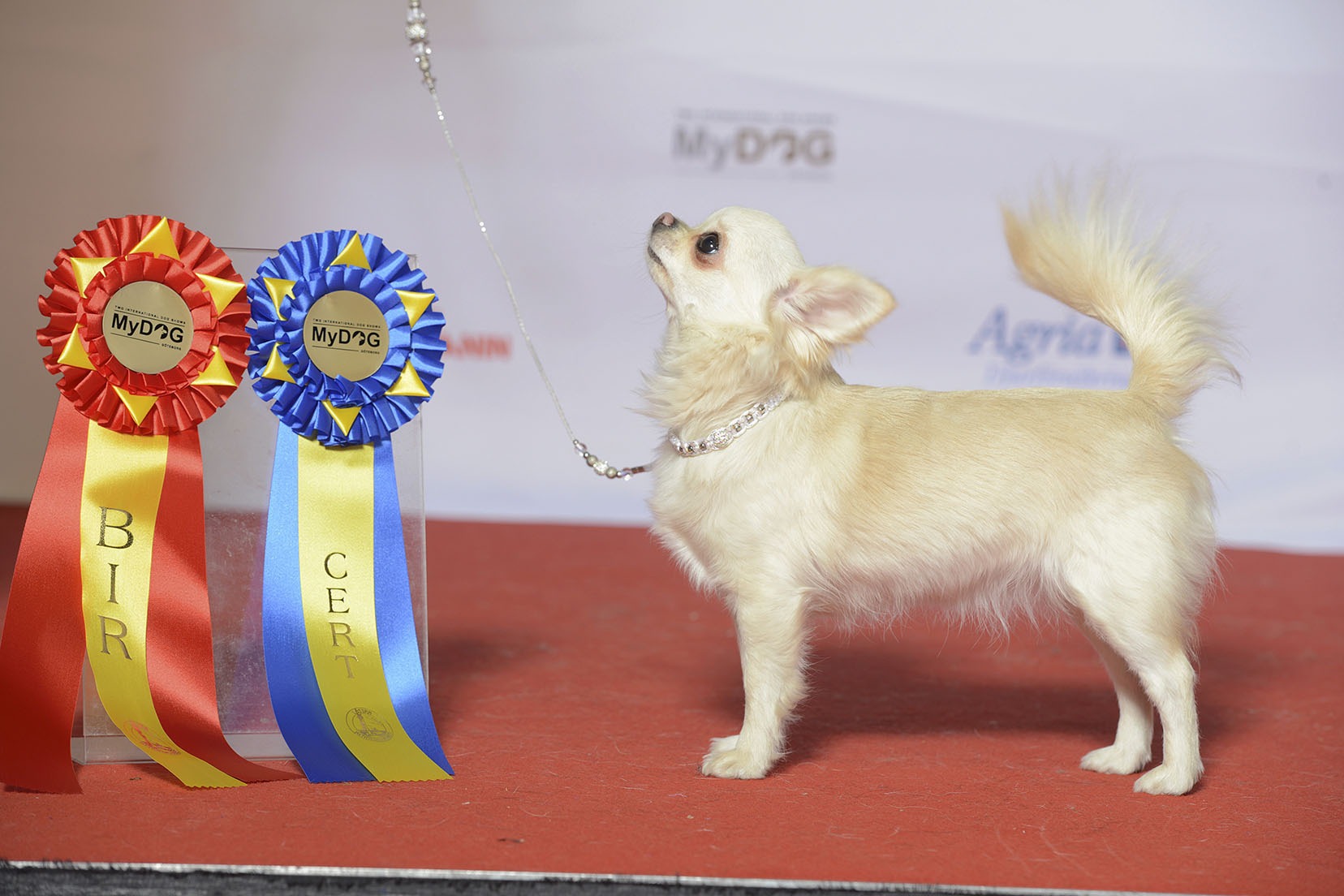

Do you have a better photo of a Chihuahua in the American show ring? If you have a show photo you’d let us use, email it to [email protected] — tell us the dog’s name and the show, and it may be featured here. Please only send photos you took yourself or have the photographer’s permission to share, and tell us the photographer’s name.
1. Breed at a glance
Toy Group; recognized by the AKC in 1904
Height 5–8 in at the shoulder; weight not to exceed 6 lb
Two varieties — Long Coat and Smooth Coat; any color, solid, marked, or splashed
14–16 years
Alert, charming, graceful, and sassy; confident and self-reliant, with terrier-like qualities
Chihuahua Club of America, founded 1923, AKC parent club since 1924
A Chihuahua is a tiny dog with a huge personality — the AKC calls the breed alert and amusing, a national symbol of Mexico and one of the oldest breeds of the Americas. It is also the smallest breed the AKC recognizes, which makes everything about it a study in proportion: the apple-dome head, the large erect ears, the full round eyes, and the attitude of a dog three times its size, all in a dog that must not exceed 6 pounds. It is one of the most popular breeds in the country, so most people meet their first Chihuahua on a lap, not at a dog show — but the show ring is where the breed’s type is defined, and the national specialty is where the best of them gather.
2. History
The Chihuahua’s ancestors are the small companion dogs of Mexico — the Techichi, kept by the Toltec people, a small dog with a fat body and large, Chihuahua-like ears, and later kept by the Aztec nobility. The dogs were believed to have been bred with the Xoloitzcuintli, the Mexican hairless dog, to produce the Chihuahua as it is known today. (Source: AKC, Chihuahua History.)
The modern breed takes its name from the Mexican state of Chihuahua, where American visitors in the mid-1800s found the tiny dogs being sold in markets and carried them north into Texas and Arizona. The first Chihuahua was exhibited in 1884 at the Philadelphia Kennel Club, and in 1904 the AKC recognized the breed, with the first registered Chihuahua, “Midget,” owned by H. Raynor of Texas. The first three AKC-registered Chihuahuas were Long Coats. (Sources: AKC, Chihuahua History; Chihuahua Club of America, Illustrated Standard.)
The Chihuahua Club of America was formed in February 1923, and the club’s first specialty was held on May 19, 1928, at the Queensboro Kennel Club show, with 42 entries. Within a few years the club settled its annual specialty in Chicago, and at the 1949 specialty there the entry was 109. Smooth Coats and Long Coats were divided into varieties in 1952, and the standard has been revised several times since — 1934, 1954, 1972, and 1990 — though the words describing the general appearance have stayed the same since 1923. In 1951, Ch. Attas’ Gretchen, a Smooth Coat female, was the first Chihuahua to win an all-breed Best in Show; the first Long Coat to do it followed in 1975. The first rotating specialty was held in 1977 in Atlanta, Georgia. (Sources: Chihuahua Club of America, About the CCA; Chihuahua Club of America, Illustrated Standard.)
3. The standard and why it is written that way
- General appearance — graceful, alert, and saucy. “A graceful, alert, swift-moving little dog with saucy expression, compact, and with terrier-like qualities of temperament.” Those words have described the breed since the original standard of 1923, through revisions in 1934, 1954, 1972, and 1990. The Chihuahua should project self-importance, confidence, and self-reliance — the smallest breed, but with substance, never fragile in appearance. (Source: Chihuahua Club of America, Illustrated Standard.)
- Size & weight — not over 6 pounds. A well balanced dog not to exceed 6 pounds. The disqualification is on weight, not size: a Chihuahua over 6 pounds must be disqualified, and within the limit no preference may be given to size, no matter how large or small. The body is slightly longer than tall, measured from point of shoulder to point of buttocks, with somewhat shorter bodies preferred in males. (Source: Chihuahua Club of America, Illustrated Standard.)
- Head — the apple dome. A well rounded “apple dome” skull, with or without molera — the open fontanel, once required in the original standard, is now of no consequence. The muzzle is moderately short and slightly pointed, with a well defined stop forming a near 90-degree angle where muzzle joins skull. The nose is self-colored in blond types, or black. (Source: Chihuahua Club of America, Illustrated Standard.)
- Eyes & ears — large, round, and erect. Eyes full but not protruding, balanced, set well apart — luminous dark or luminous ruby. Ears large and erect, held more upright when alert and flaring to the sides at a 45-degree angle when in repose. Blue eyes, or a difference in iris color between the two eyes, is a serious fault; broken down or cropped ears are a disqualification. (Source: Chihuahua Club of America, Illustrated Standard.)
- Coat — two varieties, one standard. The two varieties are based solely on coat — everything else is identical. The Smooth Coat is soft in texture, close and glossy, with a ruff on the neck preferred and a furry tail. The Long Coat is soft in texture, flat or slightly curly, with undercoat preferred, feathering on feet and legs, pants on the hind legs, a large ruff on the neck, fringed ears, and a plumed tail. In Long Coats, too thin a coat that resembles bareness is a disqualification. (Source: Chihuahua Club of America, Illustrated Standard.)
- Color — any color. Any color — solid, marked, or splashed. No color is preferred; all colors are acceptable, and there are no mismarks. (Source: Chihuahua Club of America, Illustrated Standard.)
- Temperament in the standard — alert, with terrier-like qualities. Chihuahuas should approach others, dogs and people, with confidence and interest, even impudence, with no evidence of shyness or fright. They may “spar” in the ring — nose to nose, in the alert, challenging posture typical of terriers — and the tail must never be tucked between the legs. (Source: Chihuahua Club of America, Illustrated Standard.)
- Disqualifications — the hard lines. Any dog over 6 pounds in weight. Broken down or cropped ears. Cropped tail, bobtail. In Long Coats, too thin a coat that resembles bareness. (Source: Chihuahua Club of America, Illustrated Standard.)
- Why it is written that way. Every clause in the standard points back to a small dog that had to be noticed: the apple dome and huge ears are the silhouette that says Chihuahua at a glance; the 6-pound ceiling keeps the breed the smallest of all, so the dog stays portable and the type stays unmistakable; the two coats are the breed’s one real fork in the road, and the standard guards it with a disqualification for a Long Coat that is not truly long-coated. And the temperament paragraph is the job description itself — a companion dog that behaves like a terrier, confident and impudent, never shy and never tucked away.
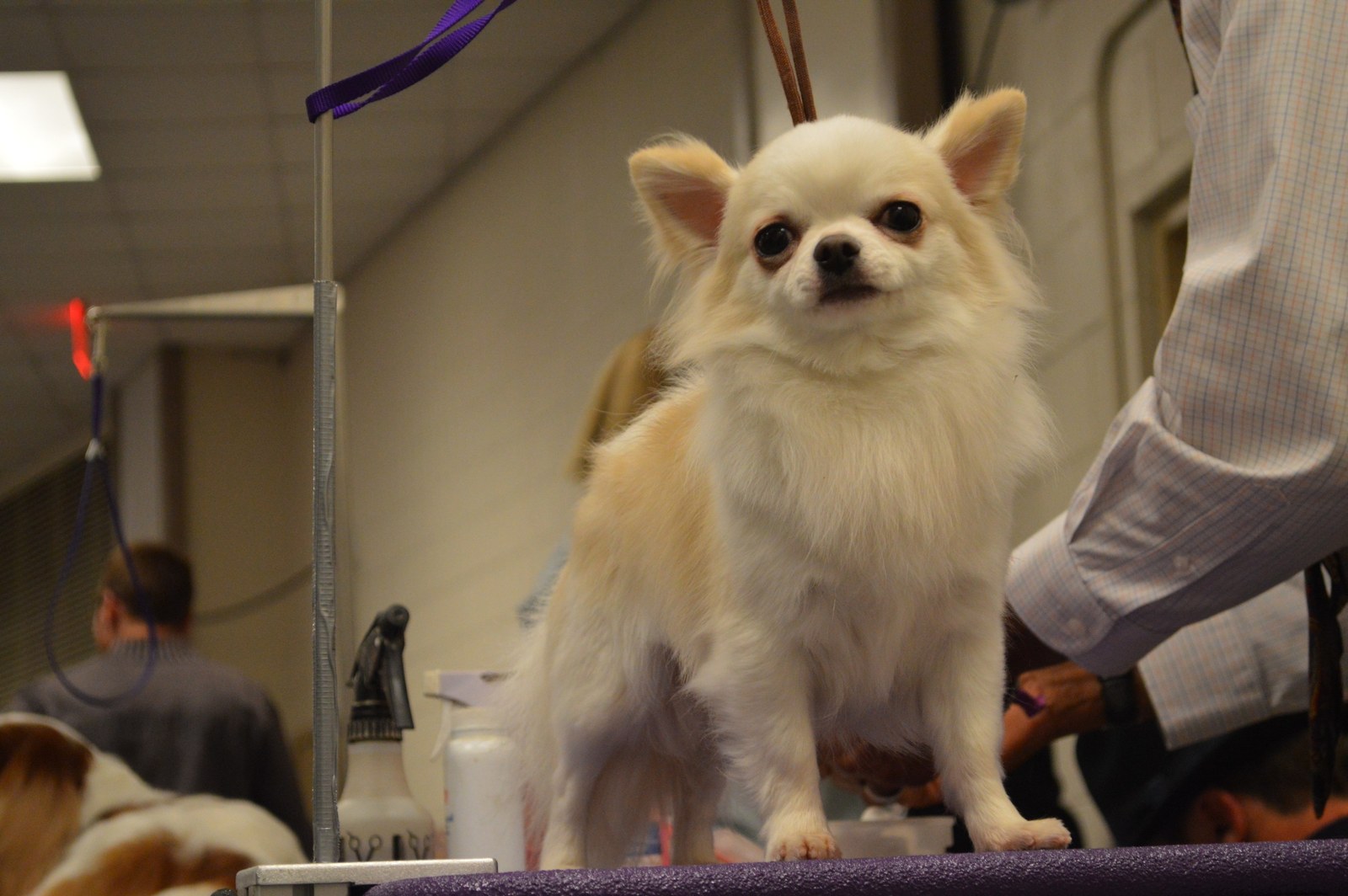

4. Temperament & living with one
The standard’s temperament paragraph is short and plain: alert, with terrier-like qualities. The Illustrated Standard spells out what that looks like in the ring — a dog that approaches others with confidence and interest, even impudence, with no evidence of shyness or fright — and the AKC’s own summary is shorter still: a tiny dog with a huge personality, alert and amusing. (Sources: Chihuahua Club of America, Illustrated Standard; AKC, Chihuahua.)
- With its own people: devoted and intensely bonded, often to one person above all. A Chihuahua leans on its people, follows them from room to room, and expects to be part of whatever is happening — on a lap, in a bag, or at the foot of the bed.
- With strangers: confident and watchful rather than shy. The breed is alert by design and quick to announce a visitor, and early socialization is what turns that wariness into the standard’s calm confidence instead of fear or snapping.
- Training: bright and quick to learn — and famously self-willed. The terrier in the standard means a dog with opinions, and it responds to fair, consistent training and to praise. House-training takes patience: a small dog’s accidents are easy to miss, and a self-willed dog notices when you do.
- Exercise: small but not sedentary. A Chihuahua needs daily walks and play, and it is quick and agile for its size — the standard’s “swift-moving” is literal. What it does not need is a yard: it is an indoor dog that goes out, not an outdoor dog that comes in.
- Fragility: the size that makes the breed portable also makes it breakable. A Chihuahua can be seriously hurt by a fall from a couch or a step from a careless foot, and it chills easily in cold weather. Small children and Chihuahuas need supervision, not just affection.
- First-dog honesty: this is a lot of personality for a first-time owner. The confidence, the barking, and the willfulness all demand an owner who trains from day one and keeps training. If that sounds like a burden rather than a pleasure, a softer breed is the honest choice.
5. Grooming
The Chihuahua’s coat is wash-and-wear for a toy dog, but the two varieties ask for different routines: the Smooth Coat is soft, close, and glossy, while the Long Coat carries feathering, a ruff, and a plumed tail that all need regular attention. Both varieties shed seasonally. (Source: Chihuahua Club of America, Illustrated Standard.)
- Smooth Coat: a weekly brush with a soft brush or hound glove is enough to pull out dead hair and keep the close coat glossy. The ruff on the neck should not be trimmed off.
- Long Coat: brush several times a week to keep the feathering on the ears, legs, and tail from tangling, and check behind the ears and under the legs, where mats start. Some trimming for neatness is acceptable, but it should not look radical.
- Bathing: as needed, not on a schedule — a Chihuahua that lives indoors and walks on clean ground will need a bath far less often than one that works outside. Dry the ears after baths.
- Nails, ears & teeth: trim nails every few weeks, check ears after baths, and brush teeth regularly. Small mouths crowd teeth, so dental care matters more in a Chihuahua than in most breeds.
6. Health testing
The parent club’s recommended health tests, as published by the AKC, are a patella evaluation, a cardiac exam, and an ophthalmologist evaluation. A CHIC number requires the breed-specific results to be released publicly, pass or fail. The lists:
- Patella evaluation — the big one. Patellar luxation — slipping kneecaps — is the most common joint problem in the breed, and the OFA evaluation grades it from normal to Grade IV. Dogs must be at least 12 months old for an official OFA patella evaluation. (Sources: AKC, Toy Group Health Testing Requirements; OFA, CHIC Program: Chihuahua.)
- Cardiac exam. The cardiac exam screens for congenital heart disease, which turns up across the toy breeds. Some breeders go further and have an echocardiogram done by a board-certified cardiologist, which shows the heart’s structure and valves rather than only what can be heard. (Sources: AKC, Toy Group Health Testing Requirements; OFA, CHIC Program: Chihuahua.)
- Ophthalmologist evaluation. The eye exam by a board-certified ACVO ophthalmologist screens for hereditary eye disease. Eye clearances are renewed annually, because some eye diseases develop later in life. (Sources: AKC, Toy Group Health Testing Requirements; OFA, CHIC Program: Chihuahua.)
- Other conditions to ask about: patella luxation is the one the standard itself names as a serious fault, and the breed’s small size brings its own risks — a dropped or stepped-on Chihuahua is an emergency, and the open fontanel (molera) that some puppies carry is, by the standard’s own account, of no consequence. (Source: Chihuahua Club of America, Illustrated Standard.)
Ask any breeder for the parents’ results for all three tests and look them up in the OFA database yourself before you commit. The breed’s 14-to-16-year lifespan is a long one for any dog, and the testing exists so that those years are healthy ones.
7. The annual Chihuahua specialty dog show
A specialty is the breed’s All-Star show — its Super Bowl. Once a year, the best Chihuahuas from across the country, and often from around the world, come together in one place.
The Chihuahua Club of America’s national specialty: one national event each year, with conformation, sweepstakes, junior showmanship, and the club’s Annual Top 20 Competition and Gala. The 2026 national: October 10–11, at the Crowne Plaza St. Louis Airport by IHG in Bridgeton, Missouri, with 204 competitors and 247 entries in conformation. The 2025 national: October 11–12, at the Renaissance Hotel & Convention Center in Tulsa, Oklahoma, with 219 competitors and 253 entries. The 2027 national: October 9–10, at the Embassy Suites Norman Hotel and Conference Center in Norman, Oklahoma.
The standard, in brief: a graceful, alert, swift-moving little dog with saucy expression, compact, with terrier-like qualities of temperament. Weight not to exceed 6 pounds — any dog over 6 pounds: disqualified. Two varieties, Long Coat and Smooth Coat, judged to the same standard except for coat. Apple-dome skull, large erect ears, full round eyes. Any color — solid, marked, or splashed.
The 2026 National Specialty — Saturday, October 10 – Sunday, October 11, 2026, at the Crowne Plaza St. Louis Airport by IHG, 11228 Lone Eagle Dr, Bridgeton, Missouri. Entry: 247 entries / 204 competitors in conformation (120 Long Coat, 84 Smooth Coat competitors). Entries closed September 23, 2026. Event Chair: Dr. Kathy D Wigal-Shafer, Gilbert, Arizona. Superintendent: Executive Dog Shows, LLC. National week: October 7–11, 2026, with the regional specialty October 8–9 and the club’s Annual Top 20 Competition and Gala. (Sources: AKC event search, event 2026008802; Chihuahua Club of America.)
National specialty judge: Mrs. C P Patterson — conformation (both varieties) and junior showmanship. Sweepstakes offered; the sweepstakes judge not confirmed in an official source as of November 2026. (Source: AKC event search, event 2026008802.)
Results (2026 national). Best of Breed: GCHP CH Omegas Nacho Average Dip Wesanns S (Smooth Coat, dog). Best of Opposite Sex: GCH CH Onelove If The Shoe Fitz (Long Coat, bitch). Long Coat: Best of Variety GCHB CH Master Yoda S Lipetskih Ozer; Winners Dog CH Tesoro Aspen Breeze; Winners Bitch and Best of Winners Fedra (Sanchez); Select Dog GCHG CH I Am Ninja Warrior Dareta; Select Bitch CH Cruella De Vil (Mercado, Negron, Macias). Smooth Coat: Best of Variety GCHP CH Omegas Nacho Average Dip Wesanns S; Winners Dog and Best of Winners CH Inspired Big Dreams; Winners Bitch Misty Meadow’s Dressed To Parti; Select Dog CH Legado De Lagos Quiero Mas; Select Bitch CH Legado De Lagos Rumba. Best Junior Handler: Faith McKee (Long Coat); Reserve Best Junior Handler: Jamie Hill (Smooth Coat). (Source: AKC event search, event 2026008802.)
The 2027 National Specialty: Saturday, October 9 – Sunday, October 10, 2027, two days, at the Embassy Suites Norman Hotel and Conference Center, 2501 Conference Dr, Norman, Oklahoma. Superintendent: Executive Dog Shows, LLC. AKC event number, judges, entries, closing date, and national-week details not yet published as of November 2026. (Sources: AKC Upcoming National Specialties; Embassy Suites by Hilton Norman Hotel & Conference Center.)
Past national specialties: 2025
Chihuahua Club of America — chihuahuaclubofamerica.org
8. Regional specialties through the year: smaller regional shows
The national is the anchor, but the breed’s year also runs through regional specialties — smaller regional shows, not the national — held around the country, including the regional specialty that runs with the national. These are the 2026 regionals verified from club and AKC sources so far:
Eight regional Chihuahua specialties verified for 2026 so far, including the regional specialty that runs with the national in Bridgeton, Missouri:
- Chihuahua Club of America regional specialty — Thursday, October 8 – Friday, October 9, 2026, Bridgeton, Missouri: at the Crowne Plaza St. Louis Airport by IHG, with the national week (AKC event 2026008801). Judge: Mr. J A Fehring. Entry: 227 entries / 201 competitors. Best of Breed: GCHB CH Knockout Look What You Made Me Do (Smooth Coat); Best of Opposite Sex: GCHS CH Urano Malkanorah (Smooth Coat). Event Chair: Dr. Kathy D Wigal-Shafer. Superintendent: Executive Dog Shows, LLC.
- Southern California Chihuahua Club specialty — Saturday, April 18, 2026, City of Industry, California: at the Industry Hills Exposition Center (AKC event 2026016901). Judge: Ms. J S Brewster. Entry: 35 entries / 31 competitors. Best of Breed: CH Lucky Star Amber Glow (Smooth Coat); Best of Opposite Sex: GCH CH Shar’s Bad Bad Leroy Brown (Smooth Coat). Superintendent: Jack Bradshaw Dog Shows.
- Chihuahua Club of Michigan specialty — Sunday, May 24, 2026, Kalamazoo, Michigan: at the Kalamazoo Co Fairgrounds (AKC event 2026088802). Judge: A Gau. Entry: 40 entries / 36 competitors. Best of Breed: GCHB CH Knockout Sugar Shot (Smooth Coat); Best of Opposite Sex: CH Jo-Li’s Call Me The Breeze-L (Long Coat). Superintendent: MB-F Inc.
- Houston Chihuahua Club specialty — Thursday, September 17, 2026, Belton, Texas: at the Huntington Bank Expo, afternoon event (AKC event 2026130602). Judge: Mrs. S Dillin. Entry: 36 entries / 29 competitors. Best of Breed: GCHG CH Bramver’s Stylish OHG (Long Coat); Best of Opposite Sex: GCHP CH Bramver’s Frank (Smooth Coat). Superintendent: Onofrio Dog Shows, L.L.C.
- Houston Chihuahua Club specialty — Saturday, September 19, 2026, Belton, Texas: at the Huntington Bank Expo (AKC event 2026130603). Judge: P Wilson. Entry: 45 entries / 38 competitors. Best of Breed: GCHG CH Bramver’s Stylish OHG (Long Coat); Best of Opposite Sex: GCH CH Dazzles Shar’s Superstar (Long Coat). Superintendent: Onofrio Dog Shows, L.L.C.
- Texas Chihuahua Club specialty — Sunday, September 20, 2026, Belton, Texas: at the Huntington Bank Expo (AKC event 2026178003). Judge: S Patton. Entry: 46 entries / 41 competitors. Best of Breed: GCHG CH Legado De Lagos Munequita (Smooth Coat); Best of Opposite Sex: GCHP CH Bramver’s Frank (Smooth Coat). Superintendent: Onofrio Dog Shows, L.L.C.
- Evergreen Chihuahua Club specialty — Saturday, September 26, 2026, Kennewick, Washington: at the Benton County Fairgrounds (AKC event 2026215505). Judge: Mr. H Tatro III. Entry: 28 entries / 24 competitors. Best of Breed: GCHS CH I Am Mr Brasil Dareta (Smooth Coat); Best of Opposite Sex: GCHB CH Elegant Exotic Pink OHG (Long Coat). Superintendent: BaRay Event Services, Inc.
- Nashville Chihuahua Club concurrent specialty — Friday, October 23, 2026, Murfreesboro, Tennessee: at the Tennessee Miller Coliseum, 304 W Thompson Ln, with the Greater Murfreesboro Kennel Club (AKC event 2026276901). Regular classes judge: Carolyn A Herbel; sweepstakes judge: Leeann Podruch. Entries closed October 7, 2026; entries limited to 100. Results not verified in an official source as of November 2026. (Sources: Greater Murfreesboro / Nashville Kennel Club premium list, Onofrio; Nashville Chihuahua Club.)
Past regional specialties: 2025
More regional specialties will be added here as their programs are verified — this section is built from show data, not guesswork. Browse upcoming show weekends →
9. Clubs
- Chihuahua Club of America (CCA) (parent club) — the AKC-recognized national breed club for the Chihuahua, and the only Chihuahua club the AKC recognizes. Founded in 1923 and recognized by the AKC as the official national breed club in 1924, it maintains the breed standard, holds the national specialty each year, publishes the quarterly Chi Chatter magazine, and publishes the 104-page Illustrated Standard. Its online breeder directory is listed as coming soon. (Sources: Chihuahua Club of America, About the CCA; Chihuahua Club of America, Membership.)
- CCA member clubs. Local and regional Chihuahua clubs across the country hold the regional specialties in section 8, including the Chihuahua Club of Michigan, the Houston Chihuahua Club, the Texas Chihuahua Club, the Southern California Chihuahua Club, the Evergreen Chihuahua Club, and the Nashville Chihuahua Club — and, among others, the Chihuahua Club of Atlanta, the Chihuahua Club of Maryland, the Chihuahua Club of Greater New York, the Chihuahua Club of Northern California, the Chihuahua Club of Oklahoma, the Chihuahua Club of Greater Phoenix, the Chihuahua Club of Greater Milwaukee, the Chihuahua Club of Mid-Jersey, the Chihuahua Club of Hawaii, and the Central Carolina Chihuahua Club. (Sources: AKC Club Search, C clubs; AKC event records in section 8.)
- AKC Marketplace and breeder referral. The AKC’s club directory lists each club’s breeder-referral and rescue contacts, and the CCA is the first stop for anyone looking for a puppy from a breeder who works under the club’s code. (Source: AKC Club Search, Texas Chihuahua Club.)
10. Rescue
- Chihuahua Rescue & Transport, Inc. (CRT). The national breed-only rescue for Chihuahuas — a foster-based 501(c)(3) nonprofit that has placed Chihuahuas and Chihuahua mixes in approved homes since 1996, through Midwest, Southeast, and Southwest regions. Dogs are fostered in volunteers’ homes, never warehoused in a shelter, and every dog is spayed or neutered, vaccinated, heartworm tested, and on heartworm prevention before adoption. CRT requires an application, vet check, reference check, and home visit for each adopter, and it is known for taking the injured, infirm, and elderly dogs as well. (Sources: Chihuahua Rescue & Transport; Chihuahua Rescue, Policies and Procedures.)
- AKC Rescue Network. The AKC’s rescue network lists Chihuahua rescue organizations under its C breeds page, and the parent club is the first stop if you do not know which contact covers your area. (Source: AKC Rescue Network, C Breeds.)
- Chihuahuas are common in rescue. The breed’s popularity cuts both ways: Chihuahuas are among the dogs most often surrendered to shelters, so a rescued Chihuahua is easy to find and usually an adult, and it will arrive with its temperament visible before you commit. A rescue is the honest first stop if you want the breed without the puppy wait.
11. Breeder vs. rescue: honest guidance
- If you buy: start with the parent club, the Chihuahua Club of America — its online breeder directory is listed as coming soon, so contact the club directly — and ask for the parents’ health-test results — patella, cardiac, and eye evaluations — and look the results up in the OFA database yourself. Expect to wait for a puppy from a careful breeder: a good breeder will have the answers, will ask you as many questions as you ask them, and will take the puppy back for its whole life if you cannot keep it.
- If you rescue: a rescued Chihuahua is usually an adult, and it will arrive with its temperament visible before you commit. What you get in return is a dog whose character you can see before you commit and a lower price. Either way, be honest with yourself first: a Chihuahua needs gentle handling because of its size, patient house-training, and an owner who socializes and trains from day one — not a purse and a hope.
- Watch out for “teacup” marketing. There is no teacup variety — the standard describes one Chihuahua, not over 6 pounds, and within that limit no preference is given to size. A seller’s “teacup” label is a sales description, not a variety and not a mark of quality or health; the tiniest dogs carry the most risk, not the most value. Judge the dog in front of you against the standard — the apple dome, the large erect ears, the saucy expression — not against a listing’s adjectives.
- Small-dog honesty: a Chihuahua is not a toy and not a starter pet for small children. The size that makes the breed portable also makes it fragile, and the terrier temperament that makes it charming also makes it willful. If that sounds like a burden rather than a pleasure, a sturdier breed is the honest choice.
12. Claim this page
This page belongs to the breed, and the people who know the breed best are the Chihuahua Club of America and its members. If you are with the parent club — or you are a breeder, a judge, a handler, or a rescue volunteer who spotted something wrong, missing, or out of date — this page is yours to set straight. Tell us what needs fixing and where the correction is documented, and we will fix it and credit the source. Contact the site through the About page, and mention “Chihuahua breed profile.”
Sources
- AKC, Chihuahua breed page — akc.org/dog-breeds/chihuahua
- AKC, Chihuahua History — akc.org
- AKC, Toy Group Health Testing Requirements — akc.org
- AKC Upcoming National Specialties — apps.akc.org
- AKC event search, event 2026008802 (2026 national) — apps.akc.org
- AKC event search, event 2026008801 (2026 regional) — apps.akc.org
- AKC event search, event 2025008802 (2025 national) — apps.akc.org
- AKC event search, event 2025008801 (2025 regional) — apps.akc.org
- AKC event search, event 2026016901 (Southern California, 2026) — apps.akc.org
- AKC event search, event 2026088802 (Michigan, 2026) — apps.akc.org
- AKC event search, event 2026130602 (Houston, Sep 17, 2026) — apps.akc.org
- AKC event search, event 2026130603 (Houston, Sep 19, 2026) — apps.akc.org
- AKC event search, event 2026178003 (Texas, 2026) — apps.akc.org
- AKC event search, event 2026215505 (Evergreen, 2026) — apps.akc.org
- AKC event search, event 2026276901 (Nashville, 2026) — apps.akc.org
- AKC Rescue Network, C Breeds — akc.org/akc-rescue-network-c-breeds
- AKC Club Search, C clubs — apps.akc.org
- Chihuahua Club of America — chihuahuaclubofamerica.org
- Chihuahua Club of America, About the CCA — chihuahuaclubofamerica.org
- Chihuahua Club of America, Membership — chihuahuaclubofamerica.org
- Chihuahua Club of America, Illustrated Standard (PDF) — chihuahuaclubofamerica.org (PDF)
- Chihuahua Club of America, 2026 Regional/National Merchandise & Donations — chihuahuaclubofamerica.org
- Embassy Suites by Hilton Norman Hotel & Conference Center — hilton.com
- Greater Murfreesboro / Nashville Kennel Club premium list, Onofrio (PDF) — onofrio.com (PDF)
- Nashville Chihuahua Club — nashville-chihuahua-club.weebly.com
- OFA, CHIC Program: Chihuahua — ofa.org
- Chihuahua Rescue & Transport — chihuahua-rescue.com
- Chihuahua Rescue, Policies and Procedures — chihuahua-rescue.org
- Pets Adviser, GCH Sonnus Filho (Sanchez) at Westminster 2015, Wikimedia Commons (CC BY 2.0) — commons.wikimedia.org
- Pets Adviser, Ch Dazzles Touch Of Midas at Westminster 2015, Wikimedia Commons (CC BY 2.0) — commons.wikimedia.org
