
Breed profile · Sporting Group · America's own retriever
Chesapeake Bay Retriever
The Chesapeake Bay Retriever — the peerless duck dog of the Mid-Atlantic, an American original famous for its waterproof coat — is the only retriever breed developed in the United States. The American Chesapeake Club runs the national specialty every year, and the 2026 national ran October 5–10 in Colorado Springs, Colorado.
Help us improve it. This is one of ThePetAdvisor’s breed profiles, built from public sources with generous links to the people who actually own this breed’s knowledge. If something’s off or missing, the parent club can claim the page and set it straight — see the bottom of the page.
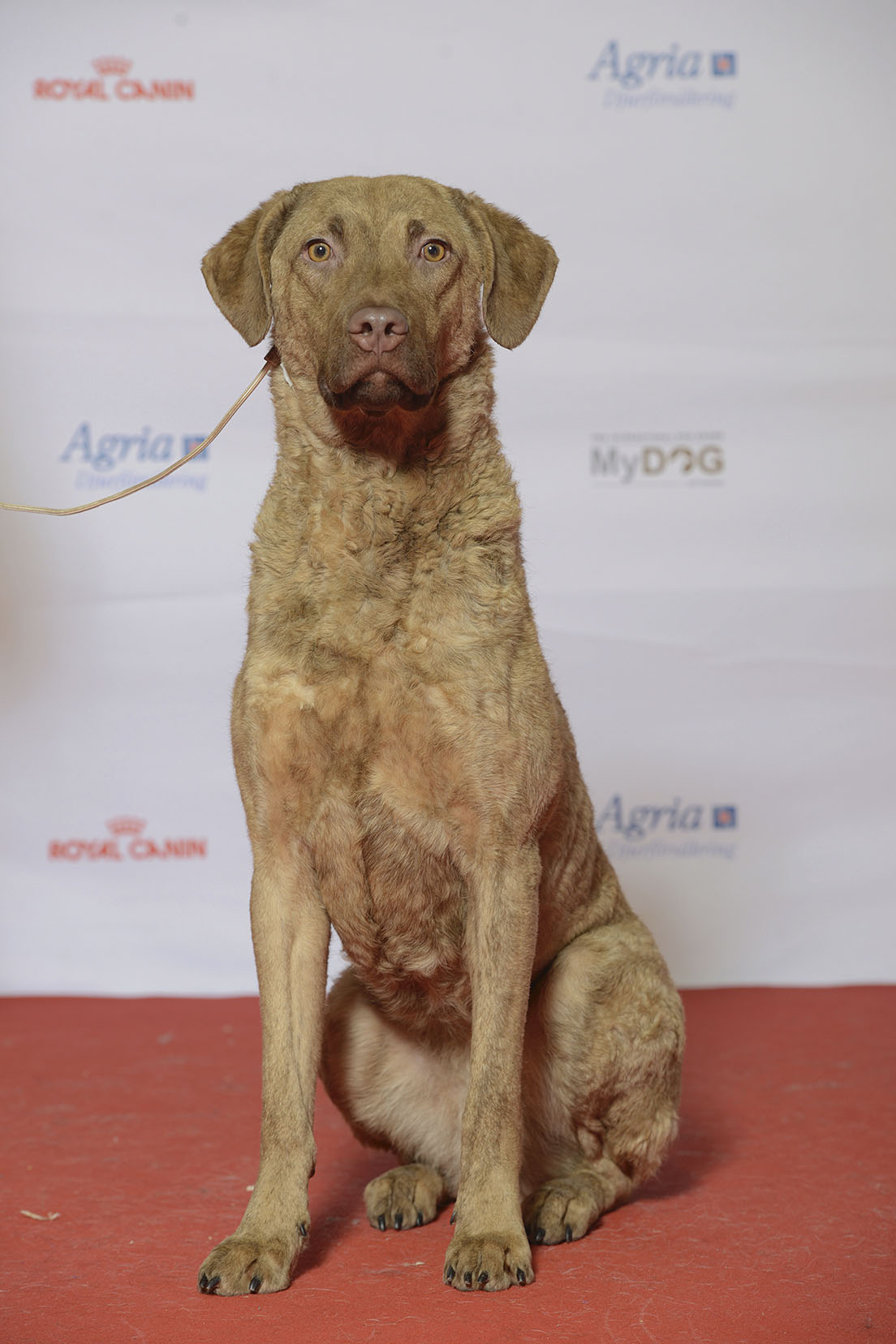

Do you have a better photo of a Chesapeake Bay Retriever in the American show ring? If you have a show photo you’d let us use, email it to [email protected] — tell us the dog’s name and the show, and it may be featured here. Please only send photos you took yourself or have the photographer’s permission to share, and tell us the photographer’s name.
1. Breed at a glance
Sporting Group; AKC-recognized since 1878
Dogs 23–26 in, bitches 21–24 in; 55–80 lb
Short, harsh, wavy double coat; brown, sedge, or deadgrass
10–13 years (AKC)
Bright and happy, intelligent, affectionate, protective
American Chesapeake Club
2. History: two shipwreck pups and a duck hunter's dream
The Chesapeake Bay Retriever traces its history to two pups rescued from a foundering ship off the coast of Maryland in 1807. The American ship Canton, on its way to Baltimore, took the crew off a sinking English brig — and found two Newfoundland pups aboard. George Law, who was on the Canton, bought the pups from the English captain for a guinea apiece, and gave the male, Sailor, to John Mercer of West River, and the female, Canton, to Dr. James Stewart of Sparrow’s Point. The two were never bred to each other; each was bred to local dogs, and over the next few decades their descendants became the Chesapeake Bay Retriever.
The breed was developed along the Chesapeake Bay by market hunters to retrieve waterfowl under the worst conditions — wind, tide, long cold swims, and ice to break through on many strenuous multiple retrieves. It is the only retriever breed developed in the United States, and the only retriever still able to earn a Dual Championship: a Field Champion and a bench Championship on the same dog. The AKC first registered a Chesapeake Bay Retriever in 1878, among the earliest breeds in the AKC stud book. The American Chesapeake Club has served as the breed’s parent club since 1918, and in 1964 Maryland named the Chesapeake its official state dog.
The breed’s biggest Westminster moment came in 2026. Cota, GCHP CH Next Generation’s Accelerate, a five-year-old male handled by Devon Kipp-Levy, won the Sporting Group and then Reserve Best in Show at the 150th Westminster Kennel Club Dog Show on February 3, 2026 — the first Chesapeake Bay Retriever ever to win Reserve Best in Show at Westminster. Cota had already won Best of Breed at the American Chesapeake Club National Specialty in both 2024 and 2025.
3. The standard: coat first, balance always
The AKC standard was approved on November 9, 1993, and effective December 31, 1993. It opens with the general appearance: “Equally proficient on land and in the water, the Chesapeake Bay Retriever was developed along the Chesapeake Bay to hunt waterfowl under the most adverse weather and water conditions, often having to break ice during the course of many strenuous multiple retrieves.”

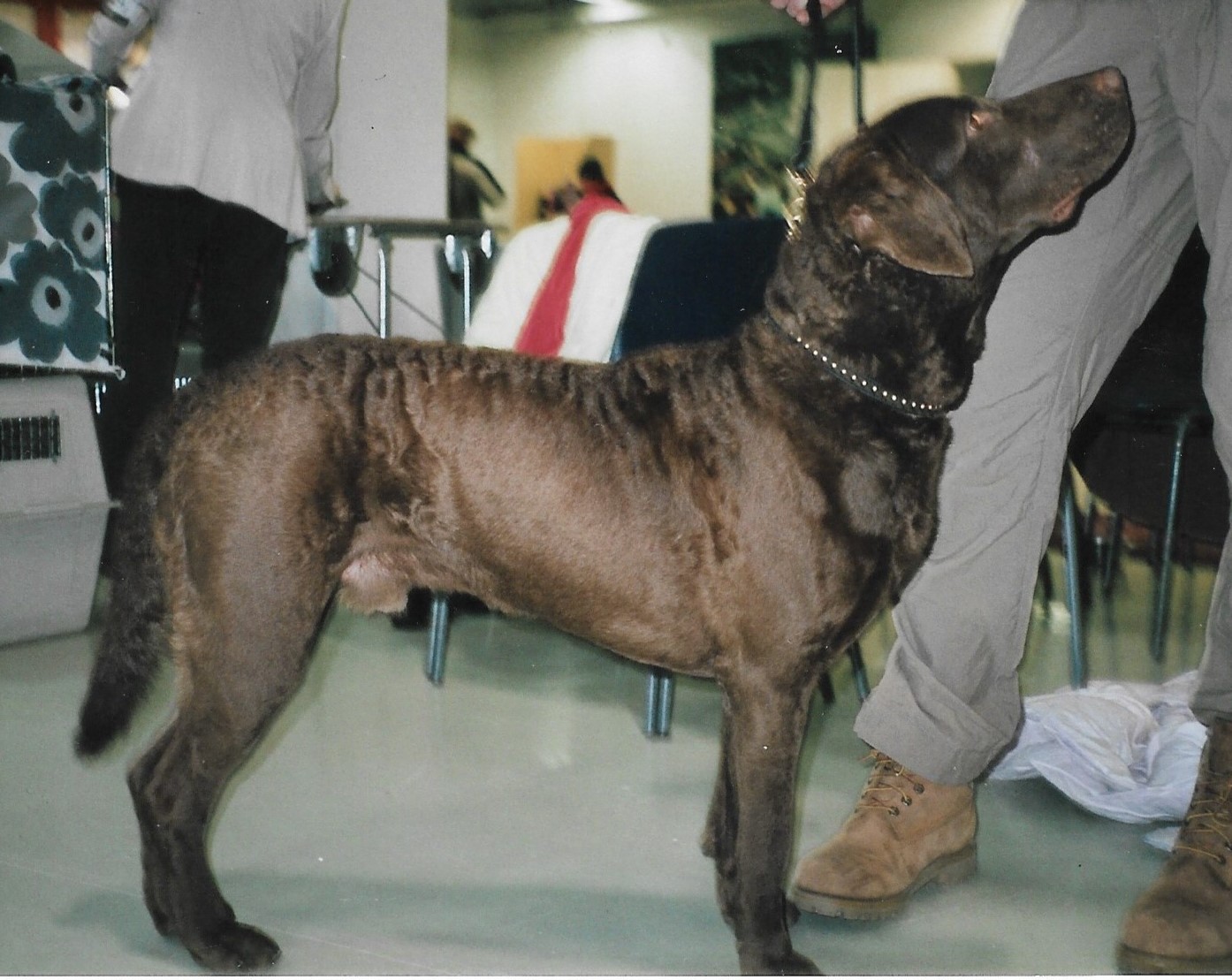
Size. Males 23 to 26 inches at the shoulder, females 21 to 24 inches; oversized or undersized animals are severely penalized. Males run 65 to 80 pounds, females 55 to 70 pounds. The body is strong, well balanced, and powerfully built, of moderate size and medium length in body and leg, deep and wide in chest, with the hindquarters as high as or a trifle higher than the shoulders. The back is short, well coupled, and powerful, and the flanks are well tucked up.
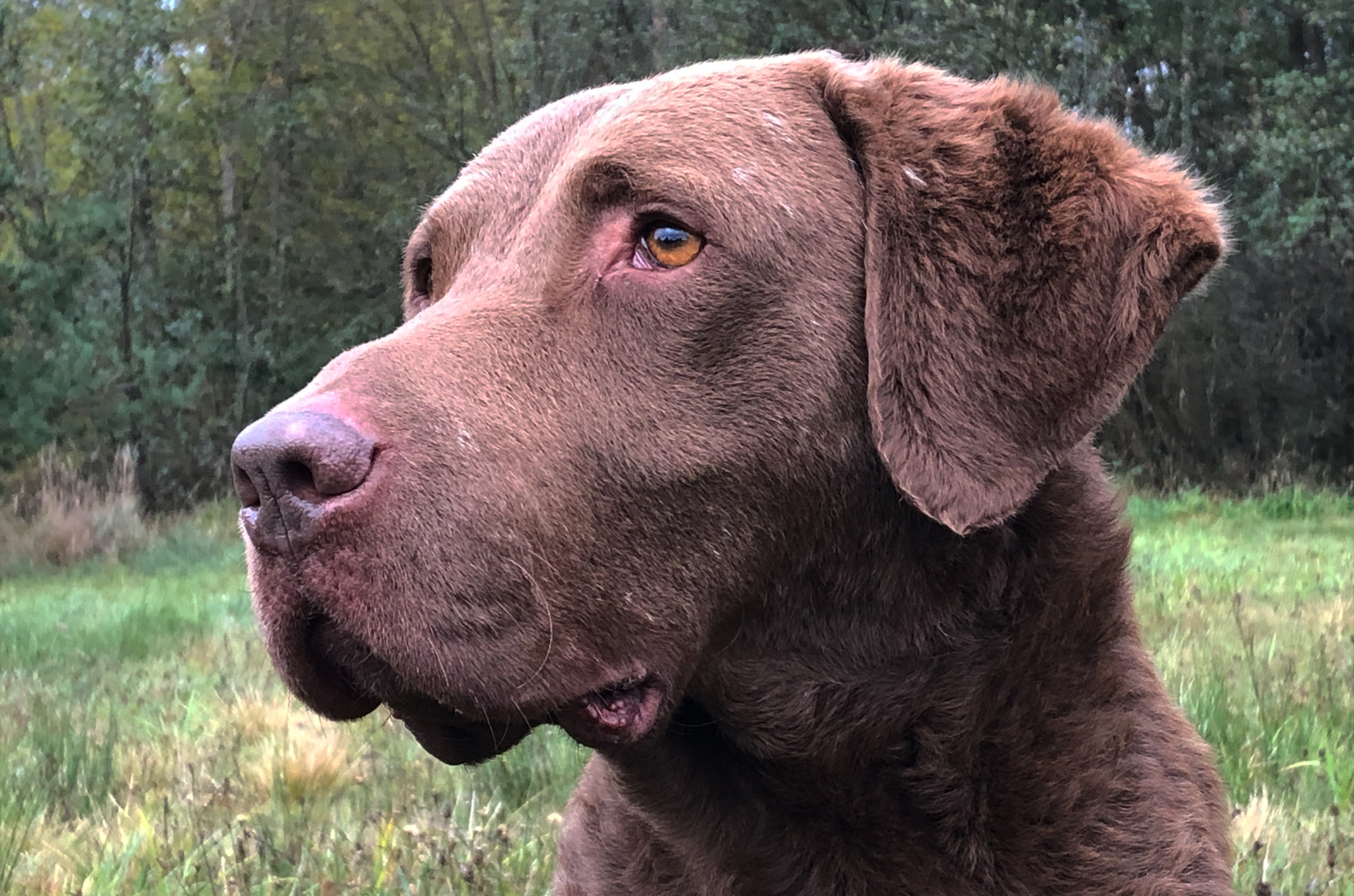
Head. The skull is broad and round with a medium stop, the muzzle approximately the same length as the skull, tapered, pointed but not sharp, with thin lips that are not pendulous. The eyes are medium large, very clear, of yellowish or amber color, and wide apart. The ears are small, set well up on the head, hanging loosely, and of medium leather. The nose is medium short. The bite is scissors preferred, but a level bite is acceptable.
Coat, color, and tail. The coat is the breed’s defining feature: thick and short, nowhere over 1½ inches long, with a dense fine wooly undercoat and a harsh, wavy outer coat full of natural oil — a coat that should resist water the way a duck’s feathers do, so that when the dog leaves the water and shakes, the coat is merely moist, not soaking wet. The wave belongs on the shoulders, neck, back, and loins only; the hair on the face and legs is very short and straight. The color must be as nearly that of the working surroundings as possible: any color of brown, sedge, or deadgrass, self-colored dogs preferred, one color not preferred over another. A white spot on the breast, belly, toes, or back of the feet is permissible, but the smaller the spot the better. The tail is of medium length and medium heavy at the base, straight or slightly curved, and should not curl over the back. The standard gives the coat more weight than any other single trait — 18 of 100 points — and says plainly that “the question of coat and general type of balance takes precedence over any scoring table which could be drawn up.”
Disqualifications. There are seven: specimens lacking in breed characteristics; teeth overshot or undershot; dewclaws on the hind legs; a coat curly or with a tendency to curl all over the body; feathering on the tail or legs over 1¾ inches long; black colored; and white on any part of the body except the breast, belly, toes, or back of the feet.
4. Temperament: bright, happy, and protective
The standard sums the temperament up in the general appearance: “The Chesapeake is valued for its bright and happy disposition, intelligence, quiet good sense, and affectionate protective nature. Extreme shyness or extreme aggressive tendencies are not desirable in the breed either as a gun dog or companion.” The temperament section adds the rest: “Courage, willingness to work, alertness, nose, intelligence, love of water, general quality and, most of all, disposition should be given primary consideration in the selection and breeding of the Chesapeake Bay Retriever.”

A Chesapeake bonds hard to its people and is intensely affectionate, sensitive, and perceptive — the parent club’s judges’ guide says the dogs know when they are liked and when they are not, and respond in kind. They are reserved and cautious with strangers, which is correct for the breed, and they need early socialization and steady training to keep that caution from hardening. They also “smile” — a grin the breed uses in a variety of situations that is a friendly gesture and should never be mistaken for a snarl.
The hunting instinct is still there. Chesapeakes point, retrieve, and track, and they will work all day in conditions that send other dogs home — which is exactly what they were bred for. That drive has a cost: a Chesapeake left alone for long hours gets anxious and destructive, and a bored Chesapeake will chew and dig with real enthusiasm. They are intelligent and quick to learn, and they respond to consistent, positive training; harsh corrections shut them down.
5. Grooming and everyday care
Grooming is straightforward but not optional: the oily double coat needs a weekly brush to keep the undercoat from matting, and an occasional bath. The oil in the coat is functional — it is what keeps cold water from reaching the skin — so baths should be infrequent enough not to strip it. Check the ears regularly: drop ears on a water dog trap moisture. Nails need trimming, and teeth need brushing.
Exercise is the hard part, and it is non-negotiable: a daily outlet for real work — swimming and retrieving are ideal, plus long walks and training. A Chesapeake that gets real exercise and mental work is a calm, pleasant house dog; one that gets a walk around the block is a demolition crew. This is not a breed for a sedentary household or for an owner who is away all day.
Feeding is straightforward: a good-quality food, measured meals, and a lean weight at 55 to 80 pounds. A Chesapeake in hard work burns more calories than a house dog, so feed to the dog’s condition, not to the bag’s chart.
6. Health: the tests that matter
The American Chesapeake Club’s CHIC profile calls for six tests for breeding stock: a hip evaluation, an elbow evaluation, an ophthalmologist eye examination, and three DNA tests — Degenerative Myelopathy (DM), Progressive Retinal Atrophy prcd (PRA-prcd), and Exercise-Induced Collapse (EIC). A CHIC number means the tests were done and published by the OFA — it does not mean the dog passed them. Ask for the parents’ CHIC numbers and look them up yourself on the OFA database.
The tests point at the breed’s known weak spots. Hip and elbow dysplasia are the most common orthopedic problems, and the hip and elbow evaluations watch for them. The DNA tests screen for three inherited conditions: degenerative myelopathy, a progressive disease of the spinal cord; progressive retinal atrophy, which causes blindness; and exercise-induced collapse, a loss of muscle control after strenuous exercise. The eye examination watches for cataracts and other eye disease. The AKC lists the breed’s lifespan as 10 to 13 years.
7. The annual Chesapeake Bay Retriever specialty dog show
A specialty is the breed’s All-Star show — its Super Bowl. Once a year, the best Chesapeake Bay Retrievers from across the country, and often from around the world, come together in one place.
The American Chesapeake Club’s national specialty: one national event each year, a full specialty week built around conformation, sweepstakes, and junior showmanship, with obedience, rally, agility, dock diving, Fetch, and field events alongside — and the working dog WD/X/Q event that opens the week. The 2026 national ran October 5–10 in Colorado Springs, Colorado, with the conformation specialty Friday–Saturday, October 9–10, and the banquet on Saturday evening. The 2027 national: not yet announced.
The standard, in brief: a strong, well-balanced, powerfully built dog of moderate size, males 23 to 26 inches at the shoulder and females 21 to 24, in any color of brown, sedge, or deadgrass, with the distinctive oily double coat that waves on the shoulders, neck, back, and loins. The coat and general type take precedence over any scoring table. The temperament is bright and happy, intelligent, with quiet good sense and an affectionate, protective nature.
The 2026 ACC National Show Specialty — national week Monday, October 5–Saturday, October 10, 2026, at Under The Sun, 6540 Vincent Dr, Colorado Springs, Colorado. Conformation ran Friday–Saturday, October 9–10: sweepstakes and bitches on Friday, dogs and intersex/Best of Breed on Saturday, with the banquet Saturday evening. The week opened with the working dog WD/X/Q event in Franktown on Monday, October 5, followed by AKC Fetch and dock diving Tuesday, agility and the Top 20 reception Wednesday, and obedience, rally, Canine Good Citizen, Trick Dog, and the Welcome Party Thursday. The national was chaired by Renee Wolfe. The show was originally announced for Elevate Ranch in Bennett, Colorado; the club moved it to Under The Sun in Colorado Springs.
The National Field Trial Specialty — a separate field event, not the conformation national — ran September 22–24, 2026, in Kevil, Kentucky, chaired by Linda and Mitch Patterson.
Results (2026 national). Best of Breed and the other top winners had not been published in an official source as of November 2026 and will be added here when they are.
The dates for the annual 2027 Chesapeake Bay Retriever specialty dog show had not been announced as of November 2026. The AKC’s Upcoming National Specialties list, which runs through October 2027, carries no American Chesapeake Club entry. This page will be updated when the club announces the 2027 national.
The national has moved around the country in recent years — Wilmington, Ohio in 2024, Ocala, Florida in 2025, Colorado Springs, Colorado in 2026 — so the 2027 location is the detail to watch for.
Past national specialties: 2025 · 2024
American Chesapeake Club — amchessieclub.org
8. Regional specialties through the year: smaller regional shows
The national is the anchor, but the breed’s year also runs through regional specialties — smaller regional shows, not the national — held around the country, including the regional specialties that run with the national. These are the 2026 regionals verified from club and AKC sources.
No 2026 regional Chesapeake Bay Retriever specialties were verified from club or AKC sources as of November 7, 2026. Regional specialties will be added here as their programs are verified.
More regional specialties will be added here as their programs are verified — this section is built from show data, not guesswork. Browse upcoming show weekends →
9. Clubs
The American Chesapeake Club (ACC) is the AKC parent club for the breed in the United States, serving as the breed’s parent club since 1918. It is the guardian of the breed and determines the official breed conformation standard, runs the national specialty every year, and promotes responsible breeding, education, research, and rescue. The club produced the Illustrated Guide to the Chesapeake Bay Retriever, the judges’ education document for the breed, and runs a breeder referral service. The club’s 2026 officers: President Tina Cox, Secretary Suellen Appellof, and Treasurer Brian Newman; AKC Delegate Heidi Henningson; Judges Education Coordinator Lynda Barber-Wiltse. The club’s website is at amchessieclub.org.
Regional clubs around the country run the regional specialties and the local life of the breed. The breed also has a field community of its own: the national specialty week still runs hunt tests, working dog events, and field trials alongside the conformation show, and the Chesapeake is the only retriever breed still able to earn a Dual Championship — a Field Champion and a bench Championship on the same dog.
10. Rescue
The nationwide rescue for the breed is Chesapeake Bay Retriever Relief & Rescue (CBRR&R), a 501(c)(3), all-volunteer organization at cbrrescue.org, with regional directors across the country. It rescues Chesapeakes, evaluates and treats them for medical conditions, and fosters and socializes them until they are adopted into thoroughly vetted homes.
Expect an application, references, and a home visit — and expect an adult dog: puppies are rare in rescue. A rescue Chesapeake comes with a known temperament, placed by a program that will match the dog to your life rather than the other way around.
11. Breeder vs. rescue: honest guidance
Either route starts with the same question: has this dog’s health been tested? From a breeder, ask for the CHIC numbers of both parents — the hip evaluation, the elbow evaluation, the eye examination, and the three DNA tests (Degenerative Myelopathy, PRA-prcd, Exercise-Induced Collapse) — and check them on the OFA database yourself, by the parents’ registered names. Ask what health issues the breeder sees in their stock, and meet at least the dam. And be honest with yourself about the exercise: a Chesapeake needs real work every day, and a breeder who asks how you will provide it is doing you a favor.
From rescue, expect an adult dog whose temperament is already known, placed by a program that will match the dog to your life rather than the other way around. Budget for the same things either way: training, exercise, and a vet who knows the breed’s health risks. Whichever route you take, the dog that fits is a bright, happy, intelligent working retriever that wants to work — and will be happiest doing exactly that, with you.
12. Claim this page
This page was built from public sources — the AKC standard, the parent club’s own material, AKC event records, and the rescue program’s site — and it is a starting point, not the last word. If you are with the American Chesapeake Club or a regional club and something here is wrong or missing, you can claim this page and set it straight: email [email protected] and tell us what needs fixing. Corrections from the people who own the breed are how this page gets better.
Sources
- AKC, Chesapeake Bay Retriever
- AKC, Official Standard of the Chesapeake Bay Retriever (approved November 9, 1993, effective December 31, 1993)
- American Chesapeake Club, An Illustrated Guide to the Chesapeake Bay Retriever (2012)
- American Chesapeake Club
- American Chesapeake Club, 2026 National Show Specialty
- AKC, Upcoming National Specialties list
- AKC, Sporting Group Health Testing Requirements
- Purina Pro Club, 2026 Westminster Kennel Club Best in Show Winner (Cota)
- AKC, Doberman Pinscher 'Penny' Wins Westminster Best in Show (Cota, Reserve Best in Show)
- Chesapeake Bay Retriever Relief & Rescue
- American Chesapeake Club, 2024 National Specialty premium
- Wikimedia Commons, Grupp 8 — Chesapeake Bay Retriever, Ceslabben Cherry Blossom (Svenska Mässan, CC BY 2.0)
- Wikimedia Commons, CBR — head (Strojmir, CC BY-SA 4.0)
- Wikimedia Commons, DocFile Chessie (Canarian, CC BY-SA 4.0)