
Breed profile · Toy Group · the gentle toy spaniel of kings
Cavalier King Charles Spaniel
The Cavalier King Charles Spaniel is the toy spaniel of the royal courts — a small, silky, gentle companion with a sporting spaniel’s verve and a melting expression. Its year turns on the annual Cavalier King Charles Spaniel specialty dog show: the 2026 national was held April 14–16, 2026, in Kingsport, Tennessee, and the 2027 national is set for April 27–29, 2027, in Virginia Beach, Virginia.
Help us improve it. This is one of ThePetAdvisor’s breed profiles, built from public sources with generous links to the people who actually own this breed’s knowledge. If something’s off or missing, the parent club can claim the page and set it straight — see the bottom of the page.
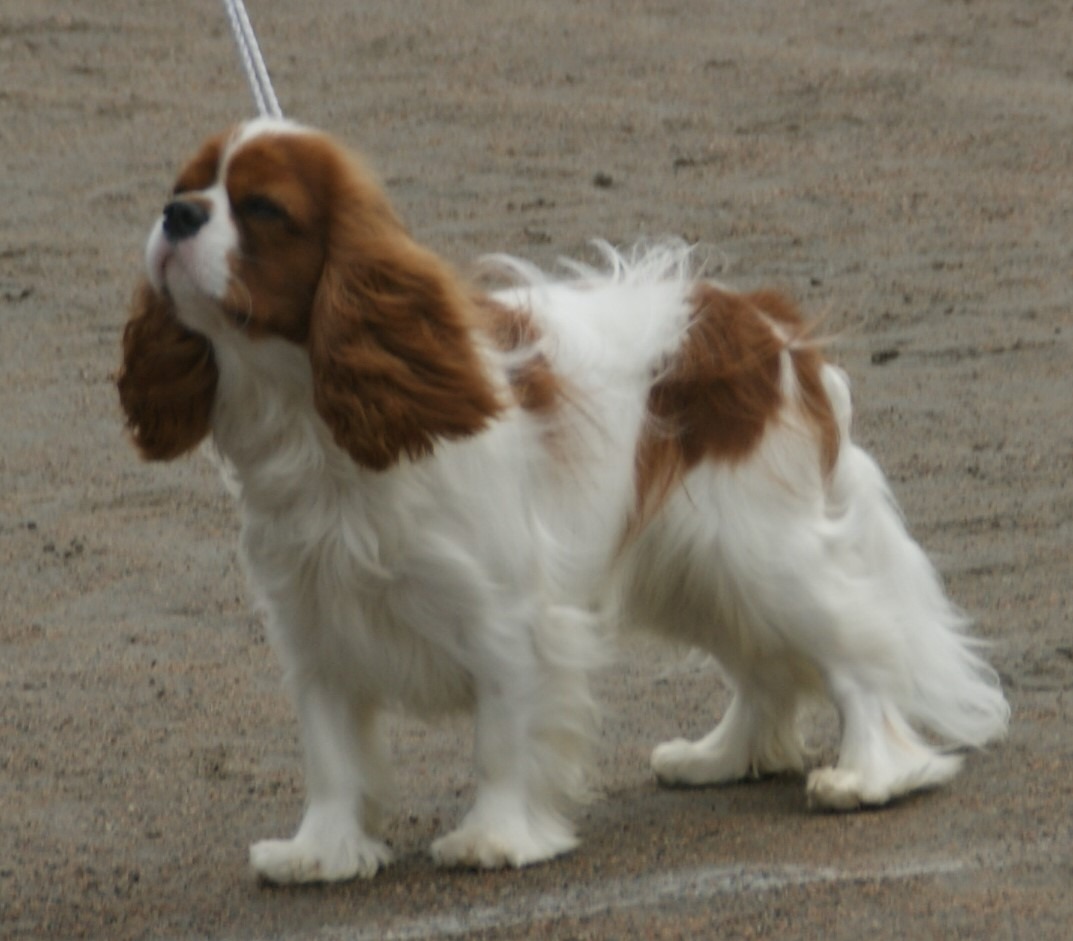

Do you have a better photo of a Cavalier King Charles Spaniel in the American show ring? If you have a show photo you’d let us use, email it to [email protected] — tell us the dog’s name and the show, and it may be featured here. Please only send photos you took yourself or have the photographer’s permission to share, and tell us the photographer’s name.
1. Breed at a glance
Group: Toy. AKC recognition: 1995 (the AKC’s 140th breed; competition in the Toy Group from January 1, 1996). Life expectancy: 12–15 years.
- Size: 12–13 inches at the withers; 13–18 pounds, weight proportionate to height; a small, well-balanced dog, slightly longer than tall.
- Coat: of moderate length, silky, free from curl; slight wave permissible; long feathering on the ears, chest, legs, and tail; feathering on the feet is a feature of the breed.
- Colors: four only — Blenheim, Tricolor, Ruby, and Black and Tan. Any other color or pattern is a disqualification.
- Hallmark: the sweet, gentle, melting expression — large, round, very dark brown eyes, set well apart, with long, heavily feathered ears framing the face.
- Temperament: gay, friendly, non-aggressive, with no tendency towards nervousness or shyness — the standard’s words, and the breed’s reputation.
- Best for: a home that wants a companion first — a lap dog with a sporting spaniel’s verve, happy in a house or an apartment, happiest with its people.
- Watch for: mitral valve disease and syringomyelia — ask any breeder for the parents’ CHIC numbers (see section 6) — and the feathered coat’s mats behind the ears.
2. History
The Cavalier is the toy spaniel of the royal courts — the small spaniels in the paintings of Charles I and Charles II, curled at the feet of kings. When the breed drifted toward a shorter face and a domed skull in the 19th century, American financier Roswell Eldridge offered a 25-pound prize in the 1920s for the dog that most resembled the old-type spaniel of Charles II’s day, and the breeders who answered him began rebuilding the longer-muzzled, flatter-skulled dog. The Cavalier King Charles Spaniel Club was founded in Britain in 1928; the Kennel Club recognized the breed as a variety of the King Charles Spaniel in 1928 and as a distinct breed in 1945.
The first Cavaliers came to America in 1952. The Cavalier King Charles Spaniel Club, USA (CKCSC-USA) was founded in 1954 by Sally Brown of Louisville, Kentucky, with Elizabeth Spalding; the breed entered the AKC’s Miscellaneous Class in 1962, and the United Kennel Club recognized it in 1992. When the AKC invited the breed into full recognition, CKCSC-USA’s members voted nine-to-one against joining — and a small group formed the American Cavalier King Charles Spaniel Club (ACKCSC) in 1993, which became the AKC parent club in December 1994. The AKC recognized the breed in March 1995, its 140th breed, with competition in the Toy Group from January 1, 1996.
Today the Cavalier is one of the most popular toy breeds in America — a companion first, and a show dog second. The parent club’s national specialty draws about 200 Cavaliers each spring, and the breed’s four colors share the ring.
3. The standard and why it's written that way
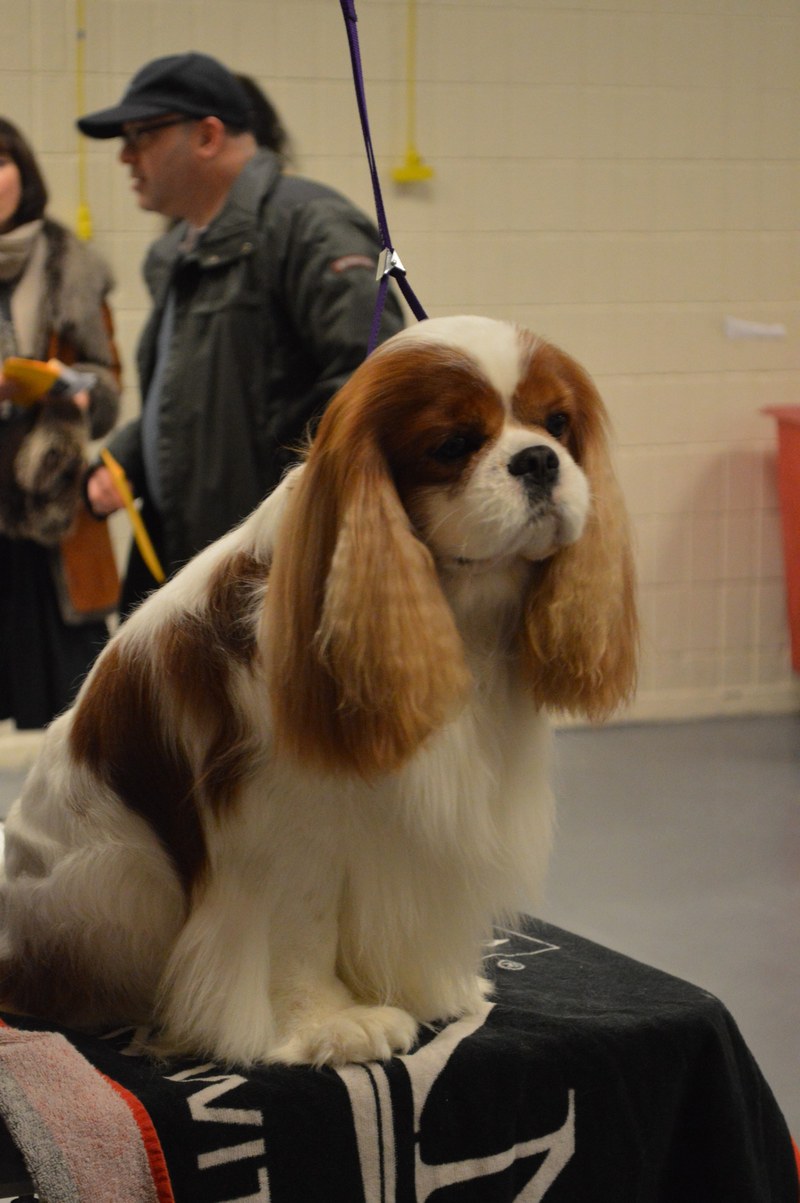
The standard describes “an active, graceful, well-balanced toy spaniel, very gay and free in action; fearless and sporting in character, yet at the same time gentle and affectionate.” Natural appearance with no trimming, sculpting, or artificial alteration is essential to breed type. The current standard was approved January 10, 2023, and took effect March 29, 2023. What it asks for, and why:
- Size and substance. Height 12 to 13 inches at the withers; weight proportionate to height, between 13 and 18 pounds. A small, well-balanced dog within these weights is desirable, but slight variations are permissible. The body approaches squareness, yet is slightly longer than the height at the withers; bone moderate in proportion to size; weedy and coarse specimens are to be equally penalized.
- Head and expression. The sweet, gentle, melting expression is an important breed characteristic. Eyes large, round, but not prominent, set well apart, a warm, very dark brown, giving a lustrous, limpid look, with dark rims and cushioning under the eyes. Ears set high, but not close, on top of the head, leather long with plenty of feathering, wide enough that when the dog is alert the ears fan slightly forward to frame the face. Skull slightly rounded, without dome or peak. Muzzle full, slightly tapered, about 1½ inches from base of stop to tip of nose. Nose pigment uniformly black. A perfect, regular, and complete scissors bite is preferred.
- Neck, topline, body. Neck fairly long, without throatiness, slightly arched at the crest. Topline level both when moving and standing. Body short-coupled, ribs well sprung but not barrelled, chest moderately deep. Tail well set on, carried happily but never much above the level of the back, and in constant characteristic motion when the dog is in action. Docking is optional; if docked, no more than one third is to be removed.
- The coat. Of moderate length, silky, free from curl; slight wave permissible. Feathering on ears, chest, legs, and tail should be long, and the feathering on the feet is a feature of the breed. No trimming of the dog is permitted — specimens whose coats have been altered by trimming, clipping, or artificial means are penalized so severely as to be effectively eliminated from competition. Only the hair growing between the pads on the underside of the feet may be trimmed.
- Color — four, and only four. Blenheim: rich chestnut markings well broken up on a clear, pearly white ground; the ears chestnut, the color evenly spaced on the head and surrounding both eyes, with a white blaze between the eyes and ears, in the center of which may be the lozenge or “Blenheim spot” — unique and desirable, though not essential. Tricolor: jet black markings well broken up on a clear, pearly white ground; the ears black, with a white blaze between the eyes and rich tan markings over the eyes, on the cheeks, inside the ears, and on the underside of the tail. Ruby: whole-colored rich red. Black and Tan: jet black with rich, bright tan markings over the eyes, on the cheeks, inside the ears, on the chest, legs, and on the underside of the tail. Faults: heavy ticking on Blenheims or Tricolors; white marks on Rubies or Black and Tans. Dogs not of an allowed color are disqualified.
- Gait. Free moving and elegant in action, with good reach in front and sound, driving rear action — a sporting spaniel’s movement in a toy body.
- Temperament in the standard. Gay, friendly, non-aggressive, with no tendency towards nervousness or shyness. Bad temper, shyness, and meanness are not to be tolerated and are to be severely penalized as to effectively remove the specimen from competition.
4. Temperament & living with one
The AKC sums the breed up in a sentence: “Cavaliers are the best of two worlds, combining the gentle attentiveness of a toy breed with the verve and athleticism of a sporting spaniel.” That is the dog to expect — a lap dog that still wants a walk, a game, and something to chase, and a sporting dog that is happiest curled against its person afterward.
With family, Cavaliers are gentle, affectionate, and adaptable — good with children and usually good with other dogs, and comfortable in a house or an apartment as long as they are with their people. They are not a breed that thrives left alone all day; a Cavalier’s job is company, and it takes that job seriously.
Exercise. Moderate: daily walks and play suit a Cavalier. The sporting-spaniel side wants activity and can do well at agility, rally, and scent work — the national specialty week holds all three — but the breed is not a jogging partner and does not need to be run hard. A tired Cavalier is a calm Cavalier; a bored one finds its own entertainment.
Training. Willing and food-motivated, and quick to learn — but also quick to learn that a cute face gets it out of trouble. Short, positive sessions and consistent rules work best; harsh corrections are unnecessary and counterproductive with a dog this sensitive.
The ears and the coat in daily life. The long, feathered ears are the breed’s glory and its weak point: check them regularly, keep them clean and dry, and keep the feathering behind them free of mats. The silky coat needs a few brush-outs a week, not a daily battle — but it does need them.
5. Grooming
The Cavalier coat is moderate in length and silky, and the grooming is moderate too — regular, not onerous. Brush the coat and feathering a few times a week with a pin brush or a soft slicker, paying attention behind the ears, under the collar, and in the feathering on the legs, where mats start. A metal comb through the feathering after brushing catches the tangles the brush misses.
- No trimming. The standard permits no trimming of the dog — the coat is shown natural. Only the hair growing between the pads on the underside of the feet may be trimmed.
- Baths as needed. The silky coat stays clean with a bath every few weeks and a brush-out between; the white of a Blenheim or Tricolor shows dirt, and the feathering picks up leaves and mud on walks.
- Ears. Check the long ears weekly — the heavy leather and feathering trap moisture — and clean as needed. Matted ear feathering is the most common grooming problem in the breed.
- Nails and teeth. Trim the nails regularly, including the dewclaws; brush the teeth regularly.
- Show grooming. Bath, blow-dry, and brush-out, with no sculpting — the dog is presented as it is. Keep the white clean and the feathering free-flowing; the coat does the rest.
6. Health testing
The American Cavalier King Charles Spaniel Club’s CHIC (Canine Health Information Center) requirements set four mandatory tests for the breed. A CHIC number means the tests were done and the results are public on the OFA website — ask any breeder for the parents’ CHIC numbers and verify them yourself.
Four mandatory tests:
- Cardiac evaluation — by a board-certified cardiologist (OFA). Yearly exams are recommended.
- Eye exam — by a board-certified ophthalmologist (OFA/CAER).
- Patellar luxation exam — OFA.
- Hip dysplasia evaluation — OFA, PennHIP, or OVC.
Also recommended: MRI screening for Chiari-like malformation and syringomyelia (CM/SM), and DNA tests for episodic falling syndrome and for dry eye/curly coat syndrome.
Conditions to watch for: mitral valve disease (MVD) is the breed’s leading cause of death — about half of Cavaliers have a heart murmur by age 5 — and the parent club’s breeding protocol is to breed only from dogs heart-clear at 2.5 years whose parents stayed heart-clear to age 5. Syringomyelia, a painful condition in which fluid-filled cavities form in the spinal cord, is common in the breed. The parent club’s health charity, the ACKCSC Health Alliance, a 501(c)(3), funds research into both. Life expectancy is 12–15 years.
7. The annual Cavalier King Charles Spaniel specialty dog show
A specialty is the breed’s All-Star show — its Super Bowl. Once a year, the best Cavalier King Charles Spaniels from across the country, and often from around the world, come together in one place.
The American Cavalier King Charles Spaniel Club’s national specialty: the annual Cavalier King Charles Spaniel specialty dog show. The 2026 national: April 14–16, 2026, at the MeadowView Conference Resort & Convention Center in Kingsport, Tennessee, judged by Michael Hegarty. Best of Breed: Starring Trooping the Colours. Best of Opposite Sex: CH Almeara Love Her Madly. Best Junior Handler: Elizabeth Skaggs. The 2027 national: April 27–29, 2027, at The Founders Inn and Spa in Virginia Beach, Virginia. The 2025 national: April 15–17, 2025, at The Emerald Resort in Hyannis, Massachusetts, judged by Tanya Ireland, 205 dogs in the entry. Best of Breed: GCHG CH Forestcreek Just Right. The 2024 national: April 16–18, 2024, at the Hampton Inn & Suites Dallas-Mesquite in Mesquite, Texas, judged by James Finlay-Kirkwood, 192 dogs in the entry.
The standard, in brief: an active, graceful, well-balanced toy spaniel, 12 to 13 inches at the withers, 13 to 18 pounds, with a sweet, gentle, melting expression — a coat of moderate length, silky, free from curl, with long feathering on ears, chest, legs, and tail — four colors only: Blenheim, Tricolor, Ruby, and Black and Tan — no trimming of the dog permitted — gay, friendly, non-aggressive, with no tendency towards nervousness or shyness.
The 2026 National Specialty — the 28th annual, Monday, April 13 – Thursday, April 16, 2026, at the MeadowView Conference Resort & Convention Center, 1901 Meadowview Pkwy, Kingsport, Tennessee. Conformation Tuesday, April 14 – Thursday, April 16, 2026. AKC event 2026499005, Parent Specialty (National Specialty). Conformation judge: Mr. Michael Hegarty (Chantismere, Derry, Northern Ireland). Junior Showmanship judge: Dr. Tracie Laliberte. Futurity judge: Ms. Elizabeth Reed. Sweepstakes and Veteran Sweepstakes judge: Ms. Leslie Slusher. Obedience & Rally judge: Ms. Cheryl Tisdale (AKC events 2026499007 and 2026499008). Superintendent: BaRay Event Services, Inc. Event chair: Molly Hughes. Entries closed Wednesday, March 18, 2026, at 12:00 p.m. PDT. The entry: 264 dogs, 310 entries. The week also held Scent Work April 11–12; Fast CAT April 14; an ACKCSC Independent Specialty Wednesday, April 15, and Friday, April 17; and a Rescue Trust dinner and Parade of Rescue Dogs. (Sources: AKC event search, event 2026499005; BaRay, 2026 ACKCSC National Specialty premium list.)
Results (2026 national). Best of Breed: Starring Trooping the Colours (also Best of Winners). Best of Opposite Sex: CH Almeara Love Her Madly. Select Dog: GCHB CH Northpointe Let’s Start a Revolution. Select Bitch: GCH CH Fields Edge Off to See the Wizard. Best in Futurity: Sheeba Master Reuben. Best Puppy: Crownheir Faith, Hope and Love. Best Veteran: GCH CH Wellsworth Heaven’s Gate CGC TKN. Best Bred By Exhibitor: Nighthawk’s Outstanding Presentation. Best Junior Handler: Elizabeth Skaggs; Reserve Best Junior Handler: Madyson Smith. Beginner Puppy Best of Breed: Saranade Make It Rain. Winners Bitch not confirmed in an accessible official source. (Source: American Cavalier King Charles Spaniel Club, 2026 National Specialty unofficial results.)
The 2027 National Specialty: a week of events Saturday, April 24 – Monday, May 3, 2027, at The Founders Inn and Spa, Tapestry Collection by Hilton, 5641 Indian River Road, Virginia Beach, Virginia. The AKC Upcoming National Specialties list gives the national as Tuesday, April 27 – Thursday, April 29, 2027 (3 days); the parent club’s conformation schedule runs Monday, April 26 – Thursday, April 29, 2027 — Monday: Puppy & Veteran Sweepstakes and Futurity; Tuesday: 4–6 month Puppies, Regular Dog classes, and Veteran Dog classes; Wednesday: Regular Bitch classes and Veteran Bitch classes; Thursday: Veteran Parade, Junior Showmanship, Best of Breed, and Non-Regular classes. Superintendent: BaRay Event Services, Inc. Show chair: Gwen Wells. National specialty judge, Futurity judge, Sweepstakes judge, and Junior Showmanship judge to be announced; all events and judges pending AKC approval. An Independent Specialty follows Friday, April 30, 2027. The week also holds Scent Work April 24–25; Rally and Obedience April 27–28 (entries close March 31, 2027, at noon PST); CGC and Trick Dog April 27; Fast CAT April 27–29 (tentative); and Agility April 30 – May 3. Room rates $139 and $159 per night, six dogs per room. AKC event number, entries, and closing date not yet published as of November 2026. (Sources: AKC Upcoming National Specialties; American Cavalier King Charles Spaniel Club, National Specialty competitions; American Cavalier King Charles Spaniel Club, National Specialty venue.)
Past national specialties: 2025 · 2024
American Cavalier King Charles Spaniel Club — 2027 national specialty
8. Regional specialties through the year: smaller regional shows
The national is the anchor, but the breed’s year also runs through regional specialties — smaller regional shows, not the national — held by the parent club’s regional clubs around the country, usually as designated specialties with all-breed shows. These are the 2026 regionals verified from club and AKC sources so far:
Five Cavalier regional and independent specialties verified for 2026 so far:
- Cavalier King Charles Spaniel Club of Central Arizona Specialties — Friday, January 30, and Saturday, January 31, 2026, Phoenix, Arizona: at the Arizona Exposition & State Fairgrounds, held with the Heart of the Desert Classic. Concurrent specialties, limited to 100 entries each. Entries closed Wednesday, January 14, 2026, at noon MST. AKC events 2026642501 and 2026642502. (Source: Cavalier King Charles Spaniel Club of Central Arizona, 2026 specialty premium list.)
- ACKCSC Independent Specialty — Wednesday, April 15, and Friday, April 17, 2026, Kingsport, Tennessee: at the MeadowView Conference Resort & Convention Center, 1901 Meadowview Pkwy, held during national week. Wednesday: Obedience & Rally, judged by Ms. Cheryl Tisdale. Friday: Conformation — dogs, intersex, Best of Breed, and Beginner Puppy judged by Ms. Heidi Mohn; bitches and non-regular classes judged by Ms. Erica Venier; Junior Showmanship by Ms. Heidi Mohn. AKC events 2026499011-C/J, 2026499006-O, 2026499009-R, 2026499012-BP. (Source: BaRay, 2026 ACKCSC National Specialty premium list.)
- Cavalier King Charles Spaniel Fanciers of the Susquehanna Valley Specialty — Saturday, May 9, 2026, Lebanon, Pennsylvania: at the Lebanon Valley Exposition Center, 2120 Cornwall Rd. AKC event 2026713701. Judge J Elliott. The entry: 23 dogs (10 dogs, 13 bitches). Entries closed Wednesday, April 22, 2026; entries limited to 100. Superintendent: Jim Rau Dog Shows. (Source: AKC event search, event 2026713701.)
- Cavalier King Charles Spaniel Club of Greater Atlanta Specialty — Saturday, June 27, 2026, Atlanta, Georgia: at the Atlanta Exposition Center South, 3850 Jonesboro Rd. AKC event 2026516501. Judge Ms. Paula L. Ayers. The entry: 26 dogs (14 dogs, 12 bitches). Entries closed Wednesday, June 10, 2026; entries limited to 100. Event chair: Beth L. Lassiter. (Source: AKC event search, event 2026516501.)
- Cavalier King Charles Spaniel Club of Delaware Valley Specialties — Sunday, October 4, 2026, West Chester, Pennsylvania: two back-to-back specialty shows at the Dog Training Club of Chester County, 880 Springdale Drive, Suite 100, dedicated to Dorothy Heffner (Starborn Cavaliers). Show #1, AKC event 2026610103; Show #2, AKC event 2026610101; Beginner Puppy 2026610104 and 2026610102. Junior Showmanship (Show #1), Puppy & Veteran Sweepstakes (both shows), 4–6 month Beginner Puppy (both shows), and NOHS (both shows). Entries closed Wednesday, September 16, 2026, at noon EST; entries limited to 100 each. (Source: Cavalier King Charles Spaniel Club of Delaware Valley, 2026 specialty premium list.)
The 2027 regionals announced so far:
- ACKCSC Independent Specialty — Friday, April 30, 2027, Virginia Beach, Virginia: at The Founders Inn and Spa, 5641 Indian River Road, held during national week, the day after the national specialty. Judges to be announced. Other 2027 regional specialties had not been published as of November 2026. (Source: American Cavalier King Charles Spaniel Club, National Specialty competitions.)
Past regional specialties: 2025 · 2024
More regional specialties will be added here as their programs are verified — this section is built from show data, not guesswork. Browse upcoming show weekends →
9. Clubs
The parent club is the American Cavalier King Charles Spaniel Club, Inc. (ACKCSC), formed in 1993 and the AKC parent club since December 1994 — ackcsc.org. The club runs the annual national specialty, publishes the breed’s health information, and supports the ACKCSC Health Alliance and the ACKCS Rescue Trust.
The older independent club, the Cavalier King Charles Spaniel Club, USA (CKCSC-USA), founded in 1954, continues as a separate club and registry — ckcsc.org.
Regional clubs affiliated with the parent club, from the AKC club directory, include:
- Cavalier King Charles Spaniel Club of Central Arizona
- Cavalier King Charles Spaniel Club of Central Oklahoma
- Cavalier King Charles Spaniel Club of Delaware Valley
- Cavalier King Charles Spaniel Club of Greater Atlanta
- Cavalier King Charles Spaniel Club of Greater Chicago
- Cavalier King Charles Spaniel Club of Greater Houston
- Cavalier King Charles Spaniel Club of North Texas
- Cavalier King Charles Spaniel Club of Northeastern New York
- Cavalier King Charles Spaniel Club of Northern Florida
- Cavalier King Charles Spaniel Club of Puget Sound
- Cavalier King Charles Spaniel Club of Southern Arizona
- Cavalier King Charles Spaniel Club of Southern California
- Cavalier King Charles Spaniel Club of Southern New England
- Cavalier King Charles Spaniel Fanciers of the Susquehanna Valley
- Cavalier King Charles Spaniel Club of Greater San Diego
- Central Carolina Cavalier King Charles Spaniel Club
- Columbia River Cavalier King Charles Spaniel Club
- Meadowlands Cavalier King Charles Spaniel Club
- Mid-Florida Cavalier King Charles Spaniel Club
- Music City Cavalier King Charles Spaniel Club
- Twin Cities Cavalier King Charles Spaniel Club
10. Rescue
If a Cavalier King Charles Spaniel comes into your life through rescue, it will usually be a middle-aged or senior dog whose temperament is already known — and that is an advantage with a companion breed. The rescues below work with the breed specifically.
- ACKCS Rescue Trust: cavalierrescuetrust.org — the parent club’s rescue, an all-volunteer 501(c)(3). Surrender line 1-888-314-7779. PO Box 181, Crozier, VA 23039. Dogs are usually middle-aged to senior and spend at least three weeks in a foster home before adoption.
- Cavalier Rescue USA: (520) 268-8284, [email protected].
- Lucky Star Cavalier Rescue: [email protected].
The national specialty holds a Rescue Trust dinner and a Parade of Rescue Dogs — at the 2026 national the parade was part of the week’s program — where rescued Cavaliers are celebrated in the ring. A rescue Cavalier still needs the same things a puppy does: regular grooming, heart and eye checks, and an owner who understands the breed’s health picture.
11. Breeder vs rescue
From a breeder: expect the parents’ CHIC health tests — cardiac, eye, patella, and hip evaluations — with OFA/CHIC numbers you can verify on the OFA website; a health guarantee; a take-back commitment for the life of the dog; and questions about your home, your hours away, and your experience with the breed’s health picture. Puppies should be raised in the home and socialized early. Red flags: no health testing, no take-back, puppies always available, a breeder who will not show you the parents’ test records, or a breeder who cannot explain the mitral valve protocol.
From rescue: expect a middle-aged or senior dog whose temperament is already known, an adoption process that asks about your home and your hours away, and an adoption fee far below a purchase price. The dog still needs the same grooming and the same heart and eye checks.
Either way, a Cavalier King Charles Spaniel is a 12–15 year commitment to a small, affectionate companion with a serious health picture. Choose the route that fits your household — then choose the individual dog, not the idea of the breed.
12. Claim this page
Are you the American Cavalier King Charles Spaniel Club, a regional club, or a breeder or rescue listed here? This page is maintained from public sources — if a date, a judge, or a result is wrong, or a link is out of date, tell us and we will fix it. Clubs and breeders who would like their events, health clinics, or rescue work featured can reach us at the same address.
Sources
- American Kennel Club — Cavalier King Charles Spaniel breed page
- American Kennel Club — Official Standard for the Cavalier King Charles Spaniel (approved January 10, 2023; effective March 29, 2023)
- American Kennel Club — Upcoming National Specialties
- American Cavalier King Charles Spaniel Club — National Specialty competitions (2027)
- American Cavalier King Charles Spaniel Club — National Specialty summary of events (2027)
- American Cavalier King Charles Spaniel Club — National Specialty venue (2027)
- American Cavalier King Charles Spaniel Club — 2026 National Specialty, Kingsport, TN (unofficial results)
- BaRay Event Services — 2026 ACKCSC National Specialty premium list
- AKC event search — 2026 national specialty, event 2026499005
- American Cavalier King Charles Spaniel Club — 2025 National Specialty, Hyannis, MA (unofficial results)
- BaRay Event Services — 2025 ACKCSC National Specialty premium list
- AKC event search — 2025 national specialty, event 2025499012
- BaRay Event Services — 2024 ACKCSC National Specialty judging program
- AKC event search — 2024 national specialty, event 2024499003
- American Kennel Club — 2024 ACKCSC National Specialty premium list
- Westminster Kennel Club — 2027 Westminster invitees (National Specialty Winners)
- ACKCS Rescue Trust
- Flickr — Ch Chadwick Midnight Sun At Hudsonview (Pets Adviser, CC BY 2.0) — hero photo
- Wikimedia Commons — GCH Forestcreek Louisiana Lagniappe, Louie (Pets Adviser, CC BY 2.0) — section 3 photo
- Cavalier King Charles Spaniel Club of Delaware Valley — 2026 specialty premium list
- Cavalier King Charles Spaniel Club of Central Arizona — 2026 specialty premium list
