
Breed profile · Working Group · AKC recognition 2010
Cane Corso
The Cane Corso is Italy’s bodyguard dog — a medium-large Molossus, sturdy and muscular, bred to guard property and family and to hunt wild boar. The AKC calls it “smart, trainable, and of noble bearing, the assertive and confident Cane Corso is a peerless protector.” This page covers the standard and why it is written that way, health testing, temperament, the annual specialty, clubs, and rescue.
Help us improve it. This is one of ThePetAdvisor’s breed profiles, built from public sources with generous links to the people who actually own this breed’s knowledge. If something’s off or missing, the parent club can claim the page and set it straight — see the bottom of the page.

Do you have a photo of a Cane Corso in the American show ring? We’d love this page to lead with one. If you have a show photo you’d let us use, email it to [email protected] — tell us the dog’s name and the show, and it may be featured here. Please only send photos you took yourself or have the photographer’s permission to share, and tell us the photographer’s name. We couldn’t find a public photo of a Cane Corso in the American show ring that we were free to share, so the photo leading this page was made with AI. We’d much rather lead with a real one — if you’re a club member with an approved photo, we’d love to feature it.
1. Breed at a glance
- Group: Working. Full AKC recognition July 2010; Miscellaneous Class July 2007.
- Size: dogs 25 to 27½ inches at the withers, bitches 23½ to 26 inches; weight proportionate to height. The AKC’s breed page lists 90 to 120 pounds. Life expectancy 9 to 12 years.
- Coat: short, stiff, shiny, adherent and dense, with a light undercoat that grows thicker in cold weather.
- Color: black, lighter and darker shades of gray, lighter and darker shades of fawn, and red; brindling allowed on all of these. Solid fawn and red dogs carry a black or gray mask that does not go beyond the eyes. A white patch may appear on the chest, throat, chin, backs of the pasterns, and on the toes.
- Temperament: guardian of property, family, and livestock; extremely agile and responsive. The AKC’s summary: “Smart, trainable, and of noble bearing, the assertive and confident Cane Corso is a peerless protector.”
- Popularity: No. 14 in the AKC’s 2024 rankings, up from No. 47 in 2014 — registrations up 414 percent in a decade — and No. 11 in 2025.
- Name: roughly “bodyguard dog,” from the Latin, per the AKC.
Everything about this breed follows from the job: the standard opens by calling it a property watchdog and hunter of difficult game such as the wild boar, and every line after that describes a dog built to do that work — sturdy, muscular, athletic, and moving with considerable ease and elegance. (Sources: AKC, Cane Corso breed page; AKC, Official Standard of the Cane Corso; AKC, Most Popular Dog Breeds of 2024.)
2. History
The standard opens with the job, not the look: “Ancient Italian breed medium-large size Molossus Dog. Sturdy, with a strong skeleton. Muscular and athletic, it moves with considerable ease and elegance. It has always been a property watchdog and hunter of difficult game such as the wild boar.” The AKC puts the same span in plainer terms — the Corso’s lineage goes back to ancient Roman times, and the breed’s name roughly translates from the Latin as “bodyguard dog.” For centuries the Corso was the all-around farm dog of southern Italy, guarding property and livestock and hunting boar.
The modern breed nearly did not survive the twentieth century. As rural life changed, the farm dogs dwindled, and in the 1970s a group of Italian enthusiasts began tracking down the surviving dogs, mostly in Puglia in southern Italy, and rebuilding the breed from them.
- 1983. The Società Amatori Cane Corso (SACC) is formed in Italy by Dr. Paolo Breber and five others, to save the breed from obscurity and to standardize it.
- 1988. Michael Sottile Sr., a Neapolitan Mastiff breeder, imports the first litter of Cane Corsos to the United States; a second litter, a repeat breeding, follows in 1989.
- 1993. The International Cane Corso Federation (ICCF) is formed by Ed and Kris Hodas with Mark and Tracy Wilson, to serve as the parent breed club and registry for the Cane Corso in America.
- 1994. The Italian Kennel Club (ENCI) recognizes the Cane Corso as the 14th Italian breed. In America, the ICCF splits its club and registry late in the year; the club is reformatted as an AKC-style club, complete with elections, a constitution, a board of directors, and regional vice presidents, and the original Sottile standard is reinstated.
- 1996. The Fédération Cynologique Internationale (FCI) accepts the breed provisionally; full FCI acceptance follows in 2007.
- 2000–2003. Delegates from the Italian club (AICC) come to America to give judging seminars and judge at the ICCF National Specialty in 2000 and 2001; ICCF delegates go to Italy in 2000, 2001, and 2003.
- 2003. The ICCF general membership votes to seek AKC recognition. The club is renamed the Cane Corso Association of America, and its constitution and standard are revised to meet AKC criteria.
- July 2007. The breed is approved for the AKC Miscellaneous Class.
- 2008. The United Kennel Club grants full recognition.
- July 2010. Full AKC recognition, in the Working Group.
The American story is unusually short for a breed this old: every Cane Corso in the United States descends, in the end, from the handful of dogs imported in the late 1980s and the litters that followed. The parent club does not register dogs — it is a dog club that holds AKC events in conformation and performance, and the AKC-licensed national parent breed club. (Sources: Cane Corso Association of America, Frequently Asked Questions; AKC, Cane Corso breed page; AKC, Breeds by Year Recognized; National Purebred Dog Day, A Snippet of Cane Corso History.)
3. The standard and why it is written that way
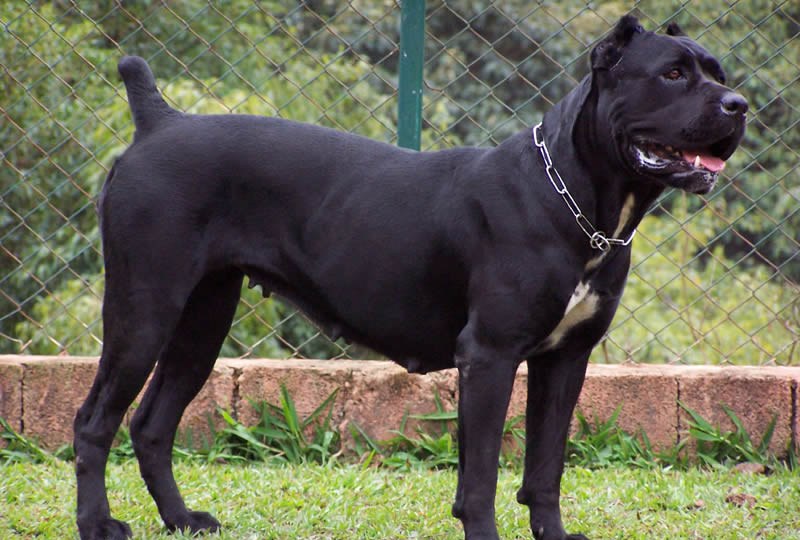

The standard is short, and nearly all of it serves the job in the first sentence: a property watchdog and hunter of wild boar must be sturdy, muscular, and athletic, and must move with ease. The dog is rectangular — the length from point of shoulder to point of buttock is approximately 10 percent greater than the height — and the summary at the end says the whole of it plainly: “The overall conformation of the dog should be well-balanced and proportionate.” Any deviation from the ideal is penalized to the extent of the deviation.
- Size, proportion, substance. A muscular, balanced, large-boned dog. Dogs 25 to 27½ inches at the withers; bitches 23½ to 26 inches. Weight is proportionate to height — the standard gives no weight figure. The depth of the ribcage is equal to half the total height, descending slightly below the elbow; the chest is broad, well-muscled, and strong.
- Head. Molossus, large: its total length reaches approximately one third of the height at the withers, and the circumference of the head at the cheekbones is more than twice the total length of the head. The planes of the skull and muzzle are slightly convergent, not parallel. Viewed from the top the skull looks square, thanks to the zygomatic arches and the powerful muscles swathing it. The stop is well-defined, the expression very alert and attentive, with some wrinkling on the forehead when alert.
- Muzzle and bite. Very broad and deep, its width almost equal to its length — about one third of the total length of the head — and its depth more than half its length. The top and bottom muzzle planes are parallel, and the nose and chin form a perpendicular line; viewed from the front the face looks flat and forms a trapezoid, wider at the bottom. The bite is slightly undershot (no more than ¼ inch) and level preferred; a scissor bite is acceptable if the head and muzzle parameters are correct. Dentition is complete, incisors in a straight line, no more than two missing teeth — more than two missing teeth, a wry mouth, or an undershot of more than ¼ inch are disqualifications.
- Eyes. Medium-size, almond-shaped, not round or bulging, with tight-fitting rims and only a minimal amount of haw visible. Dogs with black muzzles prefer dark brown eyes; gray muzzles allow lighter shades. Yellow bird of prey and blue eyes are disqualifications.
- Ears. Set well above the cheekbones. May be cropped or uncropped. If cropped, the ear is an equilateral triangle; if uncropped, the ears are medium size, triangular, held tight to the cheeks, and not extending beyond the jaw bone. The parent club calls cropping “a truly fundamental aspect of Cane Corso tradition” and argues it restores a functional, upright ear, keeps the ear canal open to air and light, and prevents the injuries and infections floppy ears invite — puppies are usually cropped between 8 and 12 weeks of age. The FCI standard, by contrast, calls for ears un-cropped.
- Tail. Set as an extension of the backline, thick at the root with little taper. It is docked at the fourth vertebra. A natural tail’s tip reaches the hock but not below; carried low in repose, level with the back or slightly above it in action, never vertical, never curled over the back, neither broken nor kinked but supple. A natural tail that is atrophied, or knotted and laterally deviated or twisted, is a disqualification.
- Coat and color. Short, stiff, shiny, adherent and dense, with a light undercoat that becomes thicker in cold weather. Acceptable colors are black, lighter and darker shades of gray, lighter and darker shades of fawn, and red, with brindling allowed on all of them; solid fawn and red dogs carry a black or gray mask that does not go beyond the eyes. A white patch may appear on the chest, throat, chin, backs of the pasterns, and on the toes. Any color with tan pattern markings as seen in black-and-tan breeds is a disqualification.
- Gait. Free flowing and powerful, yet effortless, with strong reach and drive. As the dog accelerates the feet converge toward a center line of gravity in a near-single track, and the topline stays level, with minimal roll or bounce.
- Temperament, in the standard’s own words. “The Cane Corso as a protector of his property and owners is unequaled. Intelligent, he is easily trained. Noble, majestic and powerful his presence is impressive. He is docile and affectionate to his owner, loving with children and family.”
Read the standard as a job description and the details stop looking arbitrary: the broad, deep muzzle and the undershot bite are the grip of a dog that once held wild boar; the rectangular body, the level topline, and the converging single-track gait are the build of a dog that must cover ground effortlessly; the cropped-or-uncropped ears and the docked tail are the working choices of a guardian whose ears and tail were once liabilities in a fight. (Sources: AKC, Official Standard of the Cane Corso; Cane Corso Association of America, Ear Cropping.)
4. Temperament & living with one
The standard’s temperament paragraph is one sentence, and it is the whole brief: “The Cane Corso as a protector of his property and owners is unequaled. Intelligent, he is easily trained. Noble, majestic and powerful his presence is impressive. He is docile and affectionate to his owner, loving with children and family.” Everything the AKC and the breed’s guides add fills that sentence in rather than qualifying it.
- Guardian first. The AKC’s summary — “smart, trainable, and of noble bearing, the assertive and confident Cane Corso is a peerless protector” — is the standard’s temperament in six words. This is a dog that watches its home and its people as its job, not as a hobby.
- Watchful, not aggressive. The breed is not naturally aggressive, but it is naturally watchful, and wary of unfamiliar people and situations. Early socialization builds positive associations with visitors, so the dog learns to look to its owner for guidance instead of deciding for itself that a stranger is a threat.
- A shorter socialization window. The Corso has a shorter socialization window than some breeds and can be more likely to develop worries around new people, places, and situations. Introductions need to be gradual and careful, with positive experiences where the dog explores at its own pace.
- Family dog, on its own terms. Corsos can get on well with children and other dogs in their own family, though that does not always extend to visitors or unfamiliar dogs. They form close bonds with their owners and can struggle when left alone, so alone time has to be built up gradually.
- Daily exercise and work. A couple of 45-minute to one-hour walks each day, plus short training sessions — trick training and food puzzles help prevent boredom and frustration. A Corso with nothing to do will find something to do, and a bored guardian is a destructive one.
- Space matters. A large breed that does best with plenty of indoor space and a secure garden. This is not an apartment dog for a first-time owner, and it is not a dog that entertains itself in a yard.
Be honest about the commitment before the dog arrives: this is a breed that asks a lot of its owner — experience with large, powerful dogs, time for daily exercise and training, consistency in rules and boundaries, and an understanding of canine body language. If the household wants a loyal, intelligent guardian and can give it structure, the temperament fits. If the household wants a low-maintenance dog, or a dog that welcomes all strangers, it does not. (Sources: AKC, Official Standard of the Cane Corso; AKC, Cane Corso breed page; Battersea Dogs & Cats Home, Cane Corso; PetShun, The Cane Corso: A Comprehensive Owner’s Guide.)
5. Grooming
Grooming a Cane Corso is a light job next to most breeds — the coat is short, stiff, shiny, adherent and dense — but it is a weekly job, not a never job.
- Brushing. A weekly brush with a bristle brush or rubber curry removes dead hair and keeps the short coat glossy. The coat sheds year-round, with heavier shedding as the seasons change, so the brush is also the furniture’s best friend.
- Bathing. Bathe as needed — when the dog is dirty or smells like a dog — rather than on a schedule. Over-bathing strips the coat’s natural oils; a rinse after a muddy walk is usually enough.
- Ears. Check the ears weekly for redness, odor, or discharge. If the ears were cropped, the post-surgery care the parent club describes is salve on the edges for about a week while healing, with the stitches out in 7 to 10 days — after that, a cropped ear needs little more than the same weekly check.
- Nails and teeth. Trim the nails regularly — the standard calls for lean, hard, dark pads and nails — and brush the teeth. A large dog that will not stand for nail trims is a problem worth preventing early.
- Bloat awareness. This is a deep-chested breed, and bloat is a serious, potentially life-threatening condition. Feed twice a day rather than once, keep meals modest, and rest the dog after eating rather than exercising it on a full stomach.
The grooming bill is small; the exercise and training bill is not. Anyone budgeting for a Corso should budget time, not shampoo. (Sources: AKC, Official Standard of the Cane Corso; Cane Corso Association of America, Ear Cropping; Must Love Corsos Rescue, Foster FAQ.)
6. Health testing
The parent club treats testing as the price of breeding a heavy guardian dog, and its CHIC protocol is six tests — four examinations and two DNA tests. The club’s CHIC page puts it plainly: “in testing potential breeding dogs we turn to the gold standard of evaluation: the Orthopedic Foundation for Animals (OFA) and PennHIP.”
- Hip dysplasia. OFA or PennHIP evaluation — the top large-breed orthopedic problem, and the first test to ask about in a heavy dog.
- Elbow dysplasia. OFA evaluation.
- Cardiac. OFA evaluation — the heart screen, where dilated cardiomyopathy, the breed’s most-cited heart disease, is caught.
- Patellar luxation. OFA evaluation.
- Neuronal Ceroid Lipofuscinosis (NCL). DNA test from an approved lab — the Cane Corso type of this inherited neurological disease.
- Dental-Skeletal-Retinal Anomaly (DSRA). DNA test from an approved lab — an inherited disease of teeth, skeleton, and retina.
- CHIC. The six tests above are the breed’s CHIC protocol, set by the parent club with the Orthopedic Foundation for Animals. A dog that completes the protocol and has its results in the public OFA database earns a CHIC number. A CHIC number means the dog was tested and the results are public — it does not mean the dog passed everything.
- Eye evaluation is not in the protocol. Unlike many breeds, the CCAA CHIC protocol does not include an eye evaluation. The AKC’s DNA program separately lists Multifocal Retinopathy 1 among the DNA tests identified in the breed, but it is not part of CHIC.
What else shows up in the breed: hip dysplasia is the most common problem breeders report, cherry eye occurs relatively often as it does in all mastiff breeds, and bloat is a serious, potentially life-threatening concern. Before you buy, ask for the parents’ OFA results for all six tests and look them up at ofa.org yourself — a breeder who has done the testing will be glad you checked. (Sources: Cane Corso Association of America, AKC Canine Health Foundation + CHIC; AKC, Breed-Specific DNA Testing Recommendations; Borealis Cane Corso, FAQ; The Vet’s Guide to Cane Corso Health Issues and Management.)
7. The annual Cane Corso specialty dog show
A specialty is the breed’s All-Star show — its Super Bowl. Once a year, the best Cane Corsos from across the country, and often from around the world, come together in one place.
The Cane Corso Association of America’s national specialty: the annual Cane Corso specialty dog show. The 2026 national: Saturday, May 2, 2026, at Purina Farms in Gray Summit, Missouri, judged by Mr. Derek Matson. Best of Breed: GCHB CH Bravado’s Guardian At Bronco. The 2027 national: Saturday, April 18, 2027, at the Georgia National Fairgrounds & Agricenter in Perry, Georgia. The 2025 national: Friday, August 15, 2025, at Island Grove Regional Park in Greeley, Colorado, judged by K Cardona (Kimberly Cardona), 81 dogs in the entry. The 2024 national: Saturday, August 24, 2024, at Meadow Event Park in Doswell, Virginia, judged by Mr. Douglas A. Johnson.
The standard, in brief: a medium-large Molossus dog, sturdy and muscular, rectangular in proportion — body length about 10 percent greater than height — dogs 25 to 27½ inches at the withers, bitches 23½ to 26 inches, weight proportionate to height, with a short, dense coat in black, gray, fawn, or red, brindling allowed, ears cropped or uncropped, tail docked at the fourth vertebra — guardian of property, family, and livestock.
The 2026 National Specialty — Saturday, May 2, 2026, at Purina Farms, 300 Checkerboard Drive, Gray Summit, Missouri, in a four-day weekend (Thursday, April 30 – Sunday, May 3, 2026) held concurrently with the Spirit of the Heartland Kennel Club show. Specialty judge: Mr. Derek Matson. Puppy & Veteran Sweepstakes judge: Ms. Bonnie Money. Superintendent: Onofrio Dog Shows, L.L.C. Entries closed Wednesday, April 23, 2026. The weekend also held the Breeder’s Cup Invitational on Thursday, April 30, the Midwest Regional Specialty on Friday, May 1, and a supported entry on Sunday, May 3, with the club’s annual meeting and awards banquet on Saturday evening. (Sources: Cane Corso Association of America, 2026 National Specialty; Cane Corso Association of America, Past Trophy Sponsors; Black Magic Cane Corso, News.)
Results (2026 national). Best of Breed: GCHB CH Bravado’s Guardian At Bronco (dog). Best of Opposite Sex: GCH CH Altiere’s Promiscuous Girl. Best of Winners and Winners Dog: Black Magic’s Boston. Winners Bitch: Sitze-Gou’s Ad Astra. (Sources: Cane Corso Association of America, Past Trophy Sponsors; Black Magic Cane Corso, News.)
The 2027 National Specialty: a one-day event on Saturday, April 18, 2027, at the Georgia National Fairgrounds & Agricenter, Perry, Georgia. Superintendent: Onofrio Dog Shows, L.L.C. Judges, AKC event number, entries, and closing date not yet published as of November 2026. (Sources: AKC Upcoming National Specialties; Cane Corso Association of America.)
Past national specialties: 2025 · 2024
Cane Corso Association of America — canecorso.org
8. Regional specialties through the year: smaller regional shows
The national is the anchor, but the breed’s year also runs through regional specialties — smaller regional shows, not the national — held by the parent club around the country, usually as designated specialties with all-breed shows. These are the 2026 regionals verified from club and AKC sources so far:
Four CCAA regional specialties verified for 2026 so far:
- Midwest Regional Specialty — Saturday, March 14, 2026, Louisville, Kentucky: at the Kentucky Fair & Exposition Center, 937 Phillips Ln. AKC event 2026683907. Specialty judge Mrs. J L Liebes (Joan Luna Liebes); sweepstakes judge Dr. Azalea Alvarez (Best in Puppy Sweepstakes: Maximus Kalinin; Best in Veteran Sweepstakes: GCHB CH Costa Bel Haniel). Best of Breed: CH Altiere’s Promiscuous Girl. Best of Opposite Sex: GCH CH Costa Bel A Drop From The Bucket. Best of Winners and Winners Dog: Maximus Kalinin. Winners Bitch: Res Ipsa’s Hailey Jane. The entry: 26 entries, 25 dogs. Supported entry Sunday, March 15, judge Mrs. Pamela S. Lambie; Best of Breed CH Bravado’s Guardian At Bronco. (Sources: AKC event search, event 2026683907; Cane Corso Association of America, blog archives, March 2026.)
- Midwest Regional Specialty — Friday, May 1, 2026, Gray Summit, Missouri: at Purina Farms, with the Rolla Missouri Kennel Club show, the day before the 2026 national specialty. Specialty judge Mr. James A. Fehring; sweepstakes judge Mr. Kevin Lind. (Source: Cane Corso Association of America, 2026 National Specialty.)
- Eastern Regional Specialty — Saturday, July 4, 2026, West Springfield, Massachusetts: at the Eastern States Exposition Grounds, 1305 Memorial Ave. Specialty judge Mrs. Vicki Seiler-Cushman. Best of Breed: GCHS CH Bravado’s Guardian At Bronco. (Source: Cane Corso Association of America, blog.)
- Southern Regional Specialty — Saturday, October 10, 2026, Lebanon, Tennessee: at the Wilson County Fairgrounds, 945 East Baddour Pkwy. AKC event 2026683902. Specialty judge Ms. Debra Thornton. Best of Breed: GCHS CH Bravado’s Guardian At Bronco. Supported entry Sunday, October 11, judge Dr. Ronald I. Spritzer. (Sources: AKC event search, event 2026683902; Cane Corso Association of America, CCAA Southern Regional Specialty, Saturday, October 10, 2026; ThePetAdvisor, Harvest Cluster 2026 premium.)
Past regional specialties: 2025 · 2024
More regional specialties will be added here as their programs are verified — this section is built from show data, not guesswork. Browse upcoming show weekends →
9. Clubs
- Cane Corso Association of America (CCAA) (parent club) — the AKC-licensed national parent breed club for the Cane Corso in the United States. It began as the International Cane Corso Federation in 1993 and was renamed the Cane Corso Association of America in 2003, when the membership voted to seek AKC recognition. It is organized in four regions — Northeast, Southeast, Midwest, and West — with regional vice presidents, and its annual meeting is held with the national specialty. The club puts on the national specialty and four regional specialties a year, plus performance events, and does not register dogs. (Sources: Cane Corso Association of America, Frequently Asked Questions; Cane Corso Association of America.)
- American Kennel Club. The AKC’s breed page, its Marketplace breeder directory, and its Rescue Network C-breeds listing are the three most useful AKC starting points for the breed. (Sources: AKC, Cane Corso breed page; AKC Rescue Network, C Breeds.)
- International Cane Corso Federation Registry (ICCF Registry). A separate organization from the parent club: the registry arm split from the club in late 1994 and still operates as a registry, with its own breeder links. The AKC stopped accepting ICCF registrations in July 2015, so an ICCF registration is not an AKC registration. (Sources: Cane Corso Association of America, Frequently Asked Questions; Black Pearl Cane Corso, The Italian Cane Corso; International Cane Corso Federation Registry, Breeder Links.)
- Regional clubs. No separate regional Cane Corso club with a verified website was found as of November 2026. In practice the parent club itself puts on the regional specialties listed in section 8.
If you are new to the breed, the national specialty itself is the better first stop than a breeder’s website: the people there have owned, shown, and worked Corsos, and they will tell you the truth about the size, the guarding instinct, and the training before you fall for a puppy.
10. Rescue
- Cane Corso Rescue, Inc. — the national breed rescue. It started in 2005 as part of the Cane Corso Association of America and became independent in 2009 under the name Cane Corso Rescue Inc. It is a 501(c)(3) nonprofit coordinating fosters and adoptions across the country, and reports more than 1,500 Cane Corsos rescued and rehomed. (Sources: Pupvine, 5 Best Cane Corso Rescues for Adoption; Cane Corso Rescue, Inc..)
- Must Love Corsos Rescue — an all-volunteer 501(c)(3) foster-based rescue saving Cane Corsos from shelters and owner surrenders nationwide, based in Ashley, Ohio (P.O. Box 546, Ashley, OH 43003; [email protected]). A Best Friends Network partner. (Sources: Must Love Corsos Rescue; Best Friends Network, Must Love Corsos Rescue.)
- West Coast Cane Corso Rescue — helps Cane Corsos from the western United States find new homes, and is part of the CCAA. (Source: Pupvine, 5 Best Cane Corso Rescues for Adoption.)
- AKC Rescue Network. The AKC’s rescue network carries a Cane Corso listing among its C breeds. (Source: AKC Rescue Network, C Breeds.)
- Rescued Corsos are usually adults. That is the bargain and the advantage: the temperament is visible before you commit, and the dog arrives with its size, coat, and character already set — but breed rescue often runs a waiting list, so patience is part of the deal. If you bought your Corso from a responsible breeder, contact the breeder first — most responsible breeders include a take-back clause and want to know if you cannot keep the dog.
11. Breeder vs. rescue: honest guidance
- If you buy: start with the parent club, the Cane Corso Association of America (canecorso.org), and the AKC Marketplace, which lists breeders. Ask for the parents’ health results — the six CHIC tests in section 6 — and look the results up in the OFA database yourself. Expect to wait for a puppy from a careful breeder: a good breeder will have the answers, will ask you as many questions as you ask them, and will take the puppy back for its whole life if you cannot keep it.
- If you rescue: a rescued Corso is usually an adult, and it will arrive with its temperament and size visible before you commit. What you get in return is a dog whose character you can see before you commit and a lower price. Either way, be honest with yourself first: a Corso needs daily exercise and training, an experienced owner, and a secure home — not a yard and a hope.
- Watch out for “rare color” pricing. The standard recognizes black, gray, fawn, and red, with brindling on all of them. A seller charging a premium for a “rare” straw, white, or tan-pointed Corso is selling a label the standard does not recognize — tan pattern markings as seen in black-and-tan breeds are a disqualification.
- Watch out for oversized or “King Corso” claims. The standard has one size: dogs 25 to 27½ inches, bitches 23½ to 26 inches, weight proportionate to height. There is no giant variety, and a breeder selecting for size beyond the standard is selecting away from the breed.
- Watch out for no health testing. The breed is popular, and popularity gets used to justify high prices with no testing and no papers. A seller charging a premium should have the six CHIC test results to show for it — hips, elbows, cardiac, patellas, and the NCL and DSRA DNA tests.
12. Claim this page
This page belongs to the breed, and the people who know the breed best are the Cane Corso Association of America and its members. If you are with the parent club — or you are a breeder, a judge, a handler, or a rescue volunteer who spotted something wrong, missing, or out of date — this page is yours to set straight. Tell us what needs fixing and where the correction is documented, and we will fix it and credit the source. Contact the site through the About page, and mention “Cane Corso breed profile.”
Sources
- AKC, Cane Corso breed page — akc.org/dog-breeds/cane-corso
- AKC, Official Standard of the Cane Corso — images.akc.org/pdf/breeds/standards/CaneCorso.pdf
- AKC, Breeds by Year Recognized — akc.org/press-center/articles-resources/facts-and-stats/breeds-year-recognized
- AKC, Most Popular Dog Breeds of 2024 — akc.org/expert-advice/news/most-popular-dog-breeds-2024
- AKC, Breed-Specific DNA Testing Recommendations — akc.org/breeder-programs/dna/dna-resource-center/akc-dna-health/breed-specific-dna-testing-recommendations
- AKC Rescue Network, C Breeds — akc.org/akc-rescue-network/rescue-network-c-breeds
- AKC Upcoming National Specialties — apps.akc.org/apps/events/conformation/national_specialties.cfm
- AKC event search, event 2025683901 (2025 national) — apps.akc.org/apps/events/search, event 2025683901
- Cane Corso Association of America, Frequently Asked Questions — canecorso.org/frequently-asked-questions.html
- Cane Corso Association of America, AKC Canine Health Foundation + CHIC — canecorso.org/akc-canine-health-foundation--chic.html
- Cane Corso Association of America, Ear Cropping — canecorso.org/ear-cropping.html
- Cane Corso Association of America, 2026 National Specialty — canecorso.org/2026-national-specialty.html
- Cane Corso Association of America, 2025 — canecorso.org/2025.html
- Cane Corso Association of America, 2024 — canecorso.org/2024.html
- Cane Corso Association of America, Past Trophy Sponsors — canecorso.org/past-trophy-sponsors.html
- Cane Corso Association of America, blog: CCAA Southern Regional Specialty, Saturday, October 10, 2026 — canecorso.org/cane-corso-blog/ccaa-southern-regional-specialty-saturday-october-10-2026
- Cane Corso Association of America, blog archives, May 2025 (2025 regional winners) — canecorso.org/cane-corso-blog/archives/05-2025
- Greater Fredericksburg Kennel Club, Premium: Celebrate Virginia Cluster, August 22–25, 2024 — gfkc.org/wp-content/uploads/2024/07/Premium-Celebrate-VA-7-2-24.pdf
- Battersea Dogs & Cats Home, Cane Corso — battersea.org.uk/pet-advice/dog-advice/cane-corso
- National Purebred Dog Day, A Snippet of Cane Corso History — nationalpurebreddogday.com/snippet-cane-corso-history
- Modern Molosser, Talking with Ed Hodas — modernmolosser.com/talking-with-ed-hodas-belmonte-kennels-founding-cane-corso-breeder-in-america
- Modern Molosser, Upwardly Mobile: Cane Corsos inch toward the Top 10 in popularity (2025 ranking) — modernmolosser.com/akc-list-most-popular-breeds-2025-cane-corso-inching-toward-top-other-molossers-losing-ground-in-rankings
- Cane Corso Rescue, Inc. — canecorsorescue.org
- Must Love Corsos Rescue — mustlovecorsosrescue.org
- Must Love Corsos Rescue, Foster FAQ — mustlovecorsosrescue.org/foster-faq
- Best Friends Network, Must Love Corsos Rescue — bestfriends.org/partners/must-love-corsos-rescue
- Pupvine, 5 Best Cane Corso Rescues for Adoption — pupvine.com/best-cane-corso-rescues-for-adoption
- Borealis Cane Corso, FAQ (health) — borealiscanecorso.com/FAQ.htm
- The Vet’s Guide to Cane Corso Health Issues and Management — vetslovepets.com.au/blogs/dog/cane-corsos-health-issues
- PetShun, The Cane Corso: A Comprehensive Owner’s Guide — petshun.com/article/can-corso-dog
- Black Pearl Cane Corso, The Italian Cane Corso (history timeline) — blackpearlcanecorso.com/cane-corso-history
- International Cane Corso Federation Registry, Breeder Links — iccfregistry.com/breeder-links
- Wikimedia Commons, CaneCorso (23).jpg (body photo) — commons.wikimedia.org/wiki/File:CaneCorso_(23).jpg
- ThePetAdvisor, Harvest Cluster 2026 premium (Southern Regional Specialty) — thepetadvisor.com/assets/premiums/2026/harvest-cluster-2026.pdf