
Breed profile · Non-Sporting Group · Recognized since 1886
Bulldog
The Bulldog is the breed that looks like a joke and behaves like a gentleman: a low, heavy, short-faced dog built for a blood sport that no longer exists, now one of America’s most popular companions — stubborn, kind, and happiest asleep on your feet. Everything about the dog is exaggerated except its temper.
Help us improve it. This is one of ThePetAdvisor’s breed profiles, built from public sources with generous links to the people who actually own this breed’s knowledge. If something’s off or missing, the parent club can claim the page and set it straight — see the bottom of the page.
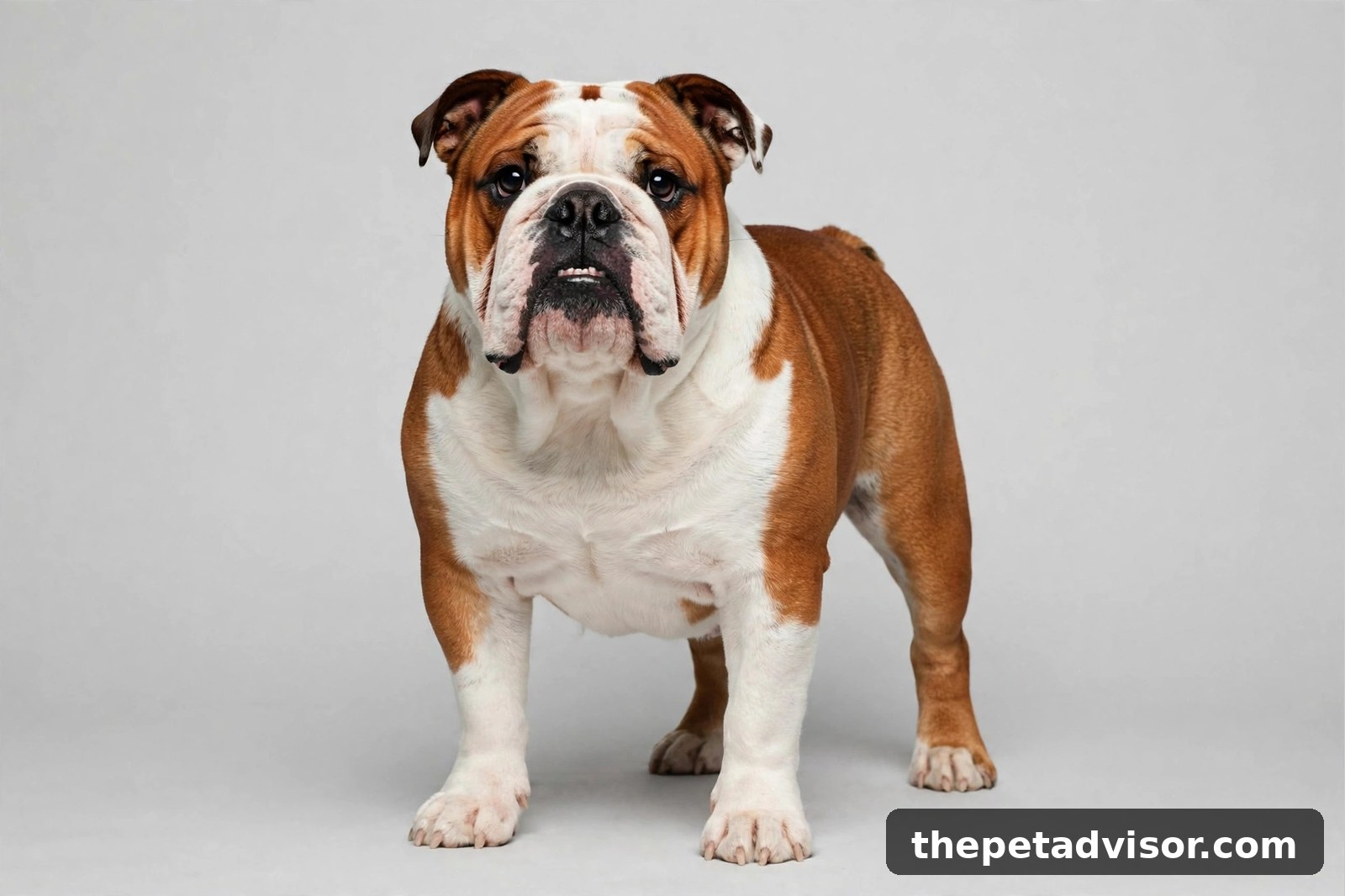
Do you have a photo of a Bulldog in the American show ring? We’d love this page to lead with one. If you have a show photo you’d let us use, email it to [email protected] — tell us the dog’s name and the show, and it may be featured here. Please only send photos you took yourself or have the photographer’s permission to share, and tell us the photographer’s name. We couldn’t find a public photo of a Bulldog in the American show ring that we were free to share, so the photo leading this page was made with AI. We’d much rather lead with a real one — if you’re a club member with an approved photo, we’d love to feature it.
1. Breed at a glance
Non-Sporting — recognized since 1886
Medium, low and heavy. Standard weight: dogs about 50 lb, bitches about 40 lb. Height 14–15 inches. The standard gives weight, not height.
Short, smooth, fine. Red, white, fawn, fallow, brindle, or piebald — and nothing else; every other color is a disqualification.
Equable and kind, resolute and courageous, pacific and dignified — the standard’s own words, and the breed’s best feature.
Low. Short bursts of play, long naps, and no tolerance for heat. A Bulldog needs daily movement and a cool house, not a marathon.
Size, coat, and temperament facts are from the AKC standard. Weight, height, and lifespan (8 to 10 years) are the AKC breed-profile figures (AKC Bulldog breed page). Popularity: the Bulldog is No. 10 in the AKC’s 2025 registrations (AKC most popular breeds 2025).
2. History
The Bulldog descends from the Old English Bulldog, a mastiff-type dog bred in England to bait bulls — to seize a bull by the nose and hold it — until the sport was outlawed under the Cruelty to Animals Act of 1835. With the job gone, the breed was remade as a companion: the ferocity bred out, the shape kept. The Bulldog Club in England formed in 1878, the Bulldog Club of America in 1890, and the AKC recognized the breed in 1886. (Sources: Bulldog; AKC Bulldog breed page.)
The new club took showing seriously from the start. In 1891 the Bulldog Club of America backed the Westminster show with 16 cups, medals, and cash prizes, and the Bulldog entry jumped to 51 — several times the number ever before shown at a single American show. The first winner of the club’s Grand Trophy, in 1891, was the newly imported English champion Harper; Richard Croker’s Ch. Rodney Stone won it in 1901. (Source: BCA, AKC Gazette, April 1946.)
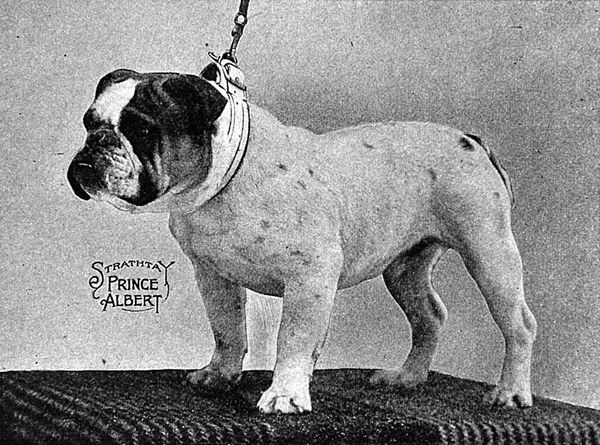
At Westminster, Bulldogs have won Best in Show twice: Ch. Strathtay Prince Albert in 1913 — he also won the club’s Grand Trophy in 1913, 1914, and 1915 — and Ch. Kippax Fearnought in 1955. No Bulldog has won it since. (Sources: AKC Westminster winners; BCA, AKC Gazette, April 1946.)
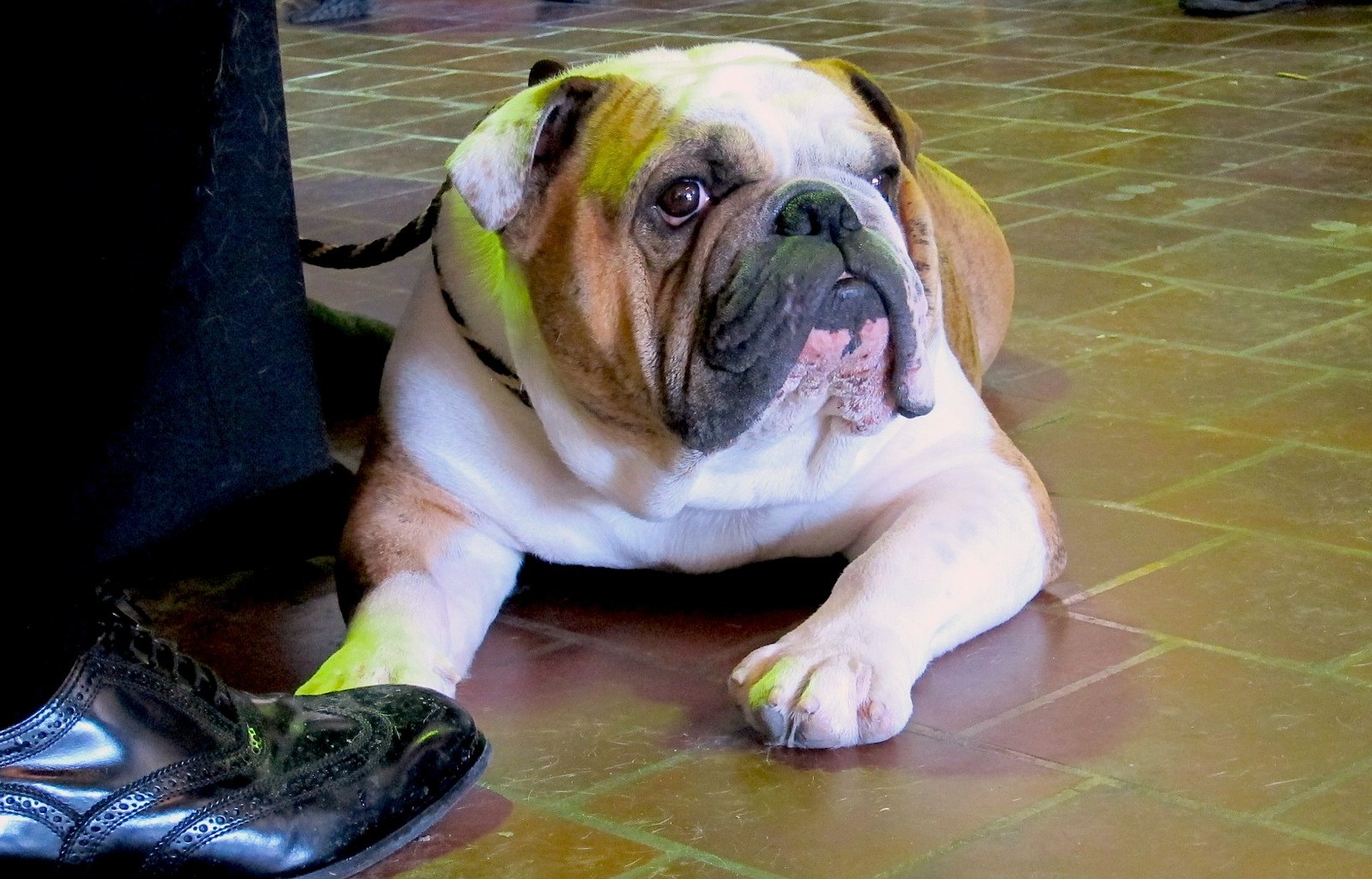
The club keeps its history where its members can see it. The National Winners Gallery — original oil paintings of every national specialty Best of Breed and Best of Opposite Sex winner, a collection begun in 1961 with the first seven paintings unveiled at the BCA banquet in St. Louis on April 20, 1963 — travels to the national specialty each year. In 2026 it grew to 120 paintings, with portraits of the 2025 winners, GCHB Karma’s Moonshadow and GCH Cherokee Legend Jacib’s Frank Butler, unveiled at the show. (Source: Canine Chronicle, National Winners Gallery.)
3. The standard and why it’s written that way
The standard’s first sentence is the whole dog, and it is worth quoting: “The perfect Bulldog must be of medium size and smooth coat; with heavy, thick-set, low-swung body, massive short-faced head, wide shoulders and sturdy limbs.” Everything in the standard is a gloss on that sentence — and the standard is blunt that no single feature may be carried so far that “the animal appears deformed or ill-proportioned.” (Sources: AKC standard; BCA health statement.)
- Head, nose, and bite. The head is massive and short-faced, with a broad skull and a short, broad muzzle turned up. The nose is large, broad, and black, its tip set back deeply between the eyes; any nose other than black is objectionable, and a brown or liver-colored nose disqualifies. The jaw is undershot, the lower jaw turned up. The ears are small and rose-shaped; the eyes dark, round, and set wide apart.
- Body and gait. Heavy, thick-set, and low-swung, with wide shoulders and sturdy limbs — and the standard demands movement to match: “unrestrained, free and vigorous gait” and “great stability.” A Bulldog that cannot move freely is not a good Bulldog, whatever its head looks like. (Sources: AKC standard; BCA health statement.)
- Color — and the fad colors. The color of coat should be uniform, pure of its kind and brilliant. Colors are red, white, fawn, fallow, or any combination of the foregoing; patterns and markings may include brindle, piebald, ticking, black masks, black tipping, and a minimal amount of solid black in piebalds. All other colors or markings are a disqualification, and the merle pattern is a disqualification. The parent club warns buyers expressly to beware of fad-color breeders: nose color must be black, eye color dark brown, and coat color only brindle, white, red, or fawn, or piebald. (Sources: AKC standard; BCA health statement.)
- Disqualifications. Blue or green eye(s) or parti-colored eye(s). Brown or liver-colored nose. Colors or markings not defined in the standard. The merle pattern. (Source: AKC standard.)
- Size. The standard gives weight, not height: dogs about 50 pounds, bitches about 40 pounds. The AKC breed profile puts the breed at 14 to 15 inches tall and 40 to 50 pounds. (Sources: Bulldog; AKC Bulldog breed page.)
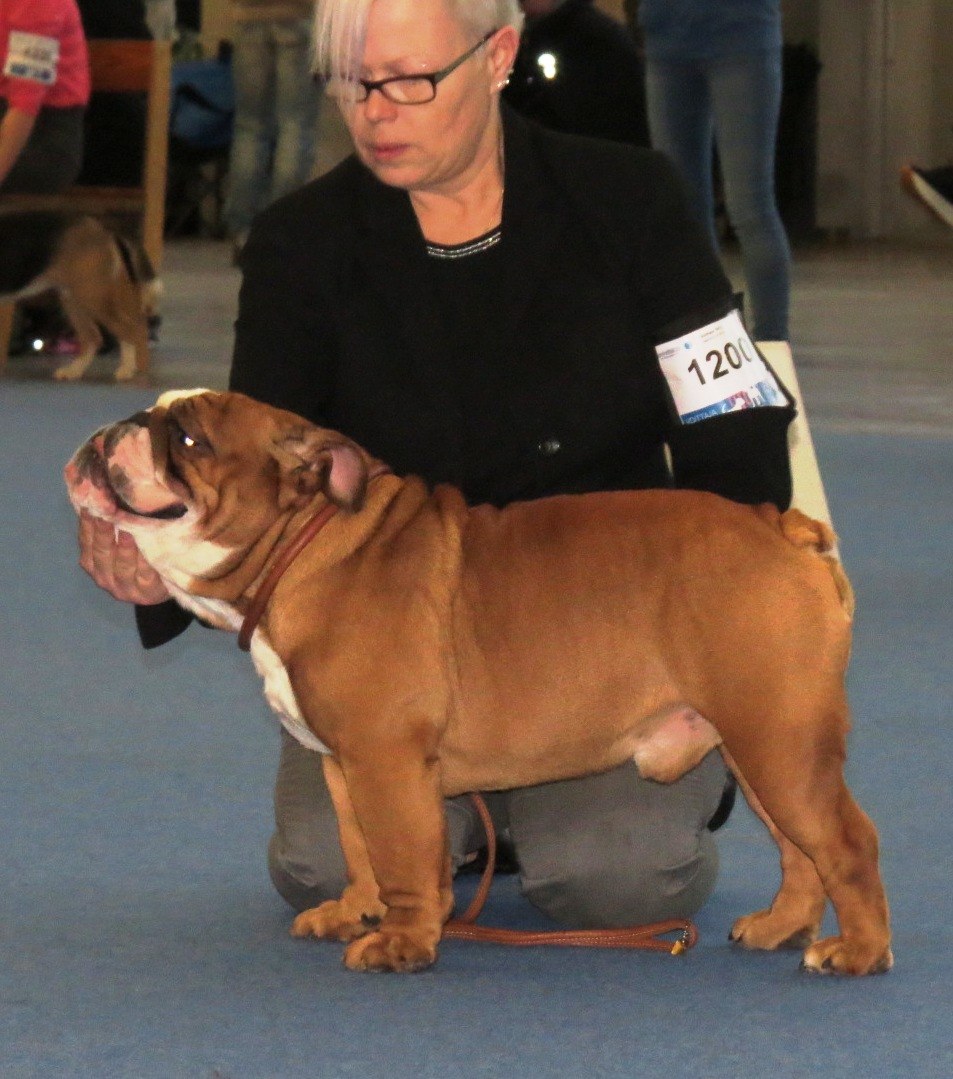
4. Temperament & living with one
The standard’s temperament line is the breed’s best advertisement: “The disposition should be equable and kind, resolute and courageous (not vicious or aggressive), and demeanor should be pacific and dignified.” A Bulldog is a companion first and a guard second — affectionate and people-oriented, good with children, usually fine with other dogs, and stubborn in the way of a dog that knows what it wants and sees no reason to hurry. (Sources: AKC standard; AKC Bulldog breed page.)
What that means at home is simple: a Bulldog is easy to live with and hard to keep healthy. It needs little exercise — short walks, play, and then a nap — but it needs a cool house, because a short-faced dog cannot shed heat the way a long-muzzled dog can. It snores, drools, sheds, and passes gas, and none of that is a fault to fix; it is the breed. Training works on food and patience, not on repetition: a Bulldog that has decided the sofa is its place will not be argued out of it, and a Bulldog that has not been taught its limits as a puppy will set them itself as an adult.
5. Grooming
Grooming is the easy part of owning a Bulldog, and the wrinkles are the hard part. The coat is short, smooth, and fine; a weekly brushing keeps it in shape, and a bath when the dog has rolled in something. Bulldogs shed moderately year-round, and no amount of brushing stops it. (Source: AKC Bulldog breed page.)
The skin folds need the attention the coat does not. The wrinkles on the face, and the tail pocket where the tail meets the body, trap moisture and food, and they should be cleaned and dried regularly or they will infect. Check the ears, keep the nails short — a Bulldog that mostly sleeps will not wear them down — and watch the skin between the toes, where allergies show up first.
6. Health testing
The Bulldog is a short-lived breed — 8 to 10 years on the AKC profile — and the honest version is shorter: a 2022 UK veterinary-data study put the breed’s life expectancy at 7.4 years, the second lowest of the breeds studied. The defining health issue is the one the standard itself creates: a short face means narrow airways, so breathing, heat tolerance, and anesthesia risk are lifelong concerns, alongside hips, skin allergies, eye problems such as cherry eye and entropion, and heart disease. None of these is a reason not to own a Bulldog. All of them are reasons to buy from a breeder who tests — and to budget for the vet. (Sources: AKC Bulldog breed page; Bulldog.)
The Bulldog Club of America does not mandate specific health tests, but its CHIC requirements are three tests on both parents: a cardiac evaluation, a patellar luxation evaluation, and a tracheal hypoplasia evaluation, all registered with the OFA. The club’s health screening matrix also lists hip and elbow radiographs, eye examinations, and thyroid panels, and the club’s Ambassador of Health program recognizes Bulldogs owned by BCA members that meet specific health-testing requirements. A CHIC number means the listed tests were done and made public — not that the results were normal. Ask for the number, and then ask what the results were. (Sources: OFA CHIC program; BCA health screening matrix; BCA health statement.)
Color deserves a line of its own, because it is where buyers get hurt. The parent club warns expressly against fad-color breeders: nose color must be black, eye color dark brown, and coat color only brindle, white, red, or fawn, or piebald, and any other colors are fad colors that may carry potential health risks. Blue, lilac, chocolate, and merle Bulldogs sell at premiums and cannot be shown — the standard disqualifies them — and a breeder leading with color is not leading with health. Ask for the health testing before you ask for the color. (Source: BCA health statement.)
7. The annual Bulldog specialty dog show
A specialty is the breed’s All-Star show — its Super Bowl. Once a year, the best Bulldogs from across the country, and often from around the world, come together in one place.
The Bulldog Club of America’s national specialty — the anchor of the Bulldog’s year — a week-long gathering at one hotel, not a single show day, with the conformation specialty at its center and puppy sweepstakes, obedience, rally, junior showmanship, and performance events around it, plus the National Winners Gallery of oil paintings of past national winners on display through the week.
The 2026 National Show: Monday to Wednesday, October 26–28, 2026, at the Embassy Suites by Hilton East Peoria Riverfront Hotel & Conference Center, 100 Conference Center Dr, East Peoria, Illinois — the conformation centerpiece of a national week, October 25–31, 2026, with the Bulldog Club of America Division II prequel show on Sunday, October 25, puppy sweepstakes on Monday, October 26, host-club specialties from the Chicago, Western Michigan, and Milwaukee Bulldog Clubs on Thursday, Friday, and Saturday, and the National Winners Gallery — 120 original oil paintings of past national winners — on display through the week. Entry: 216 dogs, 225 entries. (Sources: official premium list; official judging program; Canine Chronicle, National Winners Gallery.)
National specialty judges: Ms. Elizabeth Karshner — Best of Breed and intersex, Wednesday, October 28. Mr. Rick Franz — regular dogs, Tuesday, October 27. Mrs. Kelly Franz — regular bitches, Tuesday, October 27. Sweepstakes: Mr. Kelley Ensminger (dogs) and Ms. Alecia Wagner (bitches and Best in Sweepstakes), Monday, October 26. Junior Showmanship: Ms. Corri Long. Obedience and rally: Ms. Anna Lorenz. (Sources: official premium list; official judging program.)
Winners from the 2026 specialty had not been published in an official source as of November 2026 and will be added here when they are.
The 2027 national specialty: November 21–27, 2027, Crowne Plaza Resort, Asheville, North Carolina. (Sources: 2027 Bulldog Club of America National Show; 2027 Bulldog National Show announcement.)
Past national specialties: 2025
Bulldog Club of America — National Specialty
8. Regional specialties through the year: smaller regional shows
The national is the anchor, but the breed’s year also runs through regional specialties held by the Bulldog Club of America’s regional clubs and divisions. These are the 2026 regionals verified from club sources so far:
- Bulldog Club of America, Division II — prequel show — Sunday, October 25, 2026, Embassy Suites by Hilton East Peoria Riverfront Hotel & Conference Center, East Peoria, Illinois. Judges: Judy Wade (dogs), Ray Spivey (bitches), Chuck Spears (intersex). Entry: 170 dogs, 177 entries. (Source: official judging program.)
- Chicago Bulldog Club — host show — Thursday, October 29, 2026, Embassy Suites by Hilton East Peoria Riverfront Hotel & Conference Center, East Peoria, Illinois. Judges: Ken Calloway (dogs), Corri Long (bitches), Brandon Edge (intersex). Entry: 190 dogs, 196 entries. (Source: official judging program.)
- Western Michigan Bulldog Club — host show — Friday, October 30, 2026, Embassy Suites by Hilton East Peoria Riverfront Hotel & Conference Center, East Peoria, Illinois. Judges: Pat Ropp (dogs), Eva Dickey (bitches), Alin Retezatu (intersex). Entry: 193 dogs, 197 entries. (Source: official judging program.)
- Milwaukee Bulldog Club — host show — Saturday, October 31, 2026, Embassy Suites by Hilton East Peoria Riverfront Hotel & Conference Center, East Peoria, Illinois. Judges: Lalaine Policar (dogs), Dennis Balanag (bitches), Michelle Cazett (intersex). Entry: 171 dogs, 174 entries. (Source: official judging program.)
More regional specialties will be added here as their programs are verified — this section is built from show data, not guesswork. Browse upcoming show weekends →
9. Clubs
- Bulldog Club of America (parent club) — the AKC parent club for the breed in the United States, founded in 1890. It runs the national specialty, the breeder referral, the National Winners Gallery, and the Bulldog of the Year competition.
- Bulldog Club of America, Division II — the parent club’s division that opens national week with its prequel show, Sunday, October 25, 2026, in East Peoria, Illinois.
- Chicago Bulldog Club — regional specialty club (Illinois), host of the Thursday specialty in the 2026 national week.
- Western Michigan Bulldog Club — regional specialty club (Michigan), host of the Friday specialty in the 2026 national week.
- Milwaukee Bulldog Club — regional specialty club (Wisconsin), host of the Saturday specialty in the 2026 national week.
- Bulldog Club of Greater St. Louis and Heart of America Bulldog Club — regional specialty clubs (Missouri/Kansas) that hosted the Thursday and Friday specialties in the 2025 national week.
If you are new to the breed, a regional club is the better first stop than a breeder’s website: the people there have owned, shown, and lost Bulldogs, and they will tell you the truth about the vet bills before you fall for a puppy.
10. Rescue
Start with the parent club’s own rescue network. The Bulldog Club of America Rescue Network (BCARN) is a nonprofit, all-volunteer network with members across the United States and Canada that finds new homes for more than 2,000 Bulldogs a year. Its volunteers take in owner surrenders, strays, and dogs left with veterinarians or shelters, foster them, and place them after a home check and an adoption application. (Source: rescuebulldogs.org.)
A rescued Bulldog is usually an adult — the average age in rescue is 4 to 6 years old — and it will arrive with a history you may never fully know, often including the breathing, skin, or joint issues the breed carries. The average adoption fee runs $450 to $800 depending on the dog’s age and needs, and the average medical cost for a dog in rescue is $800 to $1,200, which is why the network runs on donations. BCARN does not ship dogs and generally does not place in homes with children under eight. What you get in return is a dog whose temperament you can see before you commit, and a rescue that has done this thousands of times. (Sources: BCARN FAQs; BCARN donations.)
11. Breeder vs. rescue: honest guidance
If you buy: start with the Bulldog Club of America’s breeder referral. Ask to see the CHIC results for both parents — heart, kneecaps, and windpipe in section 6, plus hips and eyes — and the actual results, not just the number. A good breeder will have tested the parents, will ask you as many questions as you ask them, and will take the puppy back for its whole life if you cannot keep it. And ask about the color: the standard allows only red, white, fawn, fallow, brindle, and piebald, and the parent club warns buyers to beware of fad-color breeders selling blue, lilac, chocolate, and merle dogs at premiums — colors the standard disqualifies and the club links to potential health risks.
If you rescue: a rescued Bulldog is usually an adult, often one whose owner underestimated the vet bills or the snoring, and it will arrive with a coat that needs little work and wrinkles that need a lot. What you get in return is a dog whose temperament you can see before you commit and a lower price. Either way, budget the vet first and the dog second: this is a breed where the purchase price is the cheapest part of ownership.
12. Claim this page
This page belongs to the breed, and the people who know the breed best are the Bulldog Club of America and its members. If you are with the parent club — or you are a breeder, a judge, a handler, or a rescue volunteer who spotted something wrong, missing, or out of date — this page is yours to set straight. Tell us what needs fixing and where the correction is documented, and we will fix it and credit the source. Contact the site through the About page, and mention “Bulldog breed profile.”
Sources
- AKC, Bulldog breed page — akc.org/dog-breeds/bulldog
- Bulldog Club of America, the Bulldog breed standard — bulldogclubofamerica.org/about-bulldogs/bulldog-breed-standard
- AKC, most popular dog breeds of 2025 — akc.org/expert-advice/dog-breeds/most-popular-dog-breeds-2025
- AKC, Westminster winners through the years — akc.org/expert-advice/news/westminster-winners-through-the-years
- Bulldog Club of America — bulldogclubofamerica.org
- Bulldog Club of America, National Specialty — bulldogclubofamerica.org/national-specialty
- 2026 BCA National Specialty, official premium list (National Specialty Week, October 25–31, 2026, East Peoria, Illinois) — bulldog-club-of-america-national-2026-premium.pdf
- 2026 BCA National Specialty, official judging program (National Specialty Week, October 25–31, 2026, East Peoria, Illinois) — AKC judging program
- AKC event search, Bulldog Club of America national, event 2026066147 — AKC event search
- Canine Chronicle, Bulldog Club of America to Showcase Unparalleled Traveling National Winners Gallery — caninechronicle.com
- ShowSight, BCA Makes History: Every Dog Earns a Qualifying Score in Obedience and Rally at 2026 National Specialty — showsightmagazine.com
- 2027 Bulldog Club of America National Show — bulldognationals.org
- 2025 BCA national week results — picalo.com
- Bulldog Club of America, AKC Gazette, April 1946 (club history) — bulldogclubofamerica.org
- OFA Canine Health Information Center (CHIC) — ofa.org/chic-programs
- Bulldog Club of America, health statement — cdn.akc.org/Marketplace/Health-Statement/Bulldog.pdf
- Bulldog Club of America, health screening matrix — bcod.org
- Bulldog Club of America Rescue Network — rescuebulldogs.org
- Wikipedia, Bulldog (history, recognition, lifespan study) — en.wikipedia.org/wiki/Bulldog
- Wikimedia Commons, 2014 Westminster Kennel Club Dog Show (hero photo) — commons.wikimedia.org
- Wikimedia Commons, Bulldog 2 - Helsinki 6 Dec 2015 — commons.wikimedia.org
- Wikimedia Commons, Ch Strathtay Prince Albert — commons.wikimedia.org


