
Breed profile · Herding Group · the heart wrapped in fur
Briard
The Briard is an ancient French herding and guarding dog from the Brie region of north-central France: a large, powerful, vigorous dog, 23 to 27 inches at the withers for males, wrapped in a long, coarse, slightly waving double coat — black, gray, or tawny — with the hair falling over the eyes, a long tail with a crook at the end, two dewclaws on each rear leg, and the quicksilver trot the standard compares to a large feline. The AKC sums it up as a heart wrapped in fur.
Help us improve it. This is one of ThePetAdvisor’s breed profiles, built from public sources with generous links to the people who actually own this breed’s knowledge. If something’s off or missing, the parent club can claim the page and set it straight — see the bottom of the page.
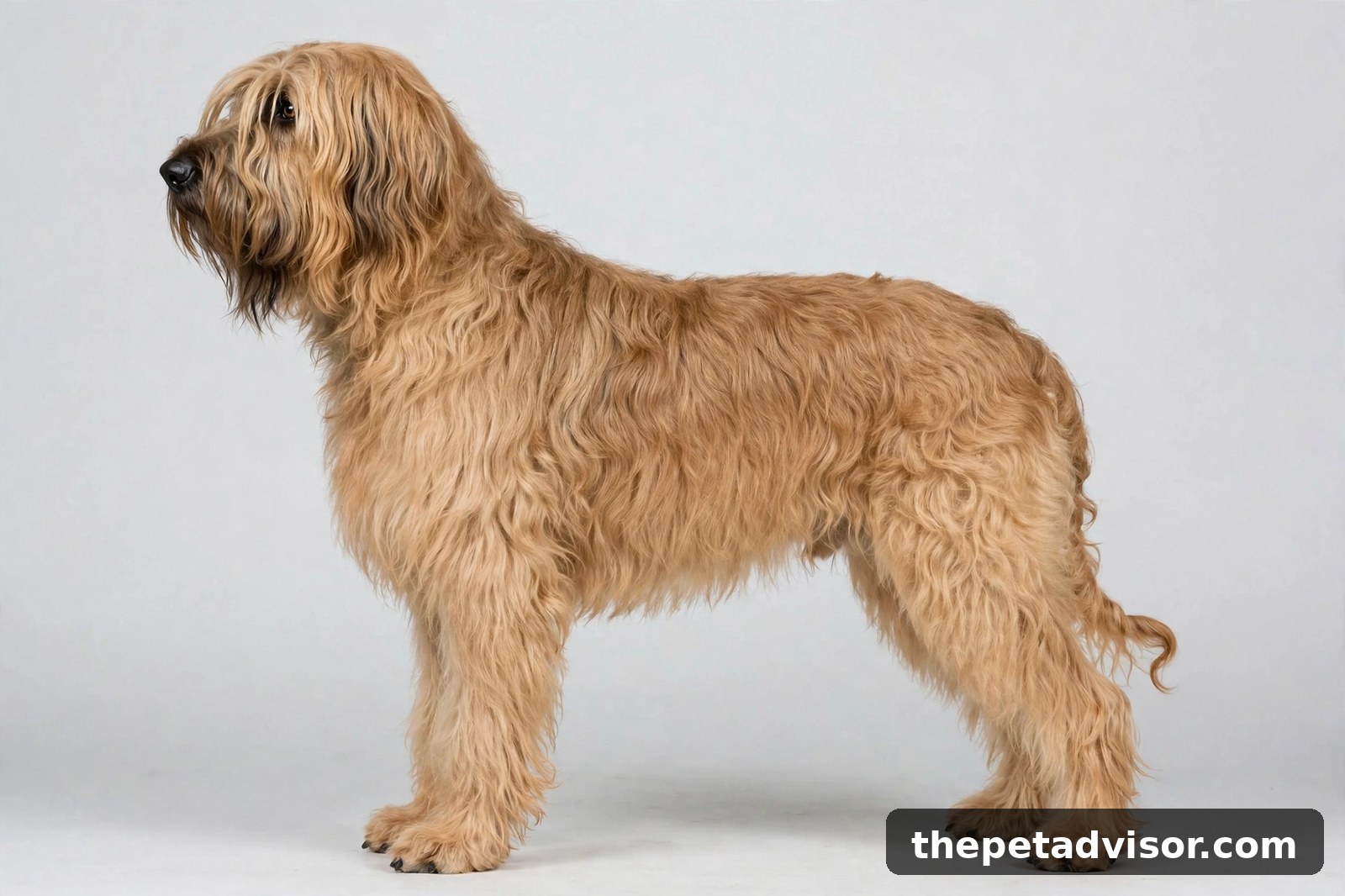
Do you have a photo of a Briard in the American show ring? We’d love this page to lead with one. If you have a show photo you’d let us use, email it to [email protected] — tell us the dog’s name and the show, and it may be featured here. Please only send photos you took yourself or have the photographer’s permission to share, and tell us the photographer’s name. We couldn’t find a public photo of a Briard in the American show ring that we were free to share, so the photo leading this page was made with AI. We’d much rather lead with a real one — if you’re a club member with an approved photo, we’d love to feature it.
1. Breed at a glance
Herding — recognized by the AKC in 1928
23–27 in at the withers (males); 22–25½ in (bitches). Weight 55–100 lb. Not cobby.
Long double coat, coarse and slightly waving, 6+ in on the shoulders. Black, gray, or tawny.
Loyal, intelligent, fearless, and obedient; reserved with strangers. AKC: “a heart wrapped in fur.”
10 to 12 years.
Size, coat, and temperament facts are from the AKC standard (approved February 8, 1975; reformatted January 12, 1992) and the AKC Briard breed page. Lifespan (10 to 12 years) and weight (55 to 100 pounds) are from Hill’s Pet and WebMD.
2. History
The Briard is an ancient French herding and guarding breed from the Brie region of north-central France — the Chien de Brie, or Berger de Brie — a dog that both herded and guarded the flocks. The first French standard dates to 1897, from the Club Français du Chien de Berger, and Les Amis du Briard, the French breed club, formed in 1909. The French Army used Briards as sentries, messengers, and searchers for the wounded in both World Wars. (Sources: Briard Club of America, About; AKC Briard breed page.)
Thomas Jefferson brought Briards to the United States, and the first AKC-registered litter dates to 1922 — Barbara Danielson’s litter in Groton, Massachusetts. The Briard Club of America formed in 1928, the AKC recognized the breed the same year, and the first Briard national specialty was held in 1939 in Rye, New York. (Sources: Briard Club of America, About; Briard Club of America.)
The parent club has been the breed’s steward ever since: it maintains the standard by which Briards are judged, runs the national specialty each year, and founded two independent non-profit trusts — the Briard Medical Trust and the Briard Rescue Trust — for breed health research and rescue. (Sources: Briard Club of America, About; Briard Club of America.)
3. The standard and why it’s written that way
- A dog of handsome form. The standard opens with the whole dog: “A dog of handsome form. Vigorous and alert, powerful without coarseness, strong in bone and muscle, exhibiting the strength and agility required of the herding dog.” (Source: AKC standard.)
- Size — 23 to 27 inches for males, 22 to 25½ for bitches. “Males 23 to 27 inches at the withers. Bitches 22 to 25½ inches at the withers.” A dog under the minimum is disqualified. Not cobby: a male’s body length equals or slightly exceeds his height, and a bitch may be a little longer. (Source: AKC standard.)
- The head: two rectangles. The head is about 40 percent of the height at the withers, built like two rectangles — skull and muzzle — with a frank, questioning, confident expression. The eyes are black or black-brown, large and well opened, never narrow or slanted; yellow or spotted eyes are a disqualification. The ears are high-set with thick leather; a natural ear reaches no more than half the head length and lifts slightly when the dog is alert. The nose is square and always black — any other color is a disqualification — and the bite is scissors. (Source: AKC standard.)
- The tail: long, with a crook at the end. The tail is uncut and well feathered, carried low, with a crook at the extremity; viewed from the dog’s right, the bone descends to the hock and forms a J. A non-existent or cut tail is a disqualification. (Source: AKC standard.)
- Double dewclaws — two required on each rear leg. Two dewclaws are required on each rear leg, placed low, ideally as additional functioning toes; anything less is a disqualification. It is the breed’s signature feature. (Source: AKC standard.)
- Coat — coarse, hard, dry, 6 inches or more on the shoulders. The outer coat is coarse, hard, and dry — “making a dry rasping sound between the fingers” — lying flat in long, slightly waving locks, 6 inches or more on the shoulders, over a fine, tight undercoat. The head hair parts in the center, and the eyebrows arch up and out, lightly veiling the eyes. (Source: AKC standard.)
- Color — all uniform colors except white. All uniform colors except white: black, various shades of gray, various shades of tawny, deeper shades preferred. Two-color combinations are permitted if the change is gradual and symmetrical, with no marked spots. The only permissible white is scattered white hairs or a chest spot no more than 1 inch in diameter; a white coat, a spotted coat, or a chest spot over 1 inch is a disqualification. (Source: AKC standard.)
- Gait — quicksilver. “Quicksilver” — supple, light, “almost like that of a large feline,” gliding along. Above all a trotter, single-tracking, occasionally galloping. (Source: AKC standard.)
- Temperament, in the standard’s own words. “He is a dog of heart, with spirit and initiative, wise and fearless with no trace of timidity. Intelligent, easily trained, faithful, gentle, and obedient, the Briard possesses an excellent memory and an ardent desire to please his master. He retains a high degree of his ancestral instinct to guard home and master. Although he is reserved with strangers, he is loving and loyal to those he knows. Some will display a certain independence.” That is the whole temperament section — and it is the sentence every Briard owner recognizes. (Source: AKC standard.)
4. Temperament & living with one
The AKC sums the breed up in a phrase: the Briard “packs so much loyalty, love, and spirit into its ample frame that it’s often described as a ‘heart wrapped in fur.’” The standard says the same thing in plainer terms — a dog of heart, wise and fearless, intelligent, easily trained, faithful, gentle, and obedient, with an excellent memory and an ardent desire to please. (Sources: AKC Briard breed page; AKC standard.)
That devotion comes with a guarding instinct the standard is explicit about: the Briard “retains a high degree of his ancestral instinct to guard home and master” and is reserved with strangers while loving and loyal to those he knows. It is a large, powerful, active herding dog that needs work, exercise, and training, and the standard warns that some Briards display a certain independence. (Source: AKC standard.)
The Briard’s history is a working history — herding and guarding flocks, then sentry and messenger work for the French Army — and the dog still wants a job. A Briard does best with an owner who trains steadily, socializes early, and gives the dog something to do, whether that is herding, obedience, rally, or simply long, purposeful walks. (Sources: Briard Club of America, About; AKC standard.)
5. Grooming
- Several times a week, brushing to the skin. The long double coat needs thorough brushing several times a week — daily is even better — with a slicker brush and a long-toothed comb, working through to the skin so the coat does not mat. (Sources: Hill’s Pet; WebMD.)
- Brush before bathing. Brush the coat out before bathing, so wet tangles do not set; bathe every 6 to 8 weeks, and keep baths to a minimum between times. (Sources: Hill’s Pet; WebMD.)
- No clipping required. The Briard is shown in its natural coat — no clipping is required, and the head hair parts naturally in the center, with the eyebrows veiling the eyes. (Sources: AKC standard; Hill’s Pet.)
- The coat is the work. Everything about the Briard’s upkeep runs through the coat: the 6-inch-plus locks on the shoulders, the beard and eyebrows, and the feathered tail all tangle if they are left alone, and a matted Briard is an uncomfortable one. Budget the grooming time before the puppy, not after. (Source: Hill’s Pet.)
6. Health testing
- Three tests for a CHIC number. For a CHIC number, the Briard needs three evaluations: a Hip Evaluation, an Ophthalmologist Evaluation, and a Congenital Stationary Night Blindness (CSNB, LCA) DNA Test. That is the parent club’s list on the AKC’s Herding Group health-testing page. Breeders must agree to have all test results, positive or negative, published in the CHIC database. (Source: AKC Herding Group Health Testing Requirements.)
- The parent club also recommends thyroid testing. The Briard Club of America’s own health page lists autoimmune thyroiditis testing as optional but recommended — an OFA evaluation from an approved laboratory, covering FT4D, cTSH, and TgAA. Ask a breeder for the parents’ results — and look them up in the OFA database yourself. (Source: Briard Club of America, A Healthy Animal.)
- CSNB: the Briard is the breed the research started with. Congenital stationary night blindness was first described in Swedish Briards, and the Briard became the animal model for the disease — the RPE65 mutation behind it was identified in Briards, and the DNA test for it is now one of the breed’s three CHIC requirements. (Sources: Narfström et al., British Journal of Ophthalmology, 1989; Aguirre et al., Molecular Vision, 1998.)
- Lifespan: 10 to 12 years. The commonly published lifespan is 10 to 12 years. (Sources: Hill’s Pet; WebMD.)
7. The annual Briard specialty dog show
A specialty is the breed’s All-Star show — its Super Bowl. Once a year, the best Briards from across the country, and often from around the world, come together in one place.
The Briard Club of America’s national specialty: a one-day conformation show in the late spring or early fall, with puppy sweepstakes, obedience, rally, and a 4–6 Month Beginner Puppy event around it. The 2026 show: Sunday, June 14, at Morgantown Center in Morgantown, Pennsylvania, with 32 dogs and 42 entries in the specialty. The 2025 show: Saturday, October 4, at the Fulton County Fairgrounds in Wauseon, Ohio, with 47 dogs and 61 entries. The 2027 show: Saturday, March 13, at the Kentucky Fair & Exposition Center in Louisville, Kentucky.
The standard, in brief: a handsome, vigorous, alert herding dog, powerful without coarseness, 23 to 27 inches at the withers for males and 22 to 25½ inches for bitches, with a long, coarse, slightly waving double coat in black, gray, or tawny, a head like two rectangles, a long tail with a crook at the end, two dewclaws required on each rear leg, and the quicksilver, almost feline trot the standard calls for.
The 2026 National Specialty — a one-day show, Sunday, June 14, 2026, at Morgantown Center, 6180 Morgantown Rd, Morgantown, Pennsylvania, in the middle of a national week running June 12–14. Entry: 32 dogs (14 dogs, 18 bitches); whole event 42 entries / 32 competitors. Entries opened Wednesday, May 6, 2026; closed Wednesday, May 27, 2026. Entry fee: $40 first entry, $30 additional, $20 sweepstakes, $15 Beginner Puppy. Event Chair: David Sullivan. Superintendent: Jim Rau Dog Shows, Ltd. The week around the national: two regional specialties Friday, June 12, and two Saturday, June 13, with obedience and rally Saturday morning; a 4–6 Month Beginner Puppy event Sunday. (Sources: AKC event search, event 2026196406; Briard Club of America, National Specialty; 2026 premium list.)
National specialty judges: Mrs. C A Chase — regular and non-regular classes. Odile Smith — Sweepstakes. (The parent club’s page names Carrie Church as the national specialty judge; the AKC event record names Mrs. C A Chase.) (Sources: AKC event search, event 2026196406; Briard Club of America, National Specialty.)
Results (2026 national). Best of Breed: not confirmed in an official source as of November 2026.
The 2027 National Specialty: a one-day show, Saturday, March 13, 2027, at the Kentucky Fair & Exposition Center, 937 Phillips Lane, Louisville, Kentucky, in the middle of a national week running March 12–13. Host hotel: Crowne Plaza Louisville, room block March 10–15, $144/night. (Sources: AKC Upcoming National Specialties; Briard Club of America, National Specialty.)
Past national specialties: 2025
Briard Club of America — briardclubofamerica.org
8. Regional specialties through the year: smaller regional shows
The national is the anchor, but the breed’s year also runs through regional specialties — smaller regional shows, not the national — held by regional Briard clubs around the country. These are the 2026 regionals verified from club sources so far:
Four regional specialties at Morgantown Center, Morgantown, Pennsylvania, during the national week, with Jim Rau Dog Shows, Ltd. as superintendent; entries closed Wednesday, May 27, 2026, with an entry limit of 100.
- Regional specialty, Morgantown Center, Morgantown, PA — Friday, June 12, 2026: judge Mrs. S Moses Combs. Entry: 31 dogs (16 dogs, 15 bitches); whole event 38 entries / 31 competitors. Event Chair: Victoria Borchorski. (Source: AKC event search, event 2026196402.)
- Regional specialty, Morgantown Center, Morgantown, PA — Friday, June 12, 2026: judge Mr. P F Willhauck. Entry: 29 dogs (15 dogs, 14 bitches); whole event 37 entries / 29 competitors. Entries opened January 6, 2026. (Source: AKC event search, event 2026196404.)
- Regional specialty, Morgantown Center, Morgantown, PA — Saturday, June 13, 2026 (morning): judge Ms. J K Laurin. Entry: 24 dogs (10 dogs, 14 bitches); whole event 42 entries / 24 competitors. Obedience judge: Mr. M P Mooney; Highest Scoring Dog in Regular Classes: GCH CH Janelle’s Pure Poison De L’Heureux BN RE TDX FCAT ATT. Event Chair: Fran Davis. (Source: AKC event search, event 2026196408.)
- Regional specialty, Morgantown Center, Morgantown, PA — Saturday, June 13, 2026 (afternoon): judge Dr. H Kellogg. Entry: 28 dogs (14 dogs, 14 bitches); whole event 38 entries / 28 competitors. (Source: AKC event search, event 2026196405.)
The premium list attributes the Friday shows to the Michigan Ohio Briard Club and the Saturday shows to the Atlantic States Briard Club; the AKC event records list the Briard Club of America, Inc. as the club for all four. (Source: 2026 premium list.)
More regional specialties will be added here as their programs are verified — this section is built from show data, not guesswork. Browse upcoming show weekends →
9. Clubs
- Briard Club of America (parent club) — the AKC parent club for the breed in the United States, founded in 1928, with about 500 members and a territory covering the entire country. President David Sullivan; AKC delegate Diane Reid; breeder referral contact Jami Groce; breed rescue contact Constance K Hardy. The club runs the national specialty each year and founded the Briard Medical Trust and the Briard Rescue Trust. (Sources: Briard Club of America; AKC club search, Briard Club of America; Briard Club of America, About.)
- Regional Briard clubs. Regional clubs around the country include the Michigan Ohio Briard Club, the Atlantic States Briard Club, and the Briard Club of California. The Michigan Ohio and Atlantic States clubs held regional specialties alongside the 2026 national; see section 8.
If you are new to the breed, the national specialty itself is the better first stop than a breeder’s website: the people there have owned, shown, and worked Briards, and they will tell you the truth about the coat, the grooming, and the guarding instinct before you fall for a puppy.
10. Rescue
- Briard Rescue Trust. Established in 2005 by the Briard Club of America, a 501(c)(3) charitable trust with managing trustee Constance Hardy. It does not do hands-on rescue itself — it networks with experienced rescuers across the USA and provides financial assistance for rescue costs and education. (Sources: Briard Rescue Trust; Briard Rescue Trust, About Us.)
- Briard Rescue and Haven. Established in 2003 by Debbie Morrow, a privately run facility funded by private donations, eBay auctions, adoption fees, and bequests. Its rule is simple: “No Briard will be turned away.” (Source: Briard Rescue Trust, Profiles in Commitment.)
- The AKC breed rescue contact. The AKC’s breed rescue contact for Briards is Constance K Hardy. (Source: AKC club search, Briard Club of America.)
- Adults and seniors. A rescued Briard is usually an adult, often one whose owner underestimated the coat, the grooming, and the guarding instinct, and it will arrive with its temperament visible before you commit. What you get in return is a dog whose character you can see before you commit and a lower price. Either way, be honest with yourself first: a Briard needs thorough brushing several times a week, early and ongoing socialization, and an owner who respects a reserved, independent dog rather than expecting a dog that fawns over strangers.
11. Breeder vs. rescue: honest guidance
- If you buy: start with the parent club, the Briard Club of America, and its breeder referral contact, Jami Groce. Ask for the parents’ health results — hip, eyes, and the CSNB DNA test — and look the results up in the OFA database yourself. Expect to wait for a puppy from a careful breeder: a good breeder will have the answers, will ask you as many questions as you ask them, and will take the puppy back for its whole life if you cannot keep it.
- If you rescue: a rescued Briard is usually an adult, often one whose owner underestimated the coat, the grooming, and the guarding instinct, and it will arrive with its temperament visible before you commit. What you get in return is a dog whose character you can see before you commit and a lower price. Either way, be honest with yourself first: a Briard needs thorough brushing several times a week, early and ongoing socialization, and an owner who respects a reserved, independent dog rather than expecting a dog that fawns over strangers. It is not a dog for a household that wants an instantly friendly, low-maintenance pet.
- One breed, one standard — and color is not value. The Briard is shown under one standard, in black, gray, or tawny, with deeper shades preferred — but the standard judges the whole dog, and a Briard’s quality is in how closely it approximates the standard, not in its shade.
12. Claim this page
This page belongs to the breed, and the people who know the breed best are the Briard Club of America and its members. If you are with the parent club — or you are a breeder, a judge, a handler, or a rescue volunteer who spotted something wrong, missing, or out of date — this page is yours to set straight. Tell us what needs fixing and where the correction is documented, and we will fix it and credit the source. Contact the site through the About page, and mention “Briard breed profile.”
Sources
- AKC Briard breed page — akc.org/dog-breeds/briard
- AKC Official Standard of the Briard (approved February 8, 1975; reformatted January 12, 1992) — images.akc.org/pdf/breeds/standards/Briard.pdf
- AKC Herding Group Health Testing Requirements — akc.org/breeder-programs/breed-health-testing-requirements/herding-group-health-testing-requirements
- Briard Club of America — briardclubofamerica.org
- Briard Club of America, About — briardclubofamerica.org/about-6
- Briard Club of America, A Healthy Animal (OFA/CHIC) — briardclubofamerica.org/briard-ofa-chic
- Briard Club of America, National Specialty — briardclubofamerica.org/copy-of-2024-national-specialty
- AKC club search, Briard Club of America — apps.akc.org/apps/club_search
- AKC Upcoming National Specialties — apps.akc.org/apps/events/conformation/national_specialties.cfm
- 2026 National Specialty, AKC event search, event 2026196406 — apps.akc.org/apps/events/search/index_results.cfm
- 2025 National Specialty, AKC event search, event 2025196414 — apps.akc.org/apps/events/search/index_results.cfm
- Briard Club of America newsletter, Vol. 111 No. 1 (2025 national winner pictures) — briardclubofamerica.org/_files/ugd/9876b2_10929c84263648a78455e7b2a3833352.pdf
- 2026 premium list (Fleshner) — app.fleshner.com/_temp/kwb_004203676254/_localpdfs/dog_breeds.txt/briard/Briard-CoA-2026-PL-2.pdf
- 2026 regional specialty, AKC event search, event 2026196402 — apps.akc.org/apps/events/search/index_results.cfm
- 2026 regional specialty, AKC event search, event 2026196404 — apps.akc.org/apps/events/search/index_results.cfm
- 2026 regional specialty, AKC event search, event 2026196408 — apps.akc.org/apps/events/search/index_results.cfm
- 2026 regional specialty, AKC event search, event 2026196405 — apps.akc.org/apps/events/search/index_results.cfm
- Briard Rescue Trust — briardrescuetrust.org
- Briard Rescue Trust, About Us — briardrescuetrust.org/about-us
- Briard Rescue Trust, Profiles in Commitment (Briard Rescue and Haven) — briardrescuetrust.org/profiles-in-commitment
- Hill’s Pet, Briard breed guide — hillspet.com/dog-care/dog-breeds/briard
- WebMD, What to Know About Briards — webmd.com/pets/dogs/what-to-know-about-briards
- Narfström et al., The Briard dog: a new animal model of congenital stationary night blindness, British Journal of Ophthalmology, 1989 — pmc.ncbi.nlm.nih.gov/articles/PMC1041872
- Aguirre et al., Congenital stationary night blindness in the dog: common mutation in the RPE65 gene indicates founder effect, Molecular Vision, 1998 — molvis.org/molvis/v4/a23