
Breed profile · Sporting Group · recognized 2022
Bracco Italiano
The Bracco Italiano is one of the oldest pointing breeds in the world — an ancient Italian gun dog with a long, sculpted head, pendulous lips, and long ears, white with orange or chestnut markings. The American Kennel Club recognized the breed in 2022, as its 200th breed. Gentle in the home and tireless in the field, the Bracco is a hunter, pointer, and retriever in one dog. This page covers the breed's history, the standard, temperament, grooming, health testing, the national specialty, clubs, and rescue.
Help us improve it. This is one of ThePetAdvisor’s breed profiles, built from public sources with generous links to the people who actually own this breed’s knowledge. If something’s off or missing, the parent club can claim the page and set it straight — see the bottom of the page.
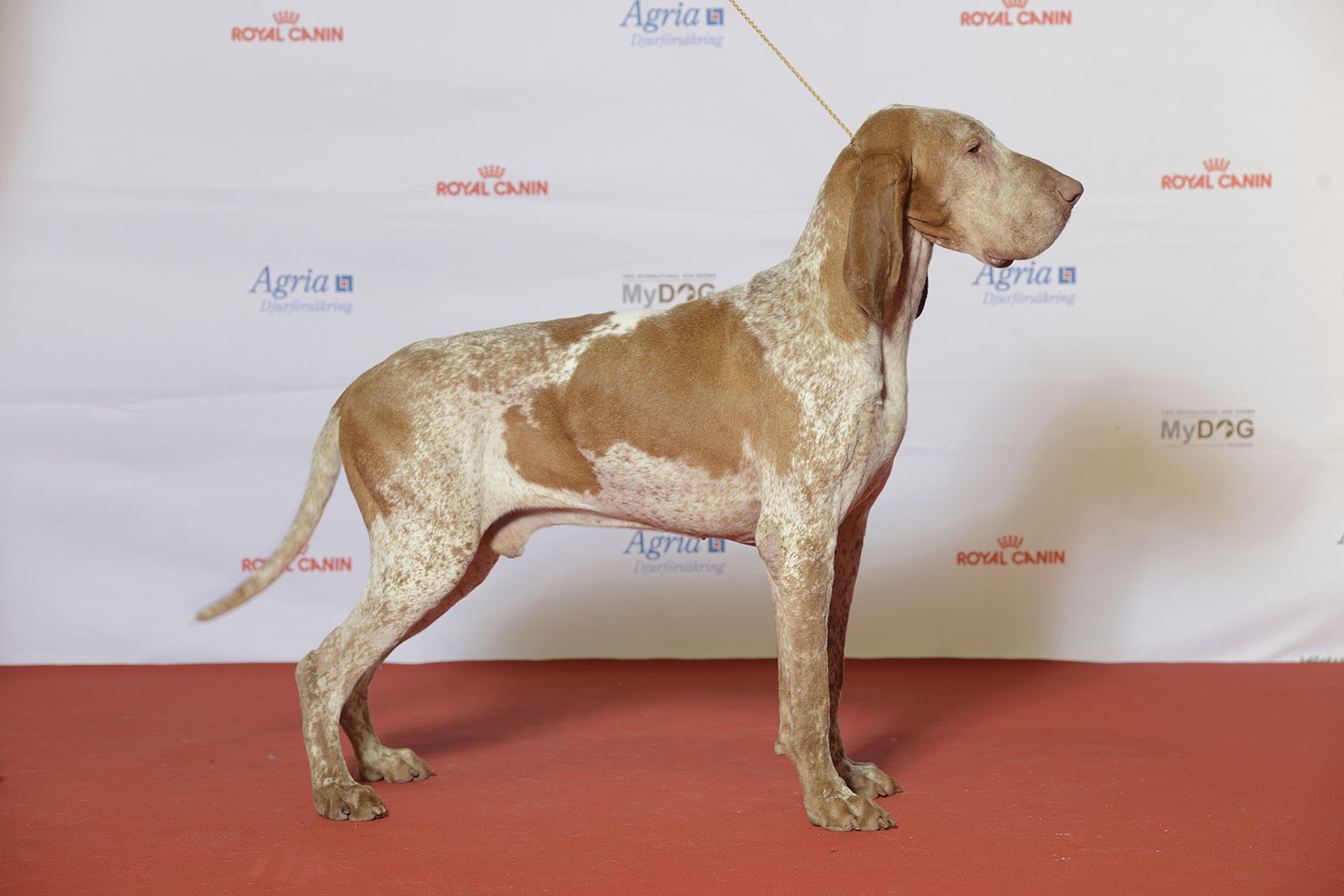
Do you have a better photo of a Bracco Italiano in the American show ring? If you have a show photo you’d let us use, email it to [email protected] — tell us the dog’s name and the show, and it may be featured here. Please only send photos you took yourself or have the photographer’s permission to share, and tell us the photographer’s name.
1. Breed at a glance
At a glance:
- Group: Sporting; recognized by the AKC in 2022 as the club's 200th breed.
- Size: 21–27 inches at the withers; preferred size for males 23–27 inches, for females 21–25 inches. Weight 55–90 pounds, depending on height.
- Coat: short, dense, and glossy — finer and shorter on the head, ears, front of the legs, and feet. Base color white: solid white, white with orange markings, or white with brown (chestnut) markings, in patches, ticking, or roan.
- Head: long and narrow, with divergent skull and muzzle planes (down-faced), pendulous lips, and long ears that reach the tip of the nose.
- Temperament: tough and adapted to all types of hunting, reliable, docile, and intelligent — friendly, never aggressive, and ready to make eye contact.
- Life expectancy: 10–14 years.
- Best suited to: active owners who hunt or work a dog in the field — and who want a gentle, affectionate companion in the house at the end of the day.
The Bracco Italiano is one of the oldest of the pointing breeds, and one of only two gundogs native to Italy. The AKC calls it gentle in the home and tireless in the field — a hunter, pointer, and retriever in one dog, and the breed's standard was written to keep it that way.
2. History
The Bracco Italiano's history reaches back to the fourth or fifth century B.C. — the AKC calls it the oldest European pointer. The prevailing theory holds that the breed came from a cross of the Segugio Italiano, the ancient Italian hound, with an ancient Molosser such as the Asiatic Mastiff: the hound gave it nose and stamina, the molosser gave it substance and bone. For centuries it was the pointing dog of the Italian nobility, working game that was first taken with nets and later with the gun.
Two regional types grew out of the breed's Italian heartland. The Piedmont type, from the mountains of the north-west, was lighter in build and lighter in color — most often white and orange — and hunted at a gallop. The Lombardy type, from the lowlands, was heavier-boned and larger, most often white and chestnut roan, and moved with the breed's characteristic trot. By the late 1800s the breed was near extinction, and the two types were officially merged into a single breed in 1923.
The rescue came in 1949, when Italian breeders formed the Società Amatori Bracco Italiano (SABI) and the Ente Nazionale della Cinofilia Italiana approved a formal breed standard the same year. The breed stayed almost entirely Italian until late in the twentieth century: the first Bracchi reached the United States around 1994, entered the AKC Foundation Stock Service in 2001, and were recognized by the United Kennel Club in 2006. The Bracco Italiano Club of America was founded in 2007 and worked for fifteen years toward full AKC recognition.
Recognition came on June 29, 2022, when the AKC admitted the Bracco Italiano as its 200th fully recognized breed, in the Sporting Group — the announcement followed on July 6, 2022. The breed first competed at the AKC National Championship in December 2022 and made its Westminster debut in 2023. The American national specialty followed the same path as the breed itself: the first AKC national specialties after recognition were held in Brainard, Nebraska (2023), Charlotte, North Carolina (2024), Lincoln, Nebraska (2025), and Wilmington, Ohio (2026).
3. The standard and why it's written that way
The AKC standard for the Bracco Italiano, approved October 8, 2018 and effective July 3, 2019, describes a dog of strong and harmonious construction and powerful appearance — tough, reliable, docile, and easy to train. The head is the breed's signature, and the standard spends most of its words there. Here is what the standard asks for, and why:
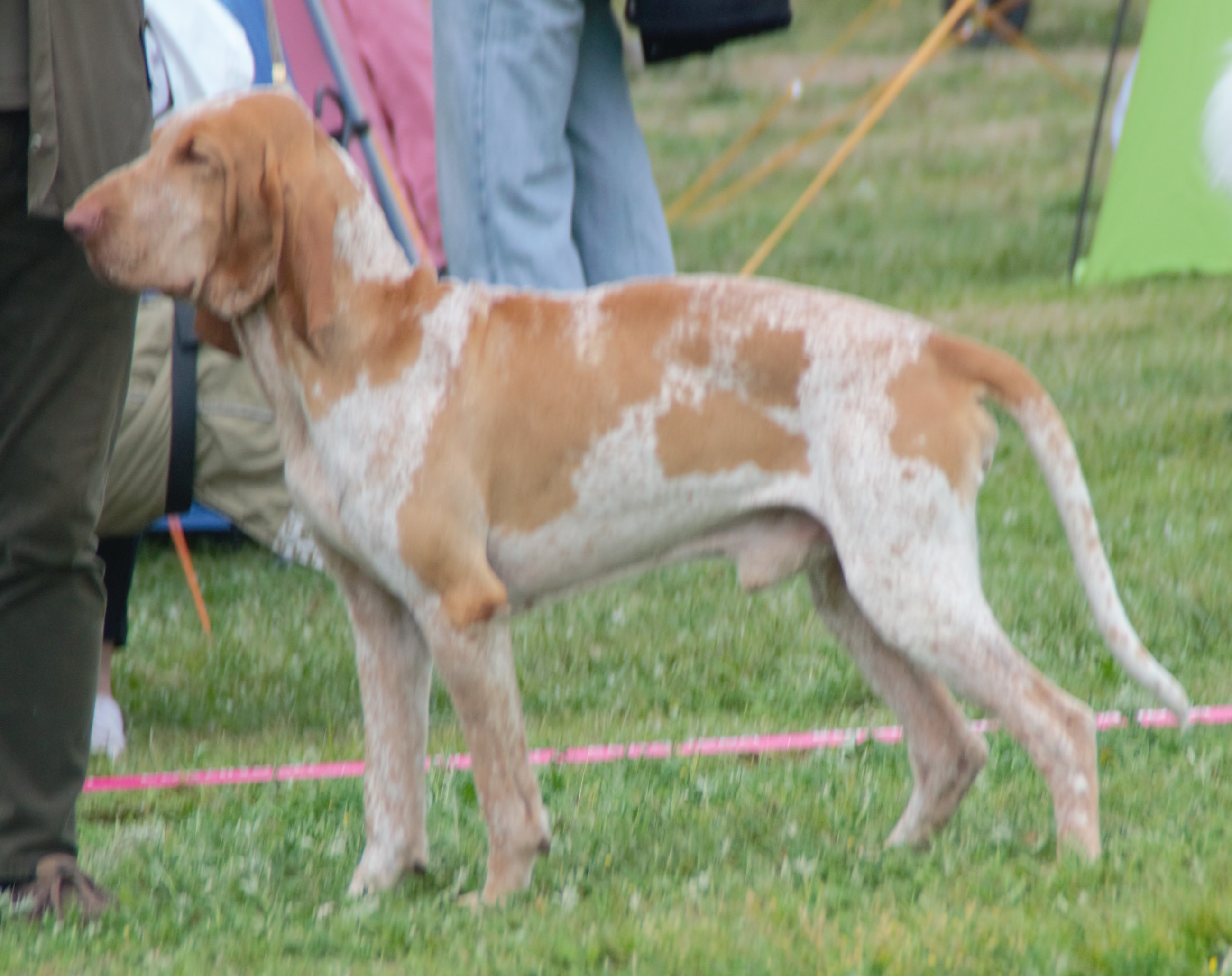
- General appearance — a strong, harmonious hunter: of strong and harmonious construction, powerful appearance, smooth-coated, with lean limbs, well-developed muscles, well-defined lines, and a markedly sculpted head with very obvious chiseling under the eyes. A dog in hard, lean field condition is not to be penalized.
- Size — big, but not lumbering: height at the withers 21 to 27 inches; preferred size for males 23 to 27 inches, for females 21 to 25 inches. Weight 55 to 90 pounds, depending on height. Height under 21 inches or over 27 inches after 12 months of age is a disqualification. The Bracco is solidly built with powerful bone, but without lumber and without sacrificing balance.
- Head — the long, sculpted head: the head is angular and narrow, its length equal to two-fifths (40 percent) of the height at the withers, and skull and muzzle are of equal length. The upper planes of the skull and muzzle are divergent — down-faced, so the muzzle's top line, extended, emerges in front of the occiput at mid-skull. Dish face, where the planes converge, is a disqualification. A soft fold of skin runs from the outer corner of the eye down the cheek, and when the head is down and relaxed there is a skin fold across the skull from ear to ear. The occiput is pronounced and the stop is not.
- Eyes — soft, gentle, intelligent: semi-lateral in position, neither deep set nor prominent, fairly large, with oval eyelids close-fitting — no entropion or ectropion. The iris is dark amber to orange or brown, depending on the color of the coat. Wall eye is a disqualification.
- Ears — long enough to reach the nose: well developed; without being stretched they should reach the tip of the nose. Their width is at least half their length, the base rather narrow and set at the level of the cheekbones, the front rim well turned inwards to frame the face, the lower end a slightly rounded tip.
- Muzzle, nose, and lips — the pendulous flews: the foreface is straight or slightly arched, its length half the head and its depth four-fifths of its length. The nose is voluminous, with large well-opened nostrils, brown or fleshy pink to deep red depending on the coat; a split nose is a disqualification. The upper lips are well developed, thin and floppy without being flaccid, covering the jaw; seen from the front they form an inverted “V” below the nose. The bite is scissors or level; overbite or underbite is faulted according to its severity.
- Neck and body — power without bulk: the neck is powerful, in a truncated cone shape, at least two-thirds but no more than the length of the head, with a soft double dewlap at the throat. The chest is broad, deep, and well down to the elbows, without forming a keel; the ribs are well sprung, the loin short, well muscled, and slightly convex, the croup long, wide, and well muscled. The body is square or slightly longer than tall.
- Coat and color — white, with orange or chestnut: the coat is short, dense, and glossy, finer and shorter on the head, ears, front of the legs, and feet. The base color is white: solid white, white with orange markings, or white with brown markings, in patches, ticking, or roan. A symmetrical face mask is preferred, but its absence is tolerated. Orange ranges from dark amber to rich orange — it is not lemon or yellow. Disqualifying colors are tricolor, tan markings, fawn, hazel, any trace of black on the coat or mucous membranes, any solid color other than white, and albinism.
- Tail and gait — the extended trot: the tail is thick at the base, straight, with a slight tendency to taper and short hair; docked, it is 6 to 10 inches from the root, and undocked it reaches the hock. In action, and especially when questing, it is carried horizontally or nearly so. The gait is an extended, fast trot with powerful reach and drive, the head raised and the nose held high — the trot is the breed's working gait, and the standard judges the dog moving.
- Temperament — the standard's own words: tough and adapted to all types of hunting, reliable, docile, and intelligent. Friendly, not shy, never aggressive, and readily makes eye contact. Extreme shyness is a fault; aggressiveness is a disqualification.
- Why the standard is written this way: every point serves the hunt. The long head carries the nose; the divergent planes and pendulous lips funnel scent; the long ears stir the air at the dog's feet; the extended trot covers ground all day without tiring the dog; the short, dense coat sheds burrs and dries fast; the white base lets the hunter see the dog at a distance. Nothing in the standard is decoration — it is a working dog's specification, written down.
4. Temperament & living with one
The Bracco is a study in contrasts, and the AKC's breed summary states it in one line: gentle in the home and tireless in the field. In the house a Bracco is a soft, affectionate, deeply people-bonded dog that wants to be where its people are — the standard says it readily makes eye contact, and owners find that is literal: a Bracco watches its person's face. In the field the same dog is a tireless, methodical hunter with a big, ground-covering trot and a serious nose.
That softness is the whole bargain. Bracchi are sensitive dogs that notice tone of voice and do not tolerate harsh handling — a rough correction shuts a Bracco down rather than sharpening it. Training works best with patience, consistency, and reward: the breed is docile and easy to train, but it learns on trust, not pressure. Early socialization matters, and so does company: a Bracco left alone for long hours is a lonely dog, and a lonely Bracco can become vocal — the breed has a deep bark and uses it on backyard wildlife.
Exercise needs are substantial: an adult Bracco needs an hour or more of genuine activity a day, plus a chance to use its nose — hunting, field work, tracking, or scent games. A Bracco that works is a calm, quiet house dog; one that never gets to work is a frustrated one. The breed is generally good with children and with other dogs, especially when raised with them, and it is friendly rather than suspicious with strangers — this is no guard dog.
5. Grooming
The short, dense, glossy coat is one of the Bracco's easiest features: a weekly brush with a rubber curry or bristle brush, a bath when the dog is actually dirty, and the coat takes care of itself. Shedding is moderate and year-round, with seasonal peaks — regular brushing keeps it manageable and the coat glossy.
What needs attention instead:
- Ears: long ears that hang close to the cheek trap moisture and air, so check the ears weekly, clean them as needed, and watch for redness, odor, or head-shaking — early signs of an ear infection. Dry the ears after baths and swimming.
- Skin folds and lips: the soft folds of skin on the head and the pendulous lips need a wipe after meals and drinking — food and water collect in the flews, and a Bracco can be a messy drinker.
- Nails and feet: strong, slightly oval feet with well-arched toes; keep the nails trimmed — a big, fast-moving dog with long nails strains its feet and pasterns.
- Teeth: brush regularly; the bite is scissors or level, and a Bracco's long jaw is worth protecting.
- Drool: the pendulous lips mean some dogs drool, especially after drinking or in warm weather — a towel by the water bowl is part of life with a Bracco.
6. Health testing
Before buying a Bracco Italiano puppy, ask the breeder for the health-test results behind the litter. The Bracco Italiano Club of America calls for every Bracco to be screened for hip dysplasia, elbow dysplasia, and eye disease before being bred — and for kidney disease as well, with annual kidney screening recommended for all Bracchi. Ask to see the results on the OFA website, not just a breeder's word.
The breed's CHIC requirements — the tests a dog needs recorded with the Orthopedic Foundation for Animals to earn a CHIC number — are an OFA hip evaluation, an OFA cardiac evaluation, and an OFA eye examination by a board-certified veterinary ophthalmologist, with the eye examination repeated yearly. Elbow evaluation is done alongside the hips and is part of the club's recommended screening.
- Hip dysplasia: OFA evaluation (PennHIP results accepted when registered with OFA).
- Elbow dysplasia: OFA evaluation, done with the hips.
- Eye diseases: CAER eye examination — entropion and ectropion, in which the eyelids roll inward or outward, and cataracts are the concerns the club names.
- Cardiac: OFA cardiac evaluation by a board-certified cardiologist.
- Kidney disease: screening for renal amyloidosis and renal maldevelopment (previously called renal dysplasia), which have been described in the breed; the club recommends annual kidney screening for every Bracco.
Conditions to watch in the breed include hip and elbow dysplasia, entropion, ectropion, cataracts, and kidney disease — the hereditary kidney disease is the breed's most significant health concern, and the club's health committee runs owner health surveys to track it, including a cancer survey completed in September 2026. As a large, deep-chested breed, the Bracco is also at risk for bloat: feed smaller meals, avoid exercise right after eating, and know the signs. Breeders have also reported sensitivity to anesthesia, so make sure any veterinarian treating your dog knows the breed. A breeder who tests, and who can show you the results, is doing the work that keeps the breed healthy. A breeder who cannot, or will not, is not.
7. The annual Bracco Italiano specialty dog show
A specialty is the breed’s All-Star show — its Super Bowl. Once a year, the best Bracco Italiani from across the country, and often from around the world, come together in one place.
The Bracco Italiano Club of America's national specialty: the annual Bracco Italiano specialty dog show. The 2027 national: Wednesday, May 19, 2027, at Wings North Hunt Club in Pine City, Minnesota, with national week May 16–21, 2027. The 2026 national: Friday, March 27, 2026, at the Roberts Centre in Wilmington, Ohio, 58 dogs in the entry. Best of Breed not confirmed in an accessible official source. The 2025 national: Friday, May 16, 2025, at the SandHills Global Event Center in Lincoln, Nebraska, 44 dogs in the entry. Best of Breed not confirmed. The 2024 national: Tuesday, April 23, 2024, at the Sonesta Charlotte Executive Park in Charlotte, North Carolina, 39 dogs in the entry. Best of Breed not confirmed.
The 2026 National Specialty of the Bracco Italiano Club of America: national week Thursday, March 26 – Sunday, March 29, 2026, at the Roberts Centre, 123 Gano Road, Wilmington, Ohio, and Cherry Bend Pheasant Farm, Wilmington, Ohio. National Specialty conformation Friday, March 27, 2026: Mr. G Philpott (58 entries — 31 dogs, 27 bitches; 65 total entries, 58 competitors; AKC event number 2026736701). Parent Specialty (afternoon event) Friday, March 27, 2026: V Sandage DVM (56 entries — 29 dogs, 27 bitches; 64 total entries, 56 competitors; AKC event number 2026736702). Sweepstakes Friday, March 27, 2026 (judge not confirmed in an accessible official source). Junior Showmanship: Ms. I Eaton (3 junior entries). Two AKC hunt tests Sunday, March 29, 2026, at Cherry Bend Pheasant Farm (AKC event numbers 2026736703 and 2026736704). Entries closed Wednesday, March 4, 2026. Event chair: Elise Letizia. Superintendent: MB-F Inc. (Sources: AKC event search, event numbers 2026736701, 2026736702, 2026736704; BICA 2026 National Specialty itinerary; AKC National Specialties and Judges Breed Study Groups for 2026.)
Best of Breed, Best of Opposite Sex, Winners Dog, and Winners Bitch not confirmed in an accessible official source. Best Junior Handler: Mary Kocab; Reserve Best Junior Handler: Madison Gamble.
The 2027 National Specialty: conformation Wednesday, May 19, 2027 (1 day), at Wings North Hunt Club, Pine City, Minnesota. National week Sunday, May 16 – Friday, May 21, 2027, at Wings North. The National and Parent Club Specialties and the Sweepstakes will be held at Wings North. Two AKC hunt tests during the week, plus a Certificate of Conformation Assessment and an Italian field evaluation. The AKC Upcoming National Specialties list names Lori Carver in its superintendent/secretary column; the club's own page lists the superintendent as TBD. AKC event number, premium, judges, entry fees, and entries opening and closing not yet published as of November 7, 2026. (Sources: AKC Upcoming National Specialties list; BICA 2027 National Specialty page.)
Past national specialties: 2025 · 2024 · 2023
Bracco Italiano Club of America
8. Regional specialties through the year: smaller regional shows
The national is the anchor, and for the Bracco Italiano it is the whole specialty year: the breed has no regional specialty clubs, so there are no separate regional specialties to list for 2026 — the national week itself carries the National Specialty, the Parent Club Specialty, the sweepstakes, and the field events.
Nothing separate to list: the breed's only specialty events are the ones held during national week (see section 7).
Regional specialties are listed here only when the details check out against the club or AKC — a date and a judge from a premium, a judging program, or the AKC event search.
9. Clubs
The parent club is the Bracco Italiano Club of America, Inc. (BICA), founded in 2007 to preserve the breed's health and hunting ability and to guide it to full AKC recognition — a fifteen-year effort that ended on June 29, 2022, when the Bracco became the AKC's 200th breed. The club runs the national specialty, judges education, the Certificate of Conformation Assessment, hunt tests, the Italian field evaluation, and the Bella e Bravo award for the dog most outstanding in both field and show. The club has no regional clubs — members are spread across the country and gather at the national. If you are looking for a breeder, a litter, or the national specialty, the parent club is the place to start: thebraccoclub.org.
In Italy, the breed's parent organization is the Società Amatori Bracco Italiano (SABI), founded in 1949, which maintains the breed standard with the Ente Nazionale della Cinofilia Italiana and holds the world Raduno. BICA works with SABI — the 2025 national specialty in Lincoln featured a SABI International dinner and conformation presentation by the Italian judge.
The breed's working side runs through the field as much as the ring: BICA holds AKC hunt tests at the national, and many American Bracchi also compete in NAVHDA (North American Versatile Hunting Dog Association) tests. The club's president at recognition was Amanda Inman.
10. Rescue
The Bracco Italiano Club of America runs its own Bracco Italiano Rescue Program, which takes in Bracchi that are abandoned or in need of a new home and places them in approved homes. The program is small — only a handful of dogs come through it in a typical year, and some are rehomed privately by their breeders without ever entering rescue — so a wait for the right dog is normal.
The process is an application, a review, and an adoption contract; the program matches each dog to a home and asks that any dog that does not work out be returned to the program at any time. Dogs in the program are spayed or neutered, vaccinated, and heartworm tested and treated, and adoption fees vary because each dog's journey to placement is different. The program does not offer transportation — the adopter bears the cost of getting the dog home — and it neither accepts nor places any unsafe dog. Rescue coordinator: Deanna Cuchiaro, (908) 462-2044, [email protected]. Start at thebraccoclub.org for the rescue application.
11. Breeder vs rescue
Both routes can lead to a wonderful Bracco — the right one depends on what you need, and with a rare breed, on how long you are willing to wait. There were only about 700 to 800 Bracchi in the United States when the breed was recognized in 2022, so litters are few and good breeders usually have waiting lists.
From a breeder: expect a breeder who shows or hunts their dogs, health-tests every breeding dog — hips, elbows, eyes, cardiac, and kidneys — and takes a dog back for life. Ask for the OFA results and the CHIC number, and verify them on the OFA database. Ask how the puppies are raised in the home, what the parents hunt or compete in, and what the breeder expects of you. A breeder who won't answer, or who always has puppies available, is a warning sign.
From rescue: expect an application and a matching process run by people who know the breed. Rescue dogs are usually adults whose temperament is already known — a real advantage with a big, sensitive sporting dog — but the program is small and the wait can be long. Either way, take your time, ask questions, and meet the dog: the Bracco you bring home will be with you for 10 to 14 years, and it will want to be with you for every one of them.
12. Claim this page
This page is maintained by ThePetAdvisor and built from public sources — the AKC standard, the Bracco Italiano Club of America's publications, and AKC event records. If you are an officer of the Bracco Italiano Club of America, a rescue coordinator, or a breeder, and you spot an error or have a correction, we would rather hear it from you than from a search result.
Send corrections, specialty dates, or photos to [email protected] with “Bracco Italiano” in the subject line. We check every message.
Sources
- AKC Official Standard for the Bracco Italiano (approved October 8, 2018; effective July 3, 2019)
- AKC breed page: Bracco Italiano
- AKC: American Kennel Club Celebrates Its 200th Recognized Breed (July 6, 2022)
- AKC: Bracco Italiano — Meet the AKC's Newest Recognized Dog Breed
- Bracco Italiano Club of America: Celebrating 200 (breed history; the Piedmont and Lombardy types merged in 1923)
- Bracco Italiano Club of America
- Bracco Italiano Club of America: National Specialty (2027)
- Bracco Italiano Club of America: Health Concerns
- Bracco Italiano Club of America: Rescue Information
- AKC Upcoming National Specialties list
- AKC event search: BICA 2026 National Specialty (event 2026736701)
- AKC event search: BICA 2026 Parent Specialty (event 2026736702)
- AKC event search: BICA 2026 hunt test (event 2026736704)
- AKC event search: BICA 2025 National Specialty (event 2025736702)
- AKC event search: BICA 2025 hunt test (event 2025736701)
- AKC event search: BICA 2024 National Specialty (event 2024736701)
- AKC event search: BICA 2023 National Specialty (event 2023736701)
- AKC event search: BICA 2023 hunt test (event 2023736703)
- AKC National Specialties and Judges Breed Study Groups for 2026
- Painted Hills Kennels: Disease Based Phenotypic Evaluations (Bracco CHIC requirements: hip, cardiac, eye)
- Hero photo: BIR Grupp 7, Bracco Italiano, Nuits Di Montemassi (Wikimedia Commons, CC BY 2.0)
- Body photo: Bracco-orangeroan1 (Wikimedia Commons, CC BY-SA 4.0)

