
Breed profile · Working Group · recognized 1904
Boxer
The Boxer is a medium-sized, square-built Working dog with a short, tight coat, a chiseled head, and a temperament the standard calls fundamentally playful yet patient and stoical with children. Bred from German Bullenbeisser stock and recognized by the AKC in 1904, the Boxer is a loyal, high-energy companion — and a serious show dog whose national specialty gathers the breed in Indianapolis each May.
Help us improve it. This is one of ThePetAdvisor’s breed profiles, built from public sources with generous links to the people who actually own this breed’s knowledge. If something’s off or missing, the parent club can claim the page and set it straight — see the bottom of the page.
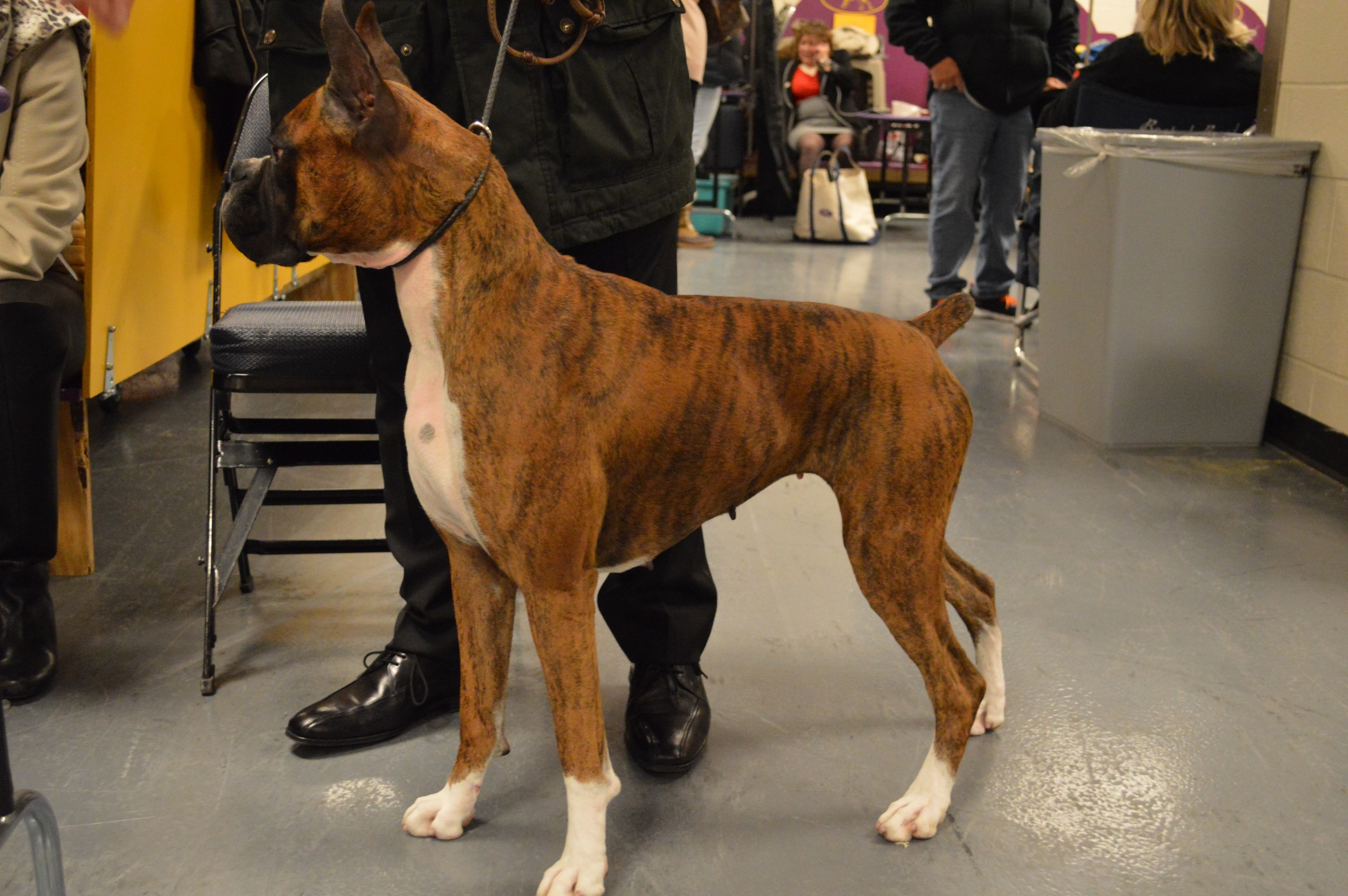
Do you have a better photo of a Boxer in the American show ring? If you have a show photo you’d let us use, email it to [email protected] — tell us the dog’s name and the show, and it may be featured here. Please only send photos you took yourself or have the photographer’s permission to share, and tell us the photographer’s name.
1. Breed at a glance
Group: Working. AKC recognition: 1904. Parent club: American Boxer Club, Inc. (ABC), founded 1935. Size: males 23–25 inches, females 21½–23½ inches at the withers; males 65–80 pounds, females about 15 pounds less. Life expectancy: 10–12 years. Coat: short, shiny, lying smooth and tight to the body. Colors: fawn and brindle only, with white markings of no more than one-third of the coat. Temperament: alert, dignified, and self-assured in the ring; playful, loyal, and patient with family at home.
The Boxer is a dog of visible contradictions that somehow hold together: a powerful Working dog with a clown’s sense of humor, a guard dog that is famously patient with children, and a short-coated dog that still needs a surprising amount of exercise. The standard sums up the ideal as “a medium-sized, square-built dog of good substance with short back, strong limbs, and short, tight-fitting coat” — and then spends most of its words on the head, because the head is what makes a Boxer unmistakable.
2. History
The Boxer descends from the Molosser family of dogs, through the Bullenbeisser — the “bull biter” — a hunting dog of German noblemen used on bear, bison, and wild boar. As big-game hunting faded, the smaller Bullenbeisser was bred down, and the modern Boxer took shape in Munich in the late 1800s: the first Boxer club was founded there in 1895, and the first standard was written in 1902.
The breed reached the United States in 1904, the same year the first Boxer was registered with the AKC — Muhlbauer’s Flock, out of Alt’s Schecken, a daughter of the imported brindle bitch Alt’s Flora. The first American champion, Sieger Dampf v Dom, finished in 1915. Boxers were among the first breeds the Germans selected for police training, and the breed’s working heritage is still visible in the standard, which calls the Boxer a dog “developed to serve as guard, working, and companion dog.”
The American Boxer Club was founded in 1935, and one of its first acts was establishing the Boxer as a member of the Working Group. The AKC standard was approved in 1938 and revised most recently in 2005. The breed’s show-ring peak came early: Ch. Warlord of Mazelaine won Best in Show at Westminster in 1947, and the Bang Away dogs dominated the 1950s. The national specialty has been held at a single centrally located site — Indianapolis — in recent years, drawing Boxers from across the country and beyond.
3. The standard and why it’s written that way
The standard describes a dog built to work and to be recognized at a glance. In judging, first consideration goes to general appearance and overall balance, then to the head, then to the body and the gait. The bullets below follow the standard’s own order.
- Square-built, and the square is measured. The ideal Boxer is “a medium-sized, square-built dog of good substance with short back, strong limbs, and short, tight-fitting coat.” The body in profile is square: a horizontal line from the front of the forechest to the rear projection of the upper thigh equals the length of a vertical line from the top of the withers to the ground. Males stand 23 to 25 inches, females 21½ to 23½ inches — and there is no size disqualification, because “proper balance and quality in the individual should be of primary importance.” (Source: AKC standard.)
- The head is the breed’s signature. The blunt muzzle is one-third the length of the head from occiput to nose tip, and two-thirds the width of the skull. The bite is undershot, the lower jaw protruding beyond the upper and curving slightly upward, and neither teeth nor tongue should show when the mouth is closed. The eyes are dark brown, frontally placed. The standard prizes the head’s “mood-mirroring character,” the wrinkled forehead giving the Boxer its unique quality of expressiveness. (Source: AKC standard.)
- Ears: cropped or uncropped, both correct. The ears are “customarily cropped, cut rather long and tapering, and raised when alert.” If uncropped, they should be of moderate size, thin, lying flat and close to the cheeks in repose, but falling forward with a definite crease when alert. The 2005 standard was the first to describe the uncropped ear in full — a natural-eared Boxer is not a fault. (Source: AKC standard.)
- Tail: docked, and the standard means it. The tail is set high, docked, and carried upward, and “an undocked tail should be severely penalized.” That is one of the strongest penalties in the standard, and it is why American show Boxers are docked. (Source: AKC standard.)
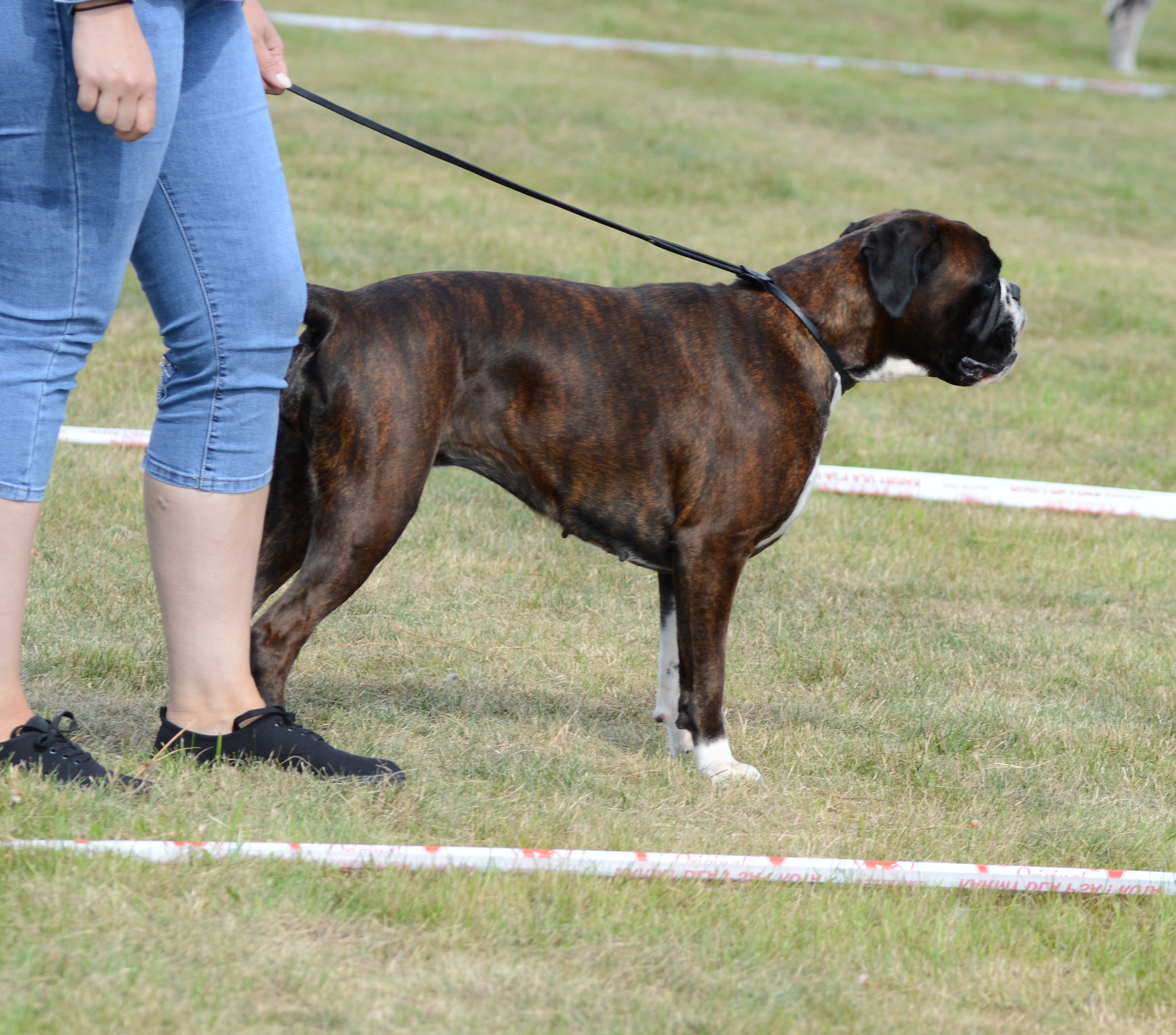
- Coat: short, shiny, tight. “Short, shiny, lying smooth and tight to the body.” The coat is not clipped or trimmed; the dog is shown in its natural state, and the hard muscle should appear smooth under taut skin. (Source: AKC standard.)
- Color: fawn and brindle, nothing else. Fawn shades run from light tan to mahogany. Brindle runs from sparse but clearly defined black stripes on a fawn background to such a heavy concentration of black striping that the essential fawn background barely, although clearly, shows through — the appearance of reverse brindling. White markings, if present, should enhance the dog’s appearance but may not exceed one-third of the entire coat, and are not desirable on the flanks or the back of the torso. On the face, white may replace part of the essential black mask and extend upward between the eyes, but must not be excessive. The absence of white — the so-called “plain” fawn or brindle — is perfectly acceptable. (Source: AKC standard.)
- Two disqualifications, and only two. Boxers of any color other than fawn or brindle are disqualified, and so are Boxers with white markings exceeding one-third of the entire coat. That is the whole list: a white Boxer, a black Boxer, or a Boxer that is more than one-third white cannot be shown. (Source: AKC standard.)
- Movement: firm, elastic, ground-covering. The gait is a smoothly efficient, level-backed, ground-covering stride with powerful drive from the rear. The front legs do not contribute impelling power, but adequate reach should be evident. The Boxer’s gait should always appear smooth and powerful, never stilted or inefficient. (Source: AKC standard.)
4. Temperament & living with one
The standard calls temperament “of paramount importance in the Boxer,” and its description is unusually complete: “Instinctively a hearing guard dog, his bearing is alert, dignified, and self-assured. In the show ring his behavior should exhibit constrained animation. With family and friends, his temperament is fundamentally playful, yet patient and stoical with children. Deliberate and wary with strangers, he will exhibit curiosity, but, most importantly, fearless courage if threatened.”
In the house, that reads as a dog that is loyal, affectionate, and almost comically playful — Boxers stay puppyish longer than most breeds and are famous for their clowning — but also watchful. A Boxer notices strangers, announces them, and decides for itself whether they are friendly. The standard adds that the Boxer “responds promptly to friendly overtures honestly rendered” and that “his intelligence, loyal affection, and tractability to discipline make him a highly desirable companion.” Shyness, or any lack of dignity or alertness, is severely penalized.
Living with one means planning for energy and strength. Boxers need daily vigorous exercise and training, and they do best with an owner who trains consistently and early: a 70-pound adolescent Boxer that has never learned not to jump is a handful. They are heat-sensitive — the short muzzle that gives the head its look also limits cooling — so exercise in hot weather needs shade, water, and restraint. Crate training, a fenced yard, and a job (obedience, agility, rally, scent work) keep a Boxer happy; long hours alone in a yard do not.
5. Grooming
The Boxer coat is about as low-maintenance as a dog coat gets. The smooth, short coat needs only a weekly brush-out with a rubber curry brush or hound glove to remove dead hair and keep the shine, and baths only when the dog is actually dirty. Shedding is moderate and year-round, heavier in spring and fall, but the short hairs are easy to sweep up.
The grooming work is in the details the coat does not cover: the flews and chin need a wipe after eating and drinking; the ears should be checked weekly; the nails need regular trimming, since a Boxer that cannot grip the ground properly moves poorly; and the teeth need brushing, since the undershot bite traps food along the lower incisors. Puppies should be handled early — ears, feet, mouth — so that routine care stays easy when the dog is 70 pounds.
6. Health testing
The Boxer’s health story is dominated by the heart. The parent club’s FAQ puts it plainly: heart disease in the breed falls into two important categories — aortic stenosis, a congenital narrowing of the aorta usually detected as a systolic murmur, and cardiomyopathy, a disturbance of the heart’s electrical conduction (arrhythmogenic right ventricular cardiomyopathy, or ARVC) that typically appears in the adult dog and is monitored with a Holter monitor, for which a blood and DNA test is available.
The OFA-CHIC requirements for the breed are a hip dysplasia evaluation, an autoimmune thyroiditis evaluation, and a cardiac evaluation. The parent club’s Health & Research Committee testing guidelines add the specifics: hip and elbow radiographs at two years; a thyroid panel (TGAA, Total T4, Free T4 by equilibrium dialysis, and cTSH) at two years and annually for breeding dogs; auscultation and a Doppler echocardiogram for aortic stenosis at 24 months; a Holter monitor from 12 months and annually for breeding dogs; and DNA testing, recommended once, for ARVC and for degenerative myelopathy.
Cancer is the other shadow over the breed, and the club answers it with research: the American Boxer Charitable Foundation exists to fund health research “in an effort to increase the longevity of our Boxers,” and the 2026 national specialty’s health seminar brought in veterinary immunotherapy researcher Dr. Nicola Mason to talk about new treatment options for previously difficult diseases like cancer. A breeder who tests to the club’s guidelines and a buyer who asks for the numbers are both part of that same effort.
7. The annual Boxer specialty dog show
A specialty is the breed’s All-Star show — its Super Bowl. Once a year, the best Boxers from across the country, and often from around the world, come together in one place.
The American Boxer Club’s national specialty: the annual Boxer specialty dog show. The 2027 national: May 5–7, 2027, at the Wyndham Indianapolis West Hotel in Indianapolis, Indiana, superintendent MB-F Inc. The 2026 national: May 6–8, 2026, at the Marriott Indianapolis East in Indianapolis, Indiana. Best of Breed: GCHG CH Tybrushe Livin On The Edge Of X-Cellence. The 2025 national: May 7–9, 2025, at the Marriott Indianapolis East in Indianapolis, Indiana, 241 dogs in the entry. Best of Breed: GCHG Bar-K’s Love As It Was. The 2024 national: May 4–10, 2024, at the Marriott Indianapolis East in Indianapolis, Indiana. Best of Breed: CH Tybrushe Livin On The Edge Of X-Cellence.
The 2026 National Specialty — national week Saturday, May 2 – Friday, May 8, 2026, at the Marriott Indianapolis East, 7202 East 21st Street, Indianapolis, IN 46219. Conformation Wednesday, May 6 – Friday, May 8, 2026. Futurity/Maturity (May 3): Erin Sposito, 119 puppies and young adults entered. Dog classes and intersex: Elizabeth Gunter (Australia; her second time judging the national). Bitch classes, 4–6 Month Puppy, veteran bitches, and brood bitches: Bert Rettick. Agility: Christy Chilcot. Top Twenty (36th Annual, Monday evening, May 4; theme “Bowties, Bubbles and Bling”): judges Gary Anderson (all-breed), Tom Latta (breeder), Carmen Skinner (handler). (Sources: American Boxer Club, National Results Edition, June 6, 2026; American Boxer Club, The ABC Countdown Continues, April 11, 2026.)
Results (2026 national). Best of Breed: GCHG CH Tybrushe Livin On The Edge Of X-Cellence. Best of Opposite Sex: GCHB CH Sin’s Evolution Of JTM TKN. Winners Dog and Best of Winners: Aldarra N Mephisto Defender of the Deep. Winners Bitch: X-Cellence Megastar. Reserve Winners Dog: Graceland Beyond The Reef. Select Dog: GCHS CH Strawberry N Cinnabons Big Deal. Select Bitch: CH Irondale’s Shake Ya Boom Boom. Best of Breed Owner-Handled: CH Aplaws N Cinnabons Something to Envy. Stud Dog: GCHP2 Rummer Run N Maximus Commander In Chief. Futurity Grand Prize: CH Aplaws N Cinnibon’s Something to Envy; Best Puppy in Futurity: Marburl and Woodside’s Pajama Party at Sunchase CGC; Maturity winner: GCH Mephisto’s Devilish by Design. Top Twenty winner: GCHG CH Irondale’s Bedazzled; Reserve Top Twenty (tie, a first): GCHG CH Bar-K’s Love As It Was and GCHG CH Sherwood’s Storm Trooper. Best Junior Handler, Reserve Winners Bitch, obedience/rally judges, entry counts, and AKC event number not confirmed in an accessible official source. (Sources: American Boxer Club, National Results Edition, June 6, 2026.)
The 2027 National Specialty: conformation Tuesday, May 5 – Thursday, May 7, 2027 (3 days), at the Wyndham Indianapolis West Hotel, Indianapolis, Indiana. Superintendent: MB-F Inc. National-week dates, judges, premium, AKC event number, entry fees, and entries opening/closing not yet published as of November 7, 2026. (Sources: AKC, Upcoming National Specialties.)
Past national specialties: 2025 · 2024
8. Regional specialties through the year: smaller regional shows
The national is the anchor, but the breed’s year also runs through regional specialties — smaller regional shows, not the national — held by the American Boxer Club’s member clubs around the country, usually as designated specialties with all-breed shows or as hosted specialties during national week. These are the 2026 regionals verified from club and AKC sources so far:
Three American Boxer Club specialties hosted by regional clubs during national week (May 2–8, 2026) at the Marriott Indianapolis East, Indianapolis, Indiana, plus the parent club’s fall regional:
- American Boxer Club Specialty hosted by Central Indiana Boxer Club — Saturday, May 2, 2026, Indianapolis, Indiana: during national week. Judges and results not confirmed in an accessible official source. (Source: Blue Grass Boxer Club premium list, 2026.)
- American Boxer Club Specialty hosted by Boxer Club of Southern California — Monday, May 4, 2026, Indianapolis, Indiana: during national week. Judges and results not confirmed in an accessible official source. (Source: Blue Grass Boxer Club premium list, 2026.)
- American Boxer Club Specialty hosted by Dallas Boxer Club — Tuesday, May 5, 2026, Indianapolis, Indiana: during national week. Judges and results not confirmed in an accessible official source. (Source: Blue Grass Boxer Club premium list, 2026.)
- American Boxer Club Regional Specialty — Saturday, October 24, 2026: Parade of Excellent Performance Titleholders in the Boxer ring; entries through the Queensboro–Riverhead premium list (MB-F). Venue and judges not confirmed in an accessible official source. (Source: American Boxer Club, Parade of Performance Titleholders — Regional.)
Past regional specialties: 2025
More regional specialties will be added here as their programs are verified — this section is built from show data, not guesswork. Browse upcoming show weekends →
9. Clubs
The parent club is the American Boxer Club, Inc. (ABC), founded in 1935 — americanboxerclub.org. The club runs the annual national specialty, publishes the In the Know newsletter, funds health research through the American Boxer Charitable Foundation, and coordinates rescue through its member clubs. Its officers (2026) include President Bridget J. Brown and Secretary Sandy Orr. The club lists more than 50 member clubs across the country.
Regional clubs affiliated with the parent club include (from club and AKC sources):
- Central Indiana Boxer Club
- Boxer Club of Southern California
- Dallas Boxer Club
- Georgia Boxer Club
- Potomac Boxer Club
- Blue Grass Boxer Club
- Spokane Boxer Club
- Midwest Boxer Club
- Tampa Bay Boxer Club
- Boxer Club of Oklahoma
- Allegheny Boxer Club
The full member-club roster is on the parent club’s website. The club also holds a fall regional specialty — in 2026, on Saturday, October 24, with entries through the Queensboro–Riverhead premium list.
10. Rescue
If a Boxer comes into your life through rescue, it will usually be an adult whose temperament is already known — and that is a real advantage with a strong, exuberant breed. Two routes lead to a rescue Boxer: the parent club’s own rescue network, and independent Boxer rescues around the country.
- American Boxer Club rescue: volunteers all over the United States, organized at the local level, take in Boxers that need special care and placement. The club publishes a downloadable U.S. Boxer Rescue contact list by state, updated September 2026; changes and additions go to Beth Downey, [email protected]. americanboxerclub.org/rescue
- American Boxer Rescue Association: a national Boxer rescue based in Carmel, Indiana. Listed on the ABC rescue page
- Local Boxer rescues: independent rescues work in most regions — Louisiana Boxer Rescue, founded by ABC lifetime member Connie Back, has rehabilitated and rehomed well over 1,000 Boxers. Your state’s entry on the ABC rescue list is the place to start.
Adoption through a Boxer rescue starts with an application, followed by a veterinary reference check and usually a home visit. The adoption fee varies with the dog and reimburses the veterinary costs of getting the dog ready for adoption. A rescue Boxer may need patience and consistent boundaries while it settles in; the payoff is a devoted dog whose temperament you already know.
11. Breeder vs rescue
From a breeder: expect the parents’ CHIC health tests (hip dysplasia, autoimmune thyroiditis, and a cardiac evaluation), with OFA/CHIC numbers you can verify on the OFA website; the club’s recommended ARVC and degenerative myelopathy DNA tests; a health guarantee; a take-back commitment for the life of the dog; and questions about your home, your schedule, and your experience with strong, high-energy breeds. Puppies should be raised in the home and socialized early. Red flags: no health testing, no take-back, puppies always available, or a breeder who will not show you the parents’ test records.
From rescue: expect an adult dog whose temperament is already known — a real advantage with a breed this strong and exuberant — and an adoption process that asks about your home, your schedule, and your vet, with a home visit before placement. The dog will come spayed or neutered, vaccinated, and evaluated for temperament and training needs. A rescue Boxer may need patience and consistent boundaries while it settles in; the payoff is a devoted dog that chose you back.
Either route, the question to ask is the same: who stands behind this dog if things go wrong? A breeder with a take-back and a rescue with a foster network both answer it. A seller with neither does not.
12. Claim this page
Are you the American Boxer Club, a regional club, or a breeder or rescue listed here? This page is maintained from public sources — if a date, a judge, or a result is wrong, or a link is out of date, tell us and we will fix it. Clubs and breeders who would like their events, health clinics, or rescue work featured can reach us at the same address.
Sources
- American Kennel Club — Boxer breed page (Working Group; recognized 1904; males 65–80 lb; life expectancy 10–12 years)
- American Kennel Club — Official Standard of the Boxer (approved February 11, 2005; effective March 30, 2005)
- American Kennel Club — Boxer history (Bullenbeisser roots; first AKC registration 1904; first champion 1915; Warlord of Mazelaine, Westminster BIS 1947)
- American Kennel Club — Upcoming National Specialties (American Boxer Club, May 5, 2027, Wyndham Indianapolis West Hotel, Indianapolis, IN; MB-F Inc.)
- American Boxer Club — parent club home (founded 1935; more than 50 member clubs)
- American Boxer Club — Health & Research Committee testing guidelines (hip/elbow, thyroid, aortic stenosis, Holter, ARVC and DM DNA)
- American Boxer Club — FAQ: medical conditions affecting the Boxer (aortic stenosis and cardiomyopathy/ARVC)
- American Boxer Club — Rescue (local volunteers; U.S. Boxer Rescue contact list by state, updated September 2026)
- American Boxer Club — National Results Edition, June 6, 2026 (2026 national judges, results, Futurity/Maturity, Top Twenty)
- American Boxer Club — The ABC Countdown Continues, April 11, 2026 (2026 national-week schedule, venue, health seminar)
- The Working Dog Digest, June/July 2025 — American Boxer Club report (2025 national judges, results, hosted specialties)
- The Working Dog Digest, July/August 2024 — American Boxer Club report (2024 national results, Futurity/Maturity, hosted specialties)
- AKC event search — 2025 American Boxer Club national specialty, event 2025093709 (241 dogs, 276 entries; entries closed April 16, 2025)
- Wikimedia Commons — Ch Mephisto’s Speak Of The Devil at the 2015 Westminster Kennel Club Dog Show (hero photo; Pets Adviser, CC BY 2.0)
- Wikimedia Commons — Brindle Boxer in profile, 2021 (section 3 photo; Wojciech Pędzich, CC BY-SA 4.0)
- American Boxer Charitable Foundation — funding health research to increase the longevity of Boxers

