
Breed profile · Non-Sporting Group · the American Gentleman in a tuxedo
Boston Terrier
The Boston Terrier — the American Gentleman — is a lively little companion in a tight tuxedo jacket: brindle, seal, or black, evenly marked with white, with big round eyes and impeccable manners. The AKC calls the breed “a lively little companion recognized by his tight tuxedo jacket, sporty but compact body, and the friendly glow in his big, round eyes.” It is a small, square-headed, short-tailed dog — shown in three weight classes, under 15 pounds, 15 to under 20, and 20 to 25 — and one of the first breeds developed in the United States that the AKC recognized, in 1893. The AKC sums the temperament up in three words: friendly, bright, and amusing.
Help us improve it. This is one of ThePetAdvisor’s breed profiles, built from public sources with generous links to the people who actually own this breed’s knowledge. If something’s off or missing, the parent club can claim the page and set it straight — see the bottom of the page.
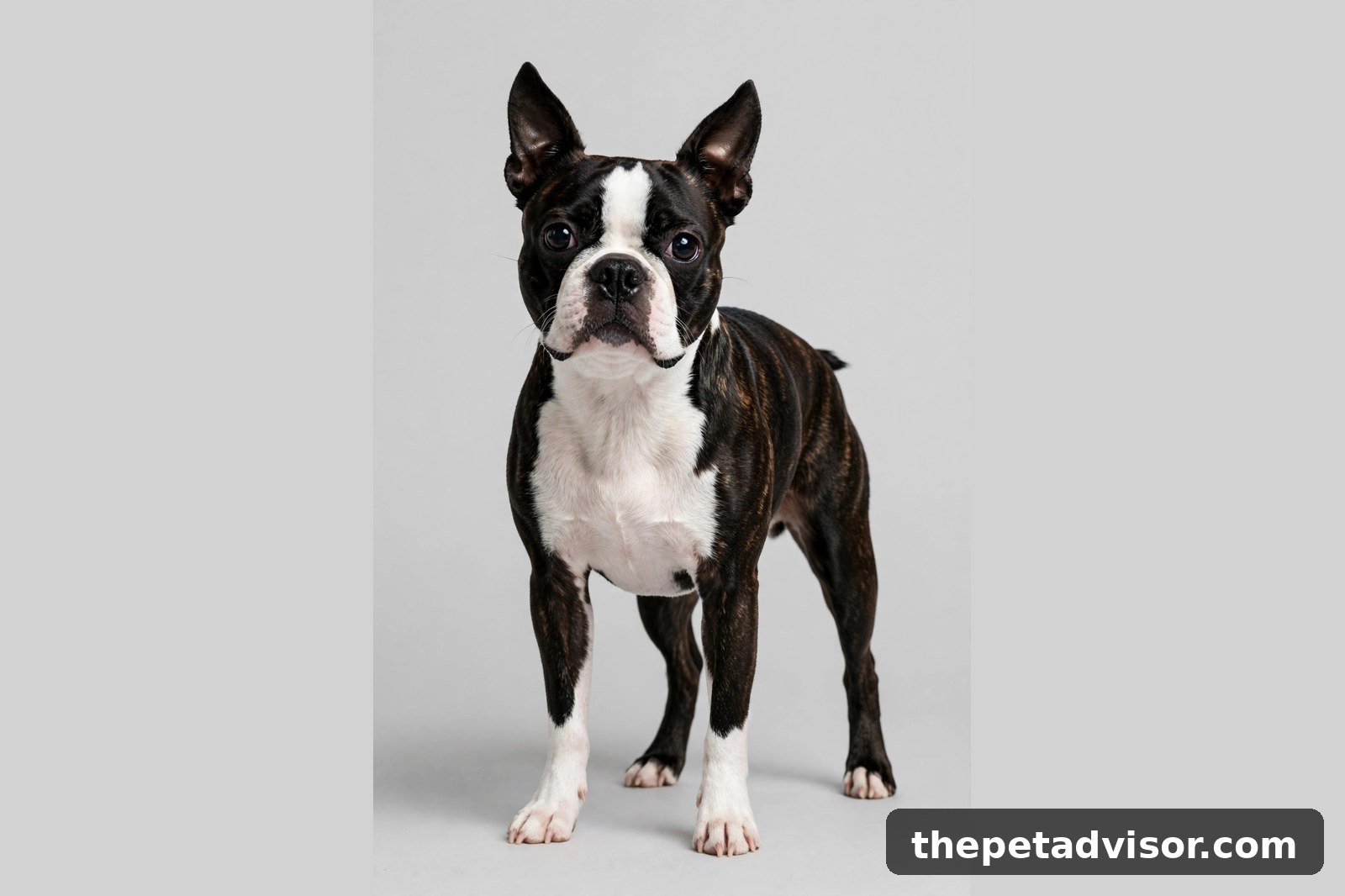
Do you have a photo of a Boston Terrier in the American show ring? We’d love this page to lead with one. If you have a show photo you’d let us use, email it to [email protected] — tell us the dog’s name and the show, and it may be featured here. Please only send photos you took yourself or have the photographer’s permission to share, and tell us the photographer’s name. We couldn’t find a public photo of a Boston Terrier in the American show ring that we were free to share, so the photo leading this page was made with AI. We’d much rather lead with a real one — if you’re a club member with an approved photo, we’d love to feature it.
1. Breed at a glance
Non-Sporting — recognized by the AKC in 1893; first member of the Non-Sporting Group when it was formed in 1923
Three weight classes: under 15 lb; 15 to under 20 lb; 20 to 25 lb. Typically about 15–17 in tall; the standard sets weight classes, not height.
Short, smooth, fine. Brindle, seal, or black, evenly marked with white; white muzzle band, white blaze between the eyes, white forechest required.
Friendly, bright, amusing. Lively, intelligent, and people-oriented; an excellent companion dog.
11 to 13 years.
Size, coat, and temperament facts are from the AKC standard (approved February 11, 2011; effective March 30, 2011) and the AKC breed page. Height (typically 15 to 17 inches) is from breed guides; the standard gives weight classes only. Lifespan (11 to 13 years) is from the AKC breed page. The 1923 Non-Sporting Group detail is from the AKC breed history article.
2. History
The Boston Terrier began with one dog. Around 1870, William O’Brien of Boston purchased a Bulldog-Terrier-type dog from England and sold him to Robert C. Hooper, also of Boston. The dog — a dark-brindle, square, blocky-headed dog weighing a stocky 32 pounds, with a white stripe on half his face — became known as Hooper’s Judge, and he is the patriarch of the breed: a cross between an English Bulldog and the White English Terrier, a breed popular in England in the late 19th century and now extinct. Judge was bred to a small white bulldog-type female named Gyp, owned by Edward Burnett of Southboro, Massachusetts. (Source: AKC, Boston Terrier History.)
The early dogs had no settled name. Breeders called them Round Heads, Bullet Heads, American Bull Terriers, and Boston Bulls, and in 1889 about thirty owners formed the American Bull Terrier Club. Bull Terrier fanciers objected to the name, and the club reorganized as the Boston Terrier Club of America in 1891, taking the name of the city where the breed developed. The AKC registered the first Boston Terrier in 1893 — 75 Bostons approved for the AKC Stud Book that year — making the Boston one of the first breeds developed in the United States to earn AKC recognition. (Sources: AKC, Boston Terrier History; Boston Terrier Society, What Is The Boston Terrier Club Of America?.)
The nickname followed the look. The dark coat with its even white markings reads as a tuxedo jacket, and the breed’s impeccable manners earned it the name “the American Gentleman.” When the AKC formed the Non-Sporting Group in 1923, the Boston Terrier was its first member. The breed has been a companion first for well over a century: the standard’s job was never field work, and the modern Boston is exactly what the early breeders were selecting for — small, sturdy, good-mannered, and funny. (Sources: AKC Boston Terrier breed page; AKC, Boston Terrier History.)
3. The standard and why it’s written that way
- General appearance — lively, highly intelligent, compactly built, short-tailed, well balanced. “The Boston Terrier is a lively, highly intelligent, smooth coated, short-headed, compactly built, short-tailed, well balanced dog, brindle, seal or black in color and evenly marked with white.” That one sentence carries the whole breed: the liveliness, the smooth coat, the short head, the compact build, the short tail, and the tuxedo markings. (Source: AKC standard.)
- Size — three weight classes, no height in the standard. “Weight is divided by classes as follows: Under 15 pounds; 15 pounds and under 20 pounds; 20 pounds and not to exceed 25 pounds.” The classes are show divisions, not feeding targets. The standard sets no height; Boston Terriers are commonly listed at about 15 to 17 inches tall. (Source: AKC standard.)
- Color — brindle, seal, or black with white markings. “Brindle, seal, or black with white markings. Brindle is preferred ONLY if all other qualities are equal.” Seal appears black except it has a red cast when viewed in the sun or bright light. The required markings are a white muzzle band, a white blaze between the eyes, and a white forechest. Solid black, solid brindle, or solid seal without the required white markings is a disqualification, as is any color not described in the standard. (Source: AKC standard.)
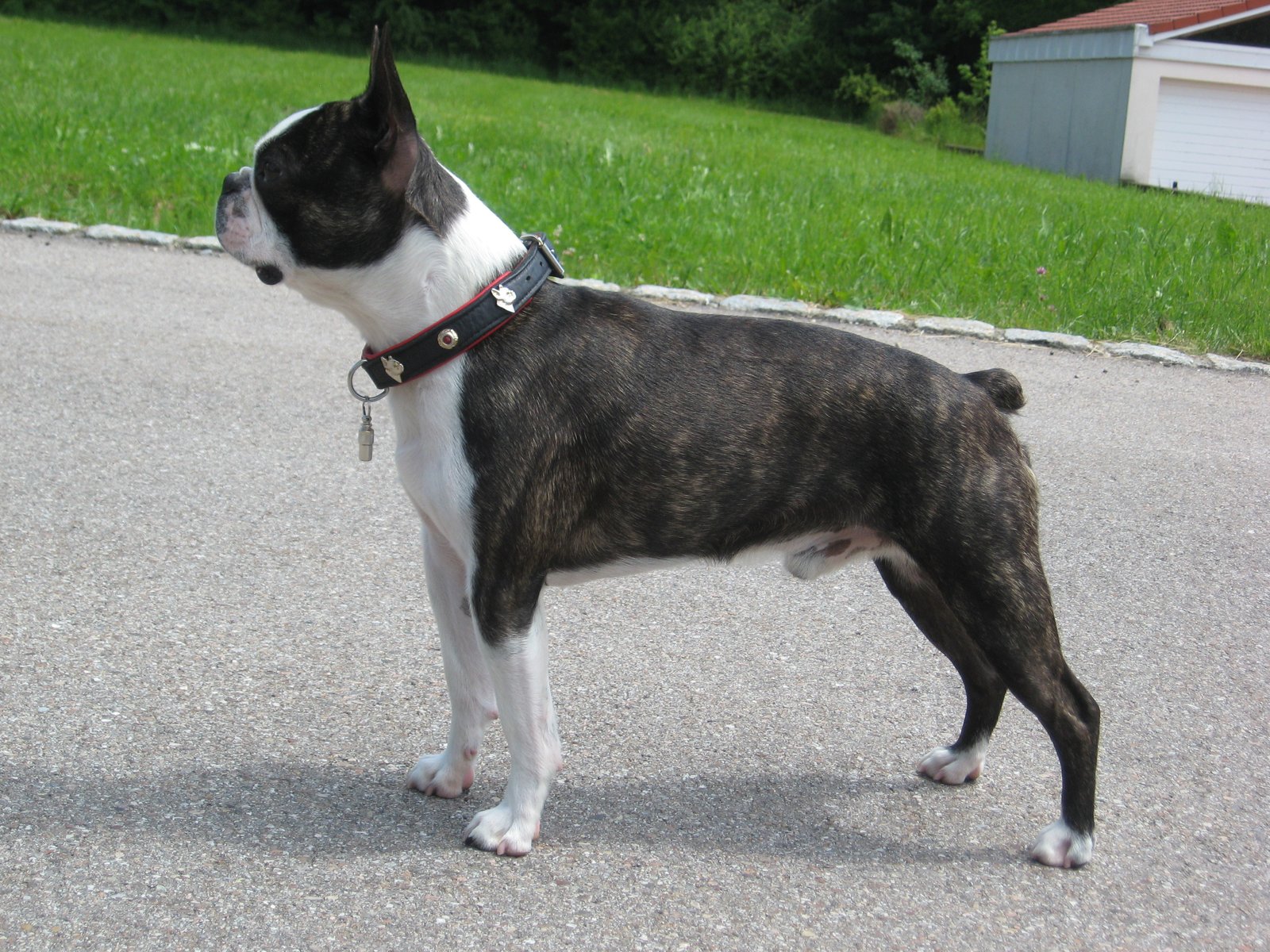
- The head: square, flat on top, with large round dark eyes. The head is square, the skull flat on top and free from wrinkles, the muzzle short. The eyes are large, round, and dark, set wide apart, and they carry the breed’s expression — the “friendly glow” the AKC breed page describes. The ears are small and carried erect. Blue eyes, or any trace of blue, are a disqualification. (Sources: AKC standard; AKC breed page.)
- Coat and tail — short, smooth, and fine; a short tail, never docked. The coat is short, smooth, bright, and fine in texture, and it needs little more than a weekly brushing. The tail is short, straight or screw-shaped. A docked tail is a disqualification, as is a Dudley nose. (Source: AKC standard.)
- Gait — smooth and rhythmic, with a jaunty stride. The Boston moves with a jaunty, rhythmic stride that shows off the breed’s enthusiasm — the AKC describes the stride as one of the traits that conveys the dog’s personality. The movement is sure-footed and straight, front and rear. (Sources: AKC standard; WebMD, All About Boston Terriers.)
- Temperament, in the standard’s own words. The standard describes a friendly and lively dog with an excellent disposition and a high degree of intelligence — a wonderful companion dog. The AKC’s three-word summary matches: friendly, bright, amusing. (Sources: AKC standard; AKC breed page.)
4. Temperament & living with one
The AKC sums the breed up in three words: friendly, bright, and amusing. Boston Terriers are people-oriented dogs that love to engage with the world around them — people in particular — and their jaunty, rhythmic stride helps convey a bit of their enthusiastic personalities. They are an endless source of amusement and a fantastic family pet: the AKC gives them five out of five for affection, five out of five for openness with strangers, and five out of five for being good with children. (Sources: AKC Boston Terrier breed page; WebMD, All About Boston Terriers.)
That devotion has a practical side. Boston Terriers are highly intelligent, have lots of energy, and require a lot of engagement — they will happily play games like fetch for hours at a time — and they respond best to positive reinforcement, shutting down if treated harshly. They can suffer from separation anxiety when left alone too often, and they can become possessive of their toys and food. They are very people-oriented and, the AKC notes, “they love nothing better than going along” — a Boston follows its people from room to room and wants to be part of whatever they are doing. (Sources: WebMD, All About Boston Terriers; AKC Boston Terrier breed page.)
The flat face sets the limits. Boston Terriers snort, grunt, and snore, and as a brachycephalic breed they overheat in summer heat and struggle with strenuous exercise in hot weather — keep exercise moderate, keep them cool, and never leave one in a hot car. They are adaptable apartment dogs with moderate exercise needs: a couple of walks and play sessions a day, plus games that use their brains, will keep a Boston happy. Early, thorough socialization keeps their friendliness broad rather than narrow. (Sources: WebMD, All About Boston Terriers; Petful, Boston Terrier breed profile.)
5. Grooming
- Brush once a week. The short, smooth coat needs little more than a weekly brushing with a soft-bristle brush or a rubber grooming mitt to remove loose hair and keep it bright. Boston Terriers shed moderately, with heavier shedding in spring and fall. (Sources: WebMD, All About Boston Terriers; Petful, Boston Terrier breed profile.)
- Bathe only occasionally. Unless a Boston has gotten into something messy, a bath every month or so is plenty; over-bathing strips the coat’s natural oils. Wipe the face and around the eyes with a damp cloth as needed. (Sources: WebMD, All About Boston Terriers; Petful, Boston Terrier breed profile.)
- Watch the prominent eyes. Those big round eyes are the breed’s glory and its weak point: check them regularly, keep the face clean, and see a veterinarian promptly for squinting, cloudiness, or discharge. Corneal injuries are one of the common reasons a Boston ends up at the vet. (Source: WebMD, All About Boston Terriers.)
- Nails, teeth, and ears. Trim nails regularly, brush teeth at least twice a week, and check and clean the ears weekly. The short version: grooming a Boston is the easy part of owning one; the work is companionship, training, and keeping a flat-faced dog cool. (Source: Petful, Boston Terrier breed profile.)
6. Health testing
- Three evaluations for a CHIC number. For a CHIC number, the Boston Terrier needs three evaluations: an annual Ophthalmologist Evaluation by a boarded ACVO ophthalmologist, a Patella Evaluation, and a BAER hearing test. That is the parent club’s list on the AKC’s Non-Sporting Group health-testing page. Breeders must agree to have all test results, positive or negative, published in the CHIC database. (Sources: AKC Non-Sporting Group Health Testing Requirements; Boston Terrier Club of America health statement.)
- Eyes — annual exam, every year. The eye exam is annual and must be done by a boarded veterinary ophthalmologist, with results registered with OFA. It screens for hereditary eye conditions, including cataracts and corneal dystrophy. The exam is required every year, not once: eyes change, and the annual exam catches problems while they are still small. (Source: Boston Terrier Club of America health statement.)
- Patellas — every two years, from 12 months. The patellar luxation exam is done by any licensed veterinarian, with results registered with OFA, once every two years; OFA registration is open only to dogs 12 months or older. A luxating patella — a kneecap that slips out of place — is one of the most commonly cited problems in the breed. (Sources: Boston Terrier Club of America health statement; AKC Non-Sporting Group Health Testing Requirements.)
- Hearing — BAER, once in a lifetime. The BAER (Brainstem Auditory Evoked Response) exam screens for congenital deafness, a documented risk in the breed, and it is required only once in the dog’s life, after 35 days of age; most breeders test puppies at six to eight weeks. It is the only accurate way to tell whether a dog hears in one ear, both ears, or neither. (Source: Boston Terrier Club of America health statement.)
- HSF4 juvenile cataracts — the DNA test behind most Boston cataracts. The parent club adds one test beyond the CHIC three: a DNA test for early-onset hereditary juvenile cataracts, caused by a mutation in the HSF4 gene, with results registered with OFA. A DNA test identifies normal, carrier, and affected dogs. Because other forms of cataract also occur, the annual eye exam with a canine ophthalmologist still matters. (Sources: Boston Terrier Club of America health statement; AKC breed-specific DNA testing recommendations.)
- Breathing — the flat face needs grading, not guessing. Boston Terriers are brachycephalic, and airway obstruction is the breed’s most serious welfare issue. The parent club offers OFA Respiratory Function Grading System testing at its national specialty, which grades brachycephalic airway severity — an increasingly important tool as the breed community works on improving respiratory health. Ask a breeder whether the parents have been graded, and keep any Boston lean, cool, and out of strenuous exercise in heat. (Source: Furry Critter Network, Boston Terrier breed guide.)
- Lifespan: 11 to 13 years. The commonly published lifespan is 11 to 13 years. (Source: AKC Boston Terrier breed page.)
7. The annual Boston Terrier specialty dog show
A specialty is the breed’s All-Star show — its Super Bowl. Once a year, the best Boston Terriers from across the country, and often from around the world, come together in one place.
The Boston Terrier Club of America’s national specialty: one national event each year, with conformation, obedience, rally, futurity, sweepstakes, junior showmanship, and a Parade of Titleholders. The 2026 national: April 30–May 1, at the Alexis Park Hotel in Las Vegas, Nevada, with 181 competitors and 210 entries in conformation. The 2025 national: April 30–May 2, at the Owensboro Convention Center in Owensboro, Kentucky, with 163 competitors and 183 entries. The 2024 national: May 16–17, at the Embassy Suites by Hilton in Tampa, Florida, with 167 competitors and 191 entries. The 2027 national: April 15–16, at the Embassy Suites by Hilton Omaha La Vista Hotel & Conference Center in La Vista, Nebraska.
The standard, in brief: a lively, highly intelligent, smooth-coated, short-headed, compactly built, short-tailed, well-balanced dog, brindle, seal, or black in color and evenly marked with white. Weight in three classes: under 15 pounds; 15 pounds and under 20 pounds; 20 pounds and not to exceed 25 pounds. Required markings: white muzzle band, white blaze between the eyes, white forechest. Eyes large, round, and dark, set wide apart; ears small and carried erect. Tail short, straight or screw; a docked tail a disqualification.
The 2026 National Specialty — the 131st Annual National Specialty and 42nd Rotating National Specialty Show, national week Monday, April 27, through Friday, May 1, 2026, at the Alexis Park Hotel, 375 East Harmon Avenue, Las Vegas, Nevada. Conformation Thursday, April 30, through Friday, May 1, 2026: regular dog and bitch classes and junior showmanship Thursday, Parade of Titleholders and Best of Breed Friday. Futurity, Puppy and Veteran Sweepstakes, and the 4–6 Month Beginner Puppy Competition Wednesday, April 29. Obedience and rally trials Monday and Tuesday, April 27–28. Host club specialties: Sierra Gold Boston Terrier Club, Monday and Tuesday, April 27–28. Entry: 210 entries / 181 competitors (72 dogs, 110 bitches). Entries opened Wednesday, February 18, 2026, at noon, and closed Wednesday, April 15, 2026. Event Chair: Marc Kelly. Event Secretary: Lorraine Yu (DogZibit). (Sources: AKC event search, event 2026213801; 2026 combined judging program.)
National specialty judges: Mrs. Beverly Staley — regular classes, junior showmanship, and Best of Breed. Ms. Jodi Koon and Mrs. Margaret Noble — Futurity. Ms. Helen Dunning — Puppy and Veteran Sweepstakes. Mr. Curt Allen Curtis — Obedience #1, Rally #1, and Rally #3. Ms. Karla Curtis — Rally #2, Obedience #2, and Obedience #3. (Source: 2026 combined judging program.)
Results (2026 national). Best of Breed, Best of Opposite Sex, Winners Dog, and Winners Bitch not confirmed in an official source as of November 2026. Best Junior Handler: Gideon Towell; Reserve Best Junior Handler: Olivia Keller. (Source: AKC event search, event 2026213801.)
The 2027 National Specialty: a two-day event April 15–16, 2027, at the Embassy Suites by Hilton Omaha La Vista Hotel & Conference Center, 12520 Westport Parkway, La Vista, Nebraska, per the AKC Upcoming National Specialties list. Super/Secretary: Lorraine Yu. AKC event number, judges, entries, and closing date not yet published as of November 2026. (Sources: AKC Upcoming National Specialties; Embassy Suites Omaha La Vista.)
Past national specialties: 2025 · 2024
Boston Terrier Club of America — bostonterrierclubofamerica.org
8. Regional specialties through the year: smaller regional shows
The national is the anchor, but the breed’s year also runs through regional specialties — smaller regional shows, not the national — held by regional Boston Terrier clubs around the country. These are the 2026 regionals verified from club sources so far:
Two regional Boston Terrier specialties verified for 2026 so far, both held by the Sierra Gold Boston Terrier Club during national week in Las Vegas:
- Sierra Gold Boston Terrier Club 54th Specialty — Monday, April 27, 2026, Las Vegas, Nevada: at the Alexis Park Hotel, 375 East Harmon Avenue. Judges: Mr. Shawn Brown — bitches; Mr. Steven Webb — Best of Breed. 188 Boston Terriers entered, total entry 209. (Source: 2026 combined judging program; AKC event 2026507304.)
- Sierra Gold Boston Terrier Club 55th Specialty — Tuesday, April 28, 2026, Las Vegas, Nevada: at the Alexis Park Hotel, 375 East Harmon Avenue. Judges: Mr. Gerry McCallum — bitches and Puppy Sweepstakes; Ms. Cynthia Pagurski — Veteran Sweepstakes (substituting for Mr. Jason Hoke); Mr. Jason Hoke — junior showmanship and Best of Breed. 196 Boston Terriers entered, total entry 277. (Source: 2026 combined judging program; AKC event 2026507306.)
Past regional specialties: 2025
More regional specialties will be added here as their programs are verified — this section is built from show data, not guesswork. Browse upcoming show weekends →
9. Clubs
- Boston Terrier Club of America (BTCA) (parent club) — the AKC-recognized national breed club for the Boston Terrier, formed in 1891, and the parent club of around 25 affiliate Boston Terrier clubs across the country. It maintains the breed standard, holds the national specialty each year, runs the health certification program and the judges education program, and keeps a breeder referral list. (Sources: Boston Terrier Society, What Is The Boston Terrier Club Of America?; AKC, Boston Terrier History.)
- Sierra Gold Boston Terrier Club — the California affiliate that hosts its own specialties during national week in Las Vegas, including the 54th and 55th specialties in 2026. See section 8.
- Heartland Boston Terrier Club — the host club for the 2025 national specialty in Owensboro, Kentucky, and the club behind that year’s regional specialty. See sections 7 and 8.
- Florida Suncoast Boston Terrier Club — the host club for the 2024 national specialty in Tampa, Florida. See section 7.
- Boston Terrier Club of New York — an affiliate of the Boston Terrier Club of America, active since 1906, and linked to rescue resources. (Source: PetsWelcome, Boston Terrier Clubs in the US.)
- Boston Terrier Club of Maryland — a nonprofit affiliate founded in 1931, dedicated to rescue and to permanent homes for rescued Boston Terriers. (Source: PetsWelcome, Boston Terrier Clubs in the US.)
If you are new to the breed, the national specialty itself is the better first stop than a breeder’s website: the people there have owned, shown, and lived with Bostons, and they will tell you the truth about the snorting, the shedding, and the separation anxiety before you fall for a puppy.
10. Rescue
- Boston Terrier Club of America rescue. The parent club runs a rescue network through breed-specific volunteers, and the AKC club directory lists the club’s breed rescue contact as Cindy Pagurski of Lombard, Illinois. The club’s rescue work connects owners surrendering Boston Terriers with new homes. Start with the parent club if you do not know which group covers your area. (Sources: AKC club directory, Boston Terrier Club of America; Furry Critter Network, Boston Terrier breed guide.)
- American Boston Terrier Rescue & Rehoming (ABTRR). A national breed rescue listed alongside the parent club in breed-club and rescue directories. (Source: Stop Online Puppy Mills, Breed Club and Rescue Links directory.)
- Midwest Boston Terrier Rescue (MABTR). A regional rescue working to match people with the right dogs, including puppies on occasion; puppies under six months are not posted online, and an adoption application puts you on the list to be notified when puppies arrive. (Source: MidAmerica Boston Terrier Rescue.)
- Boston Terrier Rescue of Tennessee. Another regional group in the breed directories. (Source: Stop Online Puppy Mills, Breed Club and Rescue Links directory.)
- Adults, usually — and usually with a known temperament. A rescued Boston is usually an adult, and it will arrive with its temperament visible before you commit. What you get in return is a dog whose character you can see before you commit and a lower price. Ask the rescue about the dog’s breathing, hearing, and eyes — the three things the breed’s health testing covers — and be honest with yourself first: a Boston is a brachycephalic companion that wants to be with its people, not a dog that stays quietly in the yard.
11. Breeder vs. rescue: honest guidance
- If you buy: start with the parent club, the Boston Terrier Club of America, and its breeder referral. Ask for the parents’ health results — the three CHIC evaluations (annual eye exam, patellas, BAER hearing) plus the HSF4 juvenile cataract DNA test — and look the results up in the OFA database yourself. Expect to wait for a puppy from a careful breeder: a good breeder will have the answers, will ask you as many questions as you ask them, and will take the puppy back for its whole life if you cannot keep it.
- If you rescue: a rescued Boston is usually an adult, and it will arrive with its temperament visible before you commit. What you get in return is a dog whose character you can see before you commit and a lower price. Either way, be honest with yourself first: a Boston needs daily company and moderate exercise, early socialization, and an owner who understands a flat-faced companion that snorts, overheats in summer heat, and follows its people from room to room rather than expecting a dog that stays quietly in the yard.
- Watch out for “rare” colors. The standard recognizes three colors only — brindle, seal, and black, each with white markings. Gray, liver, blue, red, and other colors are not in the standard, and a seller’s “rare” label is a sales description, not a mark of quality or health. Judge the dog in front of you against the standard — the tuxedo markings, the white muzzle band, blaze, and forechest, the large round dark eyes — not against a listing’s adjectives.
12. Claim this page
This page belongs to the breed, and the people who know the breed best are the Boston Terrier Club of America and its members. If you are with the parent club — or you are a breeder, a judge, a handler, or a rescue volunteer who spotted something wrong, missing, or out of date — this page is yours to set straight. Tell us what needs fixing and where the correction is documented, and we will fix it and credit the source. Contact the site through the About page, and mention “Boston Terrier breed profile.”
Sources
- AKC Boston Terrier breed page — akc.org/dog-breeds/boston-terrier
- AKC, Boston Terrier History: Where the Breed Originated — akc.org/expert-advice/dog-breeds/boston-terrier-history
- AKC Official Standard of the Boston Terrier (approved February 11, 2011; effective March 30, 2011), via the Boston Terrier Club of America — bostonterrierclubofamerica.org/about-boston-terriers/boston-terrier-breed-standards.htm
- AKC Non-Sporting Group Health Testing Requirements — akc.org/breeder-programs/breed-health-testing-requirements/non-sporting-group-health-testing-requirements
- Boston Terrier Club of America health statement (CHIC requirements) — cdn.akc.org/Marketplace/Health-Statement/Boston-Terrier.pdf
- AKC breed-specific DNA testing recommendations — akc.org/breeder-programs/dna/dna-resource-center/akc-dna-health/breed-specific-dna-testing-recommendations
- AKC Upcoming National Specialties — apps.akc.org/apps/events/conformation/national_specialties.cfm
- 2026 combined judging program, Sierra Gold BTC & BTCA — showdogvideopros.com/BostonTerrier/BTCA2026/BTCA2026JP.pdf
- 2026 national, AKC event search, event 2026213801 — apps.akc.org/apps/events/search/index_results.cfm
- BTCA 2025 National Specialty Results — bostonterrierclubofamerica.org (2025 results)
- 2025 national catalog — bostonterrierclubofamerica.org (2025 catalog)
- 2025 national, AKC event search, event 2025213810 — apps.akc.org/apps/events/search/index_results.cfm
- 2024 national catalog — bostonterrierclubofamerica.org (2024 catalog)
- 2024 national, AKC event search, event 2024213810 — apps.akc.org/apps/events/search/index_results.cfm
- Visit Owensboro, Boston Terrier Conference — visitowensboro.com/2025/03/boston-terrier-conference
- 1061 Evansville, schedule of events for the 2025 Boston Terrier Specialty Show — 1061evansville.com (2025 schedule)
- Embassy Suites Omaha La Vista Hotel & Conference Center — hilton.com (Omaha La Vista)
- Boston Terrier Club of America, AKC club directory — apps.akc.org/apps/club_search (BTCA)
- Boston Terrier Society, What Is The Boston Terrier Club Of America? — bostonterriersociety.com/boston-terrier-club-of-america
- PetsWelcome, Boston Terrier Clubs in the US — petswelcome.com/articles/boston-terrier-clubs-in-the-us.html
- Stop Online Puppy Mills, Breed Club and Rescue Links directory — stoponlinepuppymills.org/breed-club-and-rescue-links
- MidAmerica Boston Terrier Rescue — adoptaboston.com/boston-terrier-breeders
- Furry Critter Network, Boston Terrier breed guide — furrycritter.com/pages/descriptions/dogs/b/boston.htm
- WebMD, All About Boston Terriers — webmd.com/pets/dogs/what-to-know-boston-terrier
- Petful, Boston Terrier breed profile — petful.com/dog-breeds/breed-profile-boston-terrier
- Andreas Schlaugat, Boston Terrier with a black brindle coat, CC BY 3.0 via Wikimedia Commons — commons.wikimedia.org/wiki/File:Boston-terrier-carlos-de.JPG
