
Breed profile · Hound Group · recognized 1891
Borzoi
The Borzoi is a tall, long-coated Russian sighthound — calm and dignified in the house, capable of 35 to 40 miles per hour in the field. The American Kennel Club recognized the breed in 1891, when it was still called the Russian Wolfhound; the name was changed to Borzoi in 1936. The Borzoi Club of America's national specialty gathers the breed's best in Cheyenne, Wyoming, in May 2027.
Help us improve it. This is one of ThePetAdvisor’s breed profiles, built from public sources with generous links to the people who actually own this breed’s knowledge. If something’s off or missing, the parent club can claim the page and set it straight — see the bottom of the page.
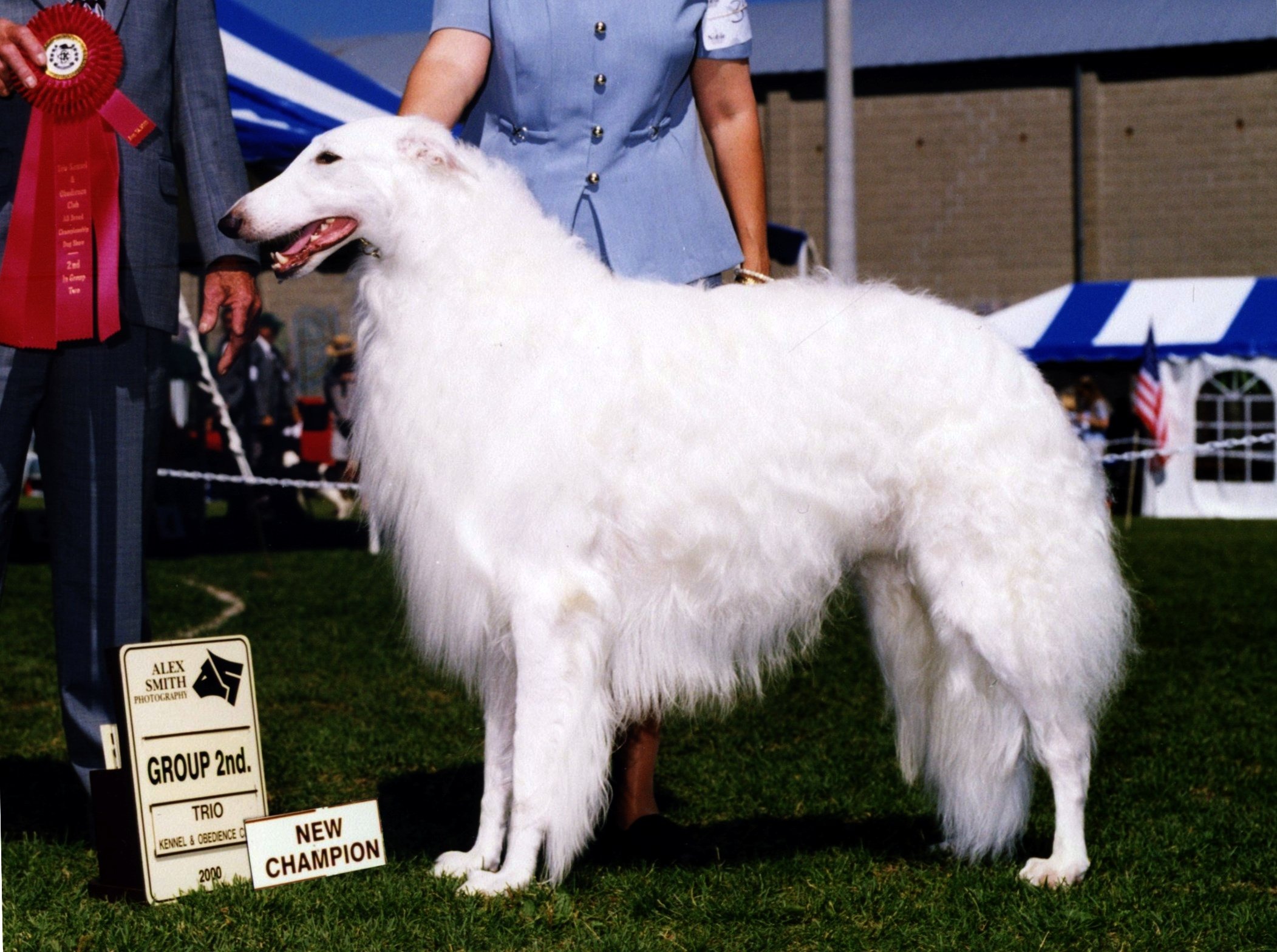
Do you have a better photo of a Borzoi in the American show ring? If you have a show photo you’d let us use, email it to [email protected] — tell us the dog’s name and the show, and it may be featured here. Please only send photos you took yourself or have the photographer’s permission to share, and tell us the photographer’s name.
1. Breed at a glance
At a glance:
- Group: Hound.
- AKC recognition: 1891, as the Russian Wolfhound. The first Borzoi registered with the American Kennel Club was Princess Irma, in 1891. The breed's name was changed to Borzoi in 1936.
- Parent club: Borzoi Club of America, Inc., founded November 12, 1903 as the Russian Wolfhound Club of America at the Brooklyn Bench Show; elected to membership in the American Kennel Club on May 19, 1904.
- Size: mature males at least 28 inches at the withers, mature bitches at least 26 inches; dogs and bitches below those limits are severely penalized, and dogs above them are not penalized as long as the extra size is not acquired at the expense of symmetry, speed, and staying quality.
- Weight: males 75 to 105 pounds, bitches 15 to 20 pounds less.
- Life expectancy: 9 to 14 years.
- Coat: long, silky (not woolly), flat, wavy or rather curly; a profuse, rather curly frill on the neck and long, profuse feathering on the hindquarters and tail.
- Color: any color, or combination of colors, is acceptable.
- Temperament: calm and agreeable — a quiet, dignified sighthound that can run 35 to 40 miles per hour.
- Former name: Russian Wolfhound (until 1936).
2. History
The Borzoi's written history reaches back to 1650, when the first standard for the breed was written in its homeland, Russia. For centuries the breed was the coursing hound of the Russian aristocracy — bred to chase, catch, and hold wolves and other game on open terrain, relying on sight rather than scent. Russian fanciers formed the Imperial Association to protect and promote the breed's qualities, and the bloodlines of many Borzoi in America trace back to dogs from its members' kennels, among them Grand Duke Nicholas, the uncle of Czar Nicholas II, and the wealthy landowner Artem Boldareff. Leo Tolstoy immortalized the Russian aristocracy's staged wolf hunts in War and Peace.
The American story began with imports from England. The first Borzoi known to have been imported to the United States was Elsie, bought from Britain by a Pennsylvania man named William Wade. In the 1890s, C. Steadman Hanks visited Russia and imported Borzoi directly from their homeland to found his Seacroft Kennels. Princess Irma was the first Borzoi registered with the American Kennel Club, in 1891. In 1903, Joseph B. Thomas helped to establish the breed in America by making three trips to Russia to buy dogs from Grand Duke Nicholas's Perchino Kennel and Artem Boldareff's Woronzova Kennel; his Valley Farm Kennel name had been registered with the AKC in December 1901.
The national club followed the same year. On November 12, 1903, at a meeting held at the Brooklyn Bench Show, exhibitors and others interested in the Russian Wolfhound organized a specialty club to be known as the “Russian Wolfhound Club of America,” and appointed an executive committee — Dr. J. E. de Mund, James Mortimer, and Joseph B. Thomas — to draft a constitution and a breed standard. The constitution and standard were approved at a meeting held during the Westminster Kennel Club show on February 4, 1904, and the club was elected to membership in the American Kennel Club on May 19, 1904. Dr. de Mund served as the club's first president, holding that office for the first six years and off and on until his death. The official breed standard was formally adopted in 1905 and has remained largely the same since, with revisions in 1940 and 1972. In 1936, the breed's name was changed from Russian Wolfhound to Borzoi, and the club's name changed to the Borzoi Club of America.
The Russian Revolution of 1917 ended the era of the noble hunt, and the breed survived abroad — in England, where the first Borzoi club had been founded in 1892, and in America. The club's recorded national-specialty history runs back to 1928, in New York, and the Borzoi Club of America remains one of the oldest parent clubs in the American Kennel Club, a member for over 100 years.
3. The standard and why it's written that way
The AKC standard for the Borzoi, approved June 13, 1972, describes a courser first and a show dog second — and it means it. Every point below comes from the standard itself.
- General appearance: the Borzoi was originally bred for the coursing of wild game on more or less open terrain, relying on sight rather than scent. To accomplish this purpose, the Borzoi needed particular structural qualities to chase, catch, and hold his quarry. Special emphasis is placed on sound running gear, strong neck and jaws, courage and agility, combined with proper condition. The Borzoi should always possess unmistakable elegance, with flowing lines, graceful in motion or repose. Males, masculine without coarseness; bitches, feminine and refined. (AKC breed standard)
- Head: skull slightly domed, long and narrow, with scarcely any perceptible stop, inclined to be Roman-nosed. Jaws long, powerful and deep, somewhat finer in bitches but not snipy. Teeth strong and clean with either an even or a scissors bite. Missing teeth should be penalized. Nose large and black. (AKC breed standard)
- Eyes: set somewhat obliquely, dark in color, intelligent but rather soft in expression; never round, full nor staring, nor light in color; eye rims dark; inner corner midway between tip of nose and occiput. (AKC breed standard)
- Ears: small and fine in quality, lying back on the neck when in repose with the tips when thrown back almost touching behind occiput; raised when at attention. (AKC breed standard)
- Neck, shoulders, and chest: neck clean, free from throatiness, slightly arched, very powerful and well set on. Shoulders sloping, fine at the withers and free from coarseness or lumber. Chest rather narrow, with great depth of brisket. Ribs only slightly sprung, but very deep, giving room for heart and lung play. (AKC breed standard)
- Back and loins: back rising a little at the loins in a graceful curve. Loins extremely muscular, but rather tucked up, owing to the great depth of chest and comparative shortness of back and ribs. (AKC breed standard)
- Legs and feet: foreleg bones straight and somewhat flattened like blades, with the narrower edge forward. The elbows have free play and are turned neither in nor out. Pasterns strong. Feet hare-shaped, with well-arched knuckles, toes close and well padded. Hindquarters long, very muscular and powerful with well bent stifles; somewhat wider than the forequarters; strong first and second thighs; hocks clean and well let down; legs parallel when viewed from the rear. (AKC breed standard)
- Tail: long, set on and carried low in a graceful curve. (AKC breed standard)
- Coat: long, silky (not woolly), either flat, wavy or rather curly. On the head, ears and front of legs it should be short and smooth; on the neck the frill should be profuse and rather curly. Feather on hindquarters and tail, long and profuse, less so on chest and back of forelegs. (AKC breed standard)
- Color: any color, or combination of colors, is acceptable. (AKC breed standard)
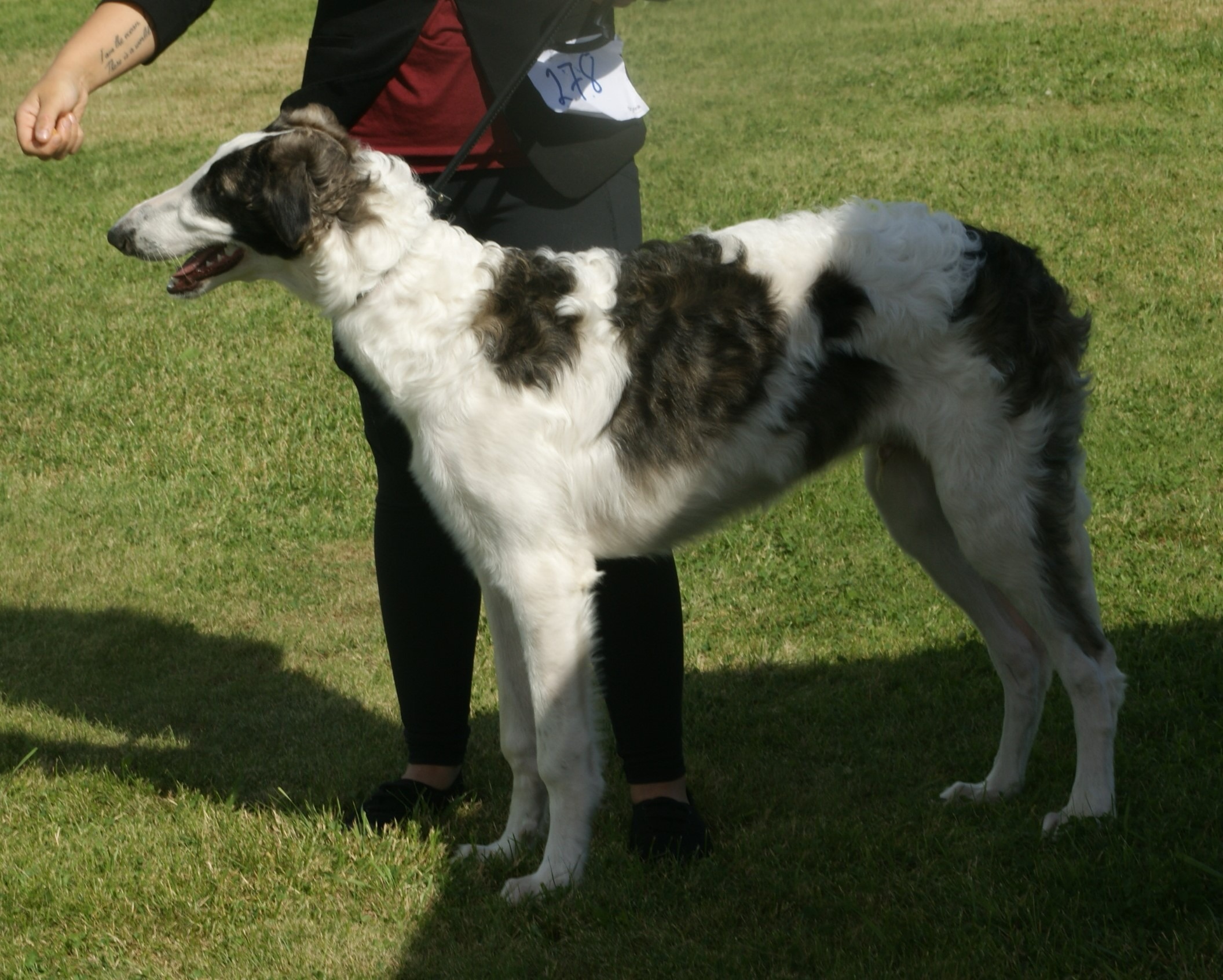
- Size: mature males should be at least 28 inches at the withers and mature bitches at least 26 inches at the withers. Dogs and bitches below these respective limits should be severely penalized; dogs and bitches above the respective limits should not be penalized as long as extra size is not acquired at the expense of symmetry, speed and staying quality. Range in weight for males from 75 to 105 pounds and for bitches from 15 to 20 pounds less. (AKC breed standard)
- Gait: front legs must reach well out in front with pasterns strong and springy. Hackneyed motion with mincing gait is not desired nor is weaving and crossing. While the hind legs are wider apart than the front, the feet tend to move closer to the center line when the dog moves at a fast trot. When viewed from the side there should be a noticeable drive with a ground-covering stride from well-angulated stifles and hocks. The overall appearance in motion should be that of effortless power, endurance, speed, agility, smoothness and grace. (AKC breed standard)
- Why the standard is written this way: everything in it serves the chase. The long, narrow head and deep jaws catch and hold quarry; the arched loin and tucked-up loins are the gallop's engine; the deep chest gives heart and lung room; the blade-flat forelegs and hare feet are built for speed over open ground; the long, silky coat protects without woolly bulk. The size minimums keep the dog a genuine courser, not a toy version of one — and “any color” is honest, because the coursing field never cared what color the dog was.
4. Temperament & living with one
The Borzoi is the dog world's quiet aristocrat. The AKC calls the temperament calm and agreeable, and that is the breed in a sentence: a dignified, undemonstrative dog that bonds to its people without fawning over them, and that is content to lie at your feet for hours — provided it has had its run. Borzoi are sensitive dogs. They notice tone of voice, they dislike raised voices and rough handling, and they take training at their own pace, on their own terms.
The run is not optional. A Borzoi can fly by at 35 to 40 miles per hour, and it needs a daily chance to run full out in a safely fenced area. Never exercise a Borzoi off-leash in open country: a sighthound that sees a deer, a rabbit, or a squirrel is gone, and recall is not reliable against prey. Fences must be tall and secure, and gates must latch — a Borzoi is an athlete that can clear a surprising height and slip a surprising gap.
With people, Borzoi are gentle and polite rather than effusive. They are usually patient with children but do best with respectful, older children, and they are aloof with strangers rather than suspicious — a Borzoi is no guard dog. Early socialization matters: a Borzoi that meets the world as a puppy grows into a confident adult; one that doesn't can grow shy and spooky.
With other animals, the prey drive is the whole story. Cats and small animals need careful introductions and supervision, and some Borzoi can never be trusted loose with them. Borzoi are generally good with other large dogs. Training works best with gentle consistency — short, upbeat, reward-based sessions. Heavy-handed methods shut a Borzoi down, and a shut-down Borzoi simply stops offering anything at all.
5. Grooming
The coat is the work. The Borzoi's long, silky coat is not woolly, but it mats where it rubs — behind the ears, under the legs, and in the feathering on the hindquarters and tail. Brush two to three times a week with a pin brush and a comb, more often in shedding season, and bathe only when the dog is actually dirty: over-bathing strips the silky texture the standard calls for.
What needs attention instead:
- Ears: small and fine, but check them weekly — the long coat traps moisture around them, and the ears lie back on the neck where problems hide.
- Feet: hare-shaped feet with feathering between the toes. Keep the hair between the pads trimmed so the dog doesn't slip, and keep the nails short — a running dog with long nails is a dog that strains.
- Teeth: brush regularly; the standard penalizes missing teeth, and a Borzoi's long jaw is worth protecting.
- Shedding: moderate, year-round, with seasonal peaks. The silky coat drops hair rather than blowing an undercoat, but a Borzoi still leaves hair on furniture and clothing.
- Cold and heat: the coat is not woolly and offers less insulation than it looks. A coat for cold walks and a warm bed are not luxuries for this breed — and in heat, shade and water, never a hot car.
6. Health testing
The Borzoi Club of America's CHIC program turns health testing into a checklist with numbers you can verify — four tests are required for a CHIC number.
Required for a CHIC number:
- Eyes — CAER/ACVO eye examination by a board-certified veterinary ophthalmologist.
- Thyroid — thyroid evaluation through an OFA-approved laboratory.
- Cardiac — advanced cardiac evaluation (echocardiogram) by a board-certified cardiologist.
- Degenerative myelopathy — DNA test for the SOD1 mutation.
Recommended in addition:
- Hips — OFA or PennHIP evaluation.
- Elbows — OFA evaluation.
- Holter monitoring — 24-hour Holter monitoring for cardiac rhythm.
Some conditions of concern have no screening test: bloat and gastric dilatation-volvulus, osteosarcoma, hemangiosarcoma, chylothorax, and lung lobe torsion. Ask the breeder what has appeared in their lines and what they screen for. And one practical note for any veterinarian treating your dog: Borzoi, like other sighthounds, are sensitive to anesthesia — make sure the clinic knows the breed. When you talk to a breeder, ask for the OFA or CHIC numbers — and look them up on the OFA database before you put down a deposit.
7. The annual Borzoi specialty dog show
A specialty is the breed’s All-Star show — its Super Bowl. Once a year, the best Borzoi from across the country, and often from around the world, come together in one place.
The Borzoi Club of America’s national specialty: the annual Borzoi specialty dog show. The 2027 national: May 13–15, 2027, at the Little America Hotel & Resort in Cheyenne, Wyoming, Super/Secretary Laura Anninos. The 2026 national: May 14–16, 2026, at the Courtyard Omaha Bellevue at Beardmore Event Center in Bellevue, Nebraska, 233 dogs in the entry. Best of Breed: GCH Meyta Loverboy Romeo Auroral. The 2025 national: April 24–26, 2025, at the MeadowView Conference Resort and Convention Center in Kingsport, Tennessee, 238 dogs in the entry. Best of Breed: GCh Katz Orb Of Deception. The 2024 national: June 6–8, 2024, at the Red Lion Pasco Airport & Conference Center in Pasco, Washington, 183 dogs in the entry. Best of Breed: GCh Rey's Summerlane Night Wind At Regius. The 2023 national: April 27–29, 2023, at The Founders Inn and Spa in Virginia Beach, Virginia, 169 dogs in the entry. Best of Breed: DC Téine RunTuff Suffragette City, MC, FCh.
The 2026 National Specialty — national week Saturday, May 9 – Saturday, May 16, 2026, at the Courtyard Omaha Bellevue at Beardmore Event Center, 3730 Raynor Parkway, Bellevue, NE. Conformation Thursday, May 14 – Saturday, May 16, 2026. Entries closed Wednesday, April 8, 2026. AKC event number 2026116707. Event chair: Robin Casey; event secretary: Lorraine Yu (DogZibit). Conformation: Dr. Fausto Cavalieri (233 Ent – 114d – 119b). Sweepstakes: Kristen Suhrenbrock. Futurity: Melanie Richards. Obedience and Rally: Randy Capsel. Dual Champion Stakes: Rebecca Peters-Campbell. Junior Showmanship: Barbara Scherer. National-week field events: lure-coursing tests Saturday, May 9 – Sunday, May 10 at the Cass County Fairgrounds, Weeping Water/Manley, NE (events 2026116701/6702). AKC National Owner-Handled Series offered; points for reserve available. (Sources: Borzoi Club of America, 2026 National Specialty results; AKC event search, event 2026116707.)
Results (2026 national). Best of Breed: GCH Meyta Loverboy Romeo Auroral (dog). Best of Opposite Sex, Best of Winners, and Winners Bitch: Luxor Ravenna Shake Your Money Maker. Winners Dog: Brossok RunTuff Laelaps Red Za'atar CGC. Best Junior Handler: Olivia McDonald; Reserve Best Junior Handler: Kendall Parker. Sweepstakes, futurity, obedience, rally, and Dual Champion Stakes winners not confirmed in an accessible official source. (Sources: Borzoi Club of America, 2026 National Specialty results; AKC event search, event 2026116707.)
The 2027 National Specialty: conformation Thursday, May 13 – Saturday, May 15, 2027 (3 days), at Little America Hotel & Resort, 2800 W Lincolnway, Cheyenne, Wyoming. Super/Secretary: Laura Anninos. Judges, premium, AKC event number, entry fees, entries opening/closing, event chair, and national-week dates beyond the three conformation days not yet published as of November 7, 2026. (Sources: AKC, Upcoming National Specialties; Little America Hotel & Resort, Cheyenne.)
Past national specialties: 2025 · 2024 · 2023
8. Regional specialties through the year: smaller regional shows
The national is the anchor, but the breed’s year also runs through regional specialties — smaller regional shows, not the national — held by the Borzoi Club of America’s member clubs around the country, usually as designated specialties with all-breed shows or as hosted specialties during national week. These are the 2026 regionals verified from club and AKC sources so far:
Five Borzoi regional specialties verified for 2026 beyond the national itself:
- Borzoi Club of Delaware Valley 51st Specialty — Friday, May 1, 2026, South County Park, Hunterdon County Fairgrounds, 1207 Route 179, Lambertville, New Jersey: AKC event number 2026190401; entries closed Wednesday, April 15, 2026, 7:00 a.m. EST; entry limit 100. Event chair Daniel Brewer; event secretary Mary Mignogna (Mac Dog Shows). Conformation: Dr. K T Shimel (37 Ent – 19d – 18b); 46 entries, 37 competitors. (Source: AKC event search, event 2026190401.)
- Puget Sound Borzoi Club Specialties — Friday, July 31 – Saturday, August 1, 2026, Run Wild Dog Sports, 35612 212th Way SE, Auburn, Washington: AKC event numbers 2026190801/0802; entries closed Wednesday, July 15, 2026; entry limit 100. Event chair Janis Leikam; superintendent BaRay Event Services, Inc. Friday conformation: F R Vogel (38 Ent – 17d – 21b); 41 entries, 38 competitors; Best Junior Handler Bruce Eschler. Saturday judge and results not confirmed in an accessible official source. (Source: AKC event search, event 2026190801.)
- Rocky Mountain Borzoi Club 30th Independent Fall Specialty — Monday, September 7, 2026, Thompson Park, Longmont, Colorado: morning event 2026434308 and afternoon event 2026434307; afternoon conformation Carol Spritzer (26 entries). Morning judge and results not confirmed in an accessible official source. (Sources: Borzoi Club of America, Regional Specialties; Rocky Mountain Borzoi Club, 2026 premium list.)
- Turquoise Trail Borzoi Club Specialties — Saturday, October 31 – Sunday, November 1, 2026, Loretto Park, 237 S Camino Del Pueblo, Bernalillo, New Mexico: AKC event numbers 2026747806/0807/0808; entries close Wednesday, October 14, 2026, 11:00 a.m. MT; entry fees $30/$25. Event chair Richard K Fundom; superintendent Onofrio Dog Shows, L.L.C. Saturday conformation: Dr. Eric Liebes. Sunday judges and results not confirmed in an accessible official source. (Source: AKC event search, event 2026747806.)
- Borzoi Club of America designated specialty — Sunday, December 13, 2026, Orange County Convention Center, Orlando, Florida: a designated specialty inside the Hound Association of Central Florida group show at the AKC/Royal Canin National (shared AKC event 2026752107); entries through MB-F as part of the HACF show. Conformation: Carol Spritzer; group judge Mary Dukes; NOHS groups Marlene Groves. Entries close November 11, 2026. Show chair Jon Titus Steele. (Source: Borzoi Club of America, Regional Specialties.)
Past regional specialties: 2025 · 2024
More regional specialties will be added here as their programs are verified — this section is built from show data, not guesswork. Browse upcoming show weekends →
9. Clubs
The parent club is the Borzoi Club of America, Inc. (BCOA), founded November 12, 1903 as the Russian Wolfhound Club of America and elected to membership in the American Kennel Club on May 19, 1904 — one of the oldest parent clubs in the AKC, a member for over 100 years. The club runs the national specialty, publishes The Aristocrat, and supports the breed's rescue work. Club officers per the most recent premium verified (2023): President Ron Williams, Vice President Shirley McFadden. Current officers are listed on the club's site. (Borzoi Club of America)
Regional clubs include the Borzoi Association of New England, Borzoi Club of California, Borzoi Club of Central New Jersey, Borzoi Club of Delaware Valley, Borzoi Club of Greater New York, Borzoi Club of Greater Omaha, Borzoi Club of Northern California, Midwest Borzoi Club, Lone Star Borzoi Club, Potomac Valley Borzoi Club, Puget Sound Borzoi Club, Turquoise Trail Borzoi Club, and Rocky Mountain Borzoi Club.
The club is also active in the field: lure coursing and racing are part of national week, with lure-coursing tests held alongside the conformation show, and the club sanctions trophy-supported entries for Borzoi in areas with no regional club of their own.
10. Rescue
The National Borzoi Rescue Foundation (NBRF) — a 501(c)(3), all-volunteer, BCOA-backed rescue based in Dix, Illinois — has placed Borzoi since the mid-1990s, with an international arm since 2014. Contact: rescueborzoi.org, 844-627-3964. Dogs coming into rescue are spayed or neutered, temperament-assessed, and placed from foster homes by volunteers who know the breed.
The Borzoi Club of America itself runs a Rescue Committee, which plays a supportive role only — the foundation does the placing. Start with the NBRF, which can direct you to the rescue coordinator for your region.
Rescue Borzoi are usually adults or adolescents whose temperament is already known — a real advantage for a first-time Borzoi owner, provided the home has a safely fenced yard for running and can meet the breed's exercise and grooming needs.
11. Breeder vs rescue
From a breeder: expect a breeder who shows or courses their dogs, health-tests every breeding dog, and takes a dog back for life. Ask for CHIC numbers — eyes, thyroid, cardiac echocardiogram, and degenerative myelopathy DNA are required — plus the recommended hip and elbow evaluations and Holter monitoring, and verify them on the OFA database. Ask how the puppies are raised in the home, what the parents course or compete in, and what the breeder expects of you. A breeder who won't answer, or who has puppies always available, is a warning sign.
From rescue: expect an application, a phone interview, and often a home visit. Rescue dogs are adults or adolescents, spayed or neutered, temperament-tested, and placed by people who know the breed's needs — which means the rescue will ask hard questions about fencing, exercise, and work hours. That scrutiny is a feature: a Borzoi in a home with no safe place to run is a miserable dog.
Either way: the right question is not “breeder or rescue?” but “does this dog, and this source, fit a life with a quiet, fast, independent sighthound that needs a fenced run every day and gentle handling?” A Borzoi that runs and lives with its people is one of the great companions in the dog world. A Borzoi left alone in a yard is a tragedy in slow motion.
12. Claim this page
This page is maintained by ThePetAdvisor and built from public sources — the AKC standard, the Borzoi Club of America's publications, and AKC event records. If you are an officer of the Borzoi Club of America, a regional club officer, a rescue coordinator, or a breeder, and you spot an error or have a correction, we would rather hear it from you than from a search result.
Send corrections, specialty dates, or photos to [email protected] with “Borzoi” in the subject line. We check every message.
Sources
- American Kennel Club, Borzoi breed page
- American Kennel Club, Official Standard for the Borzoi (approved June 13, 1972)
- Borzoi Club of America, About the Borzoi Club of America, Inc.
- Borzoi Club of America, Borzoi Club of America History
- Borzoi Club of America, 2026 National Specialty results
- Borzoi Club of America, 2025 National Specialty results
- Borzoi Club of America, 2024 National Specialty results
- Borzoi Club of America, 2023 National Specialty results
- Borzoi Club of America, Specialty Cities, Dates, Judges, Counts
- Borzoi Club of America, Regional Specialties
- AKC, Upcoming National Specialties
- AKC event search, event 2026116707 (2026 national specialty)
- AKC event search, event 2025116703 (2025 national specialty)
- AKC event search, event 2024116701 (2024 national specialty)
- AKC event search, event 2026190401 (Borzoi Club of Delaware Valley, 2026)
- AKC event search, event 2026190801 (Puget Sound Borzoi Club, 2026)
- AKC event search, event 2026747806 (Turquoise Trail Borzoi Club, 2026)
- AKC event search, event 2025270301 (Potomac Valley Borzoi Club, 2025)
- AKC event search, event 2024270303 (Potomac Valley Borzoi Club, 2024)
- Little America Hotel & Resort, Cheyenne, Wyoming
- National Borzoi Rescue Foundation, Borzoi breed information
- Wikimedia Commons, Am-Can CH Abidjan's Mychtar of Ferlinka (Deb West, CC BY 2.0)
- Wikimedia Commons, Borzoi white and brindle (Canarian, CC BY-SA 4.0)

