Breed profile · Working Group · the gentle giant of the Swiss Alps
Bernese Mountain Dog
The Bernese Mountain Dog is a striking, tri-colored, large working dog from the Swiss canton of Bern — bred to pull carts, drive cattle, and guard the farm, and today one of the most good-natured family dogs in the Working Group. Its year turns on the annual Bernese Mountain Dog specialty dog show: the 2026 national was held May 13–16, 2026, in Albany, Oregon, and the 2027 national is set for April 29–May 1, 2027, at Purina Farms in Gray Summit, Missouri.
Help us improve it. This is one of ThePetAdvisor’s breed profiles, built from public sources with generous links to the people who actually own this breed’s knowledge. If something’s off or missing, the parent club can claim the page and set it straight — see the bottom of the page.
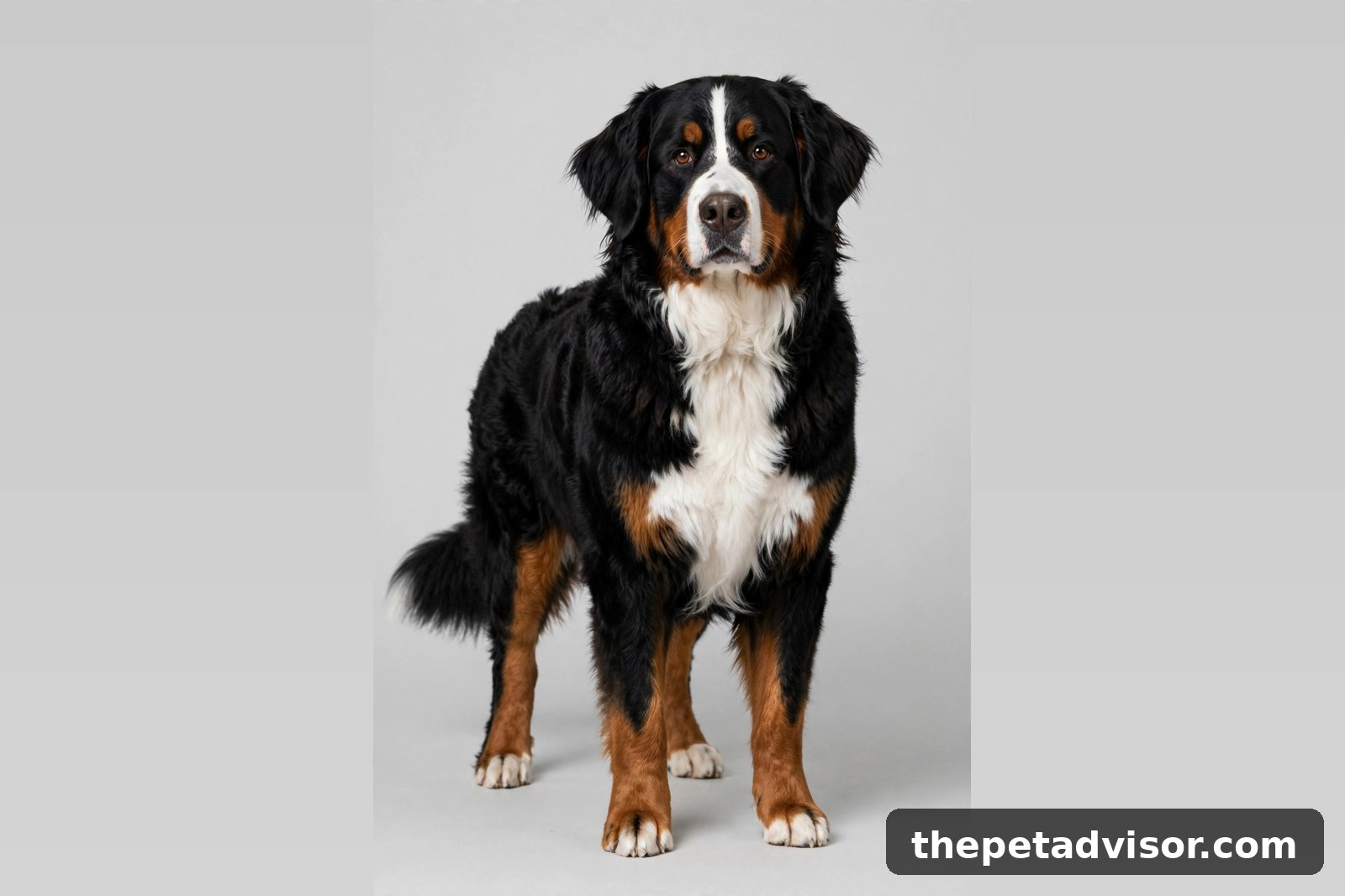
Do you have a photo of a Bernese Mountain Dog in the American show ring? We’d love this page to lead with one. If you have a show photo you’d let us use, email it to [email protected] — tell us the dog’s name and the show, and it may be featured here. Please only send photos you took yourself or have the photographer’s permission to share, and tell us the photographer’s name. We couldn’t find a public photo of a Bernese Mountain Dog in the American show ring that we were free to share, so the photo leading this page was made with AI. We’d much rather lead with a real one — if you’re a club member with an approved photo, we’d love to feature it.
1. Breed at a glance
Group: Working. AKC recognition: 1937. Life expectancy: 7–10 years.
- Size: dogs 25–27½ inches at the withers, bitches 23–26 inches; males 80–115 pounds, females 70–95 pounds; slightly longer in body than tall, with sturdy bone.
- Coat: thick, moderately long double coat, slightly wavy or straight, with a bright natural sheen; ground color jet black, with rich rust and clear white markings.
- Hallmark: the tri-color pattern — a white blaze and muzzle band, rust over each eye and on the cheeks, a white chest that typically forms an inverted cross, and a white-tipped tail.
- Temperament: good-natured, self-assured, placid towards strangers, docile; self-confident, alert, and good-natured, never sharp or shy.
- Best for: a family that wants a large, affectionate, steady dog and can handle heavy shedding and a short lifespan — and a household where someone is home most of the day.
- Watch for: heavy shedding, a 7–10 year lifespan with cancer the leading concern, bloat, heat sensitivity, and the cost of feeding and vetting a 100-pound dog.
2. History
The Bernese Mountain Dog comes from the canton of Bern, in Switzerland — one of the four Swiss mountain dogs, the Sennenhunde, the farm dogs of the Swiss Alps. For centuries, Berners worked the farms of the Bernese countryside: pulling carts loaded with milk and produce to market, driving cattle, and guarding the farmstead. The work shaped the dog — big and strong enough to pull a cart, steady enough to walk beside cattle, and gentle enough to live with the family that owned the farm.
The breed’s name is the place: Bern, the canton, and the city that is Switzerland’s capital. The dogs were the working dogs of the region’s farmers, not a kennel creation, and the standard still describes a farm dog first — sturdy, balanced, intelligent, strong, and agile enough to do the draft and droving work for which he was used in the mountainous regions of his origin.
The American Kennel Club recognized the breed in 1937, placing it in the Working Group. The Bernese Mountain Dog Club of America (BMDCA) was formed in 1968 and recognized by the AKC as the breed’s official parent club in 1981; it has about 1,200 members. The current standard was approved by the AKC on February 10, 1990.
Today the Berner still pulls — carting is a living sport for the breed, and the national specialty holds draft tests alongside the conformation show — and guards the family home the same way it once guarded a farm. The parent club’s national specialty has been held every year for decades: the 2026 gathering, in Albany, Oregon, was the 51st annual.
3. The standard and why it's written that way
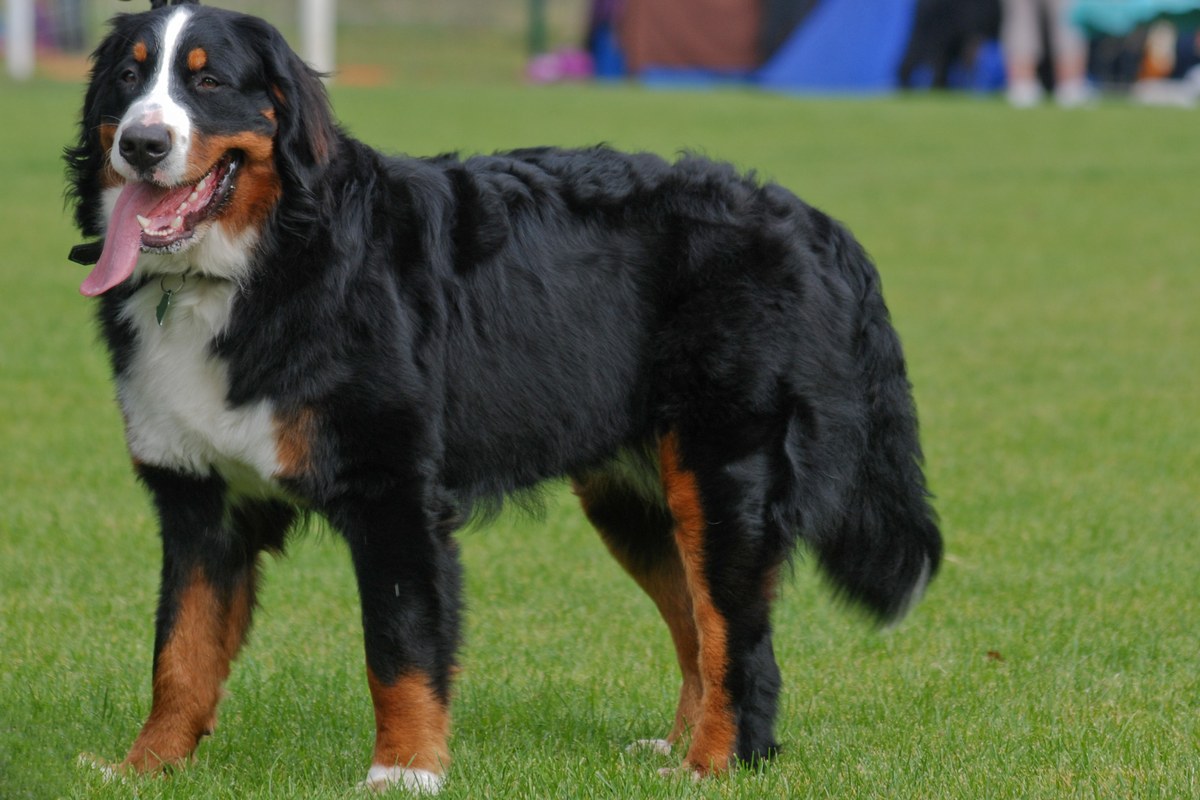
The standard describes a dog that is “striking, tri-colored, large” — sturdy and balanced, intelligent, strong, and agile enough for draft and droving work. Dogs appear masculine, bitches distinctly feminine. What it asks for, and why:
- Size and substance. Measured at the withers, dogs are 25 to 27½ inches; bitches are 23 to 26 inches. Though appearing square, Bernese Mountain Dogs are slightly longer in body than they are tall. Sturdy bone is of great importance, and the body is full. Males run 80 to 115 pounds, females 70 to 95 pounds.
- Head and expression. Expression intelligent, animated, and gentle. The eyes are dark brown and slightly oval, with close-fitting eyelids — inverted or everted eyelids are serious faults, and blue eye color is a disqualification. The ears are medium-sized, set high, triangular, gently rounded at the tip, hanging close to the head in repose. The nose is always black. The teeth meet in a scissors bite; an overshot or undershot bite is a serious fault.
- The double coat. The coat is thick, moderately long, and slightly wavy or straight, with a bright natural sheen. Extremely curly or extremely dull-looking coats are undesirable. The Bernese Mountain Dog is shown in natural coat, and undue trimming is to be discouraged.
- Color and markings. The Bernese Mountain Dog is tri-colored. The ground color is jet black. The markings are rich rust and clear white, and symmetry of markings is desired. Rust appears over each eye, on the cheeks reaching to at least the corner of the mouth, on each side of the chest, on all four legs, and under the tail. There is a white blaze and muzzle band. A white marking on the chest typically forms an inverted cross. The tip of the tail is white. White on the feet is desired but must not extend higher than the pasterns. Markings other than described are faulted in direct relationship to the extent of the deviation. White legs or a white collar are serious faults. Any ground color other than black is a disqualification.
- Topline and tail. The neck is strong, muscular, and of medium length. The topline is level from the withers to the croup. The tail is bushy, carried low when in repose; an upward swirl is permissible when the dog is alert, but the tail may never curl or be carried over the back. A kink in the tail is a fault.
- Gait. The natural working gait is a slow trot. In keeping with draft and droving work, the dog is capable of speed and agility, with good reach in front and powerful drive from the rear transmitted through a level back. There is no wasted action.
- Temperament in the standard. Self-confident, alert, and good-natured, never sharp or shy. The Bernese Mountain Dog should stand steady, though may remain aloof to the attentions of strangers.
4. Temperament & living with one
A Bernese Mountain Dog is a farm dog that moved into the house — and it shows in the temperament. The breed is good-natured, self-assured, and placid towards strangers, docile with its own people, and steady in new situations. A Berner does not startle easily, does not snap, and does not go looking for a fight. That steadiness is the point of the dog.
With its own family, a Berner is affectionate and devoted, and famously gentle with children. With strangers it is placid and may remain aloof — polite rather than effusive. Do not expect a Berner to be a social butterfly; reserve with strangers is in the standard, and it is not shyness.
Companionship. Berners were bred to work beside people all day, and they do not thrive left alone for long hours. A Berner left alone in a yard will be unhappy, and an unhappy Berner can be destructive. This is a dog for a household where someone is home most of the day, or where the dog goes along.
Training. Berners are eager to please and quick to learn, but slow to mature — expect a big, goofy adolescent for two years or more. Patient, consistent, positive training works best; harsh methods are unnecessary with a dog this willing. Socialize early and widely, and teach a reliable recall while the dog is still small enough to manage.
Exercise and heat. Moderate exercise suits a Berner: daily walks, play, and a yard to move in. The thick double coat makes the breed heat-sensitive — shade and water in summer, no hard work in the heat, and never leave a Berner in a hot car. In cold weather, a Berner is in its element.
The short life. The hardest part of living with a Berner is the lifespan: 7 to 10 years, and cancer takes many of them young. Go in with your eyes open, buy from health-tested parents, and enjoy every year.
5. Grooming
The Bernese Mountain Dog coat is beautiful and it is work. A weekly brush-out with a pin brush or slicker keeps it in order; during the spring and fall coat blows, when the undercoat comes out in handfuls, brush several times a week. Check behind the ears, under the collar, and in the feathering, where mats start.
- Never shave the double coat. The undercoat insulates against heat as well as cold, and a shaved coat grows back unevenly.
- Baths as needed. The black coat shows dust and the white shows dirt — but the coat sheds dirt as it dries, so a Berner often cleans up with a good brush-out after a muddy walk.
- Nails, ears, and teeth. Trim the nails regularly — a 100-pound dog with overgrown nails is hard on floors and on itself. Check the ears weekly and clean as needed; brush the teeth regularly.
- Show grooming. The coat is shown natural — bath, blow-dry, and brush-out, with no sculpting. Undue trimming is to be discouraged. Tidy the feet and keep the white clean; the dog does the rest.
6. Health testing
The Bernese Mountain Dog Club of America’s minimum recommended health testing — the CHIC (Canine Health Information Center) requirements for the breed — is hips, elbows, eyes, heart, and degenerative myelopathy, plus one optional test. A CHIC number means the tests were done and the results are public on the OFA website — ask any breeder for the parents’ CHIC numbers and verify them yourself.
Required tests:
- Hip evaluation — OFA, PennHIP, or OVC.
- Elbow evaluation — OFA or OVC.
- Eye examination by a board-certified ACVO ophthalmologist (CAER), registered with OFA.
- Cardiac evaluation by a cardiologist, registered with OFA.
- Degenerative myelopathy DNA test — for both the SOD1-A and SOD1-B variants.
Plus one additional test from:
- Von Willebrand’s Disease Type I DNA test
- Autoimmune thyroiditis evaluation
- Histiocytic Sarcoma Risk Test
The parent club also runs the Berner-Garde Foundation (incorporated 1995), a free public health and pedigree database of more than 220,000 dogs, where verified health results and AKC DNA numbers are recorded. A valid AKC DNA profile number is required for entry in all conformation and performance events at the BMDCA National Specialty.
Conditions to watch for: histiocytic sarcoma — the breed’s signature cancer, and the reason the parent club runs a Histiocytic Sarcoma Risk Test (a nine-gene risk test, scored A, B, or C) and liquid-biopsy research at its nationals; hip and elbow dysplasia; eye disorders including entropion and ectropion; von Willebrand’s disease; hypothyroidism; and degenerative myelopathy. As with any large, deep-chested breed, bloat (gastric dilatation-volvulus) is a risk — know the signs and ask the breeder about it. Life expectancy is 7–10 years.
7. The annual Bernese Mountain Dog specialty dog show
A specialty is the breed’s All-Star show — its Super Bowl. Once a year, the best Bernese Mountain Dogs from across the country, and often from around the world, come together in one place.
The Bernese Mountain Dog Club of America’s national specialty: the annual Bernese Mountain Dog specialty dog show. The 2027 national: April 29–May 1, 2027, at Purina Farms in Gray Summit, Missouri, with Sindi L Leo judging dogs and Erikas Piskunovas judging bitches. The 2026 national: May 13–16, 2026, at the Linn County Expo Center in Albany, Oregon, judged by Abigail Patrizio, Svante Frisk, and Joe Lobb. Best of Breed: GCHS Devael Track The Action. The 2025 national: May 1–3, 2025, at the Eisenhower Hotel & All Star Events Complex in Gettysburg, Pennsylvania, judged by Maddalena Manciani, Sara Karl, and Janet Lobb, 313 dogs in the entry. Best of Breed: GCHB BernerGarden’s Buttercup Bayley. The 2024 national: April 4–6, 2024, at the Purina Farms Events Center in Gray Summit, Missouri, judged by Satu Yla-Mononen, Jan Herngren, and Christine Mann. The 2023 national: April 2–9, 2023, at the California Expo & Fairgrounds in Sacramento, California, judged by Maija Heinila, Diane Anderson, and Elin Normannseth.
The standard, in brief: a striking, tri-colored, large dog, sturdy and balanced, intelligent, strong, and agile enough for the draft and droving work of his mountain home — dogs 25 to 27½ inches at the withers, bitches 23 to 26 inches, slightly longer in body than tall, sturdy bone of great importance — a thick, moderately long, slightly wavy or straight double coat with a bright natural sheen — ground color jet black, markings rich rust and clear white, symmetry desired, a white blaze and muzzle band, an inverted-cross marking on the chest, and a white-tipped tail — self-confident, alert and good-natured, never sharp or shy.
The 2026 National Specialty (51st) — a week of events Sunday, May 10 – Saturday, May 16, 2026, at the Linn County Expo Center, 3700 Knox Butte Rd E, Albany, Oregon. Conformation Wednesday, May 13 – Saturday, May 16, 2026: dogs Thursday, May 14; bitches Friday, May 15; Best of Breed Saturday, May 16. AKC event 2026183411, Parent Specialty (National Specialty). Intersex judge: Ms. Abigail Patrizio (USA). Dogs judge: Mr. Svante Frisk (Sweden). Bitches judge: Mr. Joe Lobb (Canada). Futurity judge: Brenda Calvelage. Sweepstakes & Veteran Sweepstakes judge: Ms. Wanda Tait (Canada). Junior Showmanship judge: Mr. Bryan Martin. Versatility Showcase judge: Ms. Raime Campbell. Superintendent: BaRay Event Services, Inc. Event chair: Linda Dalton. Host clubs (Zone 3): Greater Seattle, Oregon, Inland Northwest. Entries closed Wednesday, April 15, 2026, at 12:00 p.m. PDT. The entry: 259 dogs, 315 entries (115 dogs – 144 bitches). (Sources: Bernese Mountain Dog Club of America, 2026 Specialty; AKC event search, event 2026183411; BMDCA, 2026 national specialty premium list.)
Results (2026 national). Best of Breed: GCHS Devael Track The Action. Best Junior Handler: Addison Stabenow; Reserve Best Junior Handler: Serafina Hobbs. Best of Opposite Sex, Winners Dog, Winners Bitch, and sweepstakes/futurity winners not confirmed in an accessible official source. (Sources: Westminster Kennel Club, 2027 Westminster invitees (National Specialty Winners); AKC event search, event 2026183411.)
The 2027 National Specialty: national week Monday, April 26 – Saturday, May 1, 2027, at Purina Farms, Gray Summit, Missouri. Conformation Thursday, April 29 – Saturday, May 1, 2027 (3 days, per the AKC Upcoming National Specialties list). AKC event 2027183412. Dogs judge: Ms. Sindi L Leo. Bitches judge: Mr. Erikas Piskunovas. Junior Showmanship judge: Mrs. Hunter Couts (p). Intersex judge: To Be Assigned. Entries close Wednesday, March 31, 2027, at 12:00 p.m.; entries open Wednesday, February 17, 2027. Event chair: Dottie M Schulte. Event secretary: Lisa Merki ([email protected]). Superintendent not yet published as of November 2026. The AKC event page lists the Purina Farms address as 300 Checkerboard Drive; the parent club lists 500 William Danforth Way. Host clubs (Heartland/Zone 2): Buckeye, Grand Canyon State, Greater Twin Cities, Heart of Michigan, Heartland, Lone Star, North Coast, Northeastern Illinois, Rockies, and Southeastern Wisconsin. A second national-week event is listed for Monday, April 26, 2027 (AKC event 2027183417, show secretary Kris Osojnicki, entries close March 31, 2027); its event type is not confirmed. Future nationals: 2028 in Warwick, Rhode Island; 2029 on the West Coast. (Sources: AKC Upcoming National Specialties; AKC event search, event 2027183412; Bernese Mountain Dog Club of America, 2027 Specialty.)
Past national specialties: 2025 · 2024 · 2023
Bernese Mountain Dog Club of America — 2027 national specialty
8. Regional specialties through the year: smaller regional shows
The national is the anchor, but the breed’s year also runs through regional specialties — smaller regional shows, not the national — held by the parent club’s regional clubs around the country, usually as designated specialties with all-breed shows. These are the 2026 regionals verified from club and AKC sources so far:
Four regional specialties verified for 2026 so far:
- BMDCA Parent Specialty — Friday, January 2, 2026, Indio, California: at the Empire Equestrian Park and Polo Field. AKC event 2026183402. Judge Mrs. S L Novocin. The entry: 38 dogs, 43 entries. Entries closed Wednesday, December 17, 2025. Event chair: Bonnie Gould. (Source: AKC event search, event 2026183402.)
- Bernese Mountain Dog Club of Southeastern Wisconsin 45th and 46th Annual Local Specialty — Friday, February 27 – Saturday, February 28, 2026, West Bend, Wisconsin: at Washington County Fair Park, 3000 Hwy PV. AKC events 2026606601–2026606606. Friday (45th): 63 dogs, 99 entries; conformation judge Sindi Leo, sweepstakes judge JoAnna Matthisen. Saturday (46th): 69 dogs, 110 entries; conformation judge Joanne Leslie Gerow, sweepstakes judge Julie Siefert. Obedience & rally both days judged by Cindy Pischke. Show chair: Karen Borre. (Source: Bernese Mountain Dog Club of Southeastern Wisconsin, February 2026 marked catalog.)
- BMDCA Parent Specialty — Friday, September 25, 2026, Monroe, Michigan: at the Monroe County Fairgrounds, 3775 S Custer Rd. AKC event 2026183423. Judge Mrs. H Couts. The entry: 51 dogs, 61 entries. Best Junior Handler: Brooke Boeske; Reserve Best Junior Handler: Evan Record. Event chair: Brenda Calvelage. Superintendent: MB-F Inc. Entries closed Wednesday, September 9, 2026. (Source: AKC event search, event 2026183423.)
- Bernese Mountain Dog Club of the Rockies 27th and 28th Independent Specialty — Saturday, October 3 – Sunday, October 4, 2026, Aurora, Colorado: at the Arapahoe County Fairgrounds Event Center, 25690 E Quincy Ave. AKC events 2026631104 (Saturday) and 2026631107 (Sunday). Saturday: 65 dogs, 114 entries; breed judge Dee L McDuffee, sweepstakes judge Addy Cui, versatility judge Anne Summers, junior showmanship judge Kelli Kujawa. Sunday: 63 dogs, 111 entries; breed judge Joyce Siddall, sweepstakes judge Bill Lee, versatility judge Jacquie Hallenbeck. Obedience and rally on Friday, October 2, judged by Patricia L Maynard. Event secretary: Ginger Sammonds, c/o DogZibit. (Source: AKC, Bernese Mountain Dog Club of the Rockies October 2026 judging program.)
Past regional specialties: 2025
More regional specialties will be added here as their programs are verified — this section is built from show data, not guesswork. Browse upcoming show weekends →
9. Clubs
The parent club is the Bernese Mountain Dog Club of America (BMDCA), formed in 1968 and recognized by the AKC as the breed’s official parent club in 1981 — bmdca.org. The club runs the annual national specialty, maintains the Berner-Garde health database, and lists regional clubs and rescue contacts. It has about 1,200 members.
Regional clubs affiliated with the parent club include:
- Nashoba Valley
- Finger Lakes (NY)
- Central Virginia
- Blue Ridge
- Chattahoochee Valley
- Piedmont
- Three Rivers
- Hampton Roads
- Mason Dixon
- Potomac Valley
- Watchung
- Buckeye
- Grand Canyon State
- Greater Twin Cities
- Heart of Michigan
- Heartland
- Lone Star
- North Coast (Ohio)
- Northeastern Illinois
- Rockies
- Southeastern Wisconsin
- Northern California
- Sierra West
- Greater Seattle
- Oregon
- Southern California
10. Rescue
If a Bernese Mountain Dog comes into your life through rescue, it will usually be an adult whose temperament is already known — and that is an advantage with a large, powerful breed. The rescues below work with the breed specifically. The BMDCA’s own warning: “The BMDCA’s Rescue Committee, BARC Inc, and the Regional Club Rescues are the only valid, endorsed, and reputable Bernese Rescues in the U.S.”
- BMDCA Rescue & Rehome Committee: the parent club’s rescue program. Chair: Dawn Letry — [email protected].
- BARC Inc (Berner Auction Rescue Coalition): officialbarcinc.com — the parent club’s rescue auction arm.
- NorCal Bernese Mountain Dog Rescue: 220 Foster Ln, Dixon, CA 95620. (510) 991-6376. [email protected].
- Bernese Mountain Dog Club of the Rockies Rescue: Amanda Wilson Brazeal — [email protected], 970-213-2315. Serves Colorado, Utah, New Mexico, and Wyoming.
- Lone Star Rescue: Dawn Letry — 469-323-2038. Serves Texas, Arkansas, Oklahoma, and Louisiana.
- Bernese Mountain Dog Club of Southern California Rescue: Debi Lepoff — 818-621-1651.
A rescue Berner still needs the same things a puppy does: a secure fence, patient training, regular grooming, and an owner who understands a large, devoted dog with a short lifespan. Ask the rescue about the dog’s health history and any known conditions before adopting.
11. Breeder vs rescue
From a breeder: expect the parents’ CHIC health tests (hip and elbow evaluations, eye and cardiac exams, degenerative myelopathy DNA for both variants, plus one more from the list in section 6), with OFA/CHIC numbers you can verify on the OFA website and records in Berner-Garde; a health guarantee; a take-back commitment for the life of the dog; and questions about your home, your schedule, and your experience with large breeds. Puppies should be raised in the home and socialized early. Red flags: no health testing, no take-back, puppies always available, or a breeder who will not show you the parents’ test records.
From rescue: expect an adult dog whose temperament with children and other dogs is already known — a real advantage with a 100-pound breed — and an adoption process that asks about your fence, your schedule, and your experience. The adoption fee is far below a purchase price, and the dog still needs the same fence, grooming, and patience.
Either way, a Bernese Mountain Dog is a 7–10 year, 80–115-pound commitment with a heavy coat, a devoted temperament, and a cancer risk that no buyer should ignore. Choose the route that fits your household — then choose the individual dog, not the idea of the breed.
12. Claim this page
Are you the Bernese Mountain Dog Club of America, a regional club, or a breeder or rescue listed here? This page is maintained from public sources — if a date, a judge, or a result is wrong, or a link is out of date, tell us and we will fix it. Clubs and breeders who would like their events, health clinics, or rescue work featured can reach us at the same address.
Sources
- Bernese Mountain Dog Club of America — Breed Standard (approved by the AKC 2/10/90)
- Bernese Mountain Dog Club of America — Health Tests & Screening
- Bernese Mountain Dog Club of America — Recommended Testing (CHIC/BRT minimum)
- Bernese Mountain Dog Club of America — Rescue
- Bernese Mountain Dog Club of America — General Specialty Information
- American Kennel Club — Upcoming National Specialties
- Bernese Mountain Dog Club of America — 2027 Specialty
- AKC event search — 2027 national specialty, event 2027183412
- Bernese Mountain Dog Club of America — 2026 Specialty
- Bernese Mountain Dog Club of America — 2026 national specialty premium list
- AKC event search — 2026 national specialty, event 2026183411
- Bernese Mountain Dog Club of America — 2025 Specialty
- Jim Rau Dog Shows — 2025 BMDCA National judging program
- AKC event search — 2025 national specialty, event 2025183411
- Bernese Mountain Dog Club of America — 2024 Specialty
- American Kennel Club — 2024 BMDCA National Specialty premium list
- AKC event search — 2024 national obedience, event 2024183407
- Bernese Mountain Dog Club of America — National Specialty Show Results
- Westminster Kennel Club — 2027 Westminster invitees (National Specialty Winners)
- AKC event search — 2026 Indio parent specialty, event 2026183402
- AKC event search — 2026 Monroe parent specialty, event 2026183423
- Bernese Mountain Dog Club of Southeastern Wisconsin — February 2026 marked catalog
- American Kennel Club — Bernese Mountain Dog Club of the Rockies October 2026 judging program
- American Kennel Club — Whidbey Island Kennel Club November 2025 premium list
- AKC event search — 2025 Silver Falls supported entry, event 2025183421
- Wikimedia Commons — Bernese Mountain Dog, Rybnik 2011 (Lilly_M, CC BY-SA 3.0) — section 3 photo
