
Breed profile · Herding Group · the elegant, agile herder of Belgium
Belgian Tervuren
The Belgian Tervuren — the Terv — is an elegant, agile herding dog of medium size from Belgium: a long-coated, fawn-to-mahogany dog with a black overlay, a black mask, and mostly black ears, standing squarely on all fours with proud carriage of head and neck. The AKC calls it “a bright and self-assured herding dog of medium size, known to be affectionate and possessive with loved ones,” and adds that “lots of hard work and challenging play is heaven for this tireless, do-it-all dog.” It is one of four Belgian shepherd varieties — and in the United States, a breed of its own, with its own standard, its own parent club, and its own national specialty.
One of four Belgian shepherd varieties — and in the United States, a breed of its own: the AKC treats the Belgian Tervuren, the Belgian Sheepdog (Groenendael), the Belgian Malinois, and the Belgian Laekenois as separate breeds, each with its own standard, parent club, and national specialty. This page covers the Tervuren only.
Help us improve it. This is one of ThePetAdvisor’s breed profiles, built from public sources with generous links to the people who actually own this breed’s knowledge. If something’s off or missing, the parent club can claim the page and set it straight — see the bottom of the page.
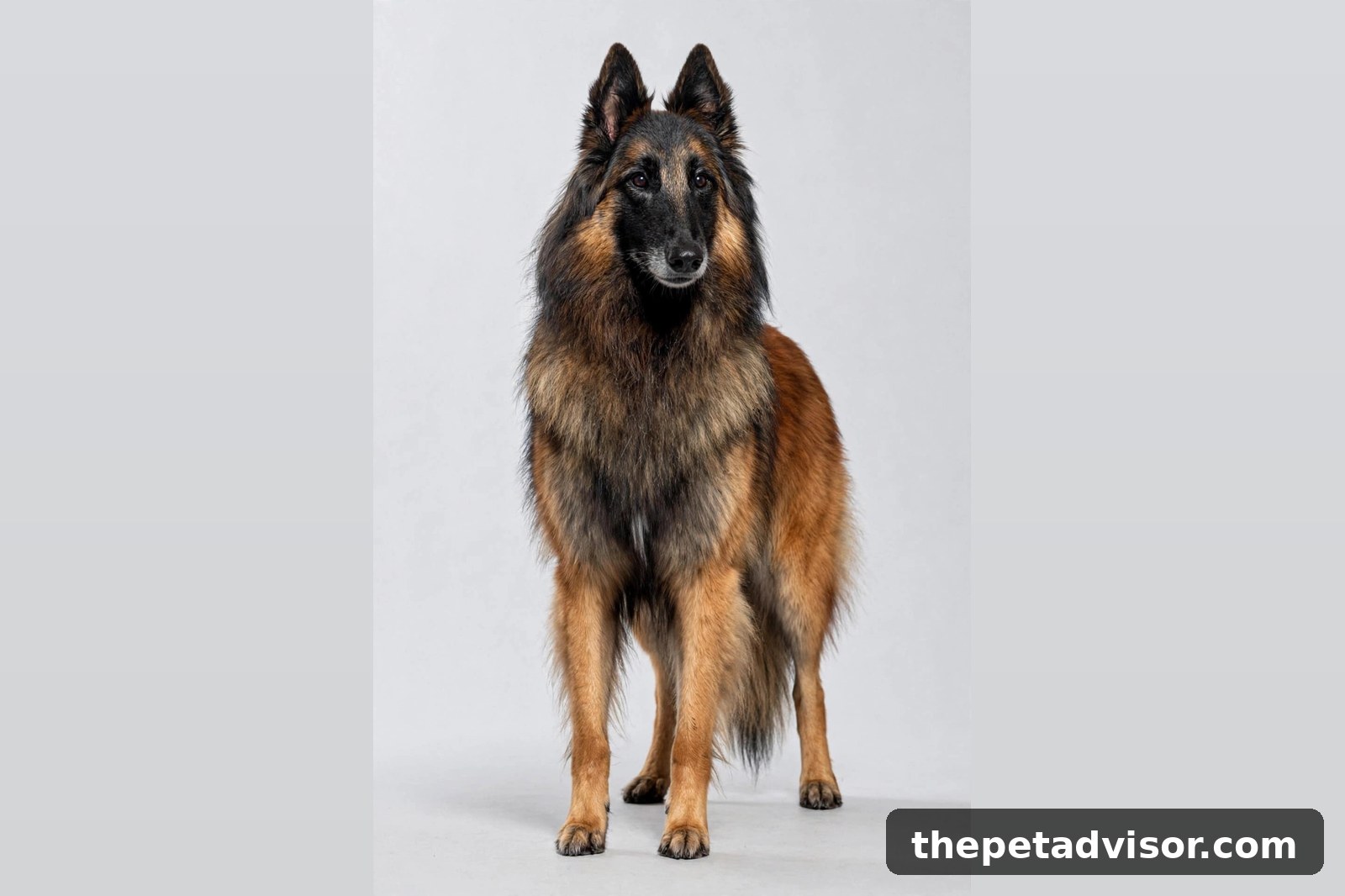
Do you have a photo of a Belgian Tervuren in the American show ring? We’d love this page to lead with one. If you have a show photo you’d let us use, email it to [email protected] — tell us the dog’s name and the show, and it may be featured here. Please only send photos you took yourself or have the photographer’s permission to share, and tell us the photographer’s name. We couldn’t find a public photo of a Belgian Tervuren in the American show ring that we were free to share, so the photo leading this page was made with AI. We’d much rather lead with a real one — if you’re a club member with an approved photo, we’d love to feature it.
1. Breed at a glance
Herding — recognized by the AKC as a separate breed in 1959; in the Working Group until the Herding Group was established in 1983
Dogs 24–26 in, bitches 22–24 in at the withers. Weight about 45–75 lb; males 55–75 lb, females 45–60 lb.
Long, abundant double coat; guard hairs straight, of medium harshness. Rich fawn to russet mahogany with black overlay, black mask and ears.
Intelligent, courageous, alert, and devoted to master. Observant and vigilant with strangers, but not apprehensive; affectionate and possessive with those he knows.
10 to 12 years.
Size, coat, and temperament facts are from the AKC standard (approved January 9, 2007; effective March 1, 2007) and the AKC Belgian Tervuren breed page. Weight by sex and lifespan (10 to 12 years) are from Dog-Learn, Belgian Tervuren.
2. History
The Belgian shepherd story starts in the late nineteenth century, when Belgian fanciers set out to decide whether an authentic Belgian shepherd dog existed at all. In 1891, veterinary professor Adolphe Reul coordinated a gathering of shepherd-type dogs near Brussels, and he and his fellow judges concluded that such a dog — squarely built and medium-sized, with brown eyes and high-set, triangular ears — did indeed exist, in several varieties set apart by coat texture, length, and color. The first breed standard for the Belgian Shepherd Dog followed in 1892. The Tervuren variety takes its name from the Belgian village of Tervuren, where the breeder M.F. Corbeel kept two long-haired, fawn-colored dogs named Tom and Poes; they were the grandparents of Milsart, whelped in 1896, who became the first Belgian Tervuren champion. (Sources: AKC, Belgian Tervuren History: A True Renaissance Dog; Dog-Learn, Belgian Tervuren.)
In America the three varieties were first registered together: by 1912 the AKC registered them all as Belgian Sheepdogs, and the first Tervuren was registered with the AKC in 1918. Following the Great Depression the breed nearly disappeared — the American Belgian Sheepdog Club dissolved and the AKC shifted the breed to the Miscellaneous class. After World War II, interest revived, a new club was established, and American enthusiasts began importing dogs from Belgium to re-establish the breed. In the 1950s some breeders began to advocate separating the three Belgian Sheepdog varieties into distinct breeds, and the AKC acceded in 1959, establishing three Belgian herding breeds: the Belgian Sheepdog, the Belgian Malinois, and the Belgian Tervuren. The American Belgian Tervuren Club was founded in 1960, shortly after the split. (Sources: AKC, Belgian Tervuren History; American Belgian Tervuren Club, About the Club.)
The parent club’s motto sums up what the breed is for: “A well-balanced Tervuren has a CH (Championship) on one end and a UDT (Utility Dog Tracker) on the other.” Tervuren fanciers take that balance seriously — by one longtime breeder’s count, ninety-eight percent of the breed’s champions hold multiple titles, in obedience, herding, tracking, Schutzhund, and service work. Today many Tervs work on farms, serve as search-and-rescue dogs, and compete in dog sports from conformation to agility to obedience. (Source: AKC, Belgian Tervuren History.)
3. The standard and why it’s written that way
- General appearance — well-balanced, medium-size, elegant, square. “The first impression of the Belgian Tervuren is that of a well-balanced, medium-size dog, elegant in appearance, standing squarely on all fours, with proud carriage of head and neck. He is strong, agile, well-muscled, alert and full of life. He gives the impression of depth and solidity without bulkiness.” The standard adds that the Tervuren “reflects the qualities of intelligence, courage, alertness and devotion to master,” and that the highest value goes to the qualities that maintain its working ability: “specifically, correct temperament, gait, bite and coat.” (Source: AKC standard.)
- Size — dogs 24 to 26 inches, bitches 22 to 24 inches. “The ideal male is 24 to 26 inches in height and female 22 to 24 inches in height measured at the withers.” Males under 23 inches or over 26½ inches, and females under 21 inches or over 24½ inches, are disqualified. “The body is square; the length measured from the point of shoulder to the point of the rump approximates the height. Females may be somewhat longer in body.” (Source: AKC standard.)
- The head: well-chiseled, long without exaggeration. “Expression intelligent and questioning, indicating alertness, attention and readiness for action.” Eyes dark brown, medium-size, slightly almond-shaped, not protruding; light, yellow, or round eyes are a fault. Ears triangular, well-cupped, stiff, erect, set high, with height equal to width at the base; hanging ears, as on a hound, are a disqualification. The nose is black, the lips tight and black, and the teeth meet in a scissors or level bite. (Source: AKC standard.)
- Coat — long, close-fitting, straight, and abundant. “The guard hairs of the coat must be long, close-fitting, straight and abundant. The texture is of medium harshness, not silky or wiry. Wavy or curly hair is a fault. The undercoat is very dense.” Ornamentation is “especially long and abundant hair, like a collarette around the neck, particularly on males; fringe of long hair down the back of the forearm; especially long and abundant hair trimming the breeches; long, heavy and abundant hair on the tail.” The female rarely carries as long or as ornamented a coat as the male, and that difference must not count against her when she is judged against a male. (Source: AKC standard.)
- Color — rich fawn to russet mahogany with black overlay. “Body rich fawn to russet mahogany with black overlay is ideal and preferred.” The coat is double-pigmented: the tips of the fawn hairs are blackened, and Tervuren characteristically become darker with age, especially on the shoulders, back, and ribs of mature males. The chest is normally black, the face has a black mask, and the ears are mostly black; a face with a complete absence of black is a serious fault. White is permitted on the chest and sternum only, not extending more than 3 inches above the prosternum, and on the tips of the toes and the chin or muzzle. Solid black, solid liver, or any area of white except as specified are disqualifications. (Source: AKC standard.)
- Gait — lively and graceful, always in motion. “Lively and graceful, covering the maximum ground with minimum effort. Always in motion, seemingly never tiring, he shows ease of movement rather than hard driving action. He single tracks at a fast gait, the legs both front and rear converging toward the centerline of gravity of the dog.” His natural tendency is to move in a circle rather than a straight line. (Source: AKC standard.)
- Temperament, in the standard’s own words. “In his relationship with humans he is observant and vigilant with strangers, but not apprehensive. He does not show fear or shyness. He does not show viciousness by unwarranted or unprovoked attack. He must be approachable, standing his ground and showing confidence to meet overtures without himself making them. With those he knows well, he is most affectionate and friendly, zealous for their attention and very possessive.” (Source: AKC standard.)
4. Temperament & living with one
The AKC sums the breed up in a sentence: the Belgian Tervuren is “a bright and self-assured herding dog of medium size, known to be affectionate and possessive with loved ones,” and “lots of hard work and challenging play is heaven for this tireless, do-it-all dog.” That is the whole ownership proposition in one line: this is a dog that wants a job, and if you do not give it one, it will invent one. (Source: AKC Belgian Tervuren breed page.)
The work ethic comes with sensitivity. Tervs are intelligent, eager to please, and highly sensitive — they learn tasks with few repetitions, they read their people closely, and they bond hard, often to one person most of all. They are also watchful and protective: the standard calls them observant and vigilant with strangers, and they will investigate — and sound a vocal alarm — at anything that captures their attention. Early, thorough socialization is what keeps that vigilance from hardening into shyness or suspicion. (Sources: AKC standard; Dog-Learn, Belgian Tervuren.)
Plan on one to two hours of vigorous, purpose-driven exercise and training every single day — walks alone do not do it. Tervs excel at herding, obedience, agility, tracking, and search-and-rescue work, and they need the mental engagement as much as the miles: a bored Tervuren is a destructive Tervuren, and an intelligent dog left alone too long will find ways to amuse itself that you will not enjoy. They do well with older children and as active family members, but they are not a good first dog, and they do not make good outdoor-only dogs — they need to be with their people. (Sources: Dog-Learn, Belgian Tervuren; Belgian Tervuren Rescue, About.)
5. Grooming
- Brush once or twice a week, daily when blowing coat. The long double coat needs a thorough brushing once or twice a week with a pin brush and a slicker brush, working down to the skin so the dense undercoat does not mat. Once or twice a year the dog blows its coat — shedding the whole undercoat — and during those weeks daily brushing is necessary, with an undercoat rake added to the toolkit to pull the dead hair out. (Sources: BreedTips, Belgian Tervuren; Cypresswood Animal Clinic, Belgian Tervuren.)
- Check the mat-prone spots. Mats form first behind the ears, under the front legs, in the breeches, and in the collarette around the neck — check those spots every time you brush, and work mats out with your fingers or a comb rather than cutting them out. Clip mats that form on the legs and collar area, and trim the hair between the toes and on the outer ears. (Sources: BreedTips, Belgian Tervuren; Pets4You, Belgian Tervuren.)
- Bathe only when necessary. The double coat protects against extremes of temperature and weather, and the breed only needs a bath when it gets dirty — a warm-water bath during shedding season can help loose dead hair come out. Do not shave a Tervuren: the coat is its protection against sun and heat as well as cold. (Sources: Pets4You, Belgian Tervuren; AKC standard.)
- Nails, teeth, and ears. Trim nails regularly, brush teeth at least twice a week, and check and clean the ears weekly — the ear opening is protected by tufts of hair that trap debris. The short version: grooming a Tervuren is the easy part of owning one; the work is exercise, not brushing. (Sources: Cypresswood Animal Clinic, Belgian Tervuren; AKC standard.)
6. Health testing
- Four evaluations for a CHIC number. For a CHIC number, the Belgian Tervuren needs four evaluations: a Hip Evaluation, an Elbow Evaluation, an Ophthalmologist Evaluation, and a Thyroid Evaluation. That is the parent club’s list on the AKC’s Herding Group health-testing page. Breeders must agree to have all test results, positive or negative, published in the CHIC database. (Source: AKC Herding Group Health Testing Requirements.)
- Hip and elbow dysplasia. The most commonly cited inherited problems in the breed, as in most medium and large breeds: the hip or elbow joint develops abnormally, which can lead to arthritis and limited mobility. Weight, exercise habits, and nutrition all make them worse — another reason the breed’s daily work matters. (Sources: Dog-Learn, Belgian Tervuren; AKC Herding Group Health Testing Requirements.)
- Eyes — progressive retinal atrophy and cataracts. The ophthalmologist evaluation in the CHIC list is there because the breed is prone to eye problems, including progressive retinal atrophy and cataracts. Ask whether the parents have current eye clearances, not just a one-time exam years ago. (Sources: Dog-Learn, Belgian Tervuren; Cypresswood Animal Clinic, Belgian Tervuren.)
- Epilepsy. Seizure disorders affect the breed, and breeders watch for them in their lines. There is no simple screening test to ask for here — what you can ask is whether epilepsy has shown up in the pedigree behind the puppy. (Source: Dog-Learn, Belgian Tervuren.)
- Bloat. Like all deep-chested breeds, the Tervuren is at risk of bloat (gastric dilatation-volvulus), a life-threatening emergency in which the stomach fills with gas and can twist. Know the signs — a swollen, hard abdomen, retching without producing anything, restlessness — and know where the nearest emergency clinic is before you ever need it. (Source: Cypresswood Animal Clinic, Belgian Tervuren.)
- Lifespan: 10 to 12 years. The commonly published lifespan is 10 to 12 years. (Source: Dog-Learn, Belgian Tervuren.)
7. The annual Belgian Tervuren specialty dog show
A specialty is the breed’s All-Star show — its Super Bowl. Once a year, the best Belgian Tervurens from across the country, and often from around the world, come together in one place.
The American Belgian Tervuren Club’s national specialty: one national event each year, with conformation, obedience, rally, herding, agility, tracking, and scent work. The 2026 national: May 7–9, at Mercy Health SportsCore2 in Loves Park, Illinois, with 131 conformation entries. The 2025 national: June 5–7, at Yellowstone Dog Sports in Roberts, Montana, with 149 conformation entries. The 2027 national: April 8–10, at Purina Farms in Gray Summit, Missouri.
The standard, in brief: a well-balanced, medium-size dog, elegant in appearance, standing squarely on all fours, with proud carriage of head and neck. Dogs 24 to 26 inches at the withers, bitches 22 to 24 inches. Long, abundant double coat, rich fawn to russet mahogany with black overlay, black mask and ears. Expression intelligent and questioning.
The 2026 National Specialty — national week May 1–9, 2026, with conformation Thursday, May 7, through Saturday, May 9, 2026, at Mercy Health SportsCore2, 8800 East Riverside Boulevard, Loves Park, Illinois. Herding ran May 1–2 at Wooden Ewe Ranch, Woodstock, Illinois; scent work May 2–3 at Taylor Farm, Rockford; agility May 4–5 at the Forest City Dog Training Club, Loves Park; obedience and rally May 6; tracking at Deer Run Forest Preserve, Cherry Valley. Entries opened Monday, February 2, 2026, and closed Wednesday, March 25, 2026, at noon. Event Chair: Trish Borgo. Event Secretary: Lorraine Yu (DogZibit). (Sources: AKC event search, event 2026131618; 2026 judging program.)
National specialty judges: Mrs. Elizabeth (Elly) McCarthy — dogs, Best of Breed, and junior showmanship. Ms. Rhonda Bermke — bitches, stud dog, brood bitch, brace, and rally. Ms. Teresa Harrison — puppy, veteran, and working sweepstakes. Obedience: Ms. Anna Lorenz and Ms. Teresa Czaplinski. Rally: Ms. Loretta Lazzara and Ms. Rhonda Bermke. (Source: 2026 judging program.)
Results (2026 national). Best of Breed, Best of Opposite Sex, Winners Dog, and Winners Bitch not confirmed in an official source as of November 2026. The AKC event record lists 131 entries and 109 competitors in conformation. Best Junior Handler: Elizabeth Lindstrom; Reserve Best Junior Handler: McLaren Creed. (Source: AKC event search, event 2026131618.)
The 2027 National Specialty: a three-day event April 8–10, 2027, at Purina Farms, Gray Summit, Missouri, per the AKC Upcoming National Specialties list. Event Secretary: Lorraine Yu (DogZibit). Judges, AKC event number, entries, and closing date not yet published as of November 2026. (Source: AKC Upcoming National Specialties.)
Past national specialties: 2025 · 2024
American Belgian Tervuren Club — abtc.org
8. Regional specialties through the year: smaller regional shows
The national is the anchor, but the breed’s year also runs through regional specialties — smaller regional shows, not the national — held by regional Belgian Tervuren clubs around the country. These are the 2026 regionals verified from club sources so far:
Three regional Belgian Tervuren specialties verified for 2026 so far:
- Belgian Tervuren Club of Southern California specialty — Friday, May 29, 2026, Ventura, California: judge M Canalizo, 16 entries, at the Ventura County Fairgrounds & Seaside Park, 10 West Harbor Boulevard, held as an afternoon specialty. Entries closed Wednesday, May 13, 2026. Superintendent: Jack Bradshaw Dog Shows. Best Junior Handler: Logan Nordahl. (Source: AKC event search, event 2026220802.)
- Heartland Belgian Tervuren Club specialty — Saturday, September 19, 2026, Gray Summit, Missouri: judge Mr. J R Cole, 20 entries (17 competitors), at Purina Farms, 300 Checkerboard Drive, held as an afternoon specialty. Entries closed Wednesday, September 2, 2026, with entries limited to 100. Superintendent: Onofrio Dog Shows. (Source: AKC event search, event 2026737801.)
- Heartland Belgian Tervuren Club specialty — Sunday, September 20, 2026, Gray Summit, Missouri: judge Mr. D J Kirkland, 25 entries (18 competitors), at Purina Farms, held as an afternoon specialty. Entries closed Wednesday, September 2, 2026. Superintendent: Onofrio Dog Shows. (Source: AKC event search, event 2026737802.)
More regional specialties will be added here as their programs are verified — this section is built from show data, not guesswork. Browse upcoming show weekends →
9. Clubs
- American Belgian Tervuren Club (parent club) — the AKC-recognized national breed club for the Belgian Tervuren, founded in 1960 shortly after the AKC made the Tervuren a separate breed. It holds the national specialty each year, encourages the formation of independent local area clubs — 17 of them, across the United States — publishes the bi-monthly magazine Tervuren News Tales, and supports responsible ownership and breeding. (Source: American Belgian Tervuren Club, About the Club.)
- Regional Belgian Tervuren clubs. Regional clubs around the country hold their own specialties through the year — see section 8 — including the Heartland Belgian Tervuren Club, the Great Lakes Belgian Tervuren Club, the Belgian Tervuren Club of Southern California, and the Redwood Belgian Tervuren Fanciers, all of which held specialties in 2025 or 2026.
If you are new to the breed, the national specialty itself is the better first stop than a breeder’s website: the people there have owned, shown, and worked Tervuren, and they will tell you the truth about the exercise, the shedding, and the wariness of strangers before you fall for a puppy.
10. Rescue
- Belgian Tervuren Rescue, Inc. The official national rescue program of the American Belgian Tervuren Club: a non-profit 501(c)(3) that acts on behalf of any homeless, purebred Belgian Tervuren, removing unwanted, impounded, neglected, or abused dogs and placing adoptable dogs in responsible, permanent homes. Before placement, dogs get temporary foster care, basic health care, training, and a temperament evaluation, and volunteers follow up with new owners afterward. A completed adoption application is the first step, and the standard adoption fee is $350 or the cost of expenses incurred on behalf of the dog. Dogs in the program are all ages, from young puppies to adults, and available dogs are posted on the rescue’s Facebook page. (Sources: Belgian Tervuren Rescue; Belgian Tervuren Rescue, Adoption.)
- Regional rescue. Regional clubs run their own rescue efforts alongside the national program — the Redwood Belgian Tervuren Fanciers, for one, helps homeless purebred Tervuren in Northern California and Nevada find permanent, responsible homes. (Source: Redwood Belgian Tervuren Fanciers, Rescue.)
- Adults, usually. A rescued Tervuren is usually an adult, and it will arrive with its temperament visible before you commit. What you get in return is a dog whose character you can see before you commit and a lower price. Either way, be honest with yourself first: a Tervuren needs one to two hours of vigorous exercise and mental work every day, a job to do, and an owner who understands a sensitive, watchful herding dog that is wary of strangers and bonds hard to its people, rather than expecting a dog that stays quietly in the yard.
11. Breeder vs. rescue: honest guidance
- If you buy: start with the parent club, the American Belgian Tervuren Club, and its breeders list and breed advisors. Ask for the parents’ health results — hips, elbows, eyes, and thyroid — and look the results up in the OFA database yourself. Expect to wait for a puppy from a careful breeder: a good breeder will have the answers, will ask you as many questions as you ask them, and will take the puppy back for its whole life if you cannot keep it. This is not a breed for a first-time owner: the standard itself warns that the Tervuren is “usually in motion when not under command,” and breeders want owners ready for one to two hours of vigorous, purpose-driven exercise and training every single day.
- If you rescue: a rescued Tervuren is usually an adult, and it will arrive with its temperament visible before you commit. What you get in return is a dog whose character you can see before you commit and a lower price. Either way, be honest with yourself first: a Tervuren needs daily hard exercise and mental work, early and thorough socialization, and an owner who understands a sensitive, watchful herding dog rather than expecting a dog that stays quietly in the yard.
- One of four Belgians — and not a Malinois. The Belgian Tervuren is one of four Belgian shepherd varieties, and in the United States each is its own breed: the Tervuren (long coat, fawn to mahogany with black overlay), the Malinois (short coat), the Belgian Sheepdog or Groenendael (long black coat), and the Laekenois (rough coat). Judge the dog in front of you against the Tervuren standard — the long, abundant coat, the black mask, the square, elegant outline — not against a Malinois, and not against a German Shepherd, which is a different breed entirely.
12. Claim this page
This page belongs to the breed, and the people who know the breed best are the American Belgian Tervuren Club and its members. If you are with the parent club — or you are a breeder, a judge, a handler, or a rescue volunteer who spotted something wrong, missing, or out of date — this page is yours to set straight. Tell us what needs fixing and where the correction is documented, and we will fix it and credit the source. Contact the site through the About page, and mention “Belgian Tervuren breed profile.”
Sources
- AKC Belgian Tervuren breed page — akc.org/dog-breeds/belgian-tervuren
- AKC Official Standard of the Belgian Tervuren (approved January 9, 2007; effective March 1, 2007) — images.akc.org/pdf/breeds/standards/BelgianTervuren.pdf
- AKC, Belgian Tervuren History: A True Renaissance Dog — akc.org/expert-advice/dog-breeds/belgian-tervuren-history-a-true-renaissance-dog
- AKC Herding Group Health Testing Requirements — akc.org/breeder-programs/breed-health-testing-requirements/herding-group-health-testing-requirements
- AKC Upcoming National Specialties — apps.akc.org/apps/events/conformation/national_specialties.cfm
- American Belgian Tervuren Club, About the Club — abtc.org/about-the-club
- American Belgian Tervuren Club, Events — abtc.org/events-new
- 2026 national, AKC event search, event 2026131618 — apps.akc.org/apps/events/search/index_results.cfm
- 2026 judging program — showdogvideopros.com/BelgianTervuren/ABTC2026/ABTC2026JP.pdf
- 2025 national, AKC event search, event 2025131614 — apps.akc.org/apps/events/search/index_results.cfm
- 2025 scent work premium — yellowstonedogsports.com (2025 scent work premium)
- 2025 agility premium — jmagilityservices.com (2025 agility premium)
- 2026 Heartland specialty (Sat), AKC event search, event 2026737801 — apps.akc.org/apps/events/search/index_results.cfm
- 2026 Heartland specialty (Sun), AKC event search, event 2026737802 — apps.akc.org/apps/events/search/index_results.cfm
- 2026 Belgian Tervuren Club of Southern California specialty, AKC event search, event 2026220802 — apps.akc.org/apps/events/search/index_results.cfm
- Belgian Tervuren Rescue — belgiantervurenrescue.com
- Belgian Tervuren Rescue, Adoption — belgiantervurenrescue.com/adoption
- Belgian Tervuren Rescue, About — belgiantervurenrescue.com/about
- Redwood Belgian Tervuren Fanciers, Rescue — rbtf.org/rescue
- Dog-Learn, Belgian Tervuren — dog-learn.com/dog-breeds/belgian-tervuren
- BreedTips, Belgian Tervuren — breedtips.com/breed/belgian-tervuren
- Cypresswood Animal Clinic, Belgian Tervuren — cypresswoodanimalclinic.com/client-resources/breed-info/belgian-tervuren
- Pets4You, Belgian Tervuren — pets4you.com/dogs/belgian-tervuren