
Breed profile · Herding Group · recognized 1912
Belgian Sheepdog
The Belgian Sheepdog is a black, long-coated herding dog — intelligent, watchful, and devoted, with erect triangular ears, a proud carriage, and a square, elegant outline. One of four Belgian herding varieties, it was first registered by the American Kennel Club in 1912 and joins the Herding Group. The Belgian Sheepdog Club of America’s national specialty gathers the breed’s best in Kingsport, Tennessee, on May 14–15, 2027.
Help us improve it. This is one of ThePetAdvisor’s breed profiles, built from public sources with generous links to the people who actually own this breed’s knowledge. If something’s off or missing, the parent club can claim the page and set it straight — see the bottom of the page.
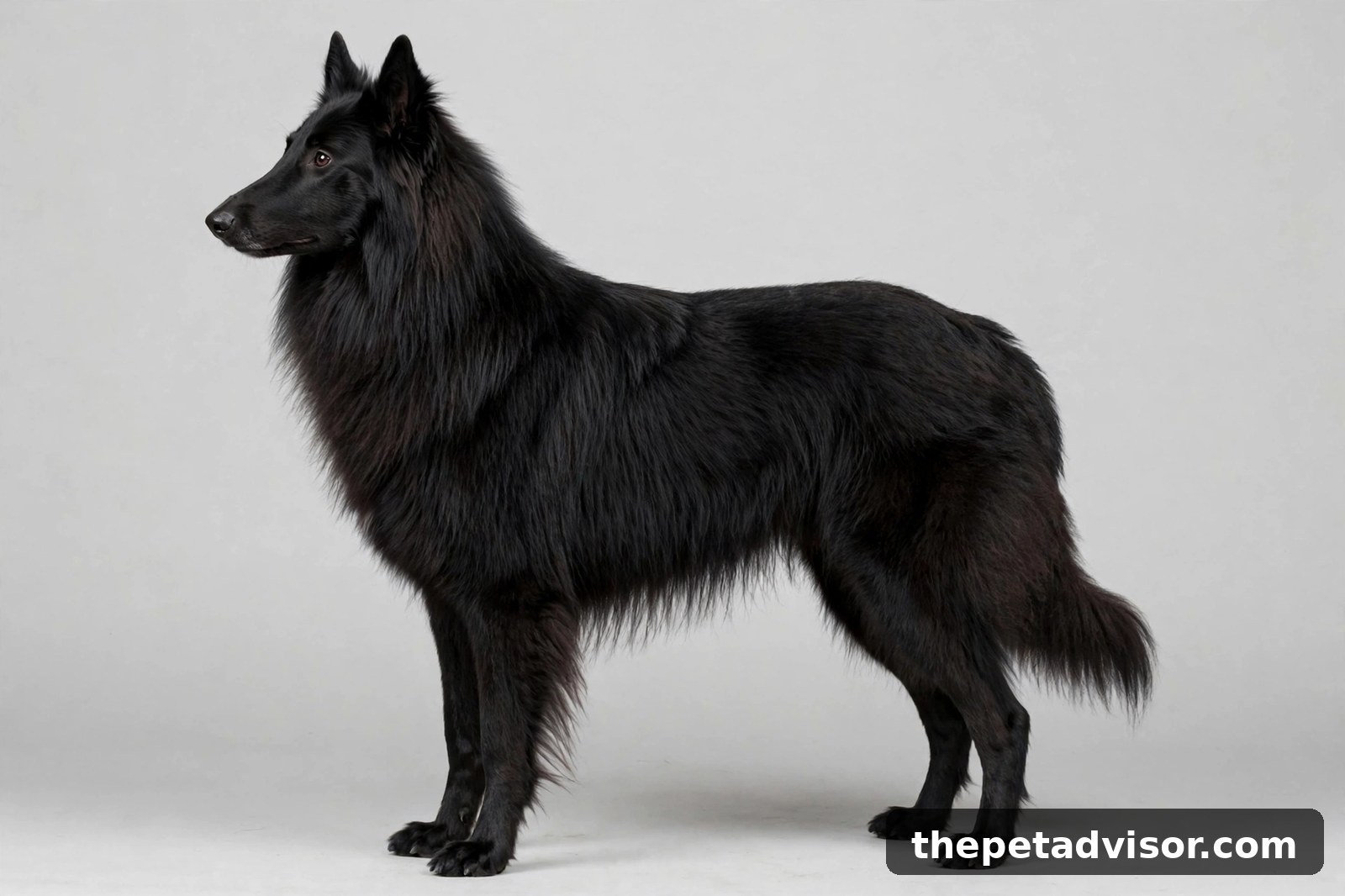
Do you have a photo of a Belgian Sheepdog in the American show ring? We’d love this page to lead with one. If you have a show photo you’d let us use, email it to [email protected] — tell us the dog’s name and the show, and it may be featured here. Please only send photos you took yourself or have the photographer’s permission to share, and tell us the photographer’s name. We couldn’t find a public photo of a Belgian Sheepdog in the American show ring that we were free to share, so the photo leading this page was made with AI. We’d much rather lead with a real one — if you’re a club member with an approved photo, we’d love to feature it.
1. Breed at a glance
At a glance:
- Group: Herding.
- AKC recognition: first registered 1912; the four Belgian varieties recognized as separate breeds in 1959.
- Parent club: Belgian Sheepdog Club of America, formed in 1919 (reformed in 1949).
- Size: males 24 to 26 inches at the withers, females 22 to 24 inches.
- Weight: males 55 to 75 pounds, females 45 to 60 pounds.
- Life expectancy: 12 to 14 years.
- Coat: long, straight, abundant double coat with an extremely dense undercoat; a long collarette around the neck, breeches on the hindquarters, and a long, heavy tail plume.
- Color: solid black. Small amounts of white are allowed on the forechest, between the pads of the feet, on the tips of the hind toes, and on the chin and muzzle (frost on older dogs). Any other color is a disqualification.
- Temperament: intelligent, courageous, alert, and devoted to master — the standard’s own words.
- Also called: the Groenendael (outside the United States).
2. History
The Belgian Sheepdog is one of four varieties of a single Belgian shepherd type, sorted by coat and color at the end of the 19th century. In 1891, shepherd-dog enthusiasts formed the Club du Chien de Berger Belge — the Belgian Shepherd Dog Club — to classify the shepherd dogs of Belgium, and the first standard for the breed was written in 1892.
The black long-coated variety was the work of Nicolas Rose, who kept the Château de Groenendael outside Brussels. From the 1890s he bred from the black bitch Petite and the dog Picard d’Uccle, keeping the black progeny until the variety bred true — and the dogs took the name of his château, Groenendael. Outside the United States the variety is still called the Groenendael; in the United States it is the Belgian Sheepdog.
The dogs worked as herders and guardians, and in the First World War as message carriers, ambulance dogs, and gun-cart pullers. American soldiers brought them home, and their popularity grew after the war: the Belgian Sheepdog Club of America was formed in 1919. Numbers fell in the Depression, the dogs served again in the Second World War, and the club was reformed in 1949. The American Kennel Club first registered the Belgian varieties in 1912 and recognized the Groenendael, Malinois, and Tervuren as separate breeds in 1959 — the Groenendael as the Belgian Sheepdog. The Laekenois is not recognized by the AKC as a separate breed.
In 2025 the breed had its most famous American moment: GCHS Prairiewind’s Sxongs of Summer at La Neige, ‘Soleil,’ won Best in Show at the National Dog Show on Thanksgiving Day, November 27, 2025 — the first Belgian Sheepdog to win there — handled by Daniel Martin and judged by Charles L. Olvis. Soleil, a five-and-a-half-year-old bitch owned by Connie Jasinski, Pat Snow, and Nancy Maye, beat nearly 2,000 dogs at the Greater Philadelphia Expo Center in Oaks, Pennsylvania, for her seventh Best in Show, a record for the breed.
3. The standard and why it's written that way
The AKC standard for the Belgian Sheepdog, approved December 11, 1990 and effective January 30, 1991, describes a working herding and guard dog — and it means it. Every point below comes from the standard itself. (Belgian Sheepdog Club of America, Official Standard of the Belgian Sheepdog)
- General appearance: the first impression is that of a well balanced, square dog, elegant in appearance, with an exceedingly proud carriage of the head and neck. He is a strong, agile, well muscled animal, alert and full of life, with depth and solidity without bulkiness. The male is usually somewhat more impressive and grand than his female counterpart; the bitch should have a distinctly feminine look. (AKC breed standard)
- Size: males 24 to 26 inches in height and females 22 to 24 inches, measured at the withers. Males under 22½ or over 27½ inches and females under 20½ or over 25½ inches shall be disqualified. The length, measured from point of breastbone to point of rump, should equal the height; bitches may be slightly longer. Bone structure should be moderately heavy in proportion to his height, so that he is well balanced throughout and neither spindly or leggy nor cumbersome and bulky. The dog should stand squarely on all fours; in side view the topline, front legs, and back legs should closely approximate a square. (AKC breed standard)
- Head and expression: clean-cut and strong, in proportion to the body. Expression indicates alertness, attention, readiness for activity; the gaze should be intelligent and questioning. Eyes brown, preferably dark brown, medium size, slightly almond shaped, not protruding. Ears triangular in shape, stiff, erect, and in proportion to the head in size; the base of the ear should not come below the center of the eye. Ears hanging (as on a hound) shall disqualify. Skull top flattened rather than rounded. Muzzle moderately pointed, approximately equal in length to the topskull. Nose black without spots or discolored areas. Teeth a full complement of strong, white teeth, evenly set; bite either even or scissors. (AKC breed standard)
- Neck, topline, body: neck round and rather outstretched, tapered from head to body, well muscled, with tight skin. Withers slightly higher, sloping into a back that must be level, straight, and firm from withers to hip joints. Chest not broad, but deep, the lowest point reaching the elbow. Tail strong at the base, bone to reach hock; at rest the dog holds it low, the tip bent back level with the hock; when in action he raises it and gives it a curl, strongest toward the tip, without forming a hook. Cropped or stump tail shall disqualify. (AKC breed standard)
- Coat and ornamentation: the guard hairs must be long, well fitting, straight and abundant; they should not be silky or wiry, and the texture should be a medium harshness. The undercoat should be extremely dense, commensurate with climatic conditions — the Belgian Sheepdog is particularly adaptable to extremes of temperature or climate. The hair is shorter on the head, outside of the ears, and lower part of the legs; the opening of the ear is protected by tufts of hair. Ornamentation: especially long and abundant hair, like a collarette, around the neck; a fringe of long hair down the back of the forearm; especially long and abundant hair trimming the hindquarters, the breeches; long, heavy and abundant hair on the tail. (AKC breed standard)
- Color: black. May be completely black, or may be black with white, limited as follows: small to moderate patch or strip on forechest; between pads of feet; on tips of hind toes; on chin and muzzle (frost may be white or gray); on tips of front toes — allowable, but a fault. Disqualification: any color other than black, except for white in specified areas. Reddening due to climatic conditions in an otherwise correct coat should not be grounds for disqualification. (AKC breed standard)
- Gait: motion should be smooth, free and easy, seemingly never tiring, exhibiting facility of movement rather than a hard driving action. He tends to single track on a fast gait, the legs converging toward the center line of gravity; the backline should remain firm and level, parallel to the line of motion, with no crabbing. He shows a marked tendency to move in a circle rather than a straight line. (AKC breed standard)
- Temperament, written into the standard: the Belgian Sheepdog should reflect the qualities of intelligence, courage, alertness and devotion to master. To his inherent aptitude as a guardian of flocks should be added protectiveness of the person and property of his master. He should be watchful, attentive, and always in motion when not under command. In his relationship with humans, he should be observant and vigilant with strangers, but not apprehensive. He should not show fear or shyness. He should not show viciousness by unwarranted or unprovoked attack. With those he knows well, he is most affectionate and friendly, zealous of their attention, and very possessive. Viciousness is a disqualification. (AKC breed standard)
- Disqualifications: males under 22½ or over 27½ inches in height and females under 20½ or over 25½ inches in height; ears hanging (as on a hound); cropped or stump tail; any color other than black; viciousness. (AKC breed standard)
- Why the standard is written this way: every point protects a working herding and guard dog. The square outline and smooth, tireless gait are for all-day work; the black coat and erect ears are the variety’s identity, and the color disqualification keeps it unmistakable; the temperament paragraph exists because a guardian that is fearful, shy, or vicious is no use to anyone.
A note on names: in the United States the black long-coated variety is the Belgian Sheepdog; elsewhere it is the Groenendael, one variety of the Belgian Shepherd Dog. The Tervuren, Malinois, and Laekenois are separate breeds under the American Kennel Club — a fawn long-coated dog is a Tervuren, not a Belgian Sheepdog.
4. Temperament & living with one
The standard’s words — intelligent, courageous, alert, and devoted — are the whole dog in four words. A Belgian Sheepdog is a working herder and guardian that wants a job and wants its people, in that order and at the same time. The AKC calls them sensitive souls that crave human companionship and abhor neglect, and that is exactly right: this is not a kennel dog or a yard dog.
With their own people they are affectionate to the point of possessiveness — the standard says so outright — and they keep a watchful eye on everything that moves. With strangers they are observant and vigilant but not apprehensive: a Belgian Sheepdog notices the visitor, decides, and settles. Fearfulness and shyness are faults of temperament; viciousness is a disqualification.
The energy is real and daily. These dogs were built for hard work, and plenty of it: long walks, training, herding, agility, obedience, scent work, or tracking — a Belgian Sheepdog that works most days is a calm, devoted house dog. One that doesn’t is a project: bored Belgians herd children and pets, patrol windows, and invent jobs you did not assign.
Training is the breed’s great strength. They are famously trainable and respond best to short, upbeat, reward-based sessions built on the relationship they already want. Start early, socialize widely, and keep the work going for life — a Belgian Sheepdog that has learned to think with you is one of the great companions in the dog world.
5. Grooming
The long double coat is the breed’s glory and its chore. Brush two or three times a week with a pin brush or slicker, working through the mane, the breeches, and the feathering, and daily when the dense undercoat blows in season. A bath only when the dog is actually dirty; the coat sheds dirt well between baths.
What needs attention instead:
- Coat: the guard hairs are long, straight, and abundant over an extremely dense undercoat. Brush in sections down to the skin — a surface brush leaves mats underneath, especially in the mane and breeches.
- Shedding: the coat sheds year-round and heavily in season. Expect black hair on everything; a high-velocity dryer after baths helps blow the dead undercoat out.
- Ears: the ear openings are protected by tufts of hair. Check weekly and clean as needed — the long coat traps moisture and debris around the ears.
- Feet and nails: round, cat-footed feet with strong black nails (white to match white toe tips). Keep nails trimmed; a running dog with long nails slips and strains.
- Teeth: brush regularly; the even or scissors bite the standard calls for is worth protecting.
- No sculpting: the coat is worn long and natural — the collarette, breeches, and tail plume are the breed’s outline, not something to trim into shape.
6. Health testing
The Belgian Sheepdog Club of America’s health program sets the testing a responsible breeder does — and the CHIC program turns it into a checklist with numbers you can verify.
The AKC lists the national breed club’s recommended health tests for the Belgian Sheepdog as hip evaluation, elbow evaluation, and ophthalmologist evaluation. The BSCA Health Committee urges breeders and owners to also test thyroids — hips and elbows are one-time certifications, while thyroid and eye tests should be repeated — and OFA records patellas and cardiac evaluations for the breed as well.
Conditions to watch for:
- Hip dysplasia — x-ray evaluation (OFA or PennHIP).
- Elbow dysplasia — x-ray evaluation.
- Eye disorders — including cataracts and progressive retinal atrophy; annual eye examinations by a veterinary ophthalmologist.
- Hypothyroidism — autoimmune thyroiditis; OFA thyroid evaluation, repeated through the dog’s life.
- Epilepsy — idiopathic epilepsy is watched in the breed; ask what the breeder knows about seizure history in the lines.
- Bloat (gastric dilatation-volvulus) — a deep-chested risk; feed smaller meals, avoid exercise right after eating, and know the signs.
When you talk to a breeder, ask for the OFA or CHIC numbers — and look them up on the OFA database before you put down a deposit. (AKC, Herding Group Health Testing Requirements; Belgian Sheepdog Club of America, Health)
7. The annual Belgian Sheepdog specialty dog show
A specialty is the breed’s All-Star show — its Super Bowl. Once a year, the best Belgian Sheepdogs from across the country, and often from around the world, come together in one place.
The Belgian Sheepdog Club of America’s national specialty: the annual Belgian Sheepdog specialty dog show. The 2027 national: May 14–15, 2027, at the MeadowView Conference Resort and Convention Center in Kingsport, Tennessee, superintendent Jayme Hicks. The 2026 national: national week May 12–16, 2026, at the South Sioux City Marriott Riverfront in South Sioux City, Nebraska; Best of Breed not confirmed in an accessible official source. The 2025 national: April 18–19, 2025, at the Roberts Centre in Wilmington, Ohio, 158 dogs in the entry; Best of Breed CH Creekwind Farm Fiery Midnight Rose ‘Ryla’. The 2024 national: May 10–11, 2024, at Under the Sun Dog Training & Daycare in Colorado Springs, Colorado, 80 dogs in the entry; Best of Breed not confirmed.
The 2026 National Specialty — national week May 12–16, 2026, at the South Sioux City Marriott Riverfront, 385 E 4th Street, South Sioux City, Nebraska. Scent work Tuesday, May 12, 2026 (event 2026126333, judges Chris Eblen and Jeff Hartzler; entries opened Wednesday, March 4, 2026, 9:00 a.m. CST; closed Wednesday, April 15, 2026, 6:00 p.m. CDT). The Trinity Valley Belgian Sheepdog Club specialty Thursday, May 14, 2026, at the same venue (event 2026145504, judge S Petersen, 58 entries — 27 dogs, 31 bitches). Herding Saturday–Sunday, April 18–19, 2026, at 1350 Dresslerville Road, Gardnerville, Nevada (events 2026126303, 2026126304, 2026126305; judges Deborah Pollard and Theresa Royer), with French herding trials Friday, April 17, 2026, at the same site. The conformation day(s), AKC event number, conformation and sweepstakes judges, entries, entry fees, and event chair/secretary were not confirmed in an accessible official source. (Sources: Belgian Sheepdog Club of America, 2026 National Specialty; BSCA 2026 Scent Work premium; AKC event search, event 2026145504.)
Results (2026 national). Best of Breed, Best of Opposite Sex, Winners Dog, Winners Bitch, and Best Junior Handler not confirmed in an accessible official source. One indirect pointer: Westminster’s 2027 national-specialty-winners invitees list names GCHG Prairiewind’s Sxongs Of Summer At La Neige (‘Soleil’) among the Belgian Sheepdogs invited as 2026 national specialty winners — which would mean Soleil won Best of Breed at the 2026 national — but that is indirect evidence and is not asserted here. (Source: Westminster Kennel Club, 2027 Westminster Invitees.)
The 2027 National Specialty: Friday–Saturday, May 14–15, 2027 (2 days), at the MeadowView Conference Resort and Convention Center, Kingsport, Tennessee. Superintendent: Jayme Hicks. AKC event number, premium, entry fees, entries opening/closing, judges, and the venue street address not yet published as of November 7, 2026. Sweepstakes judge nominees have been published by the club; the sweepstakes judge had not yet been determined. (Sources: AKC, Upcoming National Specialties; Belgian Sheepdog Club of America, 2027 Sweepstakes Judge Nominee Biographies.)
Past national specialties: 2025 · 2024
Belgian Sheepdog Club of America
8. Regional specialties through the year: smaller regional shows
The national is the anchor, but the breed’s year also runs through regional specialties — smaller regional shows, not the national — held by the Belgian Sheepdog Club of America around the country, usually as designated specialties with all-breed shows. These are the 2026 regionals verified from club and AKC sources so far:
Two Belgian Sheepdog regional weekends verified for 2026 beyond the national itself:
- Sierra Nevada Belgian Sheepdog Club regional specialties — Friday, September 25, 2026, Fairgrounds / Fuji Park, Highway 395 South and Clear Creek Road, Carson City, Nevada: AM and PM regional specialties with Veteran, Herding Titled, and Veteran, Working & Puppy Sweepstakes classes, plus the National Owner-Handled Series. AKC event numbers 2026126352 and 2026126353 (the premium prints the second number as 20261263253, an extra digit — evidently a typo). Entries closed Wednesday, September 9, 2026, 6:00 p.m. Superintendent: MB-F Inc. Judges and entries not confirmed in an accessible official source. (Source: AKC event search, event 2026126352.)
- BSCA Designated Specialty — Saturday, September 26, 2026, with the Bonanza Kennel Club shows, Fairgrounds / Fuji Park, Carson City, Nevada: the Belgian Sheepdog Club of America considers the Belgian Sheepdog classes at this show its regional specialty, with rosettes for Best of Breed, Best of Opposite Sex, Best of Winners, Winners Dog, Winners Bitch, Select Dog, Select Bitch, and veteran and herding-titled awards. Belgian Sheepdogs: Dr. Eric Liebes (Saturday) and Mrs. Joan Luna Liebes (Sunday). Entries and results not confirmed in an accessible official source. (Source: Bonanza Kennel Club.)
Past regional specialties: 2025
More regional specialties will be added here as their programs are verified — this section is built from show data, not guesswork. Browse upcoming show weekends →
9. Clubs
The parent club is the Belgian Sheepdog Club of America (BSCA), formed in 1919 and reformed in 1949. It runs the national specialty, keeps the breeders’ directory, publishes the breed’s health guidance, and runs the versatility program, which recognizes dogs that compete in conformation plus performance events at the national. Club president (2025): Kathay Lovell; AKC Delegate: Mary Grace Buckwalter. (Belgian Sheepdog Club of America)
The breeders’ directory is open May 1 to July 31 each year to BSCA members in good standing who re-sign the Breeder Code of Ethics; a $25 fee applies. The club’s breeders agree to x-ray breeding stock and have eyes checked annually. (Belgian Sheepdog Club of America, Breeders Directory)
Regional clubs (from the club’s event policy, as of 2016–2017 — the list may have changed since):
- AKC-licensed regional clubs: Downeaster, Raritan, Potomac Valley, Trinity Valley.
- BSCA regional clubs: Barbary Coast, Belgian Sheepdog Club of the Rockies, Northwest, Belgian Sheepdog Club of Oakland County Michigan, Sierra Nevada, Belgian Sheepdog Club of the Blue Ridge, Belgian Sheepdog Club of North Georgia.
Contact the BSCA for referrals to the regional club in your area.
10. Rescue
In the United States, rescue runs through the Belgian Sheepdog Rescue Trust (BSDRT), an independent 501(c)(3) organization established by the Belgian Sheepdog Club of America. The Trust takes in Belgian Sheepdogs in need, vets them, microchips them, and places them with screened adopters — and it asks for experienced Belgian homes, because a Belgian Sheepdog in the wrong home is a miserable dog.
To adopt, complete the online adoption application at bscarescue.com; a Trust representative will call to discuss your application, and applications stay active for one year. If you have recently applied and want to be considered for a particular dog, email [email protected] with your name and when you applied. Donations go to the Trust (checks to “Belgian Sheepdog Rescue Trust,” mailed to the BSCA Treasurer) and may be tax deductible.
Rescue Belgian Sheepdogs are usually adults or adolescents whose temperament is already known — a real advantage, provided the home can meet the breed’s exercise and companionship needs. Start with the parent club, which can direct you to the rescue coordinator for your area.
11. Breeder vs rescue
From a breeder: expect a breeder who shows or competes with their dogs, health-tests every breeding dog, and takes a puppy back for life. Ask for the OFA or CHIC numbers — hip, elbow, and eye evaluations at minimum, with thyroid testing urged by the club — and verify them on the OFA database. Ask how the puppies are raised in the home, what the parents do, and what the breeder expects of you. A breeder who won’t answer, or who has puppies always available, is a warning sign.
From rescue: expect an application, a phone interview, and a careful match. Rescue dogs are adults or adolescents, vetted and microchipped, placed by people who know the breed’s needs — which means the rescue will ask hard questions about exercise, work hours, and experience with Belgians. That scrutiny is a feature: a Belgian Sheepdog in the wrong home is a miserable dog.
Either way: the right question is not “breeder or rescue?” but “does this dog, and this source, fit a life with a high-energy, watchful herding dog that needs real work and its people every day?” A Belgian Sheepdog that works and lives with its people is one of the great companions in the dog world. A Belgian Sheepdog left alone in a yard is a tragedy in slow motion.
12. Claim this page
This page is maintained by ThePetAdvisor and built from public sources — the AKC standard, the Belgian Sheepdog Club of America’s publications, and AKC event records. If you are an officer of the Belgian Sheepdog Club of America, a regional club officer, a rescue coordinator, or a breeder, and you spot an error or have a correction, we would rather hear it from you than from a search result.
Send corrections, specialty dates, or photos to [email protected] with “Belgian Sheepdog” in the subject line. We check every message.
Sources
- American Kennel Club, Belgian Sheepdog breed page
- American Kennel Club, Is the Belgian Sheepdog Right for You?
- Belgian Sheepdog Club of America, Official Standard of the Belgian Sheepdog (approved December 11, 1990; effective January 30, 1991)
- Belgian Sheepdog Club of America, Health
- Belgian Sheepdog Club of America, Breeders Directory
- Belgian Sheepdog Club of America, Event Policy
- American Kennel Club, Herding Group Health Testing Requirements
- AKC, Upcoming National Specialties
- Belgian Sheepdog Club of America, 2025 National Specialty premium
- AKC event search, event 2025126317 (2025 national specialty)
- CAPER, 2025 BSCA national results — Saturday
- CAPER, 2025 BSCA national results — Friday
- AKC event search, event 2024126327 (2024 national specialty)
- Belgian Sheepdog Club of America, 2026 National Specialty
- Belgian Sheepdog Club of America, 2026 Scent Work premium
- AKC event search, event 2026145504 (2026 Trinity Valley specialty)
- AKC event search, event 2025145503 (2025 Trinity Valley regional specialty)
- AKC event search, event 2026126352 (2026 Sierra Nevada regional specialty)
- Westminster Kennel Club, 2027 Westminster Invitees
- Belgian Sheepdog Club of America, 2027 Sweepstakes Judge Nominee Biographies
- NBC Sports, Soleil shines on as Belgian Sheepdog takes Best in Show at 2025 National Dog Show
- Pet Age, Soleil, a Belgian Sheepdog, Wins Best in Show Title at National Dog Show on Thanksgiving Day
- Belgian Sheepdog Rescue Trust
- Belgian Sheepdog Rescue Trust, Adoption Application