
Breed profile · Hound Group · Two varieties by height
Beagle
The Beagle is the smallest hound the AKC recognizes for the show ring and the loudest opinion in the house: a pack hound bred to follow a scent to the end of it, merry, stubborn, and hungry — usually in that order. It comes in two sizes, 13-inch and 15-inch, and the only thing that changes between them is height.
Help us improve it. This is one of ThePetAdvisor’s breed profiles, built from public sources with generous links to the people who actually own this breed’s knowledge. If something’s off or missing, the parent club can claim the page and set it straight — see the bottom of the page.
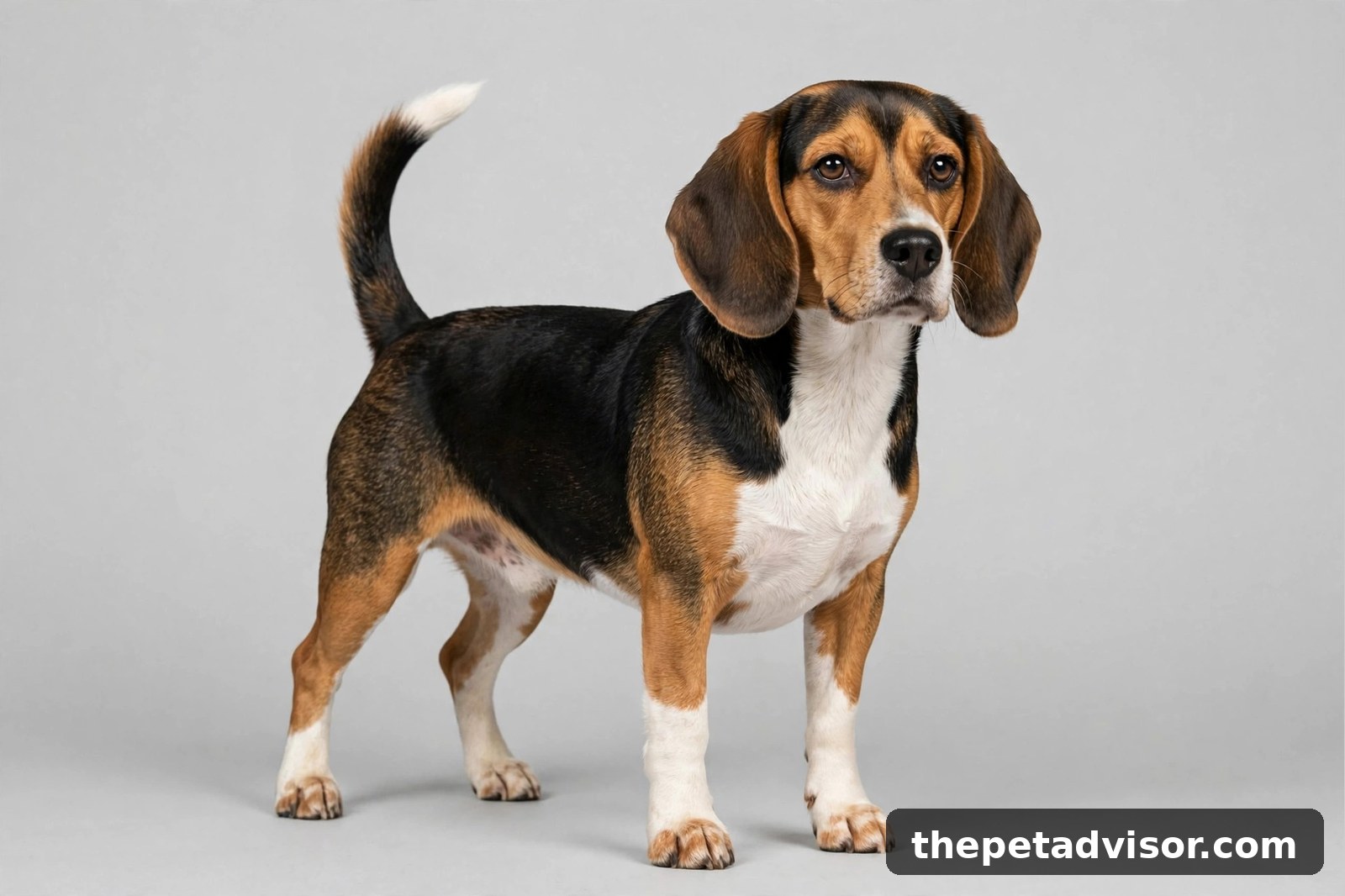
Do you have a photo of a Beagle in the American show ring? We’d love this page to lead with one. If you have a show photo you’d let us use, email it to [email protected] — tell us the dog’s name and the show, and it may be featured here. Please only send photos you took yourself or have the photographer’s permission to share, and tell us the photographer’s name. We couldn’t find a public photo of a Beagle in the American show ring that we were free to share, so the photo leading this page was made with AI. We’d much rather lead with a real one — if you’re a club member with an approved photo, we’d love to feature it.
1. Breed at a glance
Hound — recognized since 1885
Two varieties: 13-inch (13″ and under) and 15-inch (over 13″, not exceeding 15″). Anything over 15″ is disqualified.
Close, hard, of medium length. Any true hound color.
A merry hound — friendly, curious, and even-tempered, with a nose that outranks every other sense.
High, and nose-driven. A Beagle needs a job for its nose every day, or it will find one in your kitchen.
Size and coat facts are from the AKC standard. Weights and lifespan are the AKC breed-profile figures. Popularity: the Beagle is No. 7 in the AKC’s 2025 registrations (AKC most popular breeds 2025).
2. History
The Beagle is an English pack hound, bred for centuries to follow a hare on foot with a pack of hounds and a huntsman walking behind — which is why the breed is small, sturdy, and loud enough to be heard across a field. The name’s origin is uncertain; the two usual candidates are the Old French begueule, open throat, for the hound’s baying voice, and the Celtic beag, small. Either way, the dog fits the name. (Source: Beagle.)
In America, the breed was among the first the AKC recognized, in 1885, and the National Beagle Club of America is the AKC parent club. The Beagle’s most famous ambassador never entered a show: Snoopy, the Peanuts cartoon dog, is a Beagle, and he has done more for the breed’s popularity than any champion. (Sources: AKC Beagle breed page; Beagle.)
At Westminster, Beagles waited longer than any breed for the top prize — and then won it twice in seven years. Uno, Ch. K-Run’s Park Me In First, a 15-inch Beagle, won Best in Show in 2008, the first Beagle ever to do it and the first Beagle to win the Hound Group since 1939. Miss P, Ch. Tashtins Lookin For Trouble, his great-niece, won in 2015, the second Beagle at the Garden. (Source: AKC Westminster winners.)
3. The standard and why it’s written that way
There are two Beagle varieties, and the standard divides them by height alone: the 13-inch variety is 13 inches and under at the shoulder, and the 15-inch variety is over 13 inches and not exceeding 15 inches. A Beagle over 15 inches is disqualified. The two varieties are judged together in the breed ring, and the Best of Breed winner goes to the Hound Group. (Source: AKC standard.)
- A miniature Foxhound. The standard describes “a miniature Foxhound, solid and big for his inches, with the wear-and-tear look of the hound that can last in the chase and follow his quarry to the death.”
- Head, ears, and tail. The head is fairly long with a moderately domed skull, the ears long and set on low, the tail set moderately high and carried gaily, with a brush of white at the tip so the hound can be seen in cover.
- Any true hound color. Any true hound color is acceptable, and the tricolor — black, tan, and white — is the best known. (Source: AKC standard.)
4. Temperament & living with one
The standard’s temperament line is one word, and it is the whole breed: merry. A Beagle is friendly, curious, and even-tempered, a pack dog that expects company — of people and of other dogs — and does not do well left alone all day. It is also a scent hound first and a pet second: the nose goes down, the ears switch off, and the dog follows the trail wherever it leads, including across a road. A Beagle off leash in unfenced ground is a dog you are about to lose. (Sources: AKC Beagle breed page; AKC standard.)
What that means at home is simple: a Beagle is easy to love and hard to bore. It is good with children and other dogs, food-motivated enough to train well, and stubborn enough to test every rule once it knows where the food is. The baying is not a behavior problem to train away; it is the breed’s voice, and a buyer who cannot live with it should buy a quieter breed.
5. Grooming
Grooming is the easy part of owning a Beagle. The coat is close, hard, and of medium length; a weekly brushing keeps it in shape, and a bath when the dog has rolled in something — which, given the nose, will be often. Beagles shed moderately year-round, and no amount of brushing stops it. (Source: AKC Beagle breed page.)
The ears need the attention the coat does not. Long ears that hang close to the head trap moisture, and Beagle ears should be checked and cleaned regularly for infection. Keep the nails short — a Beagle that runs will wear them down, and a Beagle that does not run will need them trimmed.
6. Health testing
The Beagle is a long-lived breed — 13 to 15 years — and a generally healthy one, but the parent club’s health list is specific. The National Beagle Club’s CHIC requirements are five tests on both parents: a hip evaluation (OFA or PennHIP), an eye examination by a board-certified ophthalmologist, a DNA test for Musladin-Lueke Syndrome (MLS), a cardiac evaluation, and an OFA autoimmune thyroiditis evaluation at 24 months or older. A CHIC number means the listed tests were done and made public — not that the results were normal. Ask for the number, and then ask what the results were. (Sources: OFA CHIC program; National Beagle Club.)
MLS deserves a line of its own: it is a Beagle-specific inherited connective-tissue disorder, caused by a recessive mutation, and the DNA test for it is the one gene test the breed’s CHIC program requires. The club also recommends DNA tests for Lafora epilepsy, Factor VII deficiency, neonatal cerebellar cortical degeneration, and Imerslund-Grasbeck Syndrome, and a patellar luxation evaluation. The other conditions a buyer should hear about before they sign anything: epilepsy, hypothyroidism, hip dysplasia, and back problems. None of these is a reason not to own a Beagle. All of them are reasons to buy from a breeder who tests. (Source: OFA CHIC program.)
7. The annual Beagle specialty dog show
A specialty is the breed’s All-Star show — its Super Bowl. Once a year, the best Beagles from across the country, and often from around the world, come together in one place.
The National Beagle Club of America’s national specialty is the anchor of the Beagle’s year — a week-long gathering, not a single show day, with the conformation specialty at its center and agility, obedience, rally, and hunting performance tests around it.
The 57th National Specialty: Monday to Thursday, November 2–5, 2026, at the MeadowView Conference Resort & Convention Center, 1901 Meadowview Pkwy, Kingsport, Tennessee — the conformation centerpiece of a national week, October 30 to November 6, 2026, with agility trials October 31–November 1 and hunting performance tests November 1 and 6. Entry: 222 dogs, 332 entries, plus 7 4–6 Month Puppy entries. (Sources: 2026 NBC National; official judging program; official premium list.)
National specialty judge: Ms. Ann H. Roth of Wilmington, North Carolina — breed classes, Intervariety competition, Best Owner-Handled, Junior Showmanship, and the 4–6 Month Puppy competition. Sweepstakes and Veteran Sweepstakes: Ms. Jennifer Leitao of Coventry, Rhode Island. Obedience and rally: Mr. Russell Hornfisher of Knoxville, Tennessee. Agility: Mrs. Pamela R. Sturtz of Afton, New York. (Sources: official premium list; 2026 NBC National.)
Winners from the 2026 specialty had not been published in an official source as of November 2026 and will be added here when they are.
The 2027 national specialty dates had not been announced as of November 2026.
2026 NBC National — National Beagle Club Specialty
8. Regional specialties through the year: smaller regional shows
The national is the anchor, but the breed’s year runs through its regional specialties, held by the National Beagle Club’s regional clubs. These are the 2026 regionals verified from club sources so far:
- San Jacinto Beagle Club — specialty show, Thursday, July 16, 2026. (Source: National Beagle Club events.)
- National Beagle Club Regional Specialty — Monday–Tuesday, November 2–3, 2026, MeadowView Conference Resort & Convention Center, Kingsport, Tennessee, held alongside the national specialty week. Breed judge: Mrs. Sue E. Bownds of Birchgrove, New South Wales, Australia. Entry: 219 dogs, 328 entries. (Source: official judging program.)
More regional specialties will be added here as their programs are verified — this section is built from show data, not guesswork. Browse upcoming show weekends →
9. Clubs
- National Beagle Club of America (parent club) — the AKC parent club for the breed in the United States. It runs the national specialty, the breeder referral, and the breed’s health-testing program.
- Columbia Willamette Beagle Club — regional specialty club (Oregon/Washington), holding three specialty shows in 2027.
- San Jacinto Beagle Club — regional specialty club (Texas), holding specialty shows through the year.
- Inland Northwest Beagle Club — regional specialty club (Washington/Idaho), holding specialty shows and club events through the year.
If you are new to the breed, a regional club is the better first stop than a breeder’s website: the people there have owned, shown, and lost Beagles, and they will tell you the truth about the baying before you fall for a puppy.
10. Rescue
Start with the parent club’s rescue network, and with the breed’s own rescues. SOS Beagle Rescue (Save Our Snoopies) is one of the country’s longest-running Beagle rescues, with chapters in New Jersey and Tennessee; its dogs live in foster homes, are spayed or neutered, microchipped, and up to date on vaccinations and heartworm preventative before adoption. (Source: sosbeagles.org.)
A rescued Beagle is usually an adult whose owner underestimated the baying, the shedding, or the nose — and it will arrive with a history you may never fully know. What you get in return is a dog whose temperament you can see before you commit, and a rescue that will take the dog back for life if it does not work out. Ask the parent club for the rescue nearest you; this page will list more by name once their current details are verified.
11. Breeder vs. rescue: honest guidance
If you buy: start with the National Beagle Club’s breeder referral. Ask to see the CHIC results for both parents — hips, eyes, heart, thyroid, and the MLS DNA test in section 6 — and the actual results, not just the number. A good breeder will have tested the parents, will ask you as many questions as you ask them, and will take the puppy back for its whole life if you cannot keep it.
One thing that is not what a seller tells you: there is no such breed as a “pocket Beagle.” The standard recognizes two varieties, 13-inch and 15-inch, and nothing smaller. A breeder selling a pocket, teacup, or miniature Beagle is selling you a small dog with a made-up label, usually at a premium.
If you rescue: a rescued Beagle is usually an adult, often one whose owner underestimated the baying, and it will arrive with a coat that needs little work and a nose that needs a lot. What you get in return is a dog whose temperament you can see before you commit and a lower price. Either way, budget the exercise first: a Beagle you cannot tire out is a Beagle that will bay at your neighbors.
12. Claim this page
This page belongs to the breed, and the people who know the breed best are the National Beagle Club of America and its members. If you are with the parent club — or you are a breeder, a judge, a handler, or a rescue volunteer who spotted something wrong, missing, or out of date — this page is yours to set straight. Tell us what needs fixing and where the correction is documented, and we will fix it and credit the source. Contact the site through the About page, and mention “Beagle breed profile.”
Sources
- AKC Beagle breed standard — cdn.akc.org/Beagle.pdf
- AKC, Beagle breed page — akc.org/dog-breeds/beagle
- AKC, most popular dog breeds of 2025 — akc.org/expert-advice/dog-breeds/most-popular-dog-breeds-2025
- AKC, Westminster winners through the years — akc.org/expert-advice/news/westminster-winners-through-the-years
- National Beagle Club of America — nationalbeagleclub.org
- National Beagle Club of America, events — nationalbeagleclub.org/events
- 2026 NBC National Specialty — nbcspecialty.com/2026-nbc-national
- 2026 NBC National Specialty, official premium list (57th National Specialty, November 2–5, 2026, Kingsport, Tennessee) — national-beagle-club-national-2026-premium.pdf
- 2026 NBC National Specialty, official judging program (57th National Specialty, November 2–5, 2026, Kingsport, Tennessee) — 2026-NBC-Judging-Schedule.pdf
- OFA Canine Health Information Center (CHIC) — ofa.org/chic-programs
- SOS Beagle Rescue — sosbeagles.org
- Wikipedia, Beagle (history, name origin, Snoopy) — en.wikipedia.org/wiki/Beagle