
Breed profile · Hound Group · the low-slung scent hound
Basset Hound
The Basset Hound is a short-legged scent hound built to follow a trail for hours while its hunter follows on foot — long ears, heavy bone, a sad, soft expression, and a nose that never quits. The name comes from the French bas, low. Bassets were shown in America as early as 1884, the AKC registered its first in 1885, and the Basset Hound Club of America, founded in 1935, has run the national specialty ever since.
Help us improve it. This is one of ThePetAdvisor’s breed profiles, built from public sources with generous links to the people who actually own this breed’s knowledge. If something’s off or missing, the parent club can claim the page and set it straight — see the bottom of the page.
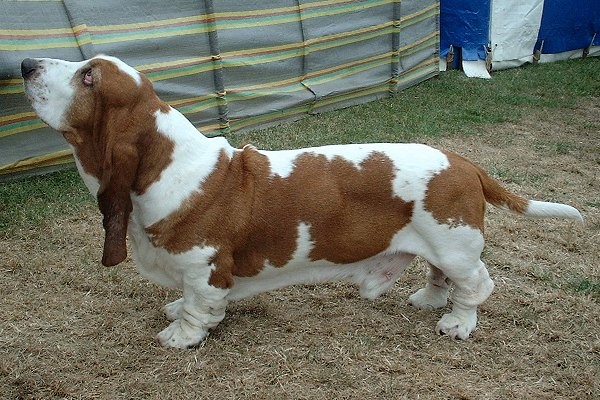

Do you have a better photo of a Basset Hound in the American show ring? If you have a show photo you’d let us use, email it to [email protected] — tell us the dog’s name and the show, and it may be featured here. Please only send photos you took yourself or have the photographer’s permission to share, and tell us the photographer’s name.
1. Breed at a glance
Hound Group; first Basset registered by the AKC in 1885
Height should not exceed 14 in; over 15 in is a disqualification; 40–65 lb
Hard, smooth, short coat; any recognized hound color
12–13 years (AKC)
Mild, never sharp or timid; devoted and stubborn in equal measure
The Basset Hound is a scent hound first and a companion second — but it is very good at both. The standard describes a short-legged dog, heavier in bone, size considered, than any other breed, built to follow a trail over and through difficult terrain: “while its movement is deliberate, it is in no sense clumsy. In temperament it is mild, never sharp or timid. It is capable of great endurance in the field and is extreme in its devotion.” The breed was formally recognized by the AKC in 1916. (Sources: AKC, Official Standard of the Basset Hound; AKC, Basset Hound.)
2. History: from the monastery to the armchair
The name says what the dog is: basset comes from the French bas, low, and the breed was defined for centuries by how low it stood. The dogs generally thought to have formed the foundation of the modern Basset appeared around 700 C.E. at the Abbey of St. Hubert, in the Ardennes region of France, where monks bred dogs for their wealthy, royal clientele. The Art of Hunting, published in 1561, described a family of hounds divided by the degree of crook in the forelegs — the defining element of the breed today, for the modern Basset is a true achondroplastic dwarf, carrying as much as 25% of its body weight in bone, proportionally the most of any breed. Shakespeare knew the type well enough to describe it in A Midsummer Night’s Dream: “Crook-knee’d, and dew-lapp’d like Thessalian bulls.”
The breed’s modern history starts with a pair of hounds the Comte de Tournon gifted to Lord Galway in 1866. In 1874 Sir Everett Millais bought a hound called Basset-Model at the Jardin d’Acclimation show in Paris and took it to England, showing it at Wolverhampton in 1875 — the first reported showing of a Basset Hound in conformation. The Kennel Club recognized the breed in 1880. Not long after, the Basset reached American shores: in 1883 Lord Aylesford brought two to his ranch in Texas for rabbit hunting, and another pair went to the Maizeland kennels of Lawrence Timson in Red Bank, New Jersey. One of these, “Nemours,” was the first Basset to appear in a U.S. conformation competition — the 1884 Westminster Kennel Club show. The AKC registered its first Basset Hound in 1885, a dog named Bouncer, and formally recognized the breed in 1916.
Concerns over inbreeding led English breeders to cross Bassets to Bloodhounds at the end of the 19th century, and the outcross cemented the modern type: long, low-set ears and a doleful yet noble expression. The standard called it a “Bloodhound head” until the 1956 rewrite removed the reference. The Basset Hound Club of America was founded in 1935, became an AKC member club in 1937, and held its first AKC-sanctioned field trial at Hastings, Michigan, on October 24, 1937. A Basset on the cover of Time in 1928, for the 52nd Westminster show, made the breed a household name. In 1943 Lynwood and Margaret Walton founded the Lyn Mar Acres kennel, whose dogs shaped the breed worldwide — the Basset Hound Club of England bought a Lyn Mar puppy, Dauntless, with club funds in 1959 to rejuvenate the gene pool. The current AKC standard was approved by the parent club on January 14, 1964. Along the way the breed picked up its popular image: the cartoon “Fred Basset,” the 1950s television character Cleo, and the nickname “armchair clown.”
3. The standard: built low, built to last
The AKC standard was approved on January 14, 1964, and it is a standard written around a job: a dog that holds its nose low for hours and keeps going. The general appearance section sets the tone — a short-legged dog, heavier in bone than any other breed, deliberate in movement but never clumsy, mild in temperament, capable of great endurance, and “extreme in its devotion.”
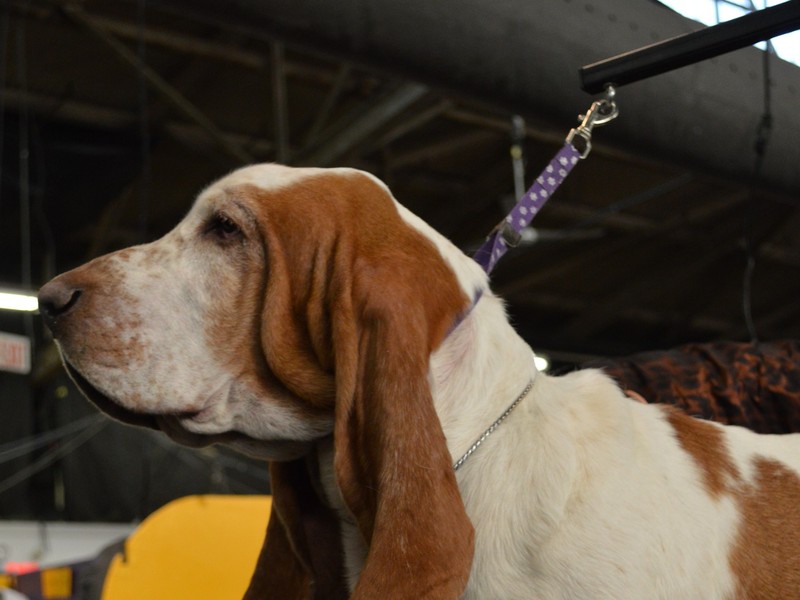

Head. Large and well proportioned, its length from occiput to muzzle greater than its width at the brow. The skull is well domed, with a pronounced occipital protuberance; a broad flat skull is a fault. The muzzle is deep and heavy, free from snipiness, and the nose is darkly pigmented, preferably black. The ears are extremely long and low set — when drawn forward they fold well over the end of the nose — velvety, hanging in loose folds, with the ends curling slightly inward. The eyes are soft, sad, and slightly sunken, showing a prominent haw, brown, with dark brown preferred. The skin over the head is loose, with distinct wrinkles over the brow when the head is lowered, and the dewlap is very pronounced.
Body, size, and gait. The chest is deep and full, with a prominent sternum; the forelegs are short, powerful, and heavy-boned, and the rib structure is long and smooth. The topline is straight and level, the hindquarters very full and well rounded, and the tail is never docked — it is set in continuation of the spine and carried gaily in hound fashion. Height should not exceed 14 inches, and height over 15 inches at the highest point of the shoulder blade is a disqualification, as are knuckled-over front legs and a distinctly long coat. The coat is hard, smooth, and short, and any recognized hound color is acceptable, with the distribution of color and markings of no importance. The gait is smooth, powerful, and effortless — a scenting dog with short legs that holds its nose low, absolutely true, with perfect coordination in a straight line.
4. Temperament: mild, devoted, and stubborn on purpose
The standard says it in one line — “in temperament it is mild, never sharp or timid” — and the rest of the breed follows from it. Bassets are affectionate and tolerant, devoted to their people, and famously funny: the 1950s nickname “armchair clown” stuck because the breed owns its family as much as any family owns the dog, and will repeat anything that made the room laugh.
The other side of the same coin is independence. A Basset was bred to work a trail on its own judgment for hours, and that thinking does not switch off in the living room. In 1994 the neuropsychologist Stanley Coren ranked the Basset 71st of 79 breeds for “working/obedience intelligence,” a ranking that measures willingness to obey a command on the first try — and a Basset will often take its time about that. Owners who understand the job understand the dog: food-motivated, trainable with patience and positive methods, and never improved by a raised voice.
As a pack hound the Basset is generally good with children and with other dogs, and it settles happily into a household routine — preferably one that includes a couch. Two things to plan for: the voice, a bay that carries, and the nose, which will follow a trail wherever it leads. A Basset needs a fence, a leash, and an owner who finds the stubborn streak charming rather than infuriating.
5. Grooming: the coat is easy, the ears are the job
The coat is the easy part: hard, smooth, and short, it needs a weekly brushing and sheds moderately. There is no clipping or trimming, and bathing only as needed. The grooming work in this breed is the ears.
Those long, low-set ears trap moisture against the ear canal, so check and clean them every week and watch for redness, odor, or head-shaking — ear infections are the breed’s most common everyday problem. Wipe the loose skin and flews, especially after eating and drinking, because the pendulous lips mean slobber. Keep the nails trimmed — the massive, heavy feet carry a lot of bone — and check the skin folds after field work for burrs and ticks.
6. Health: three DNA tests, and the shape itself
The Basset Hound Club of America participates in the OFA Canine Health Information Center program. A Basset Hound earns a CHIC number with DNA test results for three conditions registered with the OFA: thrombopathia, primary open angle glaucoma (POAG), and mucopolysaccharidosis I (MPS1). The parent club also recommends DNA testing for Lafora disease, and for severe combined immunodeficiency (XSCID). Eye, hip, elbow, and thyroid evaluations are optional but recommended.
What those tests are for, in plain words: thrombopathia is an inherited platelet disorder specific to Basset Hounds — the platelets cannot clot properly, so affected dogs bleed more than they should. A DNA test, run through Auburn University, identifies clear, carrier, and affected dogs before breeding. POAG is an inherited form of glaucoma. MPS1 is a metabolic storage disorder. Lafora disease is a late-onset neurological condition, usually appearing around age five to seven, that causes myoclonic jerks, panic episodes, impaired vision, and progressive seizures; a DNA test is available.
The everyday issues are the ones the shape predicts: ear infections from the long ears; obesity, which punishes the long back; hip dysplasia; eye disease including cherry eye and glaucoma; bloat (gastric dilatation-volvulus) in a deep-chested dog; back trouble, including intervertebral disc disease, from the long, low build; and von Willebrand disease. Lifespan is 12–13 years (AKC). Remember what a CHIC number means: the required tests were done and the results published. It does not mean the dog passed them.
7. The annual Basset Hound specialty dog show
A specialty is the breed’s All-Star show — its Super Bowl. Once a year, the best Basset Hounds from across the country, and often from around the world, come together in one place.
The Basset Hound Club of America’s national specialty: one national event each year, usually a multi-day week in October, with field trials, a hunting performance test, tracking, scent work, agility, obedience, and rally alongside the conformation show — plus sweepstakes, the Futurity/Maturity, and junior showmanship. The 2026 national: October 9–16 in Lebanon, Tennessee, with 166 dogs and 187 entries in conformation. The 2027 national: not yet announced as of November 7, 2026.
The standard, in brief: a short-legged hound, heavier in bone, size considered, than any other breed, standing no more than 14 inches at the shoulder, with an extremely long, low-set ear, a soft, sad expression with prominent haw, a deep chest, and a hard, smooth, short coat in any recognized hound color. In temperament it is mild, never sharp or timid, and extreme in its devotion.
The 2026 National Specialty — Friday, October 9–Friday, October 16, 2026, at the Wilson County Fairgrounds, James E. Ward Agricultural Center, 945 East Baddour Parkway, Lebanon, Tennessee 37087, hosted by the Mid-South Basset Hound Club. Conformation ran Wednesday, October 14 through Friday, October 16, with all conformation judged on a ramp. Entries closed at noon EST on Friday, September 11, 2026. Event Chair: Celeste M. Gonzalez. Event Secretary: Christine Allen.
The week ran the full Basset program: a hunting performance test on Friday, field trials and a Basset Fun Day on Saturday, tracking and scent work on Sunday, the Kentuckiana and Mid-South regional specialties on Monday and Tuesday, obedience and rally trials, the Futurity/Maturity on Tuesday, sweepstakes and the dog classes on Wednesday, the bitch classes on Thursday, and the Parade of Veterans, junior showmanship, and the intersex competition on Friday, with the annual banquet and awards that evening. The national drew 166 dogs and 187 entries in conformation.
Results (2026 national). Best of Breed: GCHB Blue Bay Heaven Scent (“Fiona”), a bitch whelped October 23, 2021, bred by Eva Kotilinek and Robin O’Rourke, by GCHB Blue Bay Simba The Beast — CH Damarna’s Rabbit Run Fizbin, owned by Eva Kotilinek and Robin O’Rourke; she also won Best Owner Handled. Best of Opposite Sex: GCHG DC Topsfield-Lebrera Vision Goodbye Mr. Chips, a dog. Select Dog: CH First Class John Prine. Select Bitch: CH Miracle Mary V. Grunsven. Winners Dog: Castlehill’s Tailgate Ring Of Fire At Topsfield. Winners Bitch and Best of Winners: Rivercity Are You Ready For It At Wendyhill. Best Bred By: Stradivarius That’s So Fetch. Best Junior Handler: Olivia Obreiter; Reserve Best Junior Handler: Kara Vitaich. Best in Junior Sweepstakes: Legacy’s Family Connection To Shadowmere. Best in Senior Sweepstakes: Castlehill’s Tailgate Walk The Line At Topsfield. Best in Veteran Sweepstakes: GCHB Ol’South’s Craigwood Beclove Ride ’Em Cowboy. Best in Futurity: CH Castlehill’s Tailgate Porche With No Brakes. Best in Maturity: GCHG DC Topsfield-Lebrera Vision Goodbye Mr. Chips.
The dates for the annual 2027 Basset Hound specialty dog show had not been announced as of November 2026. The AKC’s Upcoming National Specialties list, which runs through October 2027, carries no Basset Hound Club of America entry. This page will be updated when the club announces the 2027 national.
Past national specialties: 2025 · 2024
Basset Hound Club of America — basset-bhca.org
8. Regional specialties through the year: smaller regional shows
The national is the anchor, but the breed’s year also runs through regional specialties — smaller regional shows, not the national — held around the country, including the regional specialties that run with the national. These are the 2026 regionals verified from club and AKC sources.
Regional Basset Hound specialties verified for 2026, including the two regional specialties that ran with the national in Lebanon, Tennessee:
- Kentuckiana Basset Hound Club Specialty — Monday, October 12, 2026, Lebanon, Tennessee: at the Wilson County Fairgrounds (AKC event 2026141607). Judge: Claire (Kitty) Steidel. Best of Breed: CH First Class John Prine. Best of Winners: Ambrican Nutmeg, the Winners Bitch.
- Mid-South Basset Hound Club Specialty — Tuesday, October 13, 2026, Lebanon, Tennessee: at the Wilson County Fairgrounds (AKC event 2026762013). Judge: Erica Cross. Best of Breed: GCHG DC Topsfield-Lebrera Vision Goodbye Mr. Chips. Best of Winners: armband 12; the registered name is unconfirmed.
Past regional specialties: 2025 · 2024
More regional specialties will be added here as their programs are verified — this section is built from show data, not guesswork. Browse upcoming show weekends →
9. Clubs
The parent club is the Basset Hound Club of America, Inc. (BHCA), at basset-bhca.org — founded in 1935, an AKC member club since 1937, and the club that runs the national specialty, publishes the breed’s health guidance, and stewards the standard in the United States. Its Corresponding Secretary is Mark Chryssanthis. The club’s field-trial heritage runs deep: it held its first AKC-sanctioned field trial at Hastings, Michigan, on October 24, 1937, and the national specialty week still runs field trials, a hunting performance test, tracking, scent work, agility, obedience, and rally alongside the conformation show.
Regional clubs run the specialties around the country, including the Kentuckiana Basset Hound Club and the Mid-South Basset Hound Club, whose specialties run with the national, and the Basset Hound Club of Western Pennsylvania, the Badgerland Basset Hound Club, and the Pilgrim Basset Hound Club.
10. Rescue
The best place to start is the parent club’s own list: the BHCA Recognized Rescue Groups meet guidelines approved by the Basset Hound Club of America, at basset-bhca.org. They include All Bassets Cherished (ABC) Basset Rescue in New York (nybasset.org), Minnesota Basset Rescue (mnbassetrescue.com), Basset Rescue Across Texas in the Dallas area, Basset Hound Rescue of Southern California (bassethoundrescue.org), Basset Rescue of Old Dominion (BROOD) in Virginia (brood-va.org), Carolina Basset Hound Rescue in North and South Carolina (cbhr.com), which has rescued, rehabilitated, and rehomed more than 2,000 hounds over 25 years, Daphneyland / Golden Empire Basset Rescue in California, and Droopy Basset Hound Rescue in Pennsylvania.
Reputable groups will have you fill out an application, require a home visit, ask about previous pets, and require a veterinarian reference. The chair of the BHCA Rescue Committee is Sandra Wittenberg ([email protected]), who can help if you cannot find a group in your area.
11. Breeder vs. rescue: honest guidance
Either route starts with the same question: has this dog’s health been tested? From a breeder, ask for the CHIC numbers of both parents — thrombopathia, POAG, and MPS1 DNA results registered with the OFA — and check them on the OFA database yourself. Meet the breeder, see where the dogs live, and expect an honest conversation about ears, weight, and backs. A responsible breeder tests, and will talk about the breed’s faults as readily as its virtues.
From rescue, expect an adult or adolescent dog given up through no fault of its own — the parent club says so itself — and a group that has already vetted the dog, treated the ears, and will tell you what the dog is actually like in a home. Budget for the same things either way: ear care, portion control, and the possibility of eye or back trouble down the line. Whichever route you take, the dog that fits is a mild, devoted, stubborn clown that needs a fence, a leash, and a sense of humor.
12. Claim this page
This page was built from public sources — the AKC standard, the parent club’s own material, AKC event records, and the rescue groups’ sites — and it is a starting point, not the last word. If you are with the Basset Hound Club of America or a regional club and something here is wrong or missing, you can claim this page and set it straight: email [email protected] and tell us what needs fixing. Corrections from the people who own the breed are how this page gets better.
Sources
- AKC, Basset Hound
- AKC, Official Standard of the Basset Hound (approved January 14, 1964)
- AKC, Basset Hound History: Where the Breed Originated
- AKC, Basset Hound Field Trials History
- Basset Hound Club of America, Leadership Team
- Basset Hound Club of America, Basset Rescue
- Basset Hound Club of America, BHCA Recognized Rescue Groups
- Basset Hound Club of America, Health and Genetic Testing
- Orthopedic Foundation for Animals, Canine Health Information Center certificate (Basset Hound) — required tests
- Basset Hound Club of America, 2026 National Specialty premium list
- Basset Hound Club of America, 2026 National Specialty judging program
- Basset Hound Club of America, Nationals (bhcanationals.net)
- AKC event search, Basset Hound Club of America National Specialty 2026 (event 2026004417)
- AKC event search, Basset Hound Club of America National Specialty 2025 (event 2025004414)
- AKC event search, Basset Hound Club of America National Specialty 2024 (event 2024004414)
- Basset Hound Club of America, 2025 National Specialty premium list
- Basset Hound Club of America, 2024 National Specialty judging program
- Westminster Kennel Club, 2027 Westminster Invitees (National Specialty Winners)
- Wikimedia Commons, Basset Hound 600.jpg (ToB, CC BY-SA 3.0)
- Wikimedia Commons, Basset Hound-8-GCH-Bobac Spoiled Red Cecil B Demille CGC 01 (Pets Adviser, CC BY 2.0)