
Breed profile · Hound Group · Africa’s barkless hound
Basenji
The Basenji is Africa’s barkless hound: a small, short-coated hunter from the Congo villages, 16 to 17 inches at the shoulder and 22 to 24 pounds, with a wrinkled forehead, erect ears, and a tightly curled tail — a dog that does not bark, but yodels, chortles, and screams, grooms itself like a cat, and outsmarts most of its owners at least once a day.
Help us improve it. This is one of ThePetAdvisor’s breed profiles, built from public sources with generous links to the people who actually own this breed’s knowledge. If something’s off or missing, the parent club can claim the page and set it straight — see the bottom of the page.
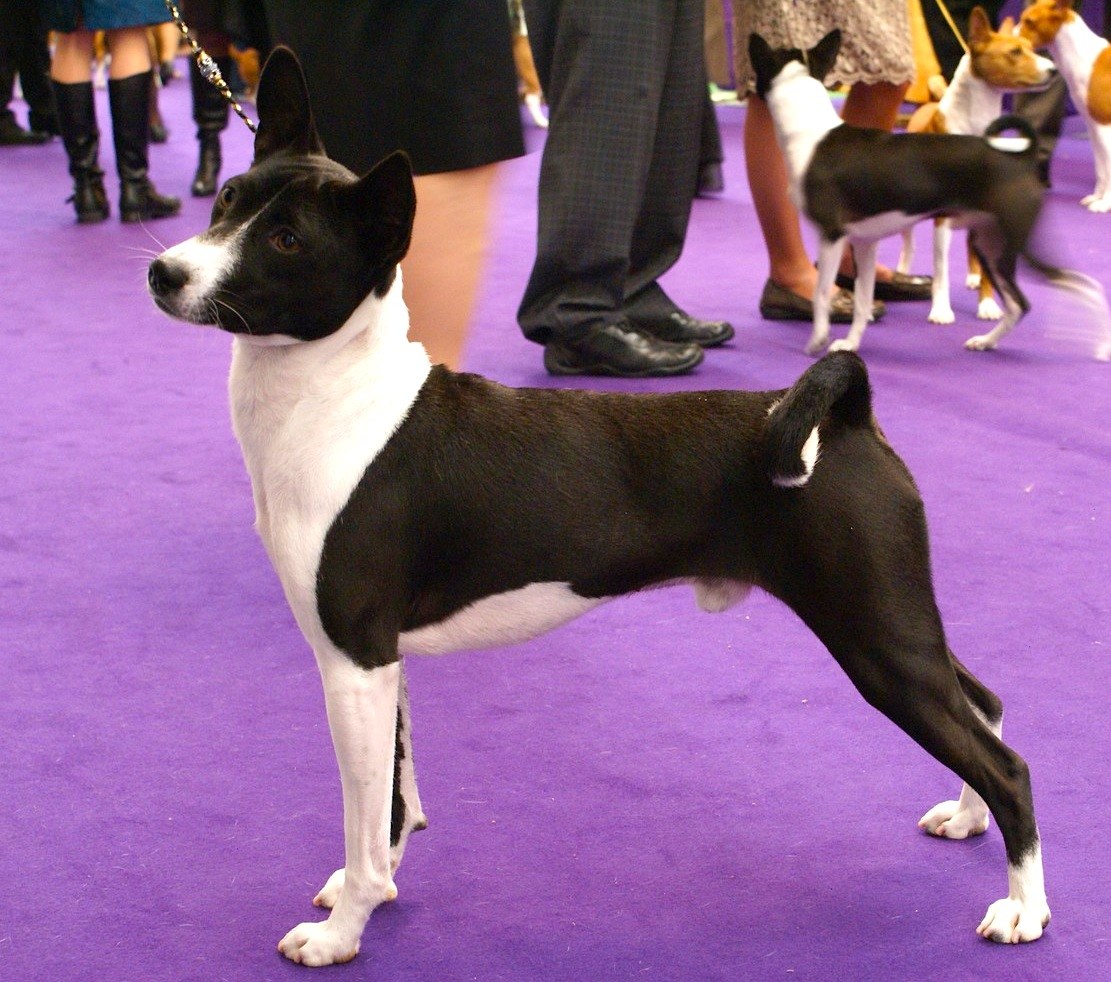

Do you have a better photo of a Basenji in the American show ring? If you have a show photo you’d let us use, email it to [email protected] — tell us the dog’s name and the show, and it may be featured here. Please only send photos you took yourself or have the photographer’s permission to share, and tell us the photographer’s name.
1. Breed at a glance
Hound — recognized by the AKC in 1943
Dogs 17 in, bitches 16 in at the shoulder. Approximate weight 24 lb (dogs), 22 lb (bitches).
Short and fine. Chestnut red, pure black, tricolor, or brindle, all with white feet, chest, and tail tip.
Intelligent, independent, affectionate, alert. Can be aloof with strangers.
High. Needs daily exercise and a secure fence — prey-driven and quick to chase.
Size, coat, and temperament facts are from the AKC standard. Lifespan (13 to 14 years) is the Basenji Club of America’s figure (Basenji Club of America).
2. History
The Basenji comes from villages along the Congo, where it has hunted small game with people for thousands of years — an ancient hunting hound from central Africa, known as the barkless dog. The first pairs to reach North America arrived in 1937, and the AKC recognized the breed in 1943, assigning it to the Hound Group. The Basenji Club of America has been the AKC parent club for the breed since 1942. (Sources: Basenji Club of America, The Basenji; Basenji Club of America.)
The breed’s gene pool has been deliberately kept open to Africa. The Native Stock Project, started in 1988 and still ongoing, keeps the stud book open to newly identified African dogs. The AKC stud book was reopened to 14 new imports in 1990 at the parent club’s request, and again to selected imported dogs from January 1, 2009 to December 31, 2013. That openness is unusual among AKC breeds, and it is the reason the modern Basenji still looks and moves like the Congo village dog it came from. (Sources: Basenji Club of America, The Basenji; Wikipedia, Basenji.)
The barkless name is the breed’s calling card, and it is exactly half true. Basenjis do not bark in the ordinary repetitive way, because of the shape of their larynx — but they are far from silent. The parent club puts it plainly: “They don’t actually bark. They yodel, chortle, and scream.” Anyone considering the breed for its quiet reputation should spend time around adult Basenjis first. (Sources: Basenji Club of America, The Basenji; Wikipedia, Basenji.)
3. The standard and why it’s written that way
- Small, short-backed, lightly built. The standard opens with the silhouette: “The Basenji is a small, short haired hunting dog from Africa. It is short backed and lightly built, appearing high on the leg compared to its length. The wrinkled head is proudly carried on a well arched neck and the tail is set high and curled. Elegant and graceful, the whole demeanor is one of poise and inquiring alertness.” (Source: AKC standard.)
- Barkless, but not mute. “The Basenji should not bark but is not mute. The wrinkled forehead, tightly curled tail and swift, effortless gait (resembling a racehorse trotting full out) are typical of the breed.” The dog hunts by both sight and scent. (Source: AKC standard.)
- Head, ears, eyes. The eyes are dark hazel to dark brown, almond shaped, obliquely set and farseeing, with dark rims. The ears are small, erect and slightly hooded, of fine texture and set well forward on top of the head. The skull is flat, well chiseled and of medium width, tapering toward the eyes. Wrinkles appear upon the forehead when the ears are erect, and are fine and profuse; side wrinkles are desirable, but should never be exaggerated into dewlap. The nose is black, greatly desired. The teeth meet in a scissors bite. (Source: AKC standard.)
- Size — one size, no miniature. Ideal height for dogs is 17 inches and bitches 16 inches, measured from the front of the chest to the point of the buttocks as well as at the shoulder. Approximate weight for dogs is 24 pounds and bitches 22 pounds, lightly built within this height to weight ratio. (Source: AKC standard.)
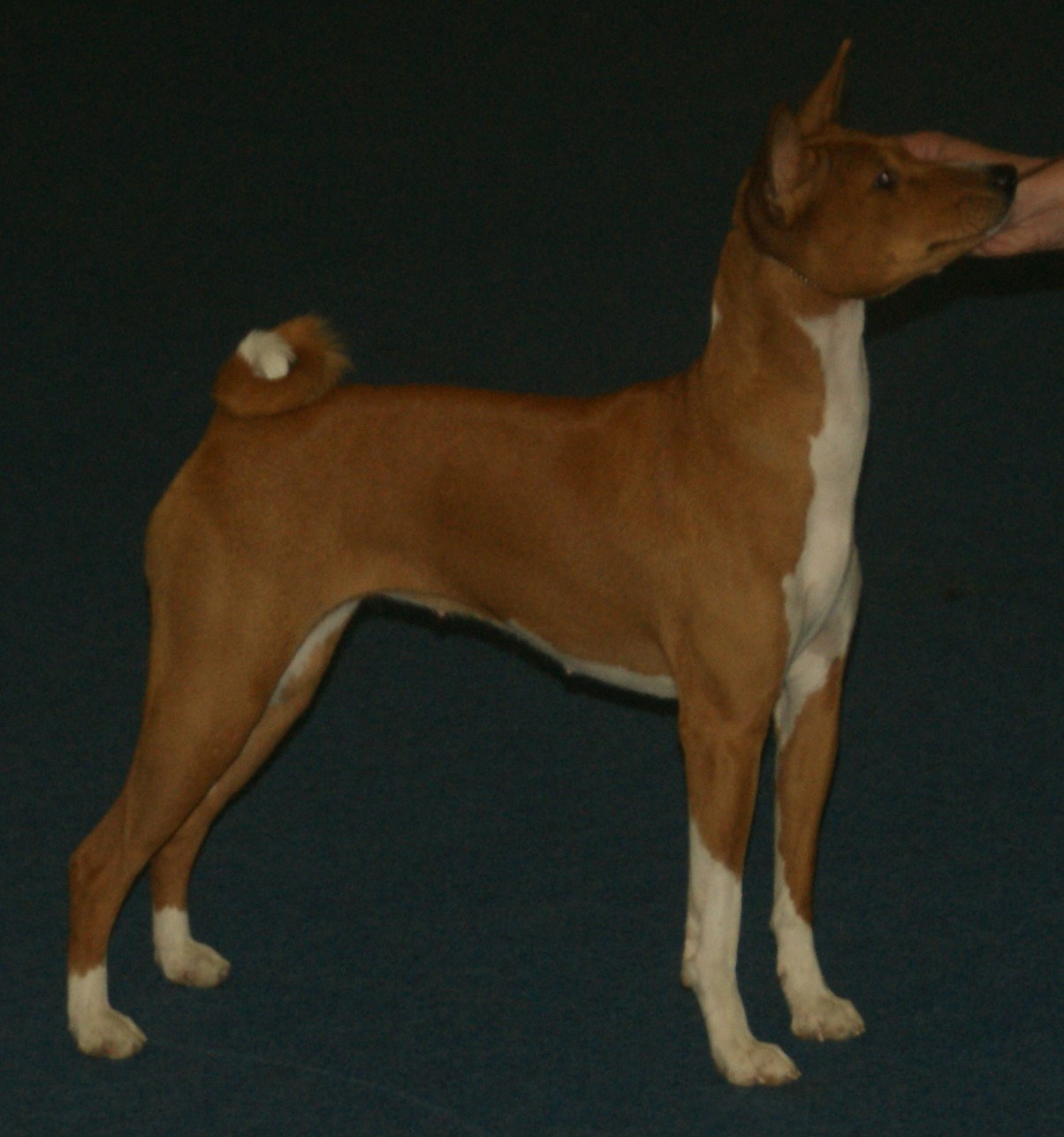
- Four colors, all with white points. “Chestnut red; pure black; tricolor (pure black and chestnut red); or brindle (black stripes on a background of chestnut red); all with white feet, chest and tail tip. White legs, blaze and collar optional. The amount of white should never predominate over primary color. Color and markings should be rich, clear and well-defined, with a distinct line of demarcation between the black and red of tricolors and the stripes of brindles.” Creams, shaded, or off colors other than those defined are heavily penalized. The AKC standard lists no disqualified color — the faults are departures from the points above. (Source: AKC standard.)
- Gait and temperament, in the standard’s own words. Gait: “Swift, tireless trot. Stride is long, smooth, effortless and the topline remains level.” Temperament: “An intelligent, independent, but affectionate and alert breed. Can be aloof with strangers.” (Source: AKC standard.)
4. Temperament & living with one
The AKC sums the breed up in a sentence: the Basenji is “a compact, sweet-faced hunter of intelligence and poise” and “unique and beguiling pets, best for owners who can meet their exercise needs and the challenge of training this catlike canine.” The parent club is blunter. Basenjis are, in its words, “little dickens” — owners brag about the destruction the dog has wrought, and new owners quickly learn to put dirty clothes in the hamper, the remote in a drawer, and the garbage behind a closed door. A tired dog is a good dog, and a Basenji raised with patience and love is unmatched. (Sources: AKC Basenji breed page; Basenji Club of America, The Basenji.)
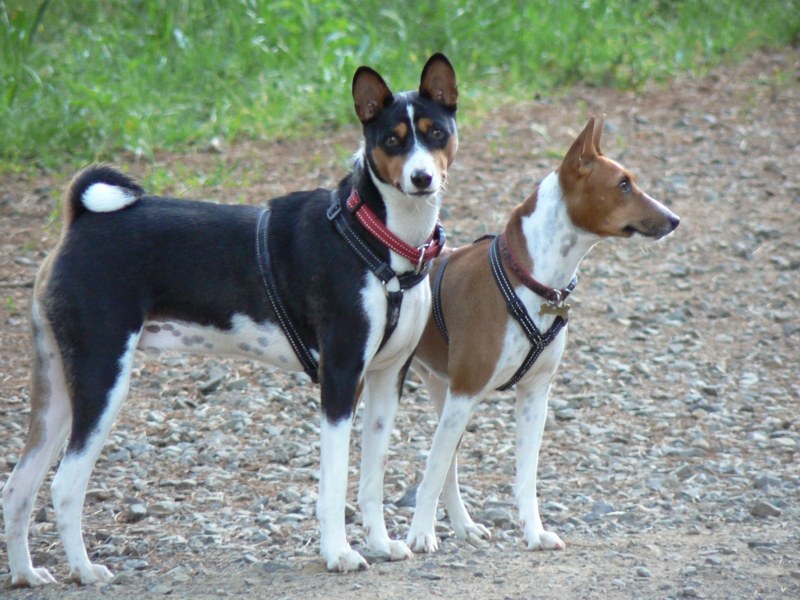
What that means in practice is a dog that is smart, not necessarily obedient. A Basenji will outsmart and out-train you if you let it; puppy kindergarten and basic obedience are strongly encouraged, positive reinforcement works very well, and harsh techniques do not. A Basenji will not grow up to be a frisbee dog and will not reliably fetch a stick — what it will do is chase every squirrel, cat, and rabbit it sees, which is why it lives on leash or behind a secure fence. Sports it does enjoy include lure coursing, tracking, conformation, agility, and obedience. Basenjis are also a handful as puppies: if you are not up for nonstop puppy demands, consider a young adult or an older dog, which usually adapts well and bonds just as strongly. (Source: Basenji Club of America, The Basenji.)
5. Grooming
- Almost no grooming. The coat is short and fine, the skin very pliant, and the dog is clean and fastidious — catlike in its grooming, in the parent club’s words, and a dog that grooms itself. A weekly brush and an occasional bath are enough for most of the year. (Sources: AKC standard; Basenji Club of America.)
- Not hypoallergenic. The short coat sheds lightly, but Basenjis are not hypoallergenic. Some allergic people tolerate them, some don’t, and there is no safe way to know without spending time around them. (Source: Basenji Club of America, The Basenji.)
6. Health testing
- Five tests for a CHIC number. The Basenji Club of America participates in the AKC’s Canine Health Information Center program. For a Basenji to earn a CHIC number, it must have a Fanconi syndrome DNA test, a PRA-Basenji DNA test, a hip evaluation through OFA or PennHIP, an eye examination through OFA’s Companion Animal Eye Registry, and a thyroid evaluation through OFA from an approved laboratory. Breeders must agree to have all test results, positive or negative, published in the CHIC database. (Sources: AKC Hound Group health testing requirements; Basenji Club of America, Basenji Health.)
- Fanconi syndrome. The disease to ask about first. Fanconi is an inherited kidney disease which, untreated, results in kidney failure and death; onset is usually after three years of age. The gene was identified in the fall of 2011, and a direct DNA test has been available since then, with results of Clear, Carrier, or Affected recorded in the OFA database. (Sources: Basenji Club of America, Basenji Health; SunDiata Basenjis, Health.)
- PRA and the rest of the watch list. The PRA-BJ1 DNA test covers about 50% of PRA cases in the breed; in progressive retinal atrophy the retina atrophies, usually later in life, and in the worst cases leads to blindness in old age. The rest of the watch list is autoimmune thyroiditis and hypothyroidism, hip dysplasia (uncommon, about 3% of the breed), eye findings such as persistent pupillary membrane on the yearly CAER exam, and IPSID, an intestinal immune disease. None of this is a reason not to own a Basenji. All of it is a reason to buy from a breeder who tests: ask for the parents’ CHIC numbers and look the results up in the OFA database yourself, rather than taking a breeder’s word for it. Lifespan is 13 to 14 years. (Sources: Basenji Club of America, Basenji Health; SunDiata Basenjis, Health; Basenji Club of America, The Basenji.)
7. The annual Basenji specialty dog show
A specialty is the breed’s All-Star show — its Super Bowl. Once a year, the best Basenjis from across the country, and often from around the world, come together in one place.
The Basenji Club of America’s national specialty: a full week at the Farm Bureau Expo Center in Lebanon, Tennessee, with the conformation specialty at its center and lure coursing, FastCAT, rally, obedience, health clinics, the Top 20, and the annual meeting and banquet around it. The 2026 week: October 5–11, with conformation October 7–10.
National Specialty week: Monday to Sunday, October 5–11, 2026, at the Farm Bureau Expo Center, Wilson County Fairgrounds, 945 East Baddour Parkway, Lebanon, Tennessee — conformation in the Made in Tennessee Building. Conformation days: Wednesday, October 7 (sweepstakes and the African Stock Exhibition), Thursday, October 8 (dog classes, annual meeting, banquet), Friday, October 9 (bitch classes, junior showmanship, rally and obedience, Top 20), Saturday, October 10 (Best of Breed). The Harvest Cluster all-breed shows around the specialty: Tri Star Kennel Club (Wednesday and Sunday), Tullahoma Kennel Club (Thursday and Saturday, the Saturday show a BCOA designated regional specialty), and Cumberland Valley Hound Association (Friday). Lure coursing Sunday, October 4; FastCAT from Monday, October 5. Entry: 139 Basenjis (79 dogs, 60 bitches); 148 entries and 138 competitors across the event. Show Chair: Thomas D. Wright. Superintendent: Onofrio Dog Shows. (Sources: 2026 BCOA National Specialty; 2026 BCOA National Specialty premium list; AKC event search, event 2026000715.)
National specialty judges: Mrs. Brenda J. Cassell — all regular classes and Best of Breed. Mrs. Pat Marshall — Sweepstakes and Veteran Sweepstakes. Ms. Rebecca Haberbush — Junior Showmanship. Ms. Laurie Owen — African Stock Exhibition. Mrs. Mary Ellen Chaffin and Mr. Joe Stewart — lure coursing. (Sources: 2026 BCOA National Specialty, General Information; 2026 BCOA National Specialty premium list.)
Results (official, AKC event 2026000715). Best of Breed: CH Dark Moon Sirius Nyanga It’s About Time (dog, owners M. Work, T. Work, V. Nagy, J. Draud MD). Best of Opposite Sex: CH Dark Moon’s Its A Pod Thing (bitch, owners V. Nagy, J. Predale, J. Draud MD, A. Nagy). Select Dog: CH Spring Willow’s Better Late Than Never At Zamaradi SC. Select Bitch: GCH CH Bellator’s Rattling The Chains With Tezeta. Best of Winners and Winners Dog: Jublie’s Jack Be Quick (owner C. Boutchyard). Winners Bitch: Jublie’s Rum Rita (owners C. Boutchyard, C. Gonter). Reserve Winners Dog: Blue Note’s Mr Saturday Night Live SC. Reserve Winners Bitch: Zamaradi’s Set Fire To The Rain. Best Owner-Handled: GCH CH Bellator’s The Truth Is Out There With Dark Moon DCAT. Best Veteran Dog: GCHB CH Dark Moon’s Bada Bing! Best Veteran Bitch: GCHS CH Dark Moon’s Barking Bad JC. Best Junior Handler: Katryna Smith; Reserve Best Junior Handler: Bentley Mato. (Source: AKC event search, event 2026000715.)
The 2027 national specialty dates had not been announced as of November 2026.
2026 BCOA National Specialty — Basenji Club of America
8. Regional specialties through the year: smaller regional shows
The national is the anchor, but the breed’s year also runs through regional specialties held by the Basenji Club of America’s regional clubs — the Evergreen Basenji Club, the Basenji Club of Northern California, the Basenji Club of Southeastern Wisconsin, the Greater Chicagoland Basenji Club, the Indian Nations Basenji Club, the Copper State Basenji Club, and the Basenji Fanciers of Greater Phoenix. These are the 2027 regionals verified from club sources so far:
No regional specialties announced yet for 2027.
More regional specialties will be added here as their programs are verified — this section is built from show data, not guesswork. Browse upcoming show weekends →
9. Clubs
- Basenji Club of America (parent club) — the AKC parent club for the breed in the United States since 1942. It runs the national specialty, held in Lebanon, Tennessee in 2026. President Natalie Scherwin, Show Chair Thomas D. Wright (2026), AKC delegate Katie Campbell.
- Regional specialty clubs. The breed’s regional AKC specialty clubs are the Evergreen Basenji Club (Seattle/Tacoma, founded 1964, the oldest existing local Basenji club affiliated with the parent club), the Basenji Club of Northern California, the Basenji Club of Southeastern Wisconsin, the Greater Chicagoland Basenji Club, the Indian Nations Basenji Club, the Copper State Basenji Club, and the Basenji Fanciers of Greater Phoenix. (Sources: AKC club search; Evergreen Basenji Club, About.)
If you are new to the breed, the national specialty itself is the better first stop than a breeder’s website: the people there have owned, shown, and worked Basenjis, and they will tell you the truth about the temperament before you fall for a puppy.
10. Rescue
- Start with BRAT. Basenji Rescue and Transport (BRAT) is the largest network of Basenji rescue volunteers in North America, with regional coordinators across the United States and Canada. BRAT handles intake, foster care, transport, and adoption matching, and most Basenjis needing a new home in the US work with BRAT at some point. BRAT is an independent 501(c)(3) organization, separately incorporated from the Basenji Club of America. (Source: Basenji Club of America, Rescue.)
- Adults and seniors. An adult or senior Basenji can be a wonderful companion, often already housetrained, past the chew-everything stage, and ready to bond with a new family. BRAT publishes available dogs on its site and runs an application-based adoption process, matching the dog’s temperament and needs to the household. If you bought your Basenji from a responsible breeder, contact the breeder first — most responsible breeders include a take-back clause in their contracts and want to know if the dog needs help. (Source: Basenji Club of America, Rescue.)
11. Breeder vs. rescue: honest guidance
- If you buy: start with the parent club, the Basenji Club of America, and its breeder directory. Ask for the parents’ CHIC numbers — Fanconi and PRA DNA tests, hips, eyes, and thyroid — and look the results up in the OFA database yourself. Expect to wait: Basenji bitches usually come into season once a year, in the fall, with puppies arriving in late fall or early winter, so a careful search may take months and you may need to travel. A good breeder will have the answers, will ask you as many questions as you ask them, and will take the puppy back for its whole life if you cannot keep it.
- If you rescue: a rescued Basenji is usually an adult, often one whose owner underestimated the time and effort the breed requires, and it will arrive with a prey drive and an escape artist’s instincts fully formed. What you get in return is a dog whose temperament you can see before you commit and a lower price. Either way, be honest with yourself first: a Basenji needs a secure fence, a leash on every outing, and an owner who finds the mischief charming rather than infuriating. It is not a dog for a household that wants an obedient off-leash companion.
- No rare color worth a premium. One thing that is not what a seller tells you: there is no such thing as a rare color worth a premium. The standard names four colors — chestnut red, pure black, tricolor, and brindle, all with white feet, chest, and tail tip — and creams, shaded, or off colors are heavily penalized. The standard also describes one size only, 17 inches for dogs and 16 for bitches, with no miniature variety. A breeder selling a “rare” color, or a “mini Basenji,” at a premium is selling you a label.
12. Claim this page
This page belongs to the breed, and the people who know the breed best are the Basenji Club of America and its members. If you are with the parent club — or you are a breeder, a judge, a handler, or a rescue volunteer who spotted something wrong, missing, or out of date — this page is yours to set straight. Tell us what needs fixing and where the correction is documented, and we will fix it and credit the source. Contact the site through the About page, and mention “Basenji breed profile.”
Sources
- AKC Basenji breed page — akc.org/dog-breeds/basenji
- AKC Basenji breed standard (approved May 8, 1990) — images.akc.org/pdf/breeds/standards/Basenji.pdf
- Basenji Club of America, The Basenji — basenji.org/basenji
- Basenji Club of America, Basenji Health — basenji.org/basenji/health
- Basenji Club of America, Rescue — basenji.org/rescue
- 2026 BCOA National Specialty — nationalspecialty.basenji.org
- 2026 BCOA National Specialty premium list — thepetadvisor.com/assets/premiums/2026/basenji-club-of-america-national-2026.pdf
- 2026 National Specialty, AKC event search, event 2026000715 (official results) — apps.akc.org/apps/events/search/index_results.cfm
- AKC Hound Group health testing requirements — akc.org/breeder-programs/breed-health-testing-requirements/hound-group-health-testing-requirements
- AKC club search (Basenji specialty clubs) — apps.akc.org/apps/club_search/search/index.cfm?clubs=B
- Wikipedia, Basenji (history, AKC recognition, stud book reopenings) — en.wikipedia.org/wiki/Basenji
- SunDiata Basenjis, Health (Fanconi, PRA) — sundiatabasenjis.com/health