
Breed profile · Sporting Group · The French water dog with the beard
Barbet
The Barbet is France’s archetypal water dog: a rustic, medium-sized sporting breed with a dense curly coat and a beard that gives the breed its name — barbe is French for beard. It has been retrieving waterfowl from French marshes since the 16th century, it is believed to be the ancestor of the Poodle, and it only joined the AKC’s Sporting Group in 2020. It is still rare — No. 129 in the AKC’s 2025 registrations — and still a working water dog at heart.
Help us improve it. This is one of ThePetAdvisor’s breed profiles, built from public sources with generous links to the people who actually own this breed’s knowledge. If something’s off or missing, the parent club can claim the page and set it straight — see the bottom of the page.
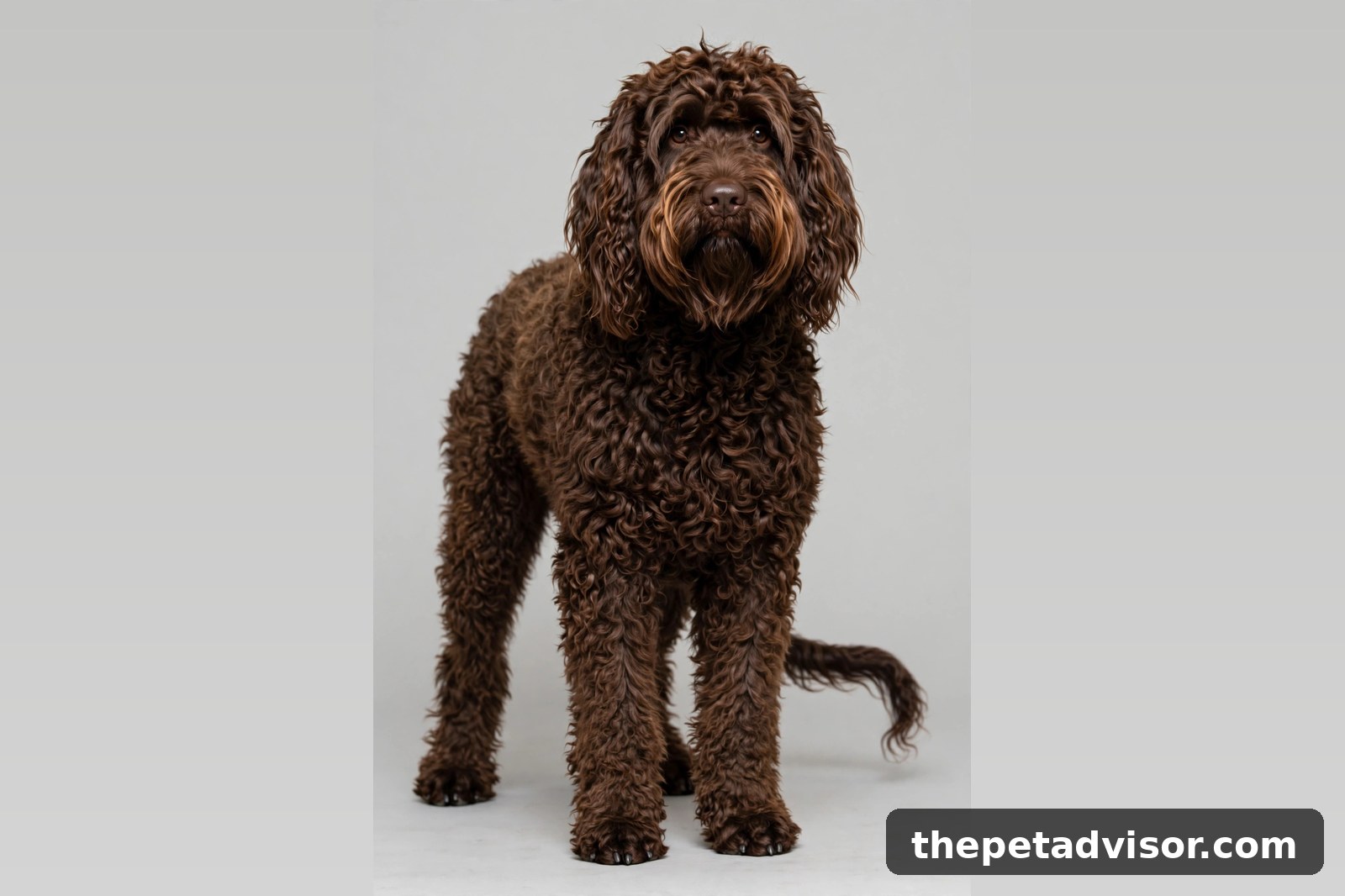
Do you have a photo of a Barbet in the American show ring? We’d love this page to lead with one. If you have a show photo you’d let us use, email it to [email protected] — tell us the dog’s name and the show, and it may be featured here. Please only send photos you took yourself or have the photographer’s permission to share, and tell us the photographer’s name. We couldn’t find a public photo of a Barbet in the American show ring that we were free to share, so the photo leading this page was made with AI. We’d much rather lead with a real one — if you’re a club member with an approved photo, we’d love to feature it.
1. Breed at a glance
Sporting — recognized by the AKC in 2020
Dogs 21–24½ in, bitches 19–22½ in at the shoulder. Weight in proportion to height, typically 35–65 lb.
Long, dense, profuse curls, with a distinctive beard. All shades of black, gray, brown, fawn, with or without white markings; pied.
Cheerful, social, and loyal; joyful, bright, and kindly natured.
An active sporting dog. Needs daily exercise and a job — and water whenever it can get it.
Size and coat facts are from the AKC standard as reproduced by the parent club. Weight is the range breeders quote; lifespan is 12 to 14 years. Popularity: the Barbet is No. 129 in the AKC’s 2025 registrations (AKC most popular breeds 2025).
2. History
The Barbet appears in French works as early as the 16th century, and its name comes from the French word barbe, meaning beard — the breed’s distinctive facial hair. The first written reference to the breed dates to 1387, and by the 16th century the shaggy bearded water dog was a familiar sight with French hunters: in 1587, King Henry IV’s mistress was scolded for bringing a Barbet to church with her. The dog’s work was to locate, flush, and retrieve waterfowl in the marshes and estuaries of France’s coasts, and it did the work in mud — the French saying être crotté comme un Barbet means to be muddy as a Barbet. (Sources: AKC standard; National Purebred Dog Day; DogTime.)
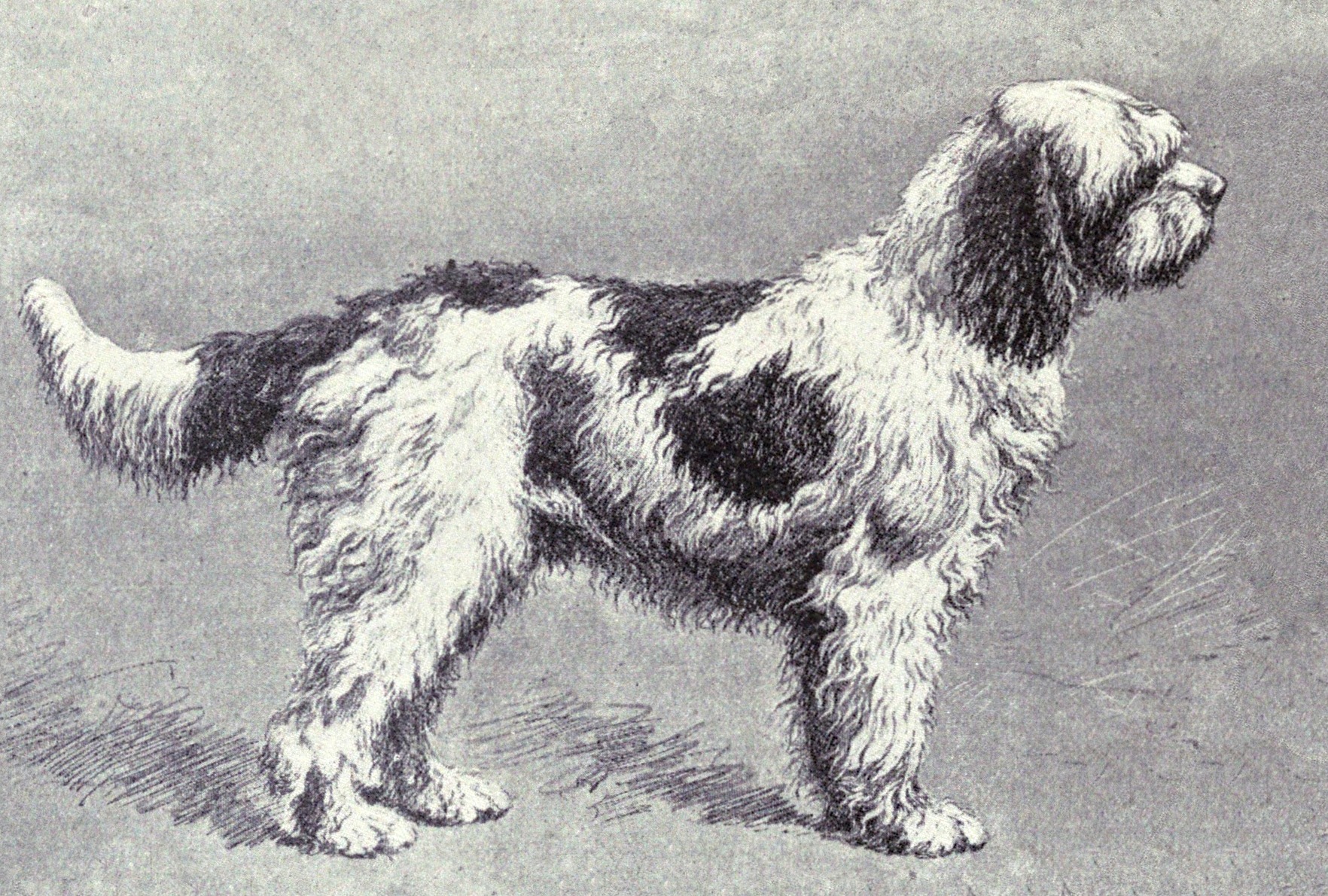
Many cynologists believe the Barbet is the principal ancestor of the Poodle, the Irish Water Spaniel, the Newfoundland, the Briard, and the Bichon breeds — and for much of the 18th and 19th centuries the Barbet and the Poodle were considered the same dog, even crossbred with each other. The split came with the dog show and selective breeding for type, and the first French breed standard followed in the 1890s. The two breeds still look alike to an untrained eye; the difference is in what the coat is for. The Poodle’s coat became a sculpted showpiece. The Barbet’s stayed a working water dog’s coat. (Sources: National Purebred Dog Day; FurLyfe.)
The American story is short. The first Barbets reached the United States in 1994, and the United Kennel Club recognized the breed on January 1, 1995. A small Barbet Club of America existed in Wisconsin in the 1990s; Foundation Stock Service paperwork followed in 2007, and the Barbet Fanciers Club of America — later renamed the Barbet Club of America — formed in 2009 to pursue AKC recognition. The breed entered the Miscellaneous Class on January 1, 2017, and the AKC granted full recognition on January 1, 2020, placing the Barbet in the Sporting Group. Nine Barbets earned AKC titles in 2020 despite the show shutdowns, the breed appeared at Westminster in 2021 and 2022, and by March 2026 the breed had 838 AKC titles. At Westminster in February 2025, GCH Bandi Lacki Splendorki took Best of Breed. (Sources: AKC, FSS News & Updates; UKC Barbet standard; Barbet Club of America, Barbet History in the United States; Barbet Club of America, Westminster 2025.)
3. The standard and why it’s written that way
- An archetypic water dog. The standard opens with the job and the age: “An archetypic water dog of France, the Barbet is a rustic breed of medium size and balanced proportions which appears in works as early as the 16th century.” Then it names the feature that gives the breed its name: “He has a long, dense covering of curly hair and a distinctive beard (French barbe), which gives the breed its name.” The coat is the breed’s defining characteristic, and the standard says so outright: “The coat of the Barbet is his defining characteristic. Profuse hair covers the whole body evenly with thick, natural curls that range from large and loose to tight, smaller curls.” The coat is shown “in as natural a state as possible; clean and free from mats. The hair is to retain curl. While scissoring is necessary to keep him neat, excessive sculpting and shaping is to be penalized.” (Source: AKC standard.)
- Size and build. The numbers are simple. Dogs stand 21 to 24½ inches, bitches 19 to 22½, with weight in proportion to height; measured from point of shoulder to buttocks and withers to ground, the Barbet is slightly longer than tall.
- Head and muzzle. The head is strong, broad, and proportionally large, with a bright, engaging expression, medium nearly-round eyes of dark hazel to dark brown, and ears set at eye level, fully covered with long hair. The muzzle is shorter than the skull and quite square, the bite scissors, and the nose is large and fully pigmented in harmony with the coat.
- Tail and color. The tail is the natural extension of the topline, long and low set, carried above horizontal in a sweeping curve when in motion, never curling onto the back, and never docked. The color list is generous: all shades of black, gray, brown, and fawn, with or without white markings, and pied — primarily white with black, gray, brown, or fawn markings. (Source: AKC standard, as reproduced by the parent club.)
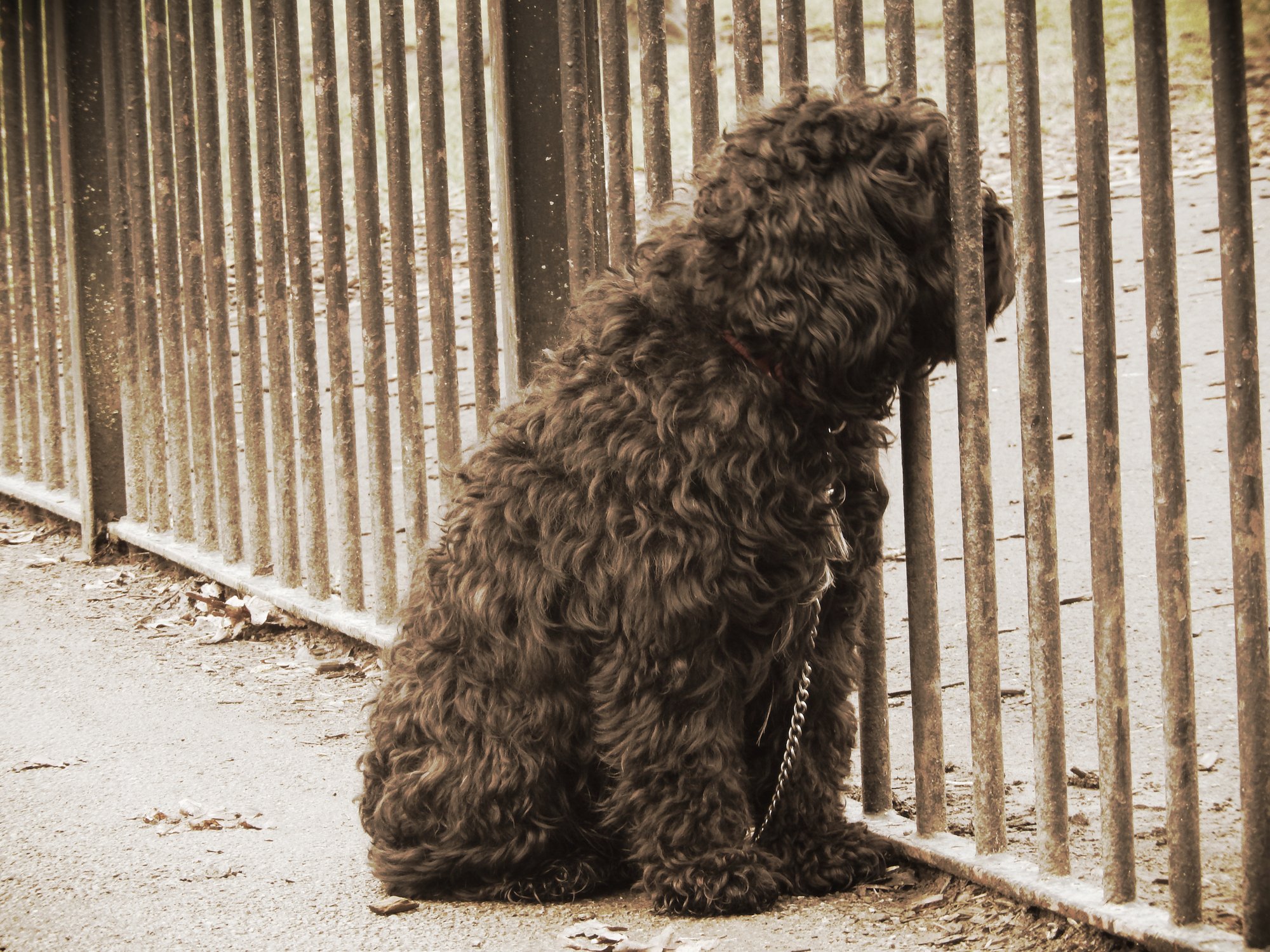
Read the standard as a working specification, not a beauty list. Round, tight feet with thick pads are for rough wet ground; a broad, deep chest reaching the elbow and rounded ribs are for lung capacity and stamina in cold water; a strong back and short, slightly arched loin carry the dog over marsh and bank. The gait the standard asks for is an “easy, ground-covering trot with good front reach and impulsion from hindquarters with precise cadence.” One thing the standard does not contain is a list of disqualifications — the AKC standard as published names none, and every color it lists is allowed. And the coat is the point where the Barbet parts company with the Poodle: the Barbet is shown natural, curl retained, and excessive sculpting is penalized. A Barbet in a Poodle clip is not a better-groomed Barbet; it is a Barbet shown wrong.
4. Temperament & living with one
The standard’s temperament lines are short and consistent: “He has a cheerful disposition; very social and loyal.” And: “The Barbet is a responsive, loving member of the family. Joyful, bright, and kindly natured, he is a versatile sporting dog and willing participant in many activities. The sensitive Barbet responds to positive interaction and training, and displays an even temperament.” Sensitive is the word to take seriously: this is a dog that shuts down under harsh discipline and bores easily under repetitive training, and does its best work for a handler who keeps training positive and interesting. (Source: AKC standard.)
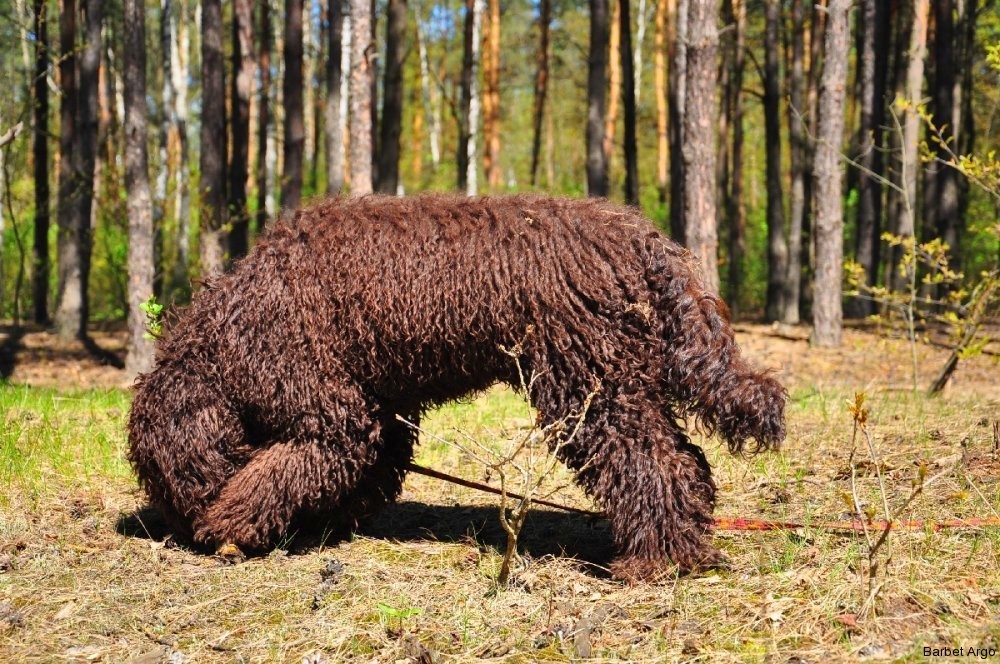
At home a Barbet is devoted to the point of following its people from room to room, and it does not do well left alone for long periods — separation anxiety is the breed’s known weakness. Barbets are good with children and famously good with other dogs, described by breeders as “good mixers,” and they will usually alert-bark when someone comes to the door, then settle once they see the visitor is approved. As a sporting breed, a Barbet may chase small animals and pets. The exercise need is moderate but real: long on-leash walks, the chance to run free, and water whenever it can be had. A Barbet with no job and no swimming is a bored Barbet, and a bored Barbet finds its own entertainment. (Sources: Hickory Tavern Barbet FAQ; AKC Barbet breed page.)
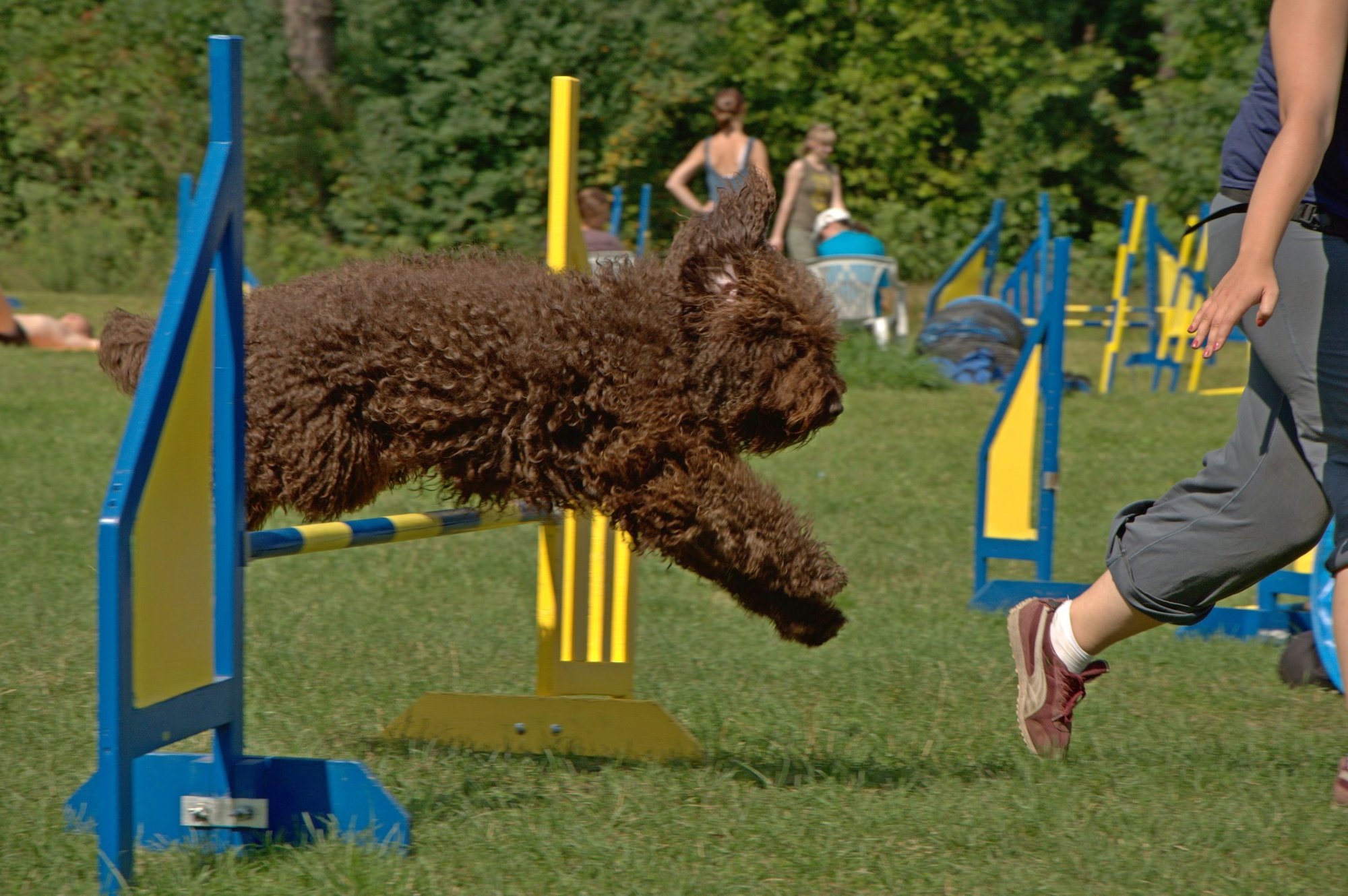
In sport, the Barbet is a versatile entry: conformation, agility, obedience, rally, and hunting retriever tests, with therapy work on the side. The same intelligence that makes the breed easy to train makes it easy to bore, so training has to stay varied — a Barbet that has learned the pattern will start offering variations of its own.
5. Grooming
- Hair, not fur. Grooming is the real work of owning a Barbet, and it starts with a correction: Barbets have hair, not fur. The hair grows continuously, sheds little, and holds its shed hair instead of dropping it — which is why the breed is often called low-shedding and why a Barbet that is not brushed mats. The coat needs a thorough comb-through at least once a week, and more often if the dog swims, because frequent swimming accelerates matting and mats tighten close to the skin, especially behind the ears, in the armpits, and around the collar. Trim the hair between the paw pads while you are trimming the nails, which grow quickly. (Sources: Hickory Tavern Barbet FAQ; AKC Barbet breed page.)
- Baths, ears, and trims. A bath about once a month is enough unless the dog has been in the mud — which, given the breed’s history, will be often. Check and clean the ears regularly: long hair and frequent swimming trap moisture, and ear infections are one of the breed’s known problems. A pet Barbet can be kept in any practical trim, and most pet owners keep the coat short for exactly that reason. A show Barbet is a different matter: the coat is shown as natural as possible, curl retained, with scissoring only to keep the dog neat. Brush the teeth regularly and keep the nails short, and start grooming early — a puppy handled, brushed, and trimmed from eight weeks old grows into an adult that stands quietly for grooming instead of fighting it.
6. Health testing
- A clear CHIC list. The Barbet Club of America publishes a clear CHIC list, and it is the list to ask a breeder for. The required tests for a Barbet to be listed on OFA’s CHIC database are: a hip evaluation, either the OFA radiographic hip evaluation or a PennHIP evaluation; an OFA radiographic elbow evaluation; a DNA-based prcd-PRA test from an approved lab; and an eye examination by a board-certified ACVO ophthalmologist, at a minimum age of 12 months, recommended before breeding and then periodically thereafter.
- CHIC means recorded, not passed. A CHIC number also requires permanent identification by microchip or tattoo. Dogs do not need passing scores for a CHIC number — only recorded results — and inclusion in both CHIC and the club’s breeder listing requires those results to be public on OFA. (Sources: Barbet Club of America, Canine Health (CHIC); Barbet Club of America, BCA Health Statement.)
- Healthy, with named risks. Barbets are generally healthy dogs, and the breed lives 12 to 14 years. The conditions the club names are hip dysplasia, eye conditions, and to a lesser extent elbow dysplasia. Other screening some breeders carry out includes cardiac and thyroid testing, knee X-rays, and testing for the D-locus dilution gene. Breeders also note the occasional case of allergies, immune-mediated conditions, heart issues, and epilepsy. None of these is a reason not to own a Barbet. All of them are reasons to buy from a breeder who tests, publishes the results, and will answer questions about them. (Sources: BCA Health Statement; Ginkgo Barbet, puppy information.)
7. The annual Barbet specialty dog show
A specialty is the breed’s All-Star show — its Super Bowl. Once a year, the best Barbets from across the country, and often from around the world, come together in one place.
The Barbet Club of America’s national specialty is the anchor of the Barbet’s year — a one-day show held inside a big all-breed cluster, with the breed’s people gathered around it. The club is small and the entry is small; the specialty is where the breed’s serious breeders, handlers, and judges meet.
The National Specialty: a one-day show, Saturday, November 14, 2026, at the Ohio Expo Center/Ohio State Fairgrounds, 717 E. 17th Ave., Columbus, Ohio — held inside the Mid-Ohio Cluster (November 12–15), concurrent with the Lima Kennel Club all-breed show. Entry: 33 dogs and 55 entries. (Sources: official premium list; AKC Upcoming National Specialties; official judging program.)
Specialty judge: Mr. Wayne R. Cavanaugh of Kalamazoo, Michigan — all regular and non-regular classes and Best Owner-Handled, Ring 11 at 10:00 am. Puppy and Veteran Sweepstakes: Ms. Anna M. Vaughn of Broken Arrow, Oklahoma, Ring 11 at 9:30 am. Junior Showmanship: Mr. Daniel Fabelo of Fairfield Township, Ohio, Ring 11 at 11:30 am. Also on the schedule: the AKC National Owner-Handled Series. (Sources: official premium list; official judging program.)
Winners from the 2026 specialty had not been published in an official source as of November 2026 and will be added here when they are.
The 2027 national specialty dates had not been announced as of November 2026.
Past national specialties: 2025
8. Regional specialties through the year: smaller regional shows
The Barbet Club of America is the breed’s only specialty club in the United States, so the Barbet’s year runs through the national specialty and the club’s supported entries at the big clusters, rather than a circuit of regional specialties. These are the 2027 regionals verified from club sources so far:
No regional specialties announced yet for 2027.
The club supports Barbet entries at the Mid-Ohio Cluster, November 12–15, 2026, and the national specialty itself is held inside that cluster, concurrent with the Lima Kennel Club show on Saturday, November 14. Browse upcoming show weekends →
9. Clubs
- Barbet Club of America (parent club) — the AKC parent club for the breed in the United States. It runs the national specialty, the breeder listing, and the rescue referral. President Stacy Able, Vice-President Lori Labian, Treasurer Susie Rohr, Secretary Michelle Charters (2026). Membership is open to anyone who agrees to abide by the AKC Code of Sportsmanship, and dues help pay for supported entries, the national, judges education, Meet the Breeds, and rescue. The club counts more than 1,500 Barbets in America. (Sources: 2026 National Specialty premium list; Barbet Club of America, Join The Club.)
- Barbet Club of Canada — the breed’s parent club in Canada, which held its own national specialty in September 2026. (Source: Showsight, Barbet.)
- Barbet Club UK — the primary club for the breed in the United Kingdom. (Source: Showsight, Barbet.)
No separate regional Barbet specialty clubs could be verified in the United States — the AKC’s club search lists only the Barbet Club of America for the breed, and the parent club is the breed’s only specialty club. If you are new to the breed, the national specialty itself is the better first stop than a breeder’s website: the people there have owned, shown, and worked Barbets, and they will tell you the truth about the grooming before you fall for a puppy.
10. Rescue
- Advisory only, no foster homes. There is no independent Barbet rescue with foster homes, so rescue in this breed works differently from most. The Barbet Club of America runs Barbet Rescue & Rehoming in an advisory role only: it has no independent rescue entity, no 501(c)(3), and no foster homes, and it cannot take a dog into foster care or re-home one itself.
- The breeder is first. If you need a new home for your Barbet, the club’s first recommendation is to contact the breeder you got the dog from. If that is not possible, a designated club representative will help — clarifying the dog’s age, sex, and reason for release, and sending a notice to Barbet owners and breeders in the United States and abroad about a possible placement — and then the club removes itself from the process. The final decision stays with the owner. (Source: Barbet Club of America, Barbet Rescue & Rehoming.)
- AKC Rescue Network contact. The AKC Rescue Network lists the club’s rescue contact as Ellen Rich, (248) 978-2715, [email protected]. Because the breed is rare, few Barbets ever reach a shelter, and a rescue Barbet is usually an adult whose breeder could not be reached. Expect a wait — and know that breeders on the club’s listing agree to take back or help rehome any dog they bred, so the breeder is always the first call. (Sources: AKC Rescue Network, B breeds; Barbet Club of America, Find a Barbet Breeder.)
11. Breeder vs. rescue: honest guidance
If you buy: start with the parent club’s breeder listing. To be listed, a breeder must be a club member in good standing for at least 12 consecutive months, test breeding dogs to the club’s health recommendations — OFA or PennHIP hips and elbows, an examination by a board-certified ophthalmologist, and a DNA test for prcd-PRA — with results public on OFA, and agree to take back or help rehome any dog they bred. Carrier-to-carrier PRA breedings are strongly discouraged. All United States–born litters and puppies must be AKC registered, puppies must be permanently identified by microchip or tattoo, and no puppies go to pet stores, mail-order houses, or auctions. The club does not recommend specific breeders; it is the buyer’s job to research and choose. Breed guides put a puppy at roughly $2,500 to $4,000. (Sources: Barbet Club of America, Find a Barbet Breeder; FurLyfe, Barbet guide.)

- If you rescue: a rescued Barbet is usually an adult, and it will arrive with a coat that needs weekly work and a history you may only partly know. What you get in return is a dog whose temperament you can see before you commit, and a lower price than a puppy. Either way, budget the grooming first: a Barbet you cannot keep combed out is a Barbet that mats, and a Barbet that never swims is a water dog kept from water.
- Not a Poodle, not a doodle. One thing that is not what a seller tells you: a Barbet is not a Poodle and not a doodle. The curly coat invites the confusion, but the Barbet is a distinct rustic French water dog, shown in the ring in its natural coat, not sculpted into a clip. There is also no miniature Barbet and no “rare” color to pay a premium for — the standard allows every shade of black, gray, brown, and fawn, with or without white markings, and pied. A breeder selling a smaller Barbet or a rare color is selling you a label.
12. Claim this page
This page belongs to the breed, and the people who know the breed best are the Barbet Club of America and its members. If you are with the parent club — or you are a breeder, a judge, a handler, or a rescue volunteer who spotted something wrong, missing, or out of date — this page is yours to set straight. Tell us what needs fixing and where the correction is documented, and we will fix it and credit the source. Contact the site through the About page, and mention “Barbet breed profile.”
Sources
- AKC Barbet breed standard (official PDF) — images.akc.org/pdf/breeds/standards/Official_Standard_for_the_Barbet.pdf
- AKC standard as reproduced by the parent club — barbetclubofamerica.com/attn-akc-breed-standard-needs-grooming-link
- AKC, Barbet breed page — akc.org/dog-breeds/barbet
- AKC, FSS News & Updates (recognition dates) — akc.org/breeder-programs/foundation-stock-service-program/fss-news-updates
- AKC, most popular dog breeds of 2025 — akc.org/expert-advice/dog-breeds/most-popular-dog-breeds-2025
- AKC Upcoming National Specialties — apps.akc.org/apps/events/conformation/national_specialties.cfm
- 2026 National Specialty premium list (MB-F) — pdf.infodog.com/prm/5436/prm5436.pdf
- 2026 National Specialty judging program (MB-F) — pdf.cxinfodog.com/jps/5436/jpg5436.pdf
- 2026 BCA National — barbetclubofamerica.com/bca-national2
- Barbet Club of America, Canine Health (CHIC) — barbetclubofamerica.com/canine-health-chic-1
- Barbet Club of America, BCA Health Statement — barbetclubofamerica.com/bca-health-statement
- Barbet Club of America, Find a Barbet Breeder — barbetclubofamerica.com/barbet-breeders
- Barbet Club of America, Barbet Rescue & Rehoming — barbetclubofamerica.com/barbet-rescue-rehoming
- AKC Rescue Network, B breeds — akc.org/akc-rescue-network/rescue-network-b-breeds
- Morris & Essex Kennel Club judging program, 2025 national — pdf.cxinfodog.com/jps/908/jpg908.pdf
- UKC Barbet breed standard — ukcdogs.com/conformation-breed-standards/barbet
- Hickory Tavern Barbet FAQ — hickorytavernbarbet.com/barbet-faq.html
- Barbet Club of America, Barbet History in the United States — instagram.com/p/DVvzKRwEfGA
- Barbet Club of America, Westminster 2025 Best of Breed — instagram.com/p/DVcyGNWjBkr
- National Purebred Dog Day, Barbet, Ancestor of Other Breeds We Love — nationalpurebreddogday.com/barbet-ancestor-of-other-breeds-we-love
- National Purebred Dog Day, “Etre Crotté Comme un Barbet” — nationalpurebreddogday.com/etre-crotte-comme-un-barbet
- DogTime, Barbet — dogtime.com/dog-breeds/barbet
- FurLyfe, Barbet guide — furlyfe.com/dog-breeds/barbet
- Ginkgo Barbet, puppy information — ginkgobarbet.com/barbet-puppy-info