Breed profile · Herding Group · the smart, work-oriented herder of the American West
Australian Shepherd
The Australian Shepherd — the Aussie — is a lean, tough ranch dog and one of those “only in America” stories: the AKC calls it “a European breed perfected in California by way of Australia,” a fixture on the rodeo circuit, closely associated with the cowboy life. It is a medium-size herding dog — males 20 to 23 inches at the withers, females 18 to 21 — with a medium-length double coat in blue merle, black, red merle, or red, with or without white markings and copper points, and eyes that can be brown, blue, amber, or one of each. The AKC calls it smart, work-oriented, and exuberant, and the parent club’s own warning is the honest version: this is a very active dog that needs a great deal of exercise every day and a job to do.
Two clubs, one breed: the AKC parent club is the United States Australian Shepherd Association (USASA); the Australian Shepherd Club of America (ASCA) is a separate, independent club with its own registry and its own national specialty. And the Miniature American Shepherd is a separate, smaller breed — not a variety of the Australian Shepherd. This page covers the Australian Shepherd only.
Help us improve it. This is one of ThePetAdvisor’s breed profiles, built from public sources with generous links to the people who actually own this breed’s knowledge. If something’s off or missing, the parent club can claim the page and set it straight — see the bottom of the page.
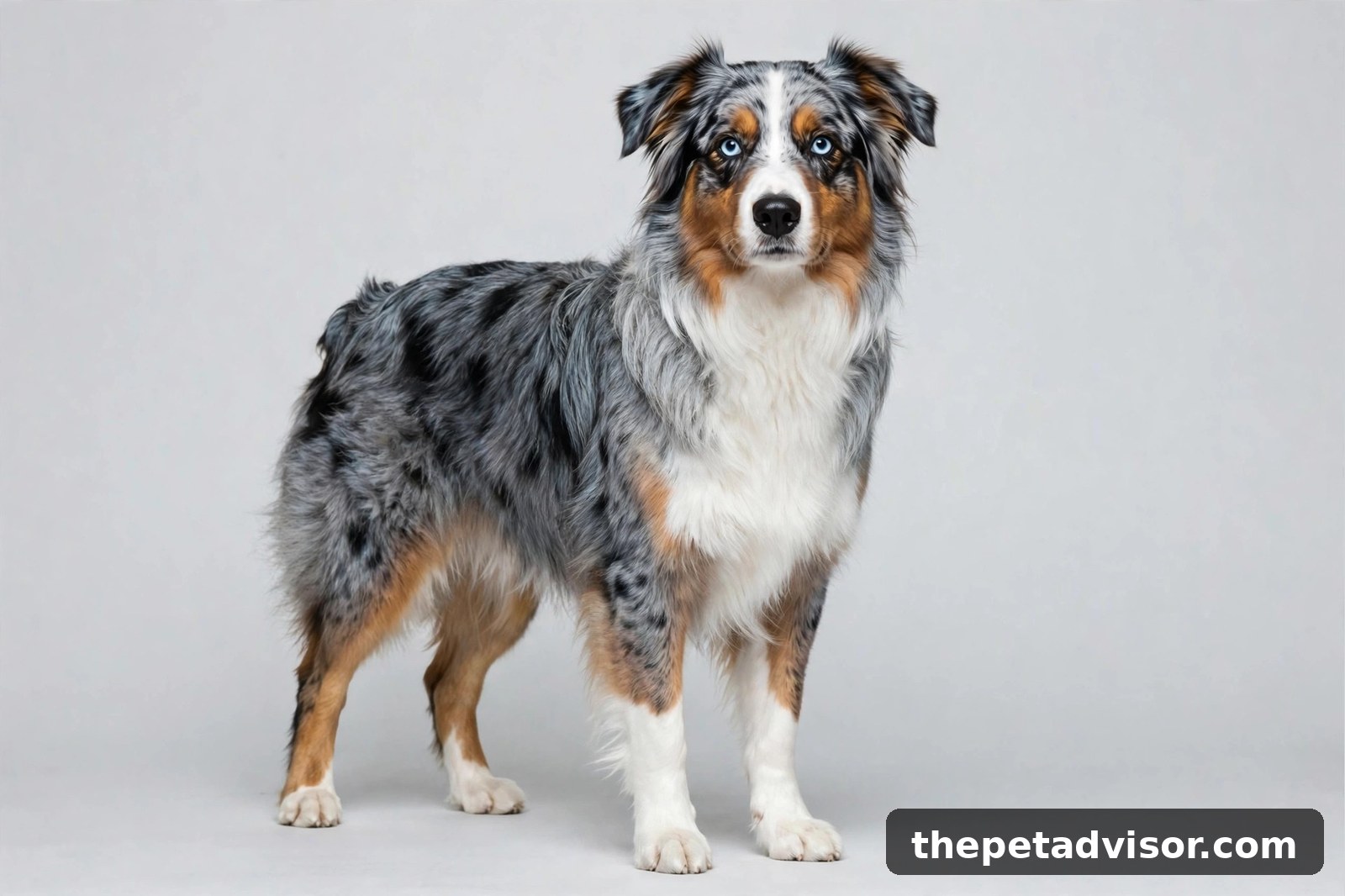
Do you have a photo of an Australian Shepherd in the American show ring? We’d love this page to lead with one. If you have a show photo you’d let us use, email it to [email protected] — tell us the dog’s name and the show, and it may be featured here. Please only send photos you took yourself or have the photographer’s permission to share, and tell us the photographer’s name. We couldn’t find a public photo of an Australian Shepherd in the American show ring that we were free to share, so the photo leading this page was made with AI. We’d much rather lead with a real one — if you’re a club member with an approved photo, we’d love to feature it.
1. Breed at a glance
Herding — recognized by the AKC September 1, 1991; in the Herding Group from January 1, 1993
Dogs 20–23 in, 50–65 lb; bitches 18–21 in, 40–55 lb at the withers. Medium size, slightly longer than tall.
Medium-length double coat, straight to wavy, weather resistant. Blue merle, black, red merle, or red, with or without white markings and/or tan (copper) points.
Intelligent, active, even disposition; good natured, seldom quarrelsome. May be somewhat reserved in initial meetings.
12 to 15 years.
Size, coat, and temperament facts are from the AKC standard (approved May 14, 1991; effective January 1, 1993) and the United States Australian Shepherd Association breed page. Weight by sex (males 50–65 lb, females 40–55 lb) is from the USASA breed page; the AKC standard gives height only. Lifespan (12 to 15 years) is from the AKC breed page.
2. History
There are many theories about the origin of the Australian Shepherd, but the parent club states the settled part plainly: the breed as we know it today developed exclusively in the United States. It was given its name because of its association with the Basque sheepherders who came to the United States from Australia in the 1800s. The Aussie rose rapidly in popularity with the boom of western riding after World War II, becoming known to the general public via rodeos, horse shows, movies, and television, and American stockmen continued the development of the breed, maintaining its versatility, keen intelligence, strong herding instinct, and eye-catching appearance. (Source: United States Australian Shepherd Association, Breed History.)
Australian Shepherds were registered by various registries from the early 1950s. The Australian Shepherd Club of America (ASCA) was founded in 1957, kept its own registry, and held a working-dog focus. When the AKC moved toward full recognition of the breed in the late 1980s and early 1990s, ASCA openly opposed the measure, and the breeders who felt AKC membership had its advantages split off to form their own club: the United States Australian Shepherd Association, established in 1990 as the parent club representing the breed to the American Kennel Club. On September 1, 1991, the AKC recognized the Australian Shepherd breed, and on January 1, 1993, accepted it into the Herding Group. (Sources: United States Australian Shepherd Association, Breed History; EasyPetMD, Australian Shepherd.)
The split never healed into one club, and the two organizations still run side by side. ASCA remains the largest independent breed-specific club in the United States, with its own registry and its own national specialty — the 52nd ASCA National Specialty ran September 18–25, 2026, at Island Grove Regional Park in Greeley, Colorado. That is a separate event from the AKC national specialty this page covers, which is put on by the United States Australian Shepherd Association, the AKC parent club. (Sources: Aussie Obsessed, ASCA National Specialty; AlphaBeta Aussies, Associations & Clubs.)
3. The standard and why it’s written that way
- General appearance — intelligent, well balanced, slightly longer than tall. “The Australian Shepherd is an intelligent working dog of strong herding and guarding instincts. He is a loyal companion and has the stamina to work all day. He is well balanced, slightly longer than tall, of medium size and bone, with coloring that offers variety and individuality. He is attentive and animated, lithe and agile, solid and muscular without cloddiness. He has a coat of moderate length and coarseness. He has a docked or natural bobbed tail.” (Source: AKC standard.)
- Size — males 20 to 23 inches, females 18 to 21 inches. “The preferred height for males is 20 to 23 inches, females 18 to 21 inches. Quality is not to be sacrificed in favor of size.” Measuring from the breastbone to the rear of the thigh and from the top of the withers to the ground, the dog is slightly longer than tall. He is solidly built with moderate bone; the male reflects masculinity without coarseness, and bitches appear feminine without being slight of bone. (Source: AKC standard.)
- The head: clean cut, strong and dry. The muzzle is equal in length or slightly shorter than the back skull; viewed from the side, the topline of the back skull and muzzle form parallel planes, divided by a moderate, well-defined stop. “Expression — Showing attentiveness and intelligence, alert and eager. Gaze should be keen but friendly.” Eyes are brown, blue, amber, or any variation or combination thereof, including flecks and marbling; almond shaped, not protruding nor sunken. The blue merles and blacks have black pigmentation on eye rims; the red merles and reds have liver (brown) pigmentation. Ears are triangular, of moderate size and leather, set high on the head; at full attention they break forward and over, or to the side as a rose ear. Prick ears and hanging ears are severe faults. (Source: AKC standard.)
- Coat — medium length, straight to wavy, weather resistant. “Hair is of medium texture, straight to wavy, weather resistant and of medium length. The undercoat varies in quantity with variations in climate.” Hair is short and smooth on the head, ears, front of forelegs, and below the hocks; the backs of forelegs and britches are moderately feathered, and there is a moderate mane and frill, more pronounced in dogs than in bitches. Nontypical coats are severe faults. (Source: AKC standard.)
- Color — four colors, no order of preference. “Blue merle, black, red merle, red — all with or without white markings and/or tan (copper) points, with no order of preference.” The hairline of a white collar does not exceed the point of the withers at the skin. White is acceptable on the neck (either in part or as a full collar), chest, legs, muzzle, underparts, blaze on head, and white extension from underpart up to four inches, measuring from a horizontal line at the elbow. White on the head should not predominate, and the eyes must be fully surrounded by color and pigment. Merles characteristically become darker with increasing age. White body splashes — white on the body between withers and tail, on the sides between elbows and the back of the hindquarters, in all colors — are a disqualification, as are an undershot bite and an overshot bite greater than one-eighth of an inch. (Source: AKC standard.)
- Gait — smooth, free, and easy, able to change direction instantly. “The Australian Shepherd has a smooth, free and easy gait. He exhibits great agility of movement with a well-balanced, ground covering stride. Fore and hind legs move straight and parallel with the center line of the body. As speed increases, the feet (front and rear) converge toward the center line of gravity of the dog while the back remains firm and level. The Australian Shepherd must be agile and able to change direction or alter gait instantly.” (Source: AKC standard.)
- The tail: straight, docked or naturally bobbed, not over four inches. “Tail is straight, docked or naturally bobbed, not to exceed four inches in length.” (Source: AKC standard.)
- Temperament, in the standard’s own words. “The Australian Shepherd is an intelligent, active dog with an even disposition; he is good natured, seldom quarrelsome. He may be somewhat reserved in initial meetings.” Any display of shyness, fear, or aggression is to be severely penalized. (Source: AKC standard.)
4. Temperament & living with one
The AKC sums the breed up in three words: smart, work-oriented, and exuberant. The parent club fills in what that means day to day: Aussies are intelligent, medium-sized dogs of strong herding and guardian instincts, delightful and loyal companions and great family dogs, who love to be part of the daily hustle and bustle and enjoy riding in the vehicle just to be with their beloved master. They are easily trained and easily housebroken, because they are intelligent and eager to please. (Sources: AKC Australian Shepherd breed page; United States Australian Shepherd Association, Temperament.)
The work ethic is the whole ownership proposition. Aussies are very active dogs that need a great deal of exercise on a daily basis to prevent them from becoming bored or frustrated and consequently developing destructive habits, and because of their high energy level, combined with high intelligence, they need to be given a “job” to perform — shepherding the children, protecting the house, herding livestock, or competing in dog events. They want to be with their owners all the time, following them from room to room in the house, and they love nothing better than going along in the car or truck on errands. They have been used as seeing-eye dogs, utility dogs for the physically handicapped, hearing dogs, police and narcotics dogs, search and rescue dogs, and therapy dogs. (Source: United States Australian Shepherd Association, Temperament.)
That devotion has an edge to manage. Aussies can be highly territorial and protective of their masters’ possessions, potentially causing serious difficulties unless the behavior is controlled with proper training, and the standard warns that they may be somewhat reserved in initial meetings. Early, thorough socialization and obedience training are what keep that reserve from hardening into suspicion, and a herding dog that is not given an outlet will herd what is available — children, other pets, bicycles, and anything else that moves. (Sources: United States Australian Shepherd Association, Temperament; AKC standard.)
5. Grooming
- Brush once a week, more often when shedding. For most of the year, Aussies need no more than a weekly brushing to keep the medium-length double coat looking clean and healthy. Once or twice a year they go through heavy shedding periods, when they need to be brushed more often with an undercoat rake and a wire brush — every two or three days during the shed is a good rhythm. (Sources: CareCredit, Australian Shepherd Dog Breed Guide; Petland Gahanna, Australian Shepherd.)
- Check the mat-prone spots. Mats form first where the coat is longest and feathered — behind the ears, in the mane and frill, on the backs of the forelegs, and in the britches. Work through those spots every time you brush, and work mats out with your fingers or a comb rather than cutting them out. (Sources: AKC standard; CareCredit, Australian Shepherd Dog Breed Guide.)
- Bathe only occasionally — and do not shave an Aussie. Aussies often work and play outdoors, so they come in dirtier than they left, but unless they have gotten into a particularly messy situation, they require a bath only occasionally. The double coat is weather resistant and protects against sun and heat as well as cold; shaving it takes that protection away. (Sources: Petland Gahanna, Australian Shepherd; MetLife Pet Insurance, Australian Shepherd Breed Facts.)
- Nails, teeth, and ears. Trim nails regularly, brush teeth at least twice a week, and check and clean the ears weekly. The short version: grooming an Aussie is the easy part of owning one; the work is exercise, not brushing. (Source: CareCredit, Australian Shepherd Dog Breed Guide.)
6. Health testing
- Three evaluations for a CHIC number. For a CHIC number, the Australian Shepherd needs three evaluations: a Hip Evaluation, an Elbow Evaluation, and an Ophthalmologist Evaluation. That is the parent club’s list on the AKC’s Herding Group health-testing page. Breeders must agree to have all test results, positive or negative, published in the CHIC database. (Source: AKC Herding Group Health Testing Requirements.)
- HSF4 hereditary cataracts — the DNA test behind most Aussie cataracts. Hereditary cataracts are a clouding of the lens caused by a breakdown of tissue in the eye, and the HSF4 form accounts for about 70% of cataract cases in the breed. A DNA test identifies normal, carrier, and affected dogs. Because other forms of cataract also occur, the annual eye exam with a canine ophthalmologist still matters. (Sources: Faithwalk Aussies, Health Testing; Calabrone Australian Shepherds, Health and Genetic Testing.)
- MDR1 — tell every veterinarian. The MDR1 mutation affects the protein that protects the brain by transporting potentially harmful chemicals away, so a dog with the mutation can react badly to ivermectin and a list of other common drugs and anesthetics. A cheek-swab DNA test identifies normal, carrier, and affected dogs — get it done and tell every veterinarian who treats your dog. (Sources: Faithwalk Aussies, Health Testing; Legends Aussies, Health Links.)
- Other eye DNA tests: CEA, prcd-PRA, CMR1, and cone degeneration. Breeders also test for Collie eye anomaly, progressive retinal atrophy (the prcd form), canine multifocal retinopathy, and cone degeneration — all eye diseases with DNA tests available. Eye exams still need doing every year: Aussies can inherit a number of eye defects that impair vision in varying degrees or cause complete blindness, including ocular coloboma, iris coloboma, juvenile and senior cataracts, detached retina, persistent pupillary membrane, progressive retinal atrophy, and distichiasis. (Sources: Faithwalk Aussies, Health Testing; Calabrone Australian Shepherds, Health and Genetic Testing.)
- Hip and elbow dysplasia. The most commonly cited inherited problems in the breed, as in most medium breeds: the hip or elbow joint develops abnormally, which can lead to arthritis and limited mobility. OFA hip ratings of Excellent, Good, or Fair pass; for elbows, only Normal passes. (Sources: Calabrone Australian Shepherds, Health and Genetic Testing; AKC Herding Group Health Testing Requirements.)
- Epilepsy. Seizure disorders affect the breed, and the breed community funds research into them: the University of Minnesota runs an epilepsy research project for Australian Shepherds, with blood draws offered at the national specialty through the combined efforts of USASA, the Australian Shepherd Health & Genetics Institute, and Toby’s Foundation. There is no simple screening test to ask for here — what you can ask is whether epilepsy has shown up in the pedigree behind the puppy. (Source: Toby’s Foundation, USASA Nationals health screenings.)
- Lifespan: 12 to 15 years. The commonly published lifespan is 12 to 15 years. (Source: AKC Australian Shepherd breed page.)
7. The annual Australian Shepherd specialty dog show
A specialty is the breed’s All-Star show — its Super Bowl. Once a year, the best Australian Shepherds from across the country, and often from around the world, come together in one place.
The United States Australian Shepherd Association’s national specialty: one national event each year, with conformation, obedience, rally, agility, herding, scent work, FastCAT, futurity, maturity, sweepstakes, and a Top 20 competition. The 2026 national: April 15–17, at Purina Farms in Gray Summit, Missouri, with 303 competitors and 346 entries in conformation. The 2025 national: cancelled — a March 2025 tornado at Purina Farms. The 2024 national: May 15–17, at Purina Farms in Gray Summit, Missouri, with 269 competitors and 333 entries. The 2027 national: April 14–16, at Purina Farms in Gray Summit, Missouri.
The standard, in brief: an intelligent working dog of strong herding and guarding instincts, well balanced, slightly longer than tall, of medium size and bone. Males 20 to 23 inches at the withers, females 18 to 21 inches. Medium-length double coat, straight to wavy, weather resistant. Colors: blue merle, black, red merle, red, with or without white markings and/or tan (copper) points. Eyes brown, blue, amber, or any variation or combination, including flecks and marbling. Tail straight, docked or naturally bobbed, not to exceed four inches in length.
The 2026 National Specialty — the 34th Annual National Specialty, national week Friday, April 10, through Friday, April 17, 2026, at the Purina Event Center, 500 William Danforth Drive, Gray Summit, Missouri. Conformation ran Wednesday, April 15, through Friday, April 17, 2026: regular dog classes Wednesday, regular bitch classes Thursday, and junior showmanship and Best of Breed Friday. Agility ran Friday through Sunday, April 10–12; herding Monday, April 13 (Australian Shepherds only) and Tuesday, April 14 (all breeds); Futurity and Maturity Monday, April 13; Sweepstakes Tuesday, April 14; the 9th Annual Top 20 competition Wednesday. Entry: 346 entries / 303 competitors (131 dogs, 172 bitches). Entries opened Monday, February 16, 2026, at 9:00 a.m., and closed Wednesday, March 25, 2026, at noon CDT. Event Chair: Martha Beale. Superintendent: MB-F Inc. Host hotel: Holiday Inn Six Flags, Eureka, Missouri. (Sources: 2026 premium list; AKC event search, event 2026471930; 2026 National Specialty Information.)
National specialty judges: Ms. Tina Beck — Futurity. Mr. Tim Preston — Maturity and Best of the Best. Mr. Jamie Clute — Sweepstakes. Ms. Regina Bryant — dogs, veteran dogs, stud dog, brood bitch, and brace. Mr. Dana Cline — bitches and veteran bitches. Mrs. Patricia V. Trotter — Best of Breed, junior showmanship, and Pee Wee. Obedience: Ms. Leslye Pinnell and Mr. Russell Hornfisher. Rally: Mr. Russell Hornfisher and Ms. Leslye Pinnell. Agility: Ms. Kim Crenshaw and Ms. Cindy Deak. Herding: Ms. Marie Koebke and Mr. Alan Koebke. Top 20 judges: Leslie Frank, Cassie Frank, and Laurie Jeff Greer. (Sources: 2026 National Specialty Information; 2026 premium list; USASA newsletter, May 2026.)
Results (2026 national). Best of Breed, Best of Opposite Sex, Winners Dog, and Winners Bitch not confirmed in an official source as of November 2026. Best Junior Handler: Evan Catterson. (Source: AKC event search, event 2026471930.)
The 2027 National Specialty: a three-day event April 14–16, 2027, at Purina Farms, Gray Summit, Missouri, per the AKC Upcoming National Specialties list. Superintendent: MB-F Inc. Judges under contract: Ms. Mary Detor — Sweepstakes; Ms. Danelle Brown — dogs, veteran dogs, stud dog, brood bitch, and brace; Ms. Carmen Battaglia — bitches and veteran bitches; Mr. Jeff Margeson — Best of Breed, Pee Wee, and juniors. Futurity and Maturity judges to be announced. AKC event number, entries, and closing date not yet published as of November 2026. (Sources: AKC Upcoming National Specialties; USASA National Specialty Judges Selection.)
Past national specialties: 2025 · 2024
United States Australian Shepherd Association — australianshepherds.org
8. Regional specialties through the year: smaller regional shows
The national is the anchor, but the breed’s year also runs through regional specialties — smaller regional shows, not the national — held by regional Australian Shepherd clubs around the country. These are the 2026 regionals verified from club sources so far:
Two regional Australian Shepherd specialties verified for 2026 so far:
- Australian Shepherd Fanciers of Arizona specialty — Saturday, May 9, 2026, Scottsdale, Arizona: judge Mr. R L Robinson, 28 entries (15 dogs, 13 bitches), at Scottsdale Westworld, 16601 North Pima Road. Entries closed Wednesday, April 22, 2026, with entries limited to 100. Event Chair: Laura Young. Superintendent: Onofrio Dog Shows. (Source: AKC event search, event 2026754115.)
- United States Australian Shepherd Association concurrent specialty — Friday, October 23, 2026, Dixon, California: held with the Northern California Herding Group at the Dixon May Fairgrounds, 655 South First Street. Judges: Ms. Nannette L Newbury — all regular and non-regular conformation classes; Ms. Jennifer Weiner — sweepstakes, veteran sweepstakes, and junior showmanship. Entries closed Wednesday, October 7, 2026, at noon PDT, with entries limited to 100. Specialty Chair: Regina Lee Bryant. Superintendent: BaRay Event Services. (Source: 2026 premium list.)
More regional specialties will be added here as their programs are verified — this section is built from show data, not guesswork. Browse upcoming show weekends →
9. Clubs
- United States Australian Shepherd Association (USASA) (parent club) — the AKC-recognized national breed club for the Australian Shepherd, established in 1990 as the parent club representing the breed to the American Kennel Club. It holds the national specialty each year, encourages the formation of independent local specialty clubs, and runs the judges education program presented at the national specialty. (Sources: United States Australian Shepherd Association, Breed History; United States Australian Shepherd Association, Constitution & Bylaws.)
- Australian Shepherd Club of America (ASCA) — founded in 1957, the largest independent breed-specific club in the United States, with its own registry and its own national specialty. ASCA is not the AKC parent club; the two clubs run side by side, and the ASCA national specialty is a separate event from the USASA national specialty. (Sources: AlphaBeta Aussies, Associations & Clubs; Aussie Obsessed, ASCA National Specialty.)
- Australian Shepherd Health & Genetics Institute (ASHGI) — the breed’s health and genetics organization, which works with USASA at the national specialty on health screenings and blood draws for research, including the University of Minnesota epilepsy project. (Source: Toby’s Foundation, USASA Nationals health screenings.)
- Regional Australian Shepherd clubs. Regional clubs around the country hold their own specialties through the year — see section 8 — including the Australian Shepherd Fanciers of Arizona and the Northern New Jersey Australian Shepherd Club, both of which held specialties in 2026.
If you are new to the breed, the national specialty itself is the better first stop than a breeder’s website: the people there have owned, shown, and worked Aussies, and they will tell you the truth about the exercise, the shedding, and the energy before you fall for a puppy.
10. Rescue
- Aussie Rescue & Placement Helpline, Inc. (ARPH). The official rescue organization of both the United States Australian Shepherd Association and the Australian Shepherd Club of America: a not-for-profit run by volunteers, dedicated solely to the Australian Shepherd, whose mission is to rescue Australian Shepherds, place them in loving, caring, permanent homes, and educate the public about owning one. It began in the early 1990s with three private rescuers and now runs a network of volunteer rescue representatives across the United States and Canada. ARPH only accepts purebred Aussies; dogs are kept in foster homes with volunteers until the right adoptive home is found, all dogs over six months are spayed or neutered, and every dog is seen by a veterinarian and declared healthy for adoption before placement. An adoption application is the first step, the standard adoption fee for a fully vetted dog is $300, and ARPH does not ship dogs to adopters. (Sources: Bubbly Pet, Australian Shepherd Rescues; ARPH, Adopting from ARPH; Australian Shepherd Nation, Aussie Foundation.)
- Regional Aussie rescues. Regional groups work alongside ARPH in their own areas, including South Texas Aussie Rescue (STAR) and Australian Shepherd Rescue of St. Louis. Start with ARPH if you do not know which group covers your area. (Source: Australian Shepherd Fans, Australian Shepherd Rescue.)
- Adults, usually — and usually for one reason. A rescued Aussie is usually an adult, and it will arrive with its temperament visible before you commit. What you get in return is a dog whose character you can see before you commit and a lower price. The parent club says one of the most frequent reasons Aussies get turned over to rescue is that their owners did not anticipate how energetic these dogs are and were not willing or able to channel that energy constructively through training. Be honest with yourself first: an Aussie needs a great deal of exercise every day, a job to do, and an owner who understands a sensitive, watchful herding dog that follows its people from room to room rather than expecting a dog that stays quietly in the yard. (Source: United States Australian Shepherd Association, Breed History and Temperament.)
11. Breeder vs. rescue: honest guidance
- If you buy: start with the parent club, the United States Australian Shepherd Association, and its breeder referral. Ask for the parents’ health results — the three CHIC evaluations (hips, elbows, eyes) plus the DNA panel (HSF4 hereditary cataracts, MDR1, CEA, and prcd-PRA) — and look the results up in the OFA database yourself. Expect to wait for a puppy from a careful breeder: a good breeder will have the answers, will ask you as many questions as you ask them, and will take the puppy back for its whole life if you cannot keep it. This is not a breed for a sedentary household: the parent club says Aussies need a great deal of exercise every single day and a job to perform, and a bored Aussie invents destructive habits.
- If you rescue: a rescued Aussie is usually an adult, and it will arrive with its temperament visible before you commit. What you get in return is a dog whose character you can see before you commit and a lower price. Either way, be honest with yourself first: an Aussie needs daily hard exercise and mental work, early and thorough socialization, and an owner who understands a sensitive, watchful herding dog rather than expecting a dog that stays quietly in the yard.
- Not a Mini American Shepherd — and not a Border Collie. The Miniature American Shepherd is a separate, smaller AKC breed, recognized in 2015, with its own standard, parent club, and national specialty — not a variety of the Australian Shepherd. And the Border Collie, the other famous medium herding breed, is a different breed entirely, with its own standard and its own national specialty. Judge the dog in front of you against the Australian Shepherd standard — the medium-length double coat, the four colors, the almond eyes that can be blue, brown, amber, or one of each, the docked or natural bobtail — not against a smaller cousin or a look-alike herder.
12. Claim this page
This page belongs to the breed, and the people who know the breed best are the United States Australian Shepherd Association and its members. If you are with the parent club — or you are a breeder, a judge, a handler, or a rescue volunteer who spotted something wrong, missing, or out of date — this page is yours to set straight. Tell us what needs fixing and where the correction is documented, and we will fix it and credit the source. Contact the site through the About page, and mention “Australian Shepherd breed profile.”
Sources
- AKC Australian Shepherd breed page — akc.org/dog-breeds/australian-shepherd
- AKC Official Standard of the Australian Shepherd (approved May 14, 1991; effective January 1, 1993) — images.akc.org/pdf/breeds/standards/AustralianShepherd.pdf
- AKC Herding Group Health Testing Requirements — akc.org/breeder-programs/breed-health-testing-requirements/herding-group-health-testing-requirements
- AKC Upcoming National Specialties — apps.akc.org/apps/events/conformation/national_specialties.cfm
- United States Australian Shepherd Association, Breed History, Temperament & Appearance — australianshepherds.org/finding-an-aussie/the-australian-shepherd
- United States Australian Shepherd Association, Constitution & Bylaws — australianshepherds.org/about-usasa/constitution-bylaws
- 2026 National Specialty Information — australianshepherds.org/shows-events/2026-national-specialty-information
- 2026 premium list — australianshepherds.org (2026 premium)
- 2025 National Specialty Information (cancellation) — australianshepherds.org/shows-events/2025-national-specialty-information
- USASA National Specialty Judges Selection — australianshepherds.org/shows-events/national-specialty-judges-selection
- USASA newsletter, May 2026 — mcusercontent.com (May 2026 newsletter)
- 2026 national, AKC event search, event 2026471930 — apps.akc.org/apps/events/search/index_results.cfm
- 2024 national, AKC event search, event 2024471908 — apps.akc.org/apps/events/search/index_results.cfm
- 2026 Arizona specialty, AKC event search, event 2026754115 — apps.akc.org/apps/events/search/index_results.cfm
- 2026 Dixon concurrent specialty premium — thepetadvisor.com/assets/premiums/2026/us-australian-shepherd-assoc-2026.pdf
- CareCredit, Australian Shepherd Dog Breed Guide — carecredit.com/well-u/pet-care/australian-shepherd-dog-breed
- Petland Gahanna, Australian Shepherd — petlandgahanna.com/breed/australian-shepherd
- MetLife Pet Insurance, Australian Shepherd Breed Facts — metlifepetinsurance.com/blog/breed-spotlights/australian-shepherd
- Faithwalk Aussies, Health Testing — faithwalkaussiesmas.com/health-testing
- Calabrone Australian Shepherds, Health and Genetic Testing — calabroneaustralianshepherds.com/about-us/health-and-genetic-testing
- Legends Aussies, Health Links — legendsaussies.com/0000LINKS.html
- Toby's Foundation, USASA Nationals health screenings — tobysfoundation.org (USASA Nationals health screenings)
- ARPH, Adopting from ARPH — aussierescue.com/Adoption/How-to-Adopt
- Bubbly Pet, Australian Shepherd Rescues — bubblypet.com/best-australian-shepherd-rescue-for-adoption
- Australian Shepherd Nation, Aussie Foundation — australianshepherdnation.com/pages/aussie-foundation
- Australian Shepherd Fans, Australian Shepherd Rescue — australianshepherdfans.com/australian-shepherd-rescue
- EasyPetMD, Australian Shepherd — easypetmd.com/doginfo/australian-shepherd
- AlphaBeta Aussies, Associations & Clubs — alphabetaussies.com/en/associations-et-clubs
- Aussie Obsessed, ASCA National Specialty — aussieobsessed.com
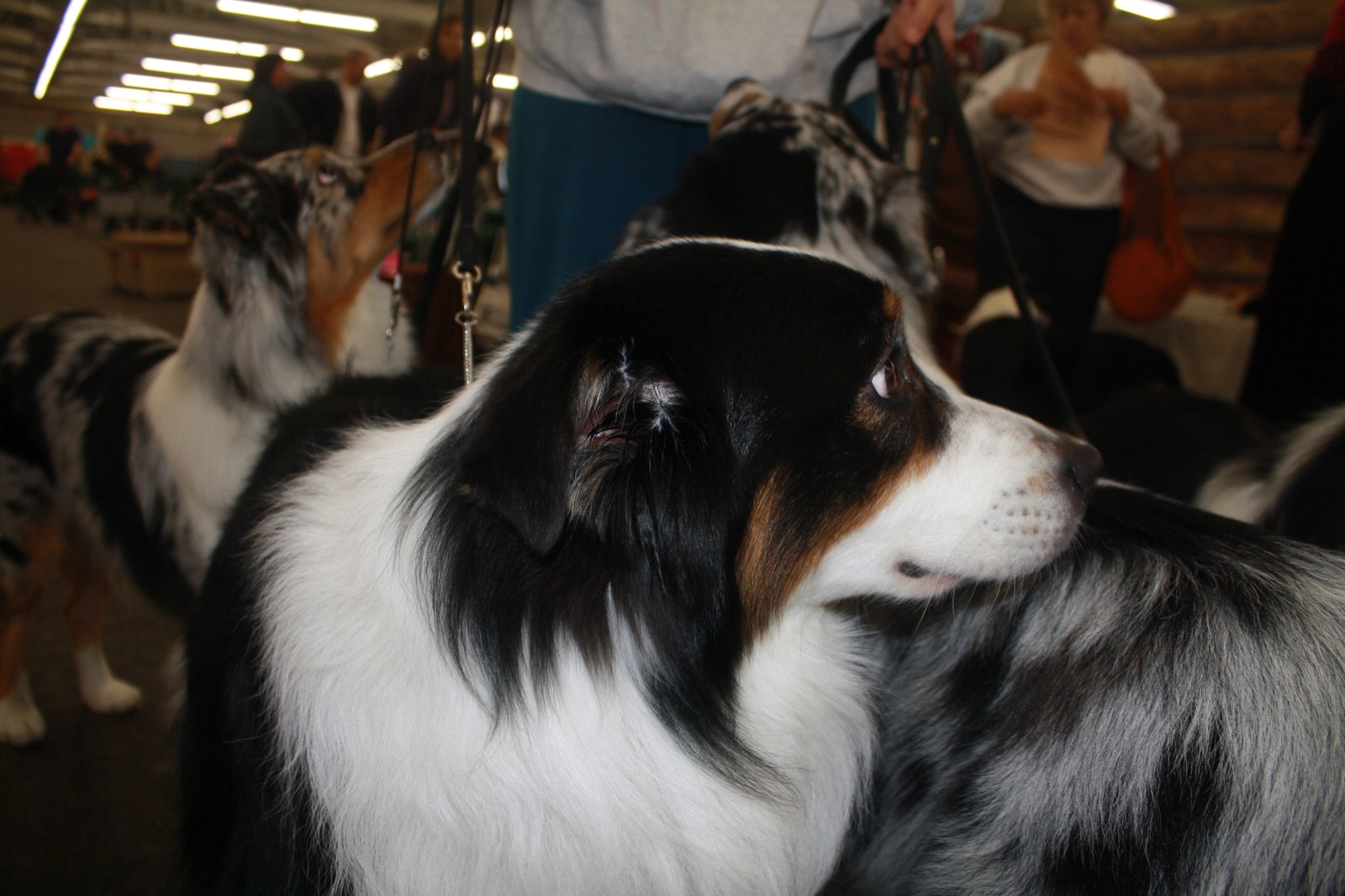
- Fido Factor, Australian Shepherd at a dog show, January 2010, CC BY-SA 2.0 via Wikimedia Commons — commons.wikimedia.org/wiki/File:Australian_shepherd_(4320397449).jpg
