Breed profile · Herding Group · the tireless heeler
Australian Cattle Dog
The Australian Cattle Dog — the Blue Heeler or Queensland Heeler — is the tireless herder of the Herding Group: a sturdy, compact working dog from the Australian outback, bred to move cattle across vast distances in heat and rough country, and famous for outsmarting its owners. The AKC recognized the breed in 1980, and the Australian Cattle Dog Club of America runs the national specialty every year — a full week of conformation, herding, agility, obedience, and rally.
Help us improve it. This is one of ThePetAdvisor’s breed profiles, built from public sources with generous links to the people who actually own this breed’s knowledge. If something’s off or missing, the parent club can claim the page and set it straight — see the bottom of the page.
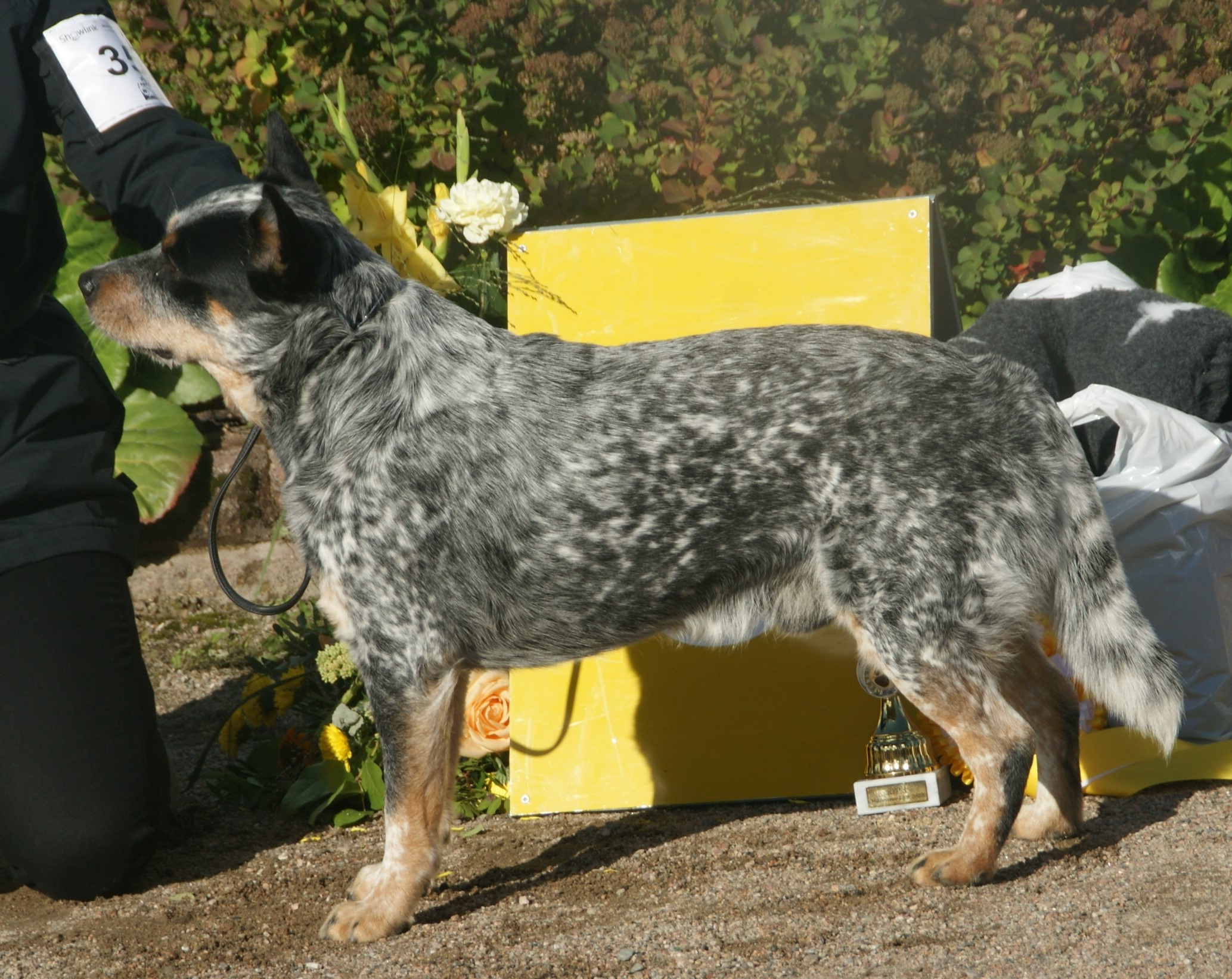

Do you have a better photo of an Australian Cattle Dog in the American show ring? If you have a show photo you’d let us use, email it to [email protected] — tell us the dog’s name and the show, and it may be featured here. Please only send photos you took yourself or have the photographer’s permission to share, and tell us the photographer’s name.
1. Breed at a glance
Herding Group; AKC-recognized since 1980
Dogs 18–20 in, bitches 17–19 in; about 35–50 lb
Smooth double coat; blue, blue-mottled, or blue speckled, or red speckled
12–16 years (AKC)
Alert, curious, pleasant; loyal, watchful, and wary of strangers
Australian Cattle Dog Club of America
2. History: the outback herder
The Australian Cattle Dog was made for a job no other dog could do: moving cattle across the vast, rough, hot distances of the Australian outback, where a herding dog had to be tough, tireless, and smart enough to work largely on its own. The breed’s ancestors were the drovers’ dogs of the early 1800s, crossed with the dingo — the AKC notes the Cattle Dog is related to Australia’s famous wild dog — and refined over the century that followed. Thomas Hall’s Halls Heelers were the foundation stock; later, Jack and Harry Bagust added Dalmatian traits for a better temperament with people, and the black-and-tan Kelpie improved the working ability. Robert Kaleski wrote the first standard for the breed in 1893, and it was approved in New South Wales in 1903.
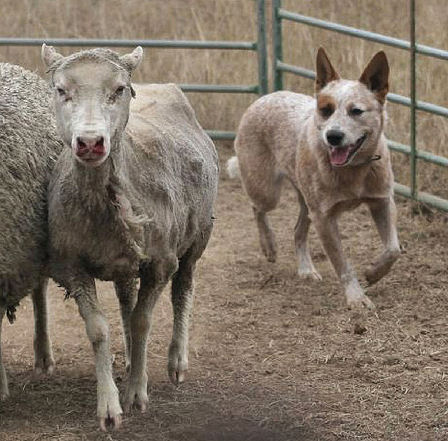

The breed reached the United States slowly. Australian Cattle Dogs had been in the AKC’s Miscellaneous class since the 1930s, and full recognition required a national parent club; the AKC took over the club registry in 1979, and the breed was fully recognized in September 1980, placed in the Working Group and moved to the Herding Group when that group was created in 1983. The Australian Cattle Dog Club of America is the AKC parent club for the breed in the United States.
The breed’s most famous dog is Bluey, an Australian Cattle Dog who lived 29 years and 5 months — the longest-lived dog on record. It is the extreme end of a genuinely long-lived breed: the AKC lists 12 to 16 years. Today the Cattle Dog is a working dog, a dog-sport dog, and a companion for active households, still at its best with a job to do.
3. The standard: compact, sturdy, and tireless
The AKC standard was approved on January 11, 1999, and effective February 24, 1999. It opens with the general appearance: “The general appearance is that of a strong compact, symmetrically built working dog, with the ability and willingness to carry out his allotted task however arduous.” The body is longer than tall — length from breast bone to buttocks greater than height at the withers, as 10 is to 9 — and the combination of substance, power, balance, and hard muscular condition must convey agility, strength, and endurance. Any tendency to grossness or weediness is a serious fault. Size is dogs 18 to 20 inches at the withers, bitches 17 to 19 inches.
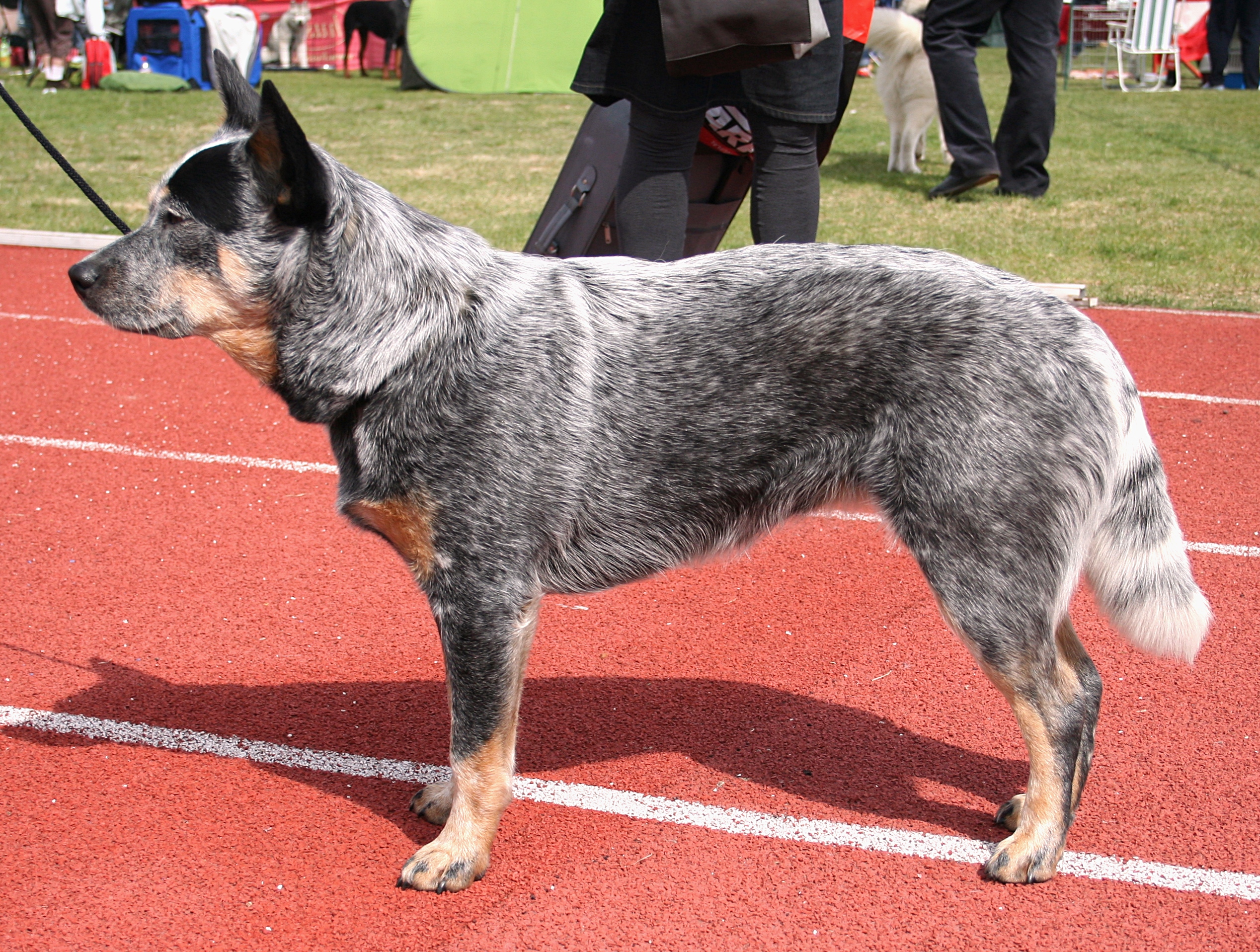

Head and body. The head is strong and in balance with the rest of the dog, with a broad skull slightly curved between the ears, flattening to a slight but definite stop, and a broad, deep, powerful muzzle. The eyes are oval, medium-sized, and dark brown, and must express alertness and intelligence — a warning or suspicious glint is characteristic when the dog is approached by strangers. The ears are of moderate size, preferably small rather than large, broad at the base, muscular, pricked, and moderately pointed. The teeth are sound, strong, and evenly spaced, with a scissor bite — and the standard explains why: as the dog is required to move difficult cattle by heeling or biting, sound, strong teeth are very important. The neck is extremely strong, muscular, and of medium length. The tail is set moderately low, of length to reach approximately to the hock, hanging in a very slight curve at rest and never carried past a vertical line drawn through its root.
Coat and color. The coat is smooth, a double coat with a short, dense undercoat and a close outer coat, each hair straight, hard, and lying flat, so that it is rain-resisting — about 1 to 1½ inches long on the body. Color is blue — blue, blue-mottled, or blue speckled, with or without other markings, the permissible markings black, blue, or tan on the head and tan on the forelegs and hindquarters — or red speckle, a good, even red speckle all over, including the undercoat, neither white nor cream, with or without darker red markings on the head. Black markings on a blue dog’s body are not desirable, and red markings on a red dog’s body are permissible but not desirable. The standard lists no disqualifications: any departure from the standard is a fault, and the seriousness with which it is regarded is in exact proportion to its degree.
4. Temperament: alert, loyal, and always working
The standard’s temperament paragraph is the whole pitch: “Always alert, extremely intelligent, watchful, courageous and trustworthy, with an implicit devotion to duty making it an ideal dog.” Loyalty and protective instincts make the Cattle Dog a self-appointed guardian to the stockman, his herd, and his property — naturally suspicious of strangers, but amenable to handling, particularly in the show ring. The AKC sums the breed up as alert, curious, and pleasant.
That intelligence is the breed’s charm and its training challenge in equal measure. Cattle Dogs are famously quick learners and problem-solvers — ranked among the most intelligent breeds — and they need mental work as much as physical work. A bored Cattle Dog is a destructive Cattle Dog: digging, chewing, and escaping are the classic signs of a dog with no job. The herding instinct is always there, and it shows up at home as a tendency to herd children, other pets, and anything that moves, by nipping at heels. It is the breed’s working method, and it has to be trained and channeled, not punished away.
In the house, expect a dog that is playful, loyal, and affectionate with its own people, and reserved — sometimes sharply so — with strangers. They are generally good with children where interactions are appropriate and introductions are handled well, best with older children who can handle a dog that herds. Give them a job, a long walk, a training session, and a place beside their people, and they give back a loyalty that is hard to match — watchfully, and for a long time.
5. Grooming and everyday care
The smooth double coat is the easy part: a weekly brushing with a slicker or bristle brush keeps the steady shedding in check and the coat from carrying dust, and during the spring and fall coat blows, a bath and a good towel-dry help move the undercoat out. The ears should be checked and cleaned regularly, the nails trimmed, and the teeth brushed over a 12- to 16-year life.
Exercise is the real commitment, and it is not optional. This is a working dog that needs daily walks and runs plus training and mental work — herding, agility, obedience, rally, scent work, and tracking are all sports the national specialty runs for a reason. A tired Cattle Dog is a good Cattle Dog; an under-exercised one will invent its own work, usually digging, chewing, or herding the family. A securely fenced yard is essential: the breed is independent and will range, and a Cattle Dog that decides to go visiting will go.
Feeding is straightforward but scaled to an active dog: a good-quality food, measured meals, and a lean weight. Extra weight makes the joints work harder, and a Cattle Dog that is allowed to get fat is a Cattle Dog heading for the vet. Because the breed is so driven, watch the weight under the coat — you should be able to feel the ribs without pressing hard — and remember that a dog this smart needs its brain tired out as much as its legs.
6. Health: the tests that matter
The Australian Cattle Dog Club of America takes part in the Canine Health Information Center (CHIC) program run by the Orthopedic Foundation for Animals, and six tests are required for a CHIC number: a hip evaluation (OFA at two years or older, OVC, or PennHIP at one year), an elbow evaluation (OFA or OVC at two years or older), an eye examination by a board-certified veterinary ophthalmologist (at 24 months or older, registered with the OFA), a DNA test for prcd-progressive retinal atrophy, a BAER test for congenital deafness, and a DNA test for primary lens luxation. The club also lists patellar luxation, a cardiac evaluation, and the RCD4 form of progressive retinal atrophy as optional tests. A CHIC number means the tests were done and published by the OFA — it does not mean the dog passed them — and the dog must be permanently identified by microchip or tattoo to qualify.
The main issues to watch are hip and elbow dysplasia — the two orthopedic tests in the CHIC panel — progressive retinal atrophy in both its prcd and RCD4 forms, primary lens luxation, congenital deafness, and patellar luxation. The AKC lists the breed’s lifespan as 12 to 16 years — long-lived for a medium breed, and the reason the testing above matters so much: a Cattle Dog is a long commitment, and the health screening is how you protect it.
7. The annual Australian Cattle Dog specialty dog show
A specialty is the breed’s All-Star show — its Super Bowl. Once a year, the best Australian Cattle Dogs from across the country, and often from around the world, come together in one place.
The Australian Cattle Dog Club of America’s national specialty: one national event each year, a full week of conformation, herding, agility, obedience, rally, scent work, and tracking, with the Top 20, sweepstakes, junior showmanship, and a rescue parade alongside the conformation show. The 2026 national: September 9–11 in Roseburg, Oregon. The 2027 national: not yet announced.
The standard, in brief: a sturdy, compact, symmetrically built working dog, dogs 18 to 20 inches at the shoulder and bitches 17 to 19, with a smooth double coat in blue — blue, blue-mottled, or blue speckled — or red speckle, pricked ears, and a tail carried low in a slight curve. In temperament it is alert, extremely intelligent, watchful, courageous, and trustworthy, with an implicit devotion to duty.
The 43rd ACDCA National Specialty — Wednesday, September 9–Friday, September 11, 2026, at the Douglas County Fairgrounds, 2110 SW Frear St, Roseburg, Oregon 97471, the centerpiece of a full specialty week, September 6–13, 2026, held with the Umpqua Kennel Club all-breed show. Conformation entry: 114 Australian Cattle Dogs, 179 total entries. Entries opened Wednesday, July 8, 2026, and closed Thursday, August 20, 2026. Event Chair: Harriet Deary. Event Secretary: Lorraine Yu, DogZibit. The specialty was dedicated to the memory of Amy Turner, Kim Griffith, and Jolyn Owen.
The week ran the full Cattle Dog program: agility and scent work, the Top 20 Gala, puppy and veteran sweepstakes, versatility, the 4–6 Month Beginner Puppy competition, junior showmanship, a parade of titleholders and a rescue parade, and herding tests and trials. At least two AKC herding trials with cattle are required during every ACDCA national, by the club’s standing rules.
Results (2026 national). Winners from the 2026 national specialty had not been published in an official source as of November 2026 and will be added here when they are.
The dates for the annual 2027 Australian Cattle Dog specialty dog show had not been announced as of November 2026. The AKC’s Upcoming National Specialties list, which runs through October 2027, carries no Australian Cattle Dog Club of America entry. This page will be updated when the club announces the 2027 national.
The club’s standing rules rotate the national specialty among three regions — East, Central, and West — and if a region does not extend an invitation two years in advance, the national defaults to Purina Farms in Gray Summit, Missouri.
Past national specialties: 2025
Australian Cattle Dog Club of America — acdca.org
8. Regional specialties through the year: smaller regional shows
The national is the anchor, but the breed’s year also runs through regional specialties — smaller regional shows, not the national — held around the country, including the regional specialties that run with the national. These are the 2026 regionals verified from club and AKC sources.
Regional Australian Cattle Dog specialties verified for 2026:
- CACDC Designated Specialty — Saturday, September 5, 2026, Roseburg, Oregon: Douglas County Fairgrounds, held with the Umpqua Kennel Club all-breed show, the weekend before the national specialty.
- Australian Cattle Dog Club of America Supported Entry and Regional Concurrent Specialty — Sunday, September 6, 2026, Roseburg, Oregon: Douglas County Fairgrounds, held with the Umpqua Kennel Club all-breed show.
Other 2026 regional specialties had not been verified from club or AKC sources as of November 7, 2026.
More regional specialties will be added here as their programs are verified — this section is built from show data, not guesswork. Browse upcoming show weekends →
9. Clubs
The Australian Cattle Dog Club of America, Inc. (ACDCA) is the AKC parent club for the breed in the United States. It maintains the official standard, runs the national specialty, promotes responsible breeding through its code of ethics, and supports the breed’s health and rescue work. The club’s officers for 2026 are President Deb Mintzer, Vice-President Heather Ritchie, Treasurer Sara Reiter, Secretary Charlotte Hince, and AKC Delegate Joyce Rowland.
The club also supports two affiliated organizations: Australian Cattle Dog Health, Education & Welfare, Inc. (ACDHEW), established in 2004 to promote the breed’s health and welfare, and Australian Cattle Dog Rescue, Inc. (ACDRI), the breed’s rescue arm. Regional clubs around the country run the regional specialties and the working life of the breed — herding trials, agility, and fun days.
10. Rescue
The main breed-specific rescue is Australian Cattle Dog Rescue, Inc. (ACDRI), which rescues purebred Australian Cattle Dogs in the United States and Canada from shelters and owners and places them into permanent adoptive homes. Contact: acdrescueinc.com. The parent club actively supports ACDRI, and the national specialty runs a rescue parade each year.
A rescue Cattle Dog is usually an adolescent or adult whose personality is already known, which is a real advantage with a breed this driven: you will know how it is with children, with other dogs, and in a home before you commit. Expect an application, references, and a home visit. Ask about hearing, hips, and herding drive before you commit, and budget for the vet care an older or surrendered dog may need. A rescue heeler still needs the same things a puppy does: a job, training, a securely fenced yard, and a household ready for a tireless working dog.
11. Breeder vs. rescue: honest guidance
Either route starts with the same question: has this dog’s health been tested? From a breeder, ask for the CHIC numbers of both parents — the hip and elbow evaluations, the ophthalmologist’s eye examination, the prcd-PRA and primary lens luxation DNA tests, and the BAER deafness test — and check them on the OFA database yourself, by the parents’ registered names. Ask about patellar, cardiac, and RCD4 testing too, and ask what health issues the breeder sees in their stock: a responsible breeder tests, and will talk about the breed’s faults as readily as its virtues. Meet at least the dam, and be honest with yourself about the energy: this is a dog that needs work every day, not just a walk around the block.
From rescue, expect an adolescent or adult dog whose personality is already known, placed by a network that has vetted the dog and will tell you what it is actually like in a home. Budget for the same things either way: joint and eye care, training, and the time a working dog demands. Whichever route you take, the dog that fits is an alert, tireless working dog that wants a job and a person to work for — and will invent its own job if you do not give it one.
12. Claim this page
This page was built from public sources — the AKC standard, the parent club’s own material, AKC event records, and the rescue network’s site — and it is a starting point, not the last word. If you are with the Australian Cattle Dog Club of America or a regional club and something here is wrong or missing, you can claim this page and set it straight: email [email protected] and tell us what needs fixing. Corrections from the people who own the breed are how this page gets better.
Sources
- AKC, Australian Cattle Dog
- AKC, Official Standard of the Australian Cattle Dog (approved January 11, 1999; effective February 24, 1999)
- Australian Cattle Dog Club of America, OFA-CHIC Health Testing Requirements
- Australian Cattle Dog Club of America
- Australian Cattle Dog Club of America, “Your New Australian Cattle Dog!” (parent club, rescue, and health links)
- Australian Cattle Dog Club of America, Standing Rules (national specialty rotation; herding trials with cattle)
- AKC event search, ACDCA National Specialty Conformation, September 9–11, 2026 (event 2026220318)
- 2026 ACDCA National Specialty judging program (AKC event plans)
- 2025 ACDCA National Specialty premium list
- Australian Cattle Dog Club of America, 2025 National Specialty
- AKC event search, ACDCA National Specialty Conformation, October 21–22, 2025 (event 2025220323)
- AKC, Upcoming National Specialties list
- Wikipedia, Australian Cattle Dog (history, recognition, Bluey)
- Australian Cattle Dog Rescue, Inc.
- Australian Cattle Dog Health, Education & Welfare, Inc.
- Wikimedia Commons, Australian Cattle Dog, blue speckled, male (Canarian, CC BY-SA 4.0)
- Wikimedia Commons, Australian Cattle Dog on dog show (Pleple2000, CC BY-SA 3.0)
- Wikimedia Commons, Australian Cattle Dog herding merino sheep (Mdk572, CC BY 3.0)