
Breed profile · Terrier Group · the King of Terriers
Airedale Terrier
The Airedale Terrier is the largest of the terriers — the King of Terriers, in the breed's own nickname — a tall, upstanding dog with a hard, wiry black-and-tan coat, a long flat head, and an expression full of terrier keenness. It was made in the valley of the River Aire in Yorkshire as a working generalist: a dog that could hunt otters and rats in the river, track, guard the farm, and retrieve, all in one body. That versatility made it a war dog, a police dog, a presidential pet, and a four-time Westminster Best in Show winner. The Airedale Terrier Club of America is the parent club.
Help us improve it. This is one of ThePetAdvisor’s breed profiles, built from public sources with generous links to the people who actually own this breed’s knowledge. If something’s off or missing, the parent club can claim the page and set it straight — see the bottom of the page.
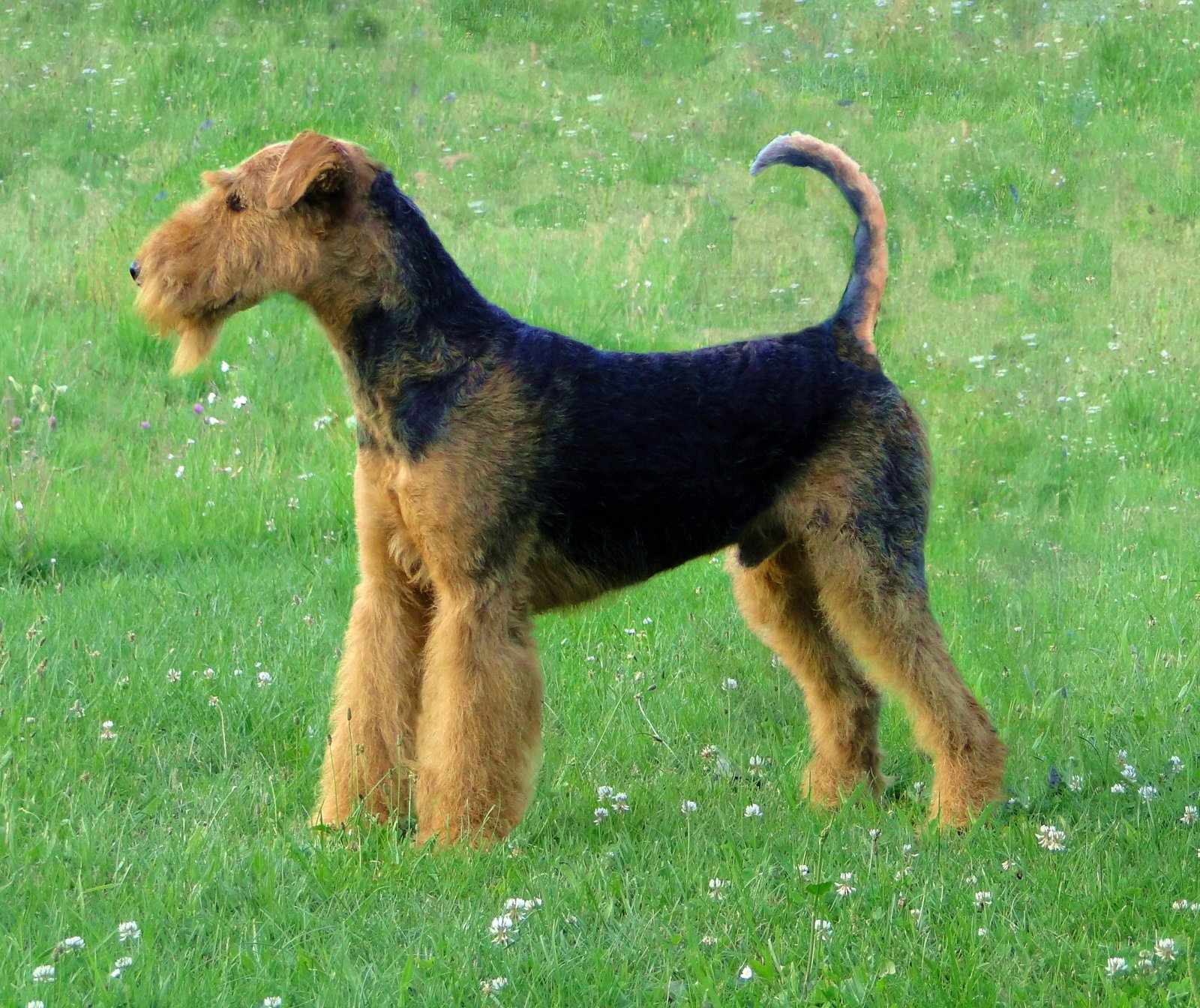
Do you have a better photo of an Airedale Terrier in the American show ring? If you have a show photo you’d let us use, email it to [email protected] — tell us the dog’s name and the show, and it may be featured here. Please only send photos you took yourself or have the photographer’s permission to share, and tell us the photographer’s name.
1. Breed at a glance
Terrier Group; recognized by the AKC in 1888
Dogs approximately 23 in at the withers, 50–70 lb; bitches slightly less
Hard, dense, wiry double coat; black or dark grizzle saddle with tan head, ears, and legs
11–14 years
Friendly, clever, courageous
The Airedale Terrier is the largest of the terrier breeds, standing about 23 inches at the shoulder — a sturdy, well-muscled, square-built dog with a short, level back, a deep chest, and straight forelegs. The coat is the breed's signature: a hard, dense, wiry outer coat over a softer undercoat, black or dark grizzle over the saddle and tan on the head, ears, legs, and chest. Underneath it is a dog bred to work all day and think for itself: intelligent, independent, and fearless, but never aggressive by design. (Sources: AKC, Airedale Terrier; AKC, Official Standard of the Airedale Terrier.)
2. History
The Airedale Terrier was made in the valley of the River Aire in the West Riding of Yorkshire, England, in the mid-19th century, by working-class mill workers who wanted one dog that could do everything: hunt rats and otters in the river, track, guard the farm, and retrieve. They crossed the old English Black and Tan Terrier with the Otterhound — which gave the breed its size, its bone, its nose, and its fondness for water — and probably other terriers besides.
- First shows and the name. The dogs were first exhibited in 1864, at a championship show sponsored by the Airedale Agricultural Society, shown under vague names — Broken-Haired Terrier, Working Terrier, Waterside Terrier. In 1879 the fanciers settled on Airedale Terrier, after the valley where the breed was made, and the Kennel Club of England formally recognized the breed in 1886.
- Coming to America. The first Airedale to reach American shores was Bruce, who arrived in 1881 and won the terrier class at a New York dog show. The AKC recognized the breed in 1888, and the Airedale Terrier Club of America was founded in 1900. CH Master Briar (1897–1906) is considered the patriarch of the breed.
- War dogs. The Airedale became the premier military dog of World War I — sentry, messenger, explosives detector, and search dog for the wounded. Lt. Col. Edwin Richardson's British War Dog School sent more than 2,000 dogs to the front, many of them Airedales. The most famous was Jack, who ran half a mile through mortar and gunfire with a message in his collar, his jaw shattered and his front leg maimed, delivered it, and fell dead on the spot. He was awarded the Victoria Cross.
- Presidents and the Titanic. Four United States presidents kept Airedales. Warren Harding's Laddie Boy, acquired the day after his 1921 inauguration, sat in his own hand-carved chair at cabinet meetings and became the first First Dog of the modern press age. Socialite Mrs. John Jacob Astor's Airedale Kitty perished on the Titanic.
- The Airedale Bowl. In 1910 the Airedale Terrier Club of America offered the Airedale Bowl as a perpetual trophy, and it is still awarded to the Best of Breed at the national specialties, its pedestal holding engraved plates with the names of hundreds of national winners.
- At Westminster. Airedale Terriers have won Best in Show at Westminster four times — 1912 (Ch. Kenmare Sorceress), 1919 (Ch. Briergate Bright Beauty), 1922 (Ch. Boxwood Barkentine), and 1933 (Ch. Warland Protector of Shelterock). No Airedale has won it since 1933.
- The Oorangs. In the 1920s, Capt. Walter Lingo of La Rue, Ohio, bred a much larger strain — the Oorang Airedale, up to 120 pounds — for big-game hunting and guard work. It was never the standard size, and the oversized dogs are significantly more prone to hip dysplasia. Serious fanciers stayed with the AKC standard dog of about 23 inches.
From a mill-worker's all-purpose dog on the River Aire, the Airedale grew into the largest terrier and one of the most versatile dogs in the world — a hunter, a soldier, a policeman, and a family companion, in that order. (Sources: AKC, Airedale Terrier History: Behind the Breed; Wikipedia, Airedale Terrier; Wikipedia, List of Best in Show winners of the Westminster Kennel Club Dog Show.)
3. The standard and why it is written that way
The standard describes a tall, upstanding terrier built for all-day work, and every part of it follows from that job. The Airedale should be sturdy, well muscled and boned, with a short, strong, level back and straight forelegs — a dog that looks ready to work, not one that looks decorated.
- Size. Dogs should measure approximately 23 inches in height at the shoulder; bitches, slightly less. Both sexes should be sturdy, well muscled and boned. The standard gives heights, not weights, by number.
- Head. Long and flat skull, with little apparent difference between the length of skull and foreface, narrowing very slightly to the eyes. Ears V-shaped, carried rather to the side of the head, small but not out of proportion. Eyes dark, small, not prominent, full of terrier expression, keenness, and intelligence. Bite either level or viselike; a slightly overlapping or scissors bite is permissible without preference.
- Coat. Hard, dense and wiry, lying straight and close, covering the dog well over the body and legs; some of the hardest coats are crinkling or just slightly waved. At the base of the hard, very stiff hair is a shorter growth of softer hair, the undercoat. A curly or soft coat is highly undesirable.
- Color. The head and ears should be tan, the ears being of a darker shade than the rest. The legs up to the thighs and elbows and the under-part of the body and chest are also tan, and the tan frequently runs into the shoulder. The sides and upper parts of the body should be black or dark grizzle. A red mixture is often found in the black and is not to be considered objectionable. A small white blaze on the chest is a characteristic of certain strains of the breed.
- Tail. The root of the tail should be set well up on the back. It should be carried gaily but not curled over the back, and should be of good strength and substance and of fair length. The standard does not require docking, and an undocked tail carried gaily is within the standard.
- Movement. “Movement or action is the crucial test of conformation. Movement should be free.” Seen from the front, the forelegs swing perpendicular from the body; seen from the rear, the hind legs are parallel, neither too close nor too far apart, giving a strong, well-balanced stance and movement.
- Faults — not disqualifications. The AKC Airedale standard lists no disqualifications at all. The faults to be severely penalized are yellow eyes, hound ears, white feet, soft coat, being much over or under the size limit, being undershot or overshot, and having poor movement.
- Scale of points. General characteristics and expression count for 15 points — more than any other single item — while head, neck/shoulders/chest, body, hindquarters/tail, legs/feet, coat, size, and movement count 10 each, and color counts 5. Expression is the breed's most heavily weighted feature.
The most important thing to know about the modern standard is the coat: hard, dense, and wiry, kept not so long as to appear ragged — and the expression, which the standard weights above everything else. (Sources: AKC, Official Standard of the Airedale Terrier; Wikipedia, Airedale Terrier.)
4. Temperament & living with one
Airedale Terriers are friendly, clever, and courageous — the AKC's own three words — and they live up to every one of them. They are alert and energetic, loyal to their people, and famously independent: bred to hunt on their own, they think for themselves, and they expect you to keep up.
- Independent and strong-minded. The Airedale was bred to work away from its handler, so it is intelligent, confident, and sometimes stubborn. It wants to work with you, not for you, and it does best with consistent, positive training — harsh methods backfire on a dog this proud.
- Exercise is not optional. Plan on an hour or more of active exercise a day, plus training and mental work. Airedales were bred to hunt, track, guard, and retrieve all day, and they are fond of water — the Otterhound in them. A dog that does not get enough work will find its own, usually by digging, chewing, or redecorating your house.
- With children and other animals. Usually good with children old enough for high-spirited play, and deeply loyal to the family. The prey drive is strong: Airedales chase small animals and are not the best fit for a home with pocket pets or unsupervised backyard wildlife. Same-sex dog friction is not uncommon.
- Highly trainable — on their terms. The breed ranks 37th in Stanley Coren's The Intelligence of Dogs, above-average working intelligence, and Airedales have worked as police dogs, military dogs, and search dogs. They learn fast and get bored faster, so keep training sessions short, varied, and rewarding.
- Not a kennel dog. Airedales want to live in the house with their people and be in the middle of whatever is happening. Left alone in a yard all day, they get bored, lonely, and destructive — and a bored terrier of this size is a problem.
The honest summary: this is a wonderful family dog for an active owner who will train it, exercise it, and laugh at it — and a poor fit for a quiet household that wants a dog to lie around. (Sources: AKC, Airedale Terrier; Wikipedia, Airedale Terrier; South of England Airedale Terrier Club, Airedale Info.)
5. Grooming
Grooming an Airedale Terrier is straightforward but regular. The hard, wiry coat sheds very little — dead hairs stay caught in the coat until they are brushed or stripped out — which is why the breed is often called low-shedding, and also why the coat needs steady attention.
Brush weekly with a slicker brush and a metal comb to remove dead hair and keep shedding to a minimum. If you find a mat, pull it apart with your fingers and then brush it out with the comb. A full grooming three or four times a year — bath, brush, and either hand-stripping or clipping — keeps the coat in shape: hand-stripping pulls the dead outer coat and keeps the harsh texture and rich color, while clipping is easier but softens the coat over time. Bathe only when the dog is dirty, roughly every eight weeks, and keep the beard and leg furnishings combed so they do not mat. Nails should be trimmed regularly and teeth brushed. (Sources: AKC, Airedale Terrier; Rover, Airedale Terrier Grooming; South of England Airedale Terrier Club, Airedale Info.)
6. Health testing
The Airedale Terrier Club of America's CHIC program sets the health testing a responsible breeder should do — and the results should be registered with the Orthopedic Foundation for Animals, where anyone can look them up.
- Hips. A hip evaluation, by OFA or PennHIP, with final OFA evaluations from 24 months of age.
- Cardiac. A cardiac exam, registered with OFA — the congenital cardiac evaluation, performed by a board-certified veterinary cardiologist.
- Kidneys. Renal disease information registered with CHIC — the DNA test for protein-losing nephropathy, looking for mutations in the KIRREL2 and NPHS1 genes. A dog with two mutated copies of both genes is considered affected; breeders should not breed affected dogs.
The club also recommends three further tests, listed as optional in the CHIC program: an eye exam by a board-certified ophthalmologist, an elbow evaluation, and a thyroid evaluation for autoimmune thyroiditis. Also worth asking about: hip dysplasia, to which the breed is prone; dilated cardiomyopathy, which Airedales develop at a higher-than-average rate; hypothyroidism; and bloat, a risk for any large, deep-chested dog. A CHIC number confirms the testing was done and published; it is not a guarantee of health, and it does not replace asking the breeder what they know about the health of their own lines. (Sources: AKC, Terrier Group Health Testing Requirements; Kokopelli Veterinary Center, Airedale Terrier; Furry Critter Network, Airedale Terrier.)
7. The annual Airedale Terrier specialty dog show
A specialty is the breed’s All-Star show — its Super Bowl. The Airedale Terrier Club of America holds two national specialties a year: the October national at Montgomery and the Floating National Specialty, which moves to a different city each year.
The club calls it the floating national specialty — the same kind of event other clubs call a roving, rotating, or traveling national.
Every breed has one show a year that matters most: the parent club’s national specialty — and the Airedale Terrier Club of America holds two a year: a floating national each spring, held at a different show around the country, and the October national at Montgomery, held each October in Pennsylvania as part of the Montgomery weekend cluster, which is also the weekend of the club’s annual meeting.
The most recent national specialty was Sunday, October 4, 2026, at the Montgomery County Kennel Club show in Macungie, Pennsylvania, judged by Mrs. Allison Corn Sunderman, with sweepstakes judged by Mrs. Lisa Berglin. Entry: 62 entries. Entries closed Wednesday, September 16, 2026. (Source: AKC event search, event 2026006701.)
The floating national
The year’s other national specialty, the floating national, was Saturday, March 21, 2026, at the Fort Worth Kennel Club show, Will Rogers Memorial Center, Fort Worth, Texas, judged by Mrs. April Clyde (regular and veterans), with sweepstakes judged by Kathi Wood. Entries closed Wednesday, March 4, 2026 (Onofrio). Best of Breed: Ch. Terrydale Hk Jetaire’s IntL Liason.
The 2027 National Specialty is Sunday, October 10, 2027, at the Montgomery County Kennel Club show in Macungie, Pennsylvania. Judges had not been announced as of November 2026. The date is per the Airedale Terrier Club of America; no 2027 AKC event number had been published as of November 2026. (Source: Airedale Terrier Club of America, events.)
The floating national
The 2027 floating national specialty had not been announced as of November 2026.
Full Montgomery weekend guide →
8. Regional specialties through the year: smaller regional shows
The national is the anchor, but the breed’s year also runs through regional specialties — smaller regional shows, not the national — held by regional Airedale Terrier clubs around the country. These are the 2026 regionals verified from club sources so far:
No regional specialties announced yet for 2026.
More regional specialties will be added here as their programs are verified — this section is built from show data, not guesswork. Browse upcoming show weekends →
9. Clubs
The parent club is the Airedale Terrier Club of America (ATCA), founded in 1900, at airedale.org — the club that runs the two national specialties, publishes the breed's health guidance and breeder referral, and coordinates the rescue network. Its Airedale Bowl, offered in 1910, is still the perpetual trophy for Best of Breed at the national specialties.
Regional specialty clubs verified in the AKC club search index during this build:
- Airedale Terrier Club of Greater Atlanta
- Airedale Terrier Club of Greater Philadelphia
- Airedale Terrier Club of Illinois
- Airedale Terrier Club of Metropolitan New York
- Airedale Terrier Club of Metropolitan Washington, DC
- Airedale Terrier Club of New England
- Airedale Terrier Club of Northern Ohio
Regional clubs run the regional specialties and are the best first contact for anyone looking for a breeder, a training contact, or a local event. The Greater Philadelphia club's specialty runs during Montgomery week — on Friday, October 2, 2026, it was held at Macungie Memorial Park, Macungie, Pennsylvania. (Sources: Airedale Terrier Club of America; AKC, Club Search Index.)
10. Rescue
Airedales come into rescue because their size, energy, and independence outrun their owner's life — a big terrier that was bred to work does not settle into a home that cannot train and exercise it. The parent club's rescue arm coordinates the network, but it does not rescue dogs itself: the actual rescuing is done by regional groups and volunteers. The first place to look:
- ATCA Rescue & Adoption Committee / National Airedale Rescue. The parent club's committee, which maintains the roster of regional rescue contacts across the country and raises funds to reimburse rescue volunteers. National Airedale Rescue, Inc. is its 501(c)(3) treasury. airedalerescue.net
- Airedale Terrier Rescue and Adoption, Inc. (ATRA). An all-volunteer organization serving 14 Midwestern states and Ontario, Canada, which has placed about 3,000 Airedales since it started. aire-rescue.org
- West Coast Airedale Rescue. An all-volunteer team under the ATCA Rescue & Adoption Committee, serving Washington, Oregon, and Northern California. westcoastairedalerescue.com
- Airedale Rescue and Adoption of the Delaware Valley. Serving Pennsylvania, New Jersey, and Delaware. airedalerescuedelval.org
- Sunshine Airedalers of Florida. Founded in 1991, a 501(c)(3) nonprofit rescuing and rehoming Airedales throughout Florida. airedalerescueflorida.org
Most of these groups place dogs on an application with references, usually into foster homes first so the dog can be evaluated medically and behaviorally. A rescue Airedale is usually an adult, so you know its size, temperament, and energy level before you commit — a real advantage with a breed this strong-minded. Ask what the dog's health testing history is, and whether it has had its hips and heart checked: a rescue that cannot tell you anything about the dog's health is a rescue to question. (Sources: National Airedale Rescue, Mission; Airedale Terrier Rescue and Adoption, Inc..)
11. Breeder vs. rescue: honest guidance
Both routes can end with a great dog. The honest difference is what you know going in — and with an Airedale, what you know about the health testing and the temperament matters more than usual.
- Choose a breeder if you want a puppy for showing, performance, or a specific purpose, and you want the health testing, pedigree, and early socialization that come with a careful breeding program. Ask for the CHIC health results in section 6, ask what the breeder does about hip dysplasia and heart disease, meet the dam if you can, and be ready to wait — good breeders have waiting lists.
- Choose rescue if you want an adult dog whose temperament, size, and energy level you can see before you commit, and you are comfortable with a dog that may need training and patience. Rescue is also the right route if you want to give a home to a dog that needs one.
- Either way, verify. Ask for health testing, ask what the dog's lines are known for, and meet the dog before you commit. A breeder who will not show you health results and a rescue that will not let you meet the dog are both telling you something.
An Airedale Terrier is an eleven-to-fourteen-year commitment to the largest, cleverest terrier there is — a dog that needs real work, real training, and a real sense of humor every day. The right question is not breeder or rescue — it is whether your life has room for a dog that was bred to think for itself.
12. Claim this page
This page was built from public sources — the AKC standard, the parent club's own material, AKC event records, and the rescue groups' sites — and it is a starting point, not the last word. If you are with the Airedale Terrier Club of America or a regional club and something here is wrong or missing, you can claim this page and set it straight: email [email protected] and tell us what needs fixing. Corrections from the people who own the breed's knowledge are always welcome.
Sources
- AKC, Airedale Terrier
- AKC, Official Standard of the Airedale Terrier
- AKC, Airedale Terrier History: Behind the Breed
- AKC, Terrier Group Health Testing Requirements
- Airedale Terrier Club of America
- Airedale Terrier Club of America, Events
- Wikipedia, Airedale Terrier
- Wikipedia, List of Best in Show winners of the Westminster Kennel Club Dog Show
- Westminster Kennel Club, Terrier Group Records
- Kokopelli Veterinary Center, Airedale Terrier
- Furry Critter Network, Airedale Terrier
- AKC, Club Search Index (regional clubs)
- National Airedale Rescue, Mission
- Airedale Terrier Rescue and Adoption, Inc. (ATRA)
- West Coast Airedale Rescue
- Airedale Rescue and Adoption of the Delaware Valley
- Sunshine Airedalers of Florida
- Airedale Terrier Club of Illinois, Links & Resources (ATCA founded 1900)
- Rover, Airedale Terrier Grooming
- South of England Airedale Terrier Club, Airedale Info
- Hill's Pet, Airedale Terrier Dog Breed Guide
- Wikimedia Commons, File:Airedale-terrier-charles14m.jpg (hero photo)
- AKC event search, event 2026006701 (2026 national)
