
Breed profile · Hound Group · The aloof and dignified aristocrat
Afghan Hound
The Afghan Hound is an aloof and dignified aristocrat of sublime beauty: a sighthound from the cold mountains of Afghanistan, built for speed over rocky ground, wearing a long, fine, silky coat, a silky topknot, and a tail with a ring curl at the end. It is the most eye-catching dog in the Hound Group — and one of the most independent-minded.
Help us improve it. This is one of ThePetAdvisor’s breed profiles, built from public sources with generous links to the people who actually own this breed’s knowledge. If something’s off or missing, the parent club can claim the page and set it straight — see the bottom of the page.
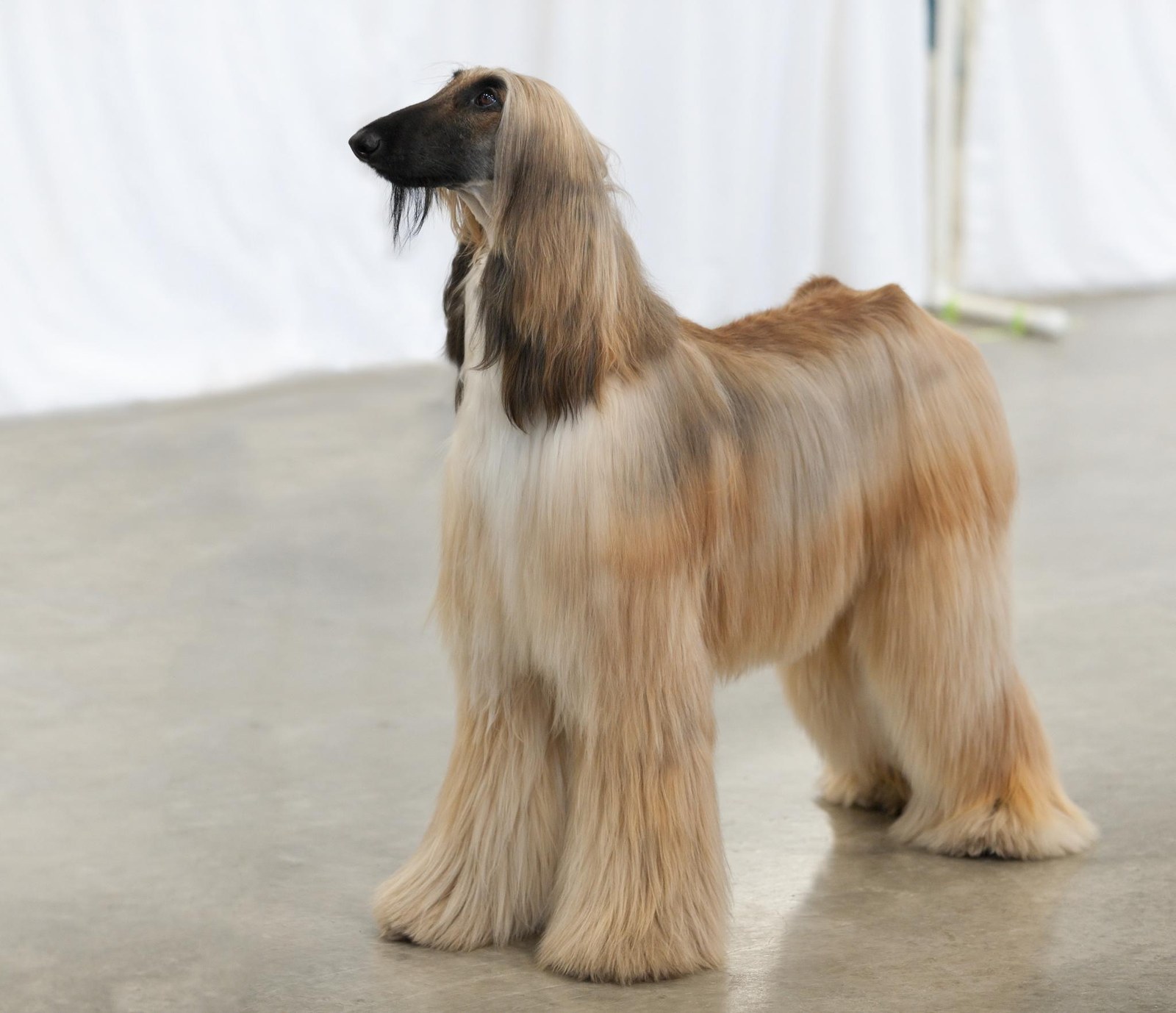
Do you have a better photo of an Afghan Hound in the American show ring? If you have a show photo you’d let us use, email it to [email protected] — tell us the dog’s name and the show, and it may be featured here. Please only send photos you took yourself or have the photographer’s permission to share, and tell us the photographer’s name.
1. Breed at a glance
Hound — recognized by the AKC in 1926
Dogs 27 in (±1 in), bitches 25 in (±1 in) at the shoulder. Dogs about 60 lb, bitches about 50 lb.
Long, fine, silky hair; short, close saddle on the back in mature dogs; long silky topknot. All colors permissible.
Aloof and dignified, yet gay. Profoundly loyal to its own people, sensitive, and clownish when playing.
A sighthound: built to run, with a high prey drive. Needs room to gallop and a securely fenced yard.
Size, coat, and temperament facts are from the AKC standard. Weight and lifespan (12 to 18 years) are the AKC breed-profile figures (AKC Afghan Hound breed page).
2. History
The Afghan Hound is an ancient sighthound from the cold mountains of Afghanistan, bred for speed and for hunting game over rocky ground. It has been identified as a basal breed — one that predates the modern breeds of the 19th century — and it is most closely related to the Saluki. In its homeland it is the Tazi, and the coat that makes it famous was protection against a harsh mountain climate, while its huge paw pads worked as shock absorbers on the rock. (Source: Wikipedia, Afghan Hound.)
Once out of Afghanistan, the breed’s history became entwined with the earliest dog shows. Sighthounds were brought to England in the 1800s by army officers returning from British India and were shown, under names such as Barukzy hounds and “Persian Greyhounds,” at shows that were themselves just becoming popular. One dog in particular, Zardin, brought from India in 1907 by Captain John Barff, became the early ideal for the breed and the basis of the first breed standard in 1912. Two strains make up the modern breed: the Bell-Murray dogs, brought from Balochistan in 1920, a lighter-coated steppe or desert type; and the Ghazni dogs, from Mrs. Mary Amps’ kennel in Kabul, shipped to England in 1925, the more heavily coated mountain type. A Ghazni dog, Sirdar, won Best in Show at Crufts in 1928 and again in 1930. The two strains mixed, and a new standard was written in 1948 — the standard still in use today. (Source: Wikipedia, Afghan Hound.)
In America, the first Afghan Hound arrived in 1926, brought by Zeppo Marx, and the AKC recognized the breed the same year. The breed’s beauty made it a show dog from the start: an Afghan Hound appeared on the cover of Life magazine on November 26, 1945, and Afghan Hounds won Best in Show at Westminster twice — Ch. Shirkhan of Grandeur in 1957 and Ch. Kabik’s The Challenger in 1983. In 2005 an Afghan Hound named Snuppy became the first dog ever cloned. The breed is no longer used for hunting, although it can still be seen in the sport of lure coursing. (Sources: Wikipedia, Afghan Hound; AKC Afghan Hound breed page.)
3. The standard and why it’s written that way
- An aristocrat, dignified and aloof. The standard opens with the silhouette: “The Afghan Hound is an aristocrat, his whole appearance one of dignity and aloofness with no trace of plainness or coarseness. He has a straight front, proudly carried head, eyes gazing into the distance as if in memory of ages past.” (Source: AKC standard.)
- Head, topknot, and expression. The head is long and refined, the skull evenly balanced with the foreface, surmounted by a topknot of long silky hair. The ears are long, set about level with the outer corners of the eyes, the leather reaching nearly to the end of the nose and covered with long silky hair. The eyes are almond-shaped, almost triangular, never full or bulgy, and dark in color; the nose is black. The “Eastern” expression — exotic, distant, a little aloof — is one of the breed’s striking characteristics, and coarseness, round or bulgy or light eyes, and a head without a topknot are all faults. (Source: AKC standard.)
- The coat pattern. Hindquarters, flanks, ribs, forequarters, and legs are well covered with thick, silky hair, very fine in texture; ears and all four feet are well feathered. From in front of the shoulders, and backwards from the shoulders along the saddle, the hair is short and close, forming a smooth back in mature dogs — a traditional characteristic of the breed, and its absence in a mature dog is a fault. The dog is shown in its natural state: the coat is not clipped or trimmed. (Source: AKC standard.)
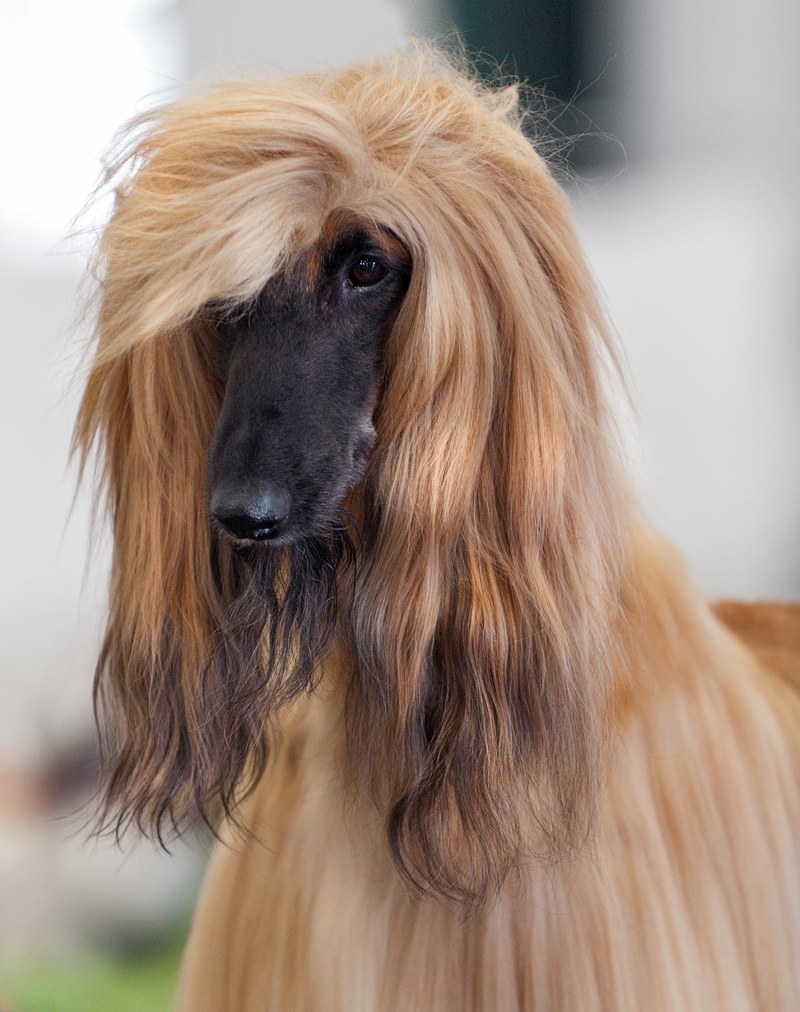
- Size, feet, and tail. Dogs, 27 inches, plus or minus one inch; bitches, 25 inches, plus or minus one inch. Dogs about 60 pounds, bitches about 50 pounds. The hipbones are very prominent, the feet large — unusually large pads, well down on the ground, covered with long thick hair — and the tail, set not too high, has a ring or a curve on the end, never curled over or resting on the back, and never bushy. (Source: AKC standard.)
- All colors permissible. “All colors are permissible, but color or color combinations are pleasing; white markings, especially on the head, are undesirable.” There is no disqualified color in the AKC ring — the standard lists no disqualifications at all. (Source: AKC standard.)
- Gait, in the standard’s own words. “When running free, the Afghan Hound moves at a gallop, showing great elasticity and spring in his smooth, powerful stride. When on a loose lead, the Afghan can trot at a fast pace; stepping along, he has the appearance of placing the hind feet directly in the foot prints of the front feet, both thrown straight ahead. Moving with head and tail high, the whole appearance of the Afghan Hound is one of great style and beauty.” (Source: AKC standard.)
4. Temperament & living with one
The AKC sums the breed up in a sentence: the Afghan Hound is “an aloof and dignified aristocrat of sublime beauty. Despite his regal appearance, he is known for his profound loyalty, sensitive nature, and absolute love for those he calls his own.” The standard’s own temperament line is shorter: “Aloof and dignified, yet gay.” At home that means a dog that bonds hard to its own people and watches the rest of the world from a reserved distance — happy and clownish when playing, dignified and a little distant the rest of the time. (Sources: AKC Afghan Hound breed page; AKC standard.)
What that means in practice is a sighthound first and a pet second. The prey drive is high: like other sighthounds, an Afghan Hound may kill small animals and livestock, and it should never be trusted off leash in unfenced ground — it will follow a moving thing until the thing stops or the dog is lost. It is a quiet, clean, sensitive dog that does not take kindly to rough handling or to being left alone all day, and it needs room to run at a gallop, not just a walk around the block. A bored Afghan Hound with no outlet is a large, fast, willful dog; the same dog with a fenced field to run in and a weekly grooming session is one of the most beautiful companions in the Hound Group. (Sources: Wikipedia, Afghan Hound; AKC Afghan Hound breed page.)
5. Grooming
- Regular brushing, or mats. Grooming is the hard part of owning an Afghan Hound. The coat is long, fine-textured, and thick, and it mats if it is left alone — a weekly brushing and a bath keep it in shape, and a dog in full coat needs that attention every week without fail. The ears need the attention the coat does not: long ears that hang close to the head trap moisture, and Afghan Hound ears should be checked and cleaned regularly. Keep the feathering on the legs and feet clean and free of tangles, and the nails short. (Sources: AKC Afghan Hound breed page; Wikipedia, Afghan Hound.)
- Never clip the coat. One thing the ring will not forgive: the coat is not clipped or trimmed. The standard says the dog is shown in its natural state, and the short saddle on the back of a mature dog is a traditional characteristic — clipping it away, or trimming the feathering into shape, spoils the look the standard describes. An Afghan Hound in the ring is shown as it lives — long-coated, clean, and untrimmed. (Source: AKC standard.)
6. Health testing
- Three tests for a CHIC number. The Afghan Hound Club of America participates in the AKC’s Canine Health Information Center program. For an Afghan Hound to earn a CHIC number, it must have an OFA or PennHIP evaluation for hips, an OFA thyroid evaluation, and an eye clearance from the Canine Eye Registry Foundation (now the OFA Companion Animal Eye Registry). Breeders must agree to have all test results, positive or negative, published in the CHIC database. (Sources: Embrace, Afghan Hound breed library; OFA CHIC program.)
- The watch list. The conditions a buyer should hear about before signing anything: hip dysplasia, juvenile cataracts, and autoimmune thyroiditis and hypothyroidism — the three the CHIC program screens for — plus allergies and cancer, which a UK study named among the breed’s major health issues. Like other sighthounds, Afghan Hounds carry little body fat and are sensitive to anesthesia, and the breed is among those most likely to develop chylothorax, a rare condition in which chyle fluid leaks into the chest cavity. Eye problems including cataract and generalized progressive retinal atrophy also occur. None of this is a reason not to own an Afghan Hound. All of it is a reason to buy from a breeder who tests: ask for the parents’ CHIC numbers and look the results up in the OFA database yourself, rather than taking a breeder’s word for it. Lifespan is 12 to 18 years. (Sources: Embrace, Afghan Hound breed library; Wikipedia, Afghan Hound.)
7. The annual Afghan Hound specialty dog show
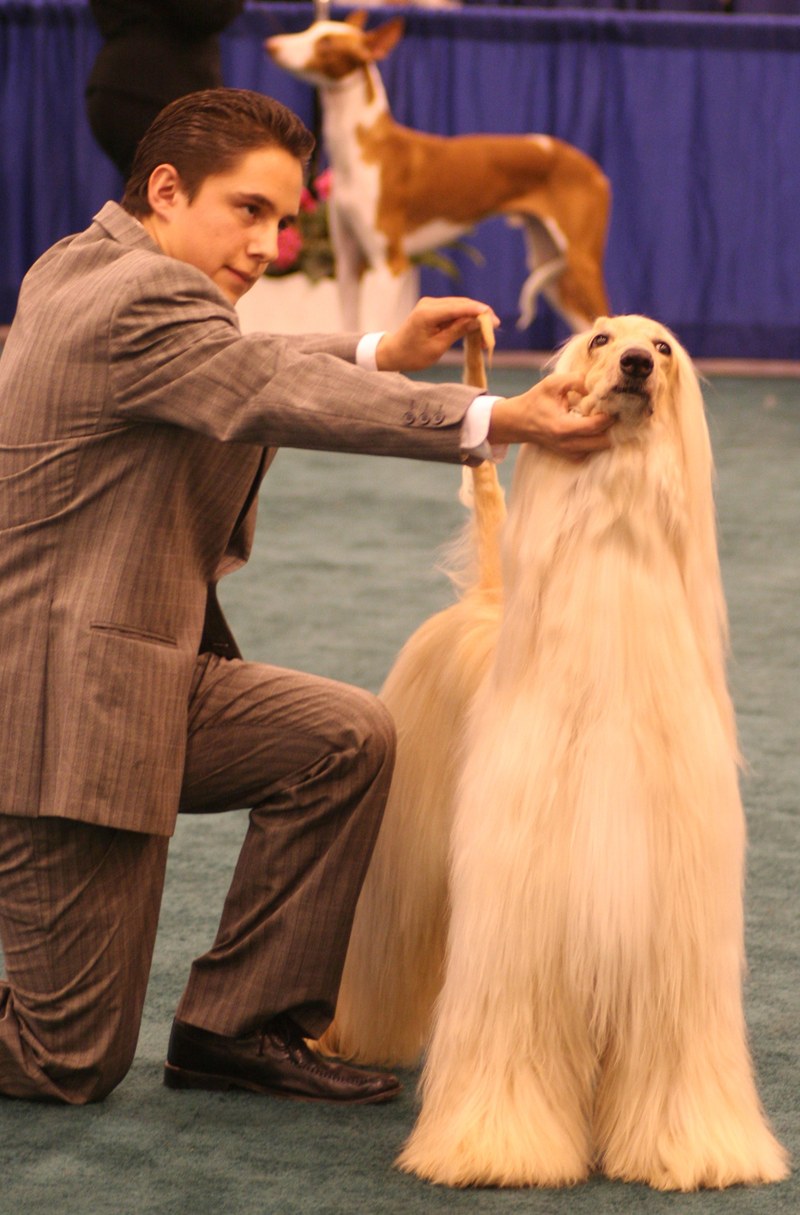
A specialty is the breed’s All-Star show — its Super Bowl. Once a year, the best Afghan Hounds from across the country, and often from around the world, come together in one place.
The Afghan Hound Club of America’s national specialty — the anchor of the Afghan Hound’s year — a four-day gathering, not a single show day, with the conformation specialty at its center and agility, obedience, rally, lure coursing, sweepstakes, and the Triathlon around it.
The 89th National Specialty — Tuesday to Friday, October 20–23, 2026, at the Roberts Centre, 123 Gano Road, Wilmington, Ohio — the conformation centerpiece of a national week themed “A Century to Remember,” marking 100 years of AKC recognition for the breed, with agility, obedience, rally, lure coursing, LGRA racing, sweepstakes, the 29th Triathlon, Junior Showmanship, and the Parade of Rescue, Parade of Veterans, and Liberty Class. Entries closed October 7, 2026. Show Chair: Rachel A. Howard. Show Secretary: MAC Dog Shows LLC. (Sources: 2026 AHCA National Specialty; official premium list.)
National specialty judges: Mr. Michael Canalizo of Palm Harbor, Florida — regular and non-regular classes, Best of Breed, and Junior Showmanship. Sweepstakes (all) and Triathlon: Ms. Laura Mauldin of Fort Mill, South Carolina. Obedience and rally: Ms. Patricia Strong of Indianapolis, Indiana. Agility: Mr. David Mancino of Pataskala, Ohio. Lure coursing: Ms. Anne Midgarden of Wapakoneta, Ohio and Ms. Jan Swayze-Curry of Columbia, Kentucky. (Sources: 2026 AHCA National Specialty; official premium list.)
The week: agility, lure coursing, and LGRA racing Tuesday, October 20; agility and lure coursing Wednesday, October 21; obedience, rally, sweepstakes, and the Triathlon Thursday, October 22; the national specialty conformation Friday, October 23 — regular and non-regular classes, Junior Showmanship, Intersex, Stud Dog and Brood Bitch, Best Puppy, Best Bred-By, Brace, and Best of Breed, with the Parade of Rescue, Parade of Veterans, and Liberty Class. Regional specialties from the Finger Lakes and Midwest Afghan Hound clubs Saturday, October 24. Host hotel: Holiday Inn — Roberts Centre, $159 a night, booking code H3A. (Sources: 2026 AHCA National Specialty; official judging program.)
Winners from the 2026 specialty had not been published in an official source as of November 2026 and will be added here when they are.
The 2027 national specialty dates had not been announced as of November 2026.
2026 AHCA National Specialty — Afghan Hound Club of America
8. Regional specialties through the year: smaller regional shows
The national specialty anchors the year, and the breed’s year also runs through its regional specialties, held by the Afghan Hound Club of America’s regional clubs. These are the 2026 regionals verified from club sources so far:
- Finger Lakes Afghan Hound Club Regional Specialty — Saturday, October 24, 2026, Roberts Centre, Wilmington, Ohio, the day after the national specialty. (Source: official premium list.)
- Midwest Afghan Hound Club Regional Specialty — Saturday, October 24, 2026, Roberts Centre, Wilmington, Ohio, the day after the national specialty. (Source: official judging program.)
More regional specialties will be added here as their programs are verified — this section is built from show data, not guesswork. Browse upcoming show weekends →
9. Clubs
- Afghan Hound Club of America (parent club) — the AKC parent club for the breed in the United States. It runs the national specialty, held at the Roberts Centre in Wilmington, Ohio in 2026, and the breeder referral. The 2026 national site is ahcanational.com.
- Regional specialty clubs. The parent club lists 33 registered regional specialty clubs across the United States, including the Finger Lakes Afghan Hound Club and the Midwest Afghan Hound Club — the two clubs that held regional specialties the day after the 2026 national — and the Potomac Afghan Hound Club, the Nutmeg Afghan Hound Club, and the Greater Twin Cities Afghan Hound Club. (Source: Afghan Hound Club of America, Find a Club.)
If you are new to the breed, the national specialty itself is the better first stop than a breeder’s website: the people there have owned, shown, and coursed Afghan Hounds, and they will tell you the truth about the coat before you fall for a puppy.
10. Rescue
- Start with the parent club’s rescue. Afghan Hound Club of America Rescue (AHCA Rescue) runs the breed’s national rescue program, providing support, coordination, and financial assistance to a national network of volunteers; regional Afghan Hound clubs find homes for the hounds they rescue in their own areas. Contact: Barb Hastings, 877-237-3728. (Source: Afghan Hound Club of America Rescue.)
- The regional rescues. The AKC Rescue Network lists the parent club’s rescue alongside the Greater Twin Cities Afghan Hound Club rescue and North East Afghan Hound Rescue. A rescued Afghan Hound is usually an adult whose owner could not keep it, and it will arrive with a history you may never fully know — and a coat that needs work. What you get in return is a dog whose temperament you can see before you commit, and a rescue that knows the breed’s prey drive and grooming needs. (Source: AKC Rescue Network, A breeds.)
11. Breeder vs. rescue: honest guidance
- If you buy: start with the parent club, the Afghan Hound Club of America, and its breeder referral. Ask for the parents’ CHIC numbers — hips, thyroid, and eyes — and look the results up in the OFA database yourself. A good breeder will have the answers, will ask you as many questions as you ask them, and will take the puppy back for its whole life if you cannot keep it.
- If you rescue: a rescued Afghan Hound is usually an adult, often one whose owner underestimated the coat, and it will arrive with a long coat that needs hours of work and a sighthound’s prey drive fully formed. What you get in return is a dog whose temperament you can see before you commit and a lower price. Either way, be honest with yourself first: an Afghan Hound needs a securely fenced place to run, a weekly grooming commitment, and an owner who accepts that the dog’s loyalty is profound and its obedience is negotiable.
- No rare color worth a premium. One thing that is not what a seller tells you: there is no such thing as a rare color worth a premium. The standard accepts all colors, and a breeder selling a “rare” color at a premium is selling you a label — the dog may be a fine Afghan Hound and a fine pet, but the color is not a reason to pay more.
12. Claim this page
This page belongs to the breed, and the people who know the breed best are the Afghan Hound Club of America and its members. If you are with the parent club — or you are a breeder, a judge, a handler, or a rescue volunteer who spotted something wrong, missing, or out of date — this page is yours to set straight. Tell us what needs fixing and where the correction is documented, and we will fix it and credit the source. Contact the site through the About page, and mention “Afghan Hound breed profile.”
Sources
- AKC Afghan Hound breed standard (approved September 14, 1948) — cdn.akc.org/AfghanHound.pdf
- AKC, Afghan Hound breed page — akc.org/dog-breeds/afghan-hound
- Afghan Hound Club of America — afghanhoundclubofamerica.org
- Afghan Hound Club of America, Find a Club (regional specialty clubs) — afghanhoundclubofamerica.org/index.php/regional-clubs/find-a-regional-club
- Afghan Hound Club of America Rescue — afghanhoundclubofamerica.org/index.php/information/find-an-afghan/rescue
- 2026 AHCA National Specialty (89th National Specialty, October 20–23, 2026, Wilmington, Ohio) — ahcanational.com
- 2026 AHCA National Specialty, official premium list — afghan-hound-club-national-2026-premium.pdf
- 2026 AHCA National Specialty, official judging program (Oct 22–23) — macdogshows.com judging program
- Finger Lakes + Midwest regional specialties judging program (Sat Oct 24, 2026) — macdogshows.com regional program
- AKC event search, event 2026169310 (conformation) — apps.akc.org event search
- AKC Upcoming National Specialties (2027 not announced) — apps.akc.org/apps/events/conformation/national_specialties.cfm
- AKC Rescue Network, A breeds — akc.org/akc-rescue-network/rescue-network-a-breeds
- OFA Canine Health Information Center (CHIC) — ofa.org/chic-programs
- Embrace, Afghan Hound breed library (CHIC requirements) — embracepetinsurance.com/dog-breeds/afghan-hound
- Wikipedia, Afghan Hound (history, Westminster wins, health) — en.wikipedia.org/wiki/Afghan_Hound
- Hero photo: AKC Helena Fall Dog Show 2011, SheltieBoy, CC BY 2.0 — commons.wikimedia.org/wiki/File:AKC_Helena_Fall_Dog_Show_2011.jpg
- Section 3 photo: AKC Helena Fall Dog Show 2011 (head portrait), SheltieBoy, CC BY 2.0 — commons.wikimedia.org/wiki/File:111_AKC_Afghan_Hound_Dog_Show_2011.jpg
- Section 7 photo: Afghan Hound with handler in a conformation show, Ed Schipul, CC BY-SA 2.0 — commons.wikimedia.org/wiki/File:Afghan_hound_dogshow.jpg


