
Breed profile · Toy Group · the monkey-like toy terrier
Affenpinscher
The Affenpinscher is Germany’s monkey-like toy dog: a small, sturdy, square Pinscher, 9½ to 11½ inches at the shoulder and 7 to 10 pounds, with a harsh, shaggy, roughly one-inch coat, a round head with a beard and bushy brows, and a fearless, game, comic-serious nature — a ratter from the stables and kitchens of Germany, and the dog that won Best in Show at Westminster in 2013.
Help us improve it. This is one of ThePetAdvisor’s breed profiles, built from public sources with generous links to the people who actually own this breed’s knowledge. If something’s off or missing, the parent club can claim the page and set it straight — see the bottom of the page.
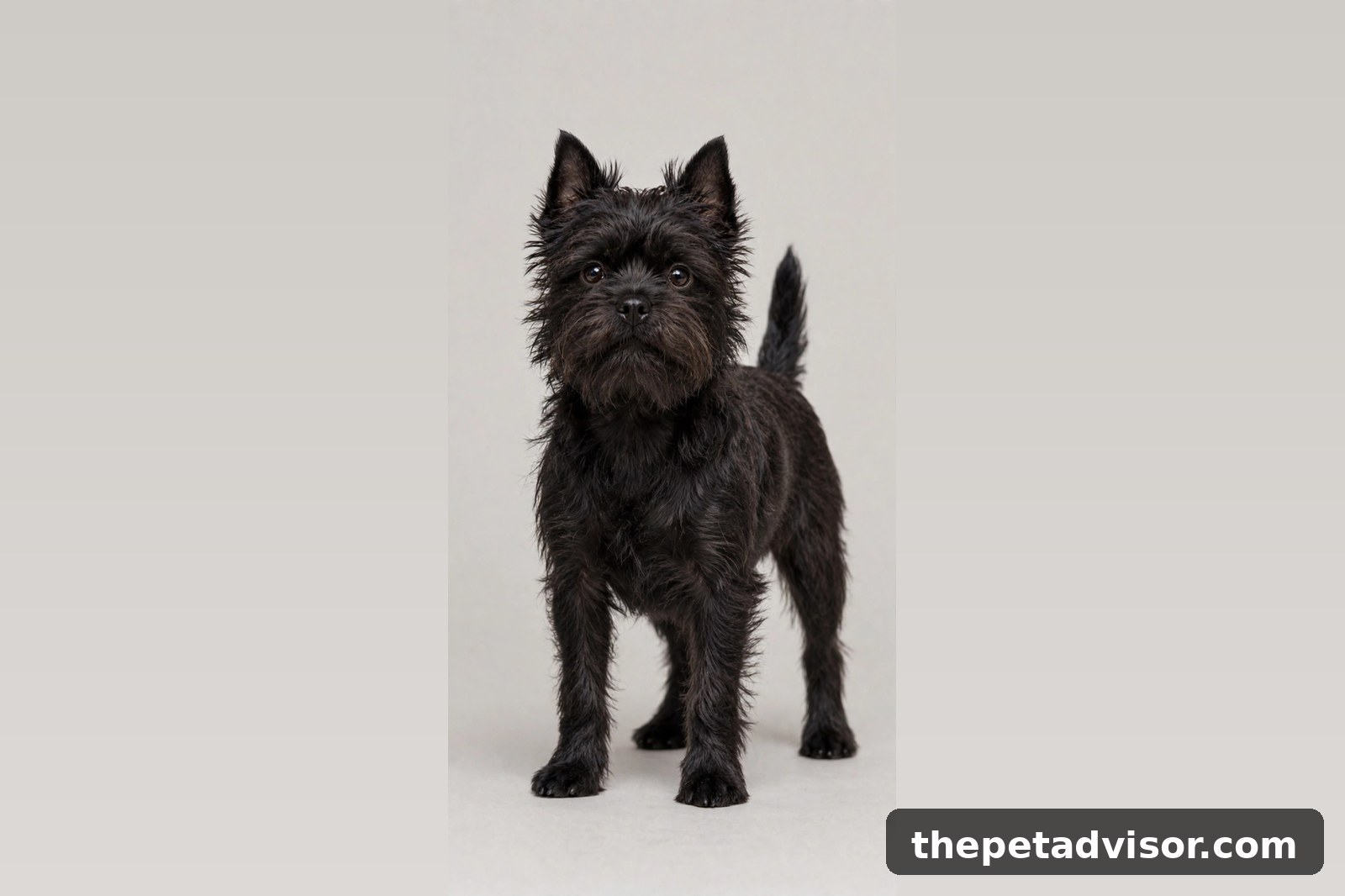
Do you have a photo of an Affenpinscher in the American show ring? We’d love this page to lead with one. If you have a show photo you’d let us use, email it to [email protected] — tell us the dog’s name and the show, and it may be featured here. Please only send photos you took yourself or have the photographer’s permission to share, and tell us the photographer’s name. We couldn’t find a public photo of an Affenpinscher in the American show ring that we were free to share, so the photo leading this page was made with AI. We’d much rather lead with a real one — if you’re a club member with an approved photo, we’d love to feature it.
1. Breed at a glance
Toy — recognized by the AKC in 1936
Preferred height 9½–11½ in at the shoulder. Weight 7 to 10 lb.
Dense, rough, harsh, about 1 in long. Black, gray, silver, red, black and tan, or belge.
Game, alert, inquisitive. Great loyalty and affection toward its master and friends. Fearless.
12 to 15 years.
Size, coat, and temperament facts are from the AKC standard. Weight (7 to 10 pounds) and lifespan (12 to 15 years) are the breed’s commonly published figures (AKC Affenpinscher breed page; Wikipedia, Affenpinscher).
2. History
The Affenpinscher is a German breed of Pinscher type, kept for centuries as a farm and stable dog to catch mice and rats. Dogs of this type, rough-haired and smooth-haired, were traditionally kept as carriage dogs or stable dogs — sometimes called Stallpinscher — and until the late nineteenth century both coat types were known as Deutscher Pinscher, from the same lineage; puppies of both types could occur in the same litter. The Pinscher was recorded in the Deutschen Hundestammbuch in 1880, the Pinscher-Schnauzer-Klub was established in 1895, and its first stud-book volume, published in 1902, listed fourteen Affenpinschers. The name comes from Affe, German for ape or monkey — “monkey-like terrier” — although the dog is a Pinscher and not a terrier. (Source: Wikipedia, Affenpinscher.)
In the United States the breed arrived in the mid-1930s: the first dogs came in 1935 from Josi Greimel, Sixtus Anwander, and Anna Katzbichler, and the AKC recognized the breed in 1936 through the persistent efforts of Bessie Mally. The first Affenpinscher registered with the AKC was Nolli v Anwander, from Mrs. Mally’s first litter. It was a small fancy: registrations ran 45 to 64 a year from 1954 to 1959 and hovered around 35 a year from 1960 to 1964. The Affenpinscher Club of America held its first meeting in the fall of 1965 in New York State, through the efforts of newer breeders, most notably Emily Kinsley and Lucille Meystedt, and held its first licensed specialty on May 17, 1986, with the Mattaponi Kennel Club. The breed’s obedience history started early too: the first CD Affenpinscher, Walhof Quita CD, titled in November 1954, and the first UD came in September 1980. (Sources: Affenpinscher Club of America, History of Affens in US; Affenpinscher Club of America, Club History.)
The breed’s modern profile rose sharply in 2013, when GCH CH Banana Joe V. Tani Kazari won Best in Show at the Westminster Kennel Club Dog Show. The FCI had definitely accepted the breed in 1955, and the United Kennel Club recognized it in 1957. The breed stays rare: in Germany, new registrations averaged just under 21 a year from 2010 to 2024. (Sources: Wikipedia, Affenpinscher; United Kennel Club, Affenpinscher breed standard.)
3. The standard and why it’s written that way
- A balanced, wiry-haired, terrier-like toy dog. The standard opens with the whole dog: “The Affenpinscher is a balanced, wiry-haired terrier-like toy dog whose intelligence and demeanor make it a good house pet. Originating in Germany, the name Affenpinscher means ‘monkey-like terrier.’ The breed was developed to rid the kitchens, granaries and stables of rodents. In France the breed is described as the ‘Diablotin Moustachu’ or the mustached little devil.” And the warning that governs the rest of the standard: “The total overall appearance of the Affenpinscher is more important than any individual characteristic. He is described as having a neat but shaggy appearance.” (Source: AKC standard.)
- Small, sturdy, square — and not delicate. “A sturdy, compact dog with medium bone, not delicate in any way. Preferred height at the withers is 9½ to 11½ inches. Withers height is approximately the same as the length of the body from the point of the shoulder to point of the buttocks, giving a square appearance. The female may be slightly longer.” (Source: AKC standard.)
- The monkey-like expression is the whole point. “The head is in proportion to the body. Carried confidently with monkey-like facial expression.” The eyes are round, dark, brilliant, and of medium size in proportion to the head, not bulging or protruding, with black eye rims. The ears are cropped to a point, set high and standing erect; or natural, standing erect, semi-erect, or dropped — all acceptable, if symmetrical, as long as the monkey-like expression is maintained. The skull is round and domed, the stop well-defined, the muzzle short and narrowing slightly to a blunt nose, about as long as the distance between the eyes. The nose is black. The bite is slightly undershot — a level bite is acceptable if the monkey-like expression is maintained, an overshot bite is to be severely penalized, and an awry mouth is a serious fault. The teeth and tongue do not show when the mouth is closed. (Source: AKC standard.)
- Coat — dense, rough, harsh, about an inch. “Dense hair, rough, harsh, and about 1 inch in length on the shoulders and body. May be shorter on the rear and tail. Head, neck, chest, stomach and legs have longer, less harsh coat. The mature Affenpinscher has a mane or cape of strong hair which blends into the back coat at the withers area. The longer hair on the head, eyebrows and beard stands off and frames the face to emphasize the monkey-like expression. Hair on the ears is cut very short. A correct coat needs little grooming to blend the various lengths of hair to maintain a neat but shaggy appearance.” (Source: AKC standard.)
- Color — six colors, and color is not a major consideration. “Black, gray, silver, red, black and tan, or belge are all acceptable. Blacks may have a rusty cast or a few white or silver hairs mixed with the black. Reds may vary from a brownish red to an orangey tan. Belge has black, brown, and/or white hairs mixed with the red. With the various colors, the furnishings may be a bit lighter. Some dogs may have black masks. A small white spot on the chest is not penalized, but large white patches are undesirable. Color is not a major consideration.” (Source: AKC standard.)
- Gait and temperament, in the standard’s own words. Gait: “Light, free, sound, balanced, confident, the Affenpinscher carries itself with comic seriousness. Viewed from the front or rear while walking, the legs move parallel to each other. Trotting, the feet will converge toward a midline as speed increases. Unsound gait is to be heavily penalized.” Temperament: “General demeanor is game, alert and inquisitive with great loyalty and affection toward its master and friends. The breed is generally quiet, but can become vehemently excited when threatened or attacked, and is fearless toward any aggressor.” The tail may be docked or natural: a docked tail is generally 1 to 2 inches long, set high and carried erect; the natural tail is set high and carried gently curved up over the back while moving. (Source: AKC standard.)
4. Temperament & living with one
The AKC sums the breed up in a sentence: the Affenpinscher is “loyal, curious, and famously amusing; this almost-human toy dog is fearless out of all proportion to his size,” and “as with all great comedians, it’s the Affenpinscher’s apparent seriousness of purpose that makes his antics all the more amusing.” That is the ratter’s dog in a pet’s life: bred to work the stables and kitchens on its own, it is game, alert, and inquisitive, loyal and affectionate toward its own people, generally quiet, and fearless toward any aggressor — a small dog that does not know it is small. (Sources: AKC Affenpinscher breed page; AKC standard.)
What that means in practice is a confident, busy companion that needs daily exercise and play, consistent training, and a job to do — even if the job is only a walk, a game, and a lap. The ratting instinct is real: a dog bred to hunt rodents in granaries notices small fast-moving things, and the stubborn streak that made it a good stable dog makes it a dog that trains best with patience and positive reinforcement, not with harsh corrections. It is a rare breed, and it has stayed rare — in Germany, new registrations averaged just under 21 a year from 2010 to 2024 — so expect a wait for a puppy, and expect the people who have them to be serious about where their puppies go. (Sources: Wikipedia, Affenpinscher; AKC standard.)
5. Grooming
- A correct coat needs little grooming. The standard says it plainly: “A correct coat needs little grooming to blend the various lengths of hair to maintain a neat but shaggy appearance.” The work is blending, not sculpting — keep the mane, beard, and brows tidy, the hair on the ears cut very short, and the shaggy outline neat. (Source: AKC standard.)
- Keep the harsh texture — clipping softens it. The coat is harsh and rough when it is not clipped, but if clipped it can be softer and fluffier. A clipped Affenpinscher loses the wiry texture the standard calls for, so a pet clip is a trade: easier upkeep, a softer coat, and a dog that no longer looks quite like the standard’s picture. (Sources: Wikipedia, Affenpinscher; AKC standard.)
- Brush two or three times a week. The harsh, shaggy coat sheds little but mats without maintenance, so brush two or three times a week, paying attention to the leg and beard furnishings, and have it hand-stripped or tidied every few months to keep the wiry texture and the characteristic monkey-faced shape. Keep the beard clean and dry, and keep the round, dark eyes clear of hair and discharge. (Sources: Mr Pet Lover, Affenpinscher Dog Breed Profile; AKC standard.)
6. Health testing
- Two tests for a CHIC number. The Affenpinscher Club of America’s health statement sets two tests for a CHIC number: an eye examination by a board-certified ACVO ophthalmologist, with results registered with CERF or OFA, and an OFA patella evaluation. The Canine Health Information Center records the Affenpinschers whose owners have tested eyes and patellas, and those two tests qualify the dog for a CHIC number. Breeders must agree to have all test results, positive or negative, published in the CHIC database. (Sources: AKC Toy Group Health Testing Requirements; Affenpinscher Club of America, Health Statement.)
- No known breed-specific inherited illness — and breeders who test beyond the minimum. The parent club’s health statement is blunt: “The bottom line is that Affenpinschers, to date, have no known inherited illness, deformity, or genetic malfunction specific to the breed.” Many breeders go beyond the required tests and add OFA evaluations for hip dysplasia, elbows, Legg-Calve-Perthes, and heart. Ask for the parents’ CHIC numbers and look the results up in the OFA database yourself, rather than taking a breeder’s word for it. (Source: Affenpinscher Club of America, Health Statement.)
- The watch list: knees, eyes, hips. Patellar luxation — the kneecap slipping out of place — is the orthopedic problem small breeds are screened for, and the OFA patella evaluation is the test. There may be some hereditary predisposition to cataracts, and the evidence on hip dysplasia is mixed: some sources report a higher-than-normal incidence, others do not. Secondary syringomyelia associated with Chiari-like malformation has been observed in the breed, as has seasonal flank alopecia. None of this is a reason not to own an Affenpinscher. All of it is a reason to buy from a breeder who tests. (Source: Wikipedia, Affenpinscher.)
- Lifespan: two numbers, honestly stated. The commonly published lifespan is 12 to 15 years. A 2024 UK study of companion-dog longevity found a mean lifespan of 9.3 years for the breed, against an average of 12.5 for all dogs — a reminder that a small sample in a rare breed can move an average a long way, and that the individual dog in front of you matters more than either number. (Sources: AKC Affenpinscher breed page; Wikipedia, Affenpinscher.)
7. The annual Affenpinscher specialty dog show
A specialty is the breed’s All-Star show — its Super Bowl. Once a year, the best Affenpinschers from across the country, and often from around the world, come together in one place.
The Affenpinscher Club of America’s national specialty: a one-day show inside a bigger all-breed weekend, with the conformation specialty at its center and sweepstakes, veteran sweepstakes, and junior showmanship around it. The 2026 show: Sunday, April 19, at the Maryland State Fairgrounds in Timonium, Maryland, with 16 Affenpinschers in the specialty. The 2025 show: Saturday, July 12, in San Antonio, Texas, with 30 Affenpinschers — the parent club’s 60th anniversary national.
The standard, in brief: a small, sturdy, square toy dog, 9½ to 11½ inches, with the monkey-like expression, the shaggy mane and beard, and the harsh, dense, roughly one-inch coat — and the fearless, game, comic-serious carriage.
The “Affens in Bloom” 2026 National Specialty — a one-day show, Sunday, April 19, 2026, at the Maryland State Fairgrounds, 2200 York Rd., Timonium, Maryland, concurrent with the Baltimore County Kennel Club show in the Cherry Blossom Cluster. Entry: 16 Affenpinschers (6 dogs, 10 bitches) in the specialty; 18 entries and 16 competitors across the event. Event Chair: Kevin Lind. Superintendent: MB-F, Inc. Entries closed Wednesday, April 1, 2026. The same weekend: the parent club’s supported entry at the Chesapeake Toy Dog Fanciers Club show on Friday, April 17, and a designated specialty on Saturday, April 18. (Sources: AKC event search, event 2026220103; 2026 National Specialty judging program; Affenpinscher Club of America, Past Specialties; AKC event search, Baltimore County Kennel Club, event 2026153001.)
National specialty judges: R. LeBeau — all regular classes and Best of Breed. Miss Rebecca S. Cross — Junior Showmanship. Best Junior Handler: Oliver Skeen. Sweepstakes and Veteran Sweepstakes: 3 sweepstakes entries and 1 veteran sweepstakes entry. (Sources: AKC event search, event 2026220103; 2026 National Specialty judging program.)
Results note. Winners from the 2026 specialty had not been published in an official source as of November 7, 2026, and will be added here when they are.
The 2027 National Specialty Weekend, “Affens in the Desert”: Friday, January 8 to Sunday, January 10, 2027, in Indio, California, with the national specialty itself on Friday, January 8, at The Empire Polo Club, alongside the Kennel Club of Palm Springs January shows. Host hotel: Hampton Inn & Suites, 42261 Spectrum Street, Indio, $159 a night with free parking and hot breakfast. Superintendent: Jack Bradshaw Dog Shows. Contact: Pam Peat. Judges’ education seminar: Friday, January 8, 8:00 a.m., presenter Cameron Riegel, with ringside mentoring during afternoon breed judging on Thursday, January 7. (Sources: Affenpinscher Club of America, 2027 Affens in the Desert; AKC Upcoming National Specialties; AKC Judges Education Seminars; Kennel Club of Palm Springs, Announcements.)
Past national specialties: 2025
2027 Affens in the Desert — Affenpinscher Club of America
8. Regional specialties through the year: smaller regional shows
The national is the anchor, but the Affenpinscher has no regional specialty clubs — the AKC club search lists the Affenpinscher Club of America as the breed’s only AKC club — so the breed’s year runs through the parent club’s supported entries and concurrent specialties at all-breed shows. Those are smaller regional shows, not the national: a supported entry puts Affenpinschers in front of a specialty judge inside an all-breed show, and a concurrent specialty is a separate parent-club show held alongside one. These are the 2027 regionals verified from club sources so far:
No regional specialties announced yet for 2027.
Past regional specialties: 2026 · 2025
More regional specialties will be added here as their programs are verified — this section is built from show data, not guesswork. Browse upcoming show weekends →
9. Clubs
- Affenpinscher Club of America (parent club) — the AKC parent club for the breed in the United States, and the national club devoted to promoting and protecting the breed. Its first meeting was held in the fall of 1965 in New York State, and it held its first licensed specialty in 1986. It runs the national specialty, held in Timonium, Maryland in 2026 and scheduled for Indio, California in 2027. President Kevin E. Lind (2026). (Sources: Affenpinscher Club of America, About the Club; Affenpinscher Club of America, Club History; AKC Club Search, Affenpinscher Club of America.)
- Regional specialty clubs: none. The AKC club search lists the Affenpinscher Club of America as the breed’s only AKC club — there is no regional Affenpinscher specialty club. The parent club’s own constitution encourages independent local Affenpinscher specialty clubs where there are enough fanciers to meet AKC requirements, but none exists yet, so the breed’s year runs through the parent club’s supported entries and concurrent specialties instead (see section 8). (Sources: AKC club search, A clubs; Affenpinscher Club of America, Constitution.)
If you are new to the breed, the national specialty itself is the better first stop than a breeder’s website: the people there have owned, shown, and worked Affenpinschers, and they will tell you the truth about the confidence, the stubborn streak, and the grooming before you fall for a puppy.
10. Rescue
- Start with Affenpinscher Rescue of America. Affenpinscher Rescue of America (ARA) is the breed’s rescue, listed in the AKC Rescue Network under the Affenpinscher Club of America’s rescue contact (Donna Wolfe). It is an all-volunteer 501(c)(3) that rescues, rehabilitates, provides veterinary care including spay and neuter, and places stray, homeless, or abandoned Affenpinschers for adoption. Adoption runs through an application to its adoption counselors, and the group says it is there to help for the life of the dog. If no dog on its site fits, contact its rescue coordinator — dogs almost ready for adoption may not be listed yet. (Sources: AKC Rescue Network, A breeds; Affenpinscher Rescue of America.)
- The M.A.D. Fund. ARA also runs an assistance program, the M.A.D. Fund, for Affen owners facing the choice of compromising on care, giving up, or euthanizing a cherished Affen because they cannot afford unexpected veterinary expenses — emergency care or routine preventive care — due to their own illness or circumstances beyond their control. The program’s initial funding came from a bequest from Mae Aspinall Dell, a longtime Affenpinscher fancier and supporter of ARA. (Source: Affenpinscher Rescue of America.)
- Adults and seniors. An adult or senior Affenpinscher can be a wonderful companion, often already housetrained and past the puppy stage, and ready to bond with a new family. Rescue groups publish available dogs on their sites and run an application-based adoption process, matching the dog’s temperament and needs to the household. If you bought your Affenpinscher from a responsible breeder, contact the breeder first — most responsible breeders include a take-back clause in their contracts and want to know if the dog needs help.
11. Breeder vs. rescue: honest guidance
- If you buy: start with the parent club, the Affenpinscher Club of America, and its Find an Affen resources. Ask for the parents’ CHIC numbers — eyes and patellas — and look the results up in the OFA database yourself. Expect to wait for a puppy from a careful breeder: this is a rare breed, and a good breeder will have the answers, will ask you as many questions as you ask them, and will take the puppy back for its whole life if you cannot keep it.
- If you rescue: a rescued Affenpinscher is usually an adult, often one whose owner underestimated the confidence, the stubborn streak, and the grooming a small fearless dog brings into a house, and it will arrive with its temperament and coat visible before you commit. What you get in return is a dog whose character you can see before you commit and a lower price. Either way, be honest with yourself first: an Affenpinscher needs daily exercise and play, consistent training, and an owner who finds a small dog with a big opinion charming rather than exasperating. It is not a dog for a household that wants a quiet, decorative lapdog.
- No rare color worth a premium. One thing that is not what a seller tells you: there is no such thing as a rare color worth a premium. The standard names six colors only — black, gray, silver, red, black and tan, and belge — and says plainly that “color is not a major consideration.” The standard also describes one size only, 9½ to 11½ inches, with no miniature variety. A breeder selling a “rare” color, or a “mini” Affenpinscher, at a premium is selling you a label.
12. Claim this page
This page belongs to the breed, and the people who know the breed best are the Affenpinscher Club of America and its members. If you are with the parent club — or you are a breeder, a judge, a handler, or a rescue volunteer who spotted something wrong, missing, or out of date — this page is yours to set straight. Tell us what needs fixing and where the correction is documented, and we will fix it and credit the source. Contact the site through the About page, and mention “Affenpinscher breed profile.”
Sources
- AKC Affenpinscher breed page — akc.org/dog-breeds/affenpinscher
- AKC Affenpinscher breed standard (approved June 12, 2000; effective July 27, 2000), via the parent club — affenpinscher.org/about-affens/akc-breed-standard
- Affenpinscher Club of America, History of Affens in US (Sharon Strempski) — affenpinscher.org/about-affens/history-of-affens-in-the-us
- Affenpinscher Club of America, Club History — affenpinscher.org/about-affens/health-wellness
- Affenpinscher Club of America, Health Statement (adopted May 12, 2015) — Affenpinscher Health Statement (PDF)
- AKC Toy Group Health Testing Requirements — akc.org/breeder-programs/breed-health-testing-requirements/toy-group-health-testing-requirements
- Affenpinscher Club of America, 2027 Affens in the Desert — affenpinscher.org/events/upcoming-events/eventdetail/2/-/2027-affens-in-the-desert
- AKC Upcoming National Specialties — apps.akc.org/apps/events/conformation/national_specialties.cfm
- 2026 National Specialty, AKC event search, event 2026220103 (official results) — apps.akc.org/apps/events/search/index_results.cfm
- 2026 National Specialty judging program (MB-F) — pdf.infodog.com/jps/1070/jpg1070.pdf
- Affenpinscher Club of America, Past Specialties — affenpinscher.org/events/past-specialties
- ShowSight, Affenpinscher Club of America Celebrates 60 Years at Its 2025 National — showsightmagazine.com/affenpinscher-club-of-america-celebrates-60-years-at-its-2025-national
- Baltimore County Combined Specialties premium list (Cherry Blossom Cluster) — pvgrc.org/mp-files/baltimore-county-combined-specialties-2026-including-pvgrc-specialty.pdf
- Affenpinscher Club of America, About the Club — affenpinscher.org/about-club
- Affenpinscher Club of America, Constitution — affenpinscher.org/about-club/constitution
- AKC club search, A clubs (only ACA listed for the breed) — apps.akc.org/apps/club_search/search/index.cfm?clubs=A
- AKC Rescue Network, A breeds (Affenpinscher Rescue of America) — akc.org/akc-rescue-network/rescue-network-a-breeds
- Affenpinscher Rescue of America — affenpinscherrescue.org
- Wikipedia, Affenpinscher (history, Westminster 2013, health studies) — en.wikipedia.org/wiki/Affenpinscher
- AKC Judges Education Seminars (January 8, 2027, Indio) — apps.akc.org/apps/clubs/seminars/seminars.cfm
- Mr Pet Lover, Affenpinscher Dog Breed Profile (grooming) — mrpetlover.com/dogs/affenpinscher
- United Kennel Club, Affenpinscher breed standard (UKC recognition 1957) — ukcdogs.com/docs/breeds/affenpinscher-breed-standard.pdf