The Reading Room • Dog Sports
Planning your dog sport season? Create your free ThePetAdvisor account — track your dogs and never miss a closing date.
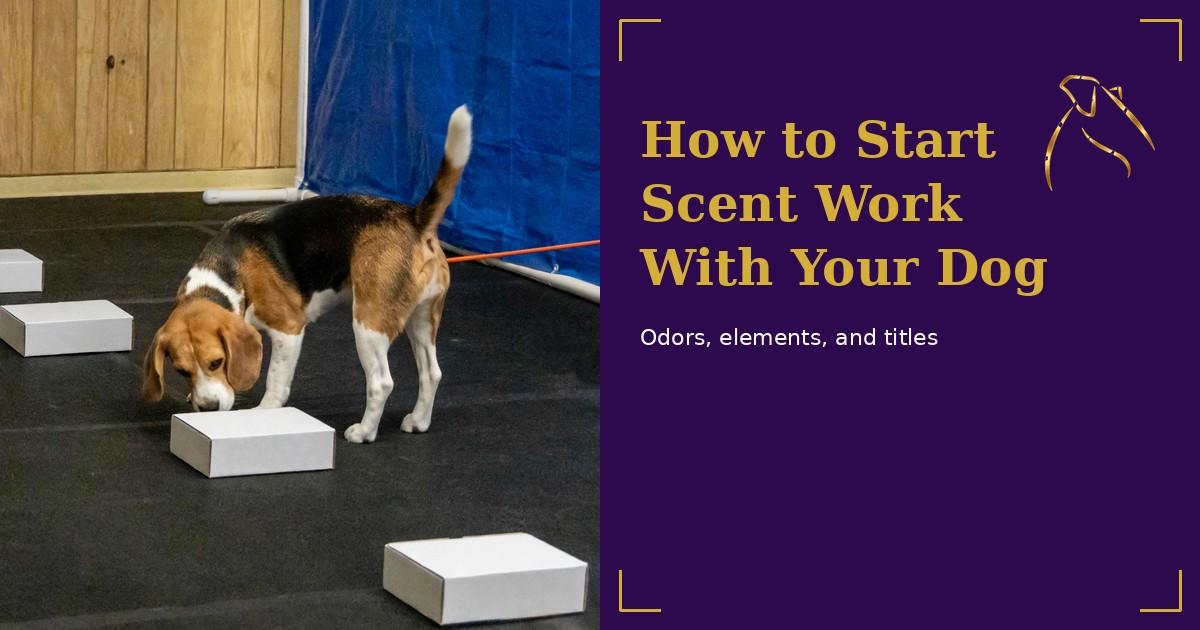
Somewhere in a row of cardboard boxes, a hotel room, or a patch of grass outside, a judge has hidden a cotton swab carrying a trace of birch oil. Your job is to stand back. Your dog’s job — the job their nose was built for — is to walk in, work the air, and tell you exactly where it is. That’s scent work: the sport modeled on real detection dogs, the narcotics and explosives dogs who search luggage and buildings for a living. Except here, the prize is a ribbon, a title, and a dog who comes home happily exhausted.
What is scent work?
Scent work turns a dog’s strongest sense into a game with rules. A judge hides a small amount of a target odor (one of four essential oils, carried on a cotton swab or similar scent vessel) somewhere in a defined search area. That hidden odor source is called a hide. The dog searches the area, follows the scent to its source, and gives an alert (the behavior that tells the handler “it’s here” — a paw, a nose freeze, a sit, a bark, whatever the dog naturally offers). The handler calls “Alert” to the judge, and when every hide is found, calls “Finish.”
The sport is judged pass or fail: find all the hides within the time limit, with no false alerts, and you earn a qualifying score — one leg toward a title. Qualifying teams are then placed first through fourth on fewest faults, then fastest time. The remarkable part is how little the handler does. The dog leads, the dog decides, the dog solves it. Handlers joke that their only real jobs are holding the leash and being wrong less often than the dog.
Which dogs can compete in AKC scent work?
Every dog with a nose — which is to say, every dog. Scent work is open to all AKC-registered breeds, mixed-breed dogs compete through the AKC Canine Partners program, and dogs with a Purebred Alternative Listing (PAL) are welcome too. Dogs must be at least 6 months old. There is no size, speed, or athletic requirement: blind dogs, deaf dogs, three-legged dogs, senior dogs, and dogs who hate other dogs all compete successfully, because the work happens one dog at a time, on leash, in a quiet search area.
This is also where scent work’s family tree matters. The game began as nose work, developed by the NACSW (National Association of Canine Scent Work) for pet dogs. AKC launched its own version, Scent Work, in 2017. Many teams train once and compete in both.
What are the four elements?
Searches happen in four environments, called elements. A trial may offer some or all of them, and your dog can be at a different level in each one.
- Container
- The hide is inside one of a row of containers — cardboard boxes at Novice, luggage and other objects as it gets harder. The dog works the line and picks the one that smells right.
- Interior
- The hide is on or in an object inside a room — a chair leg, a cabinet, a desk drawer. This is the search that looks most like a real detection dog clearing a building.
- Exterior
- The hide is outdoors, where wind, weather, and a thousand natural smells move the scent around. Beautiful to watch a good dog work a breeze.
- Buried
- The hide sits in a small container buried under sand or submerged in water. The dog has to find scent rising through the covering material.
There’s a second division, too: Handler Discrimination, where the dog searches for your scent — a cotton glove carrying your odor, hidden among gloves carrying the judge’s. Its titles are SHDN, SHDA, SHDE, and SHDM, Novice through Master.
What are the levels and titles?
Each element has four levels of difficulty. As you move up, the search areas get bigger, the hides get higher and harder to reach, distractions are added, and — the big shift — the number of hides stops being announced. At the top levels you search blind (without knowing how many hides are out there), so you have to trust your dog when they say the area is clear.
The odors layer in as you climb: Novice searches use birch only. Advanced adds anise. Excellent adds clove. Master can use all four, including cypress.
- Element titles — three qualifying scores each
- Every element at every level has its own title, built from three letters: S for Scent Work, the element letter (Container, Interior, Exterior, Buried), and the level letter (Novice, Advanced, Excellent, Master). So SCN is Scent Work Container Novice, SIE is Scent Work Interior Excellent, and SBM is Scent Work Buried Master. Sixteen element titles in all.
- SWN — Scent Work Novice
- Earn all four Novice element titles (SCN, SIN, SEN, SBN) and AKC awards the level title, SWN, which replaces them after the dog’s name.
- SWA — Scent Work Advanced
- All four Advanced element titles. Your dog now searches for birch and anise, works bigger areas, and handles distractions.
- SWE — Scent Work Excellent
- All four Excellent element titles. Clove joins the odor list, hides can be elevated, and the number of hides may be unknown.
- SWM — Scent Work Master
- All four Master element titles. All four odors, the largest areas, unknown hide counts, and hides that may be completely inaccessible — the dog has to tell you where the scent is strongest without ever touching the source.
Teams that love a particular element can keep going: ten qualifying scores in one element at one level earns an Elite element title (like SCNE, Container Novice Elite), and Elite titles in all four elements earn level titles like SWNE.
What is the Detective class?
Above Master sits one more class, and it’s the summit of the sport. The Detective class is open to dogs holding at least one Master element title, and it throws the rulebook’s neat categories away: one big integrated search of 2,000 to 5,000 square feet, indoors and out, with five to ten hides — and nobody tells you how many. Some hides may be buried, some elevated with no height limit, some inaccessible. You have 7 to 15 minutes, set by the judge, and 4 to 6 deliberate distractions working against you. It is designed to mirror a real detection dog’s shift as closely as a sport can.
Earn ten qualifying scores in the Detective class and your dog takes the title SWD — Scent Work Detective.
Why is scent work the best first sport for so many dogs?
Ask around any trial and you’ll hear the same stories. The reactive dog who could never handle a crowded obedience ring thrives because searches run one dog at a time. The senior dog whose agility days are over lights up because the game is mental, not physical — ten minutes of searching tires a dog like an hour’s walk. The shy dog gains visible confidence, because in scent work the dog is the expert and the human just follows. Handlers love it for practical reasons too: training needs a handful of boxes and a few scented swabs, practice fits in a living room, and there is no equipment to haul, no course to build, and no partner required.
How do I actually get started?
- Start with boxes and food. Put a treat in one of several cardboard boxes and let your dog find it. That searching instinct — working a problem with the nose — is the foundation everything else is built on, and most dogs take to it in one session.
- Take an intro class. Local AKC clubs and training schools run scent work classes year-round; NACSW trainers teach the same foundation skills. A good intro class teaches your dog to hunt independently and teaches you to read your dog — the subtle head snap, the change of breathing, the moment interest becomes certainty.
- Introduce odor. When your dog searches eagerly, the target becomes birch oil, paired with food rewards at first so the odor itself becomes valuable. Scent kits with the four AKC odors, tins, and vessels are inexpensive and widely sold.
- Build the alert. You don’t teach most dogs an alert so much as learn the one they already have. Reward at the source, every time, so finding odor pays exactly where the odor is.
- Enter Novice. Start with Container and Interior Novice at a local trial. Each day of a trial is a separate event, so a weekend gives you multiple chances at legs. Novice is one hide, birch only, and a known count — the gentlest possible introduction.
What should I watch for at my first trial?
- Trust the dog. Every handler’s hardest lesson. Your dog can smell things you cannot imagine. When they commit to a spot, call it — the number one way teams fail is the handler talking the dog off a correct find.
- Don’t crowd your dog. Work on a long, loose leash and let the dog range. A handler hovering over the dog blocks scent and blocks confidence.
- Mind the clock, calmly. You’ll get a 30-second warning in the regular classes. Rushing makes dogs sloppy; steady makes them fast.
- Reward the find like you mean it. When the judge confirms your alert, the party starts at the hide — treats, praise, the works. That payoff is what your dog is working for.
- Expect to be wrong sometimes. A false alert ends the search as a non-qualifying run — and AKC even offers a fix and go on option, where the judge shows you the nearest hide so your dog still gets a win before you leave the area. Nobody’s first trial is clean. The dogs don’t mind; they just had the best day ever.
Upcoming scent work events on ThePetAdvisor
Real scent work events on the schedule right now:
- Loading upcoming events…
Sources: AKC: Getting Started in Scent Work, AKC Scent Work Regulations, Pacific Northwest Scent Work Club: Sport Info, Cleveland All-Breed Training Club: AKC Scent Work Training.
Planning your dog sport season? Create your free ThePetAdvisor account — track your dogs and never miss a closing date.
Frequently asked questions
Can mixed breed dogs compete in AKC scent work?
Yes. Mixed-breed dogs compete in AKC scent work through the AKC Canine Partners program, and dogs with a Purebred Alternative Listing (PAL) can compete too. They enter the same classes, search for the same odors, and earn the same titles as AKC-registered purebred dogs.
How many qualifying scores do you need for an AKC scent work title?
Each element title — like Scent Work Container Novice (SCN) — takes three qualifying scores in that element at that level. Earn all four element titles at the same level and AKC awards the level title, such as Scent Work Novice (SWN). The Detective title (SWD) takes ten qualifying scores in the Detective class.
What odors are used in AKC scent work?
AKC scent work uses four essential oil odors: birch, anise, clove, and cypress. Novice searches use birch only. Advanced adds anise, Excellent adds clove, and Master searches can use all four, including cypress.
What is the Detective class in AKC scent work?
The Detective class is the highest level of AKC scent work. It is open to dogs holding at least one Master element title, and it offers one big integrated search of 2,000 to 5,000 square feet with an unknown number of hides — five to ten — across indoor and outdoor areas, meant to mirror the work of a real detection dog. Ten qualifying scores in the class earns the Scent Work Detective (SWD) title.
What is the difference between AKC scent work and NACSW nose work?
Nose work started with NACSW, the National Association of Canine Scent Work, whose trials award titles like NW1, NW2, and NW3. AKC Scent Work, launched in 2017, is the AKC version of the same core game, organized into four elements and four difficulty levels with titles like SWN, SWA, SWE, and SWM. Many dogs compete in both organizations.
Chasing scent work titles with your dog?
Record every title on your dog’s ThePetAdvisor profile — track progress toward the next one, and plan your weekends around the sports you love.