The Reading Room • Dog Sports
Planning your dog sport season? Create your free ThePetAdvisor account — track your dogs and never miss a closing date.
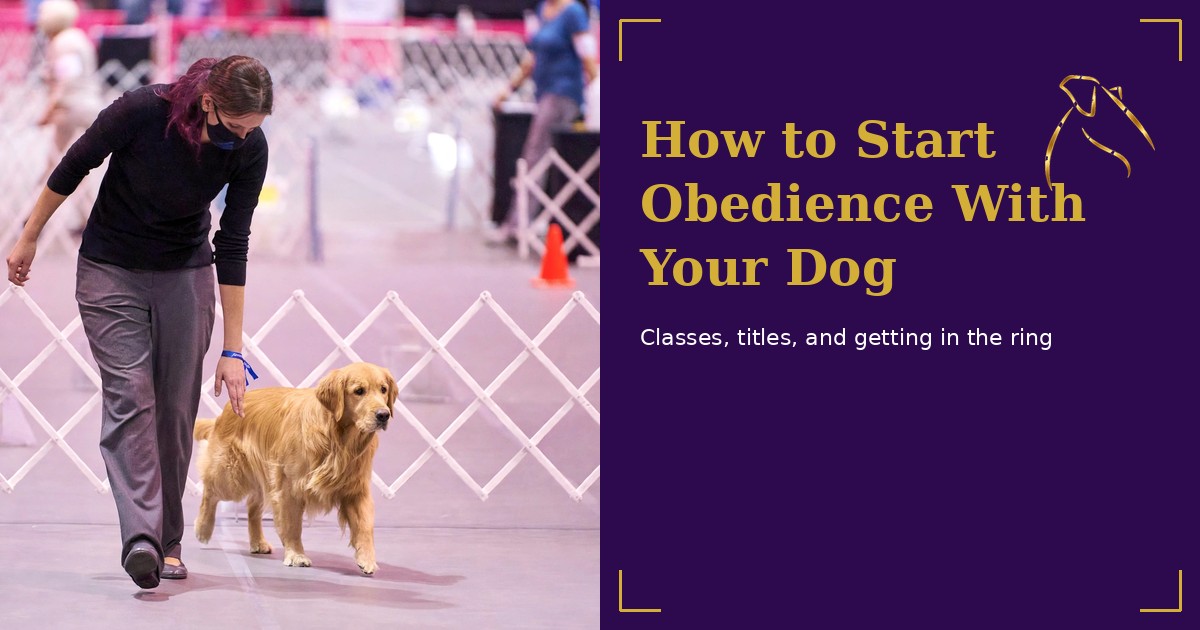
Picture this: you and your dog walk into a quiet ring, the judge nods, and one cue at a time — heel, stand, stay, come — your dog performs each exercise like you rehearsed it a thousand times. Because you did. There’s no talking between cues, no second chances, no encouraging chatter. Just the two of you, precise and connected. That’s obedience — the oldest AKC performance sport, and the foundation every other dog sport is built on.
What is AKC obedience?
Obedience is a precision team sport: a dog and handler perform a fixed set of exercises (a prescribed list of skills, performed in the same order at every trial) one at a time, in a ring, while a judge watches. The judge calls each exercise — “Forward,” “Halt,” “Exercise finished” — and scores your team against a mental picture of perfect performance. You start with 200 points, the judge deducts for faults — a crooked sit, a slow recall, a lagging heel — and if you finish with 170 or more, with more than half the points in every exercise, you earn a qualifying score, also called a leg (one qualifying run toward a title).
The defining rule: one cue per exercise. You say “sit” once. If you say it again, that exercise scores zero in most classes — an automatic NQ (non-qualifying score) for the whole run. Heeling is the one exception, where extra commands cost points instead of zeroing the exercise.
Which dogs can compete in AKC obedience?
Almost any dog. Obedience is open to all AKC-registered breeds, and mixed-breed dogs compete through the AKC Canine Partners program — same classes, same titles, no separate division. Dogs must be at least 6 months old and physically sound. Unlike rally, there’s no heeling pattern published in advance and no course to walk — the exercises are the same every time, which means your training is about polish, not surprise.
What is Beginner Novice (BN)?
Beginner Novice is the optional on-ramp AKC added for teams that aren’t ready for the full Novice class. Think of it as obedience with training wheels: everything is on leash except the recall, the heeling pattern is laid out with rally signs so you know where you’re going, and you’re allowed one verbal encouragement during the heeling. The five exercises are Heel on Leash, Figure Eight, Sit for Exam, Sit Stay, and Recall, worth 40 points each. Three qualifying scores earns the BN suffix title — and a dog that already has a CD can still compete in Beginner Novice, so it’s also a fine place to rebuild ring confidence.
What are the Novice, Open, and Utility classes?
Three levels, each harder than the last. Every title takes three qualifying scores of 170+ under at least two different judges.
- Novice — CD (Companion Dog)
- The entry level for the regular classes. Heel on Leash and Figure Eight, Stand for Exam (the dog stands still while the judge touches its head, body, and hindquarters), Heel Free (off leash), Recall with a finish back to heel position, and group Sit Stay (one minute) and Down Stay (three minutes) with the other dogs in the class.
- Open — CDX (Companion Dog Excellent)
- Everything goes off leash. Heel Free and Figure Eight, Drop on Recall (the dog drops to a down on command while coming to you), Retrieve on Flat and Retrieve over High Jump with a dumbbell (a wooden or plastic retrieving object the dog must pick up and deliver), Broad Jump, and the group stays get longer with the handler out of sight of the dogs.
- Utility — UD (Utility Dog)
- The most advanced regular class — and the one spectators stop to watch. Signal Exercise (heeling, stands, downs, sits, and a recall done on hand signals only), Scent Discrimination (the dog finds and retrieves the one leather or metal article — a small scented object — carrying the handler’s scent from a pile of unscented ones), Directed Retrieve (fetching the one glove the judge points to out of three), Moving Stand and Examination, and Directed Jumping (the dog runs out to a mark, then jumps the high jump or bar jump on the judge’s direction). Requires the CDX.
At every level there are A and B classes. A is for handlers who have never titled a dog at that level — in Novice A, the handler must never have won an AKC obedience title on any dog — and the dog must be owned by the handler or family. B is for everyone else, including dogs that already hold the title. The B classes are where the championship points are earned.
What do obedience titles like UDX mean — and what is OTCH?
Past Utility, obedience has two titles for the truly committed:
- UDX — Utility Dog Excellent
- After earning the CDX and UD, qualify in both Open B and Utility B at the same trial — a double qualifying score, or double Q — ten times. Each run must score 170+. Earn it again and the number follows: UDX2, UDX3, and so on.
- OTCH — Obedience Trial Champion
- The top of the mountain — and a prefix title, so it goes before the dog’s name. Unlike every title below it, the OTCH is won by beating other dogs. After earning the UD, a dog must earn 100 championship points by placing first through fourth in Open B and Utility B, with points scaled to the size of the competition — plus three first places under three different judges: one in Utility B with at least three dogs competing, one in Open B with at least five dogs competing, and a third in either class. Fewer than 100 dogs earn an OTCH in a typical year, which is why you’ll see it announced like a headline when one finishes.
All obedience titles except OTCH go after the dog’s name. When a dog earns a higher title, it replaces the lower one — a dog with a UD doesn’t keep listing its CDX.
How is obedience different from rally?
They share DNA — heeling, sits, recalls — but the ring experience is completely different. In obedience, you get one cue; any extra talking, encouraging, or gesturing costs points, and a second command zeroes most exercises. The judge calls every exercise in a fixed order, and a dog is judged on precision: exact heel position, crisp responses, clean fronts and finishes.
In rally, unlimited communication is encouraged. You can talk, repeat cues, clap, pat your legs, and praise your dog the whole way around a course that changes at every trial. A dog is judged on teamwork and willingness, not perfection — a crooked sit that costs half a point in obedience might cost nothing in rally.
Handlers who do both say the same thing: rally is kinder to the dog and quicker in the ring (about two minutes versus seven or eight), while obedience’s precision is mesmerizing to watch. Many teams train in both — rally keeps the dog happy, obedience keeps the handler honest.
How do I actually get started?
The honest path, step by step:
- Take a class. Find an AKC obedience club or training facility — most welcome observers, so go watch a class first. Expect to train three to six months before your first trial; obedience’s precision takes longer to build than rally’s teamwork.
- Master the basics at home. A straight sit, a prompt recall, a stay that holds while you walk away — these are the bricks everything else is built from. Short sessions, a few times a week, ending while the dog still wants more.
- Train the group stays with distractions. The stays are where Novice runs most often fall apart. Practice with other dogs around, with people walking past, with you out of sight for a few seconds. A dog that holds a stay in a quiet kitchen may not hold it in a ring full of dogs.
- Learn the judge’s language. The judge gives orders — “Forward,” “Halt,” “Slow,” “Exercise finished” — and you move on those orders, not before. Practice heeling patterns to spoken commands so the rhythm feels automatic.
- Enter Beginner Novice or Novice B. Beginner Novice is the gentlest first ring experience in the sport. If you go straight to Novice, Novice B is for handlers who’ve titled before; Novice A is reserved for true first-timers. Each day of a trial is a separate show, so a two-day weekend gives you two chances at a leg.
What should I watch for at my first trial?
Go early, bring a crate and a chair, and watch a few runs before yours. The tips experienced handlers give beginners, over and over:
- Wait for the judge’s orders. Nothing happens until the judge says so. Don’t cue your dog early, don’t start heeling before “Forward,” don’t recall before you’re told.
- One cue means one cue. Say it once, clearly. If the dog doesn’t respond, you take the zero on that exercise — repeating the command doesn’t save the run, it just confirms the NQ.
- Stay silent during group stays. No talking to your dog, no whispering, no “good stay” — any of it can cost the whole exercise. Stand quietly and breathe.
- Watch your footwork in heeling. Handlers lose more points with their feet than their dogs lose with theirs. Turns should be crisp and your pace should stay even — the dog mirrors you.
- Don’t train in the ring. It’s tempting to fix a mistake mid-run. Don’t. Finish the exercise, finish the run, and train it at home. The ring is for showing what you trained.
- Thank your judge and stewards. Then go reward your dog like they just won the National — because to them, they did.
One more: obedience scores feel brutal the first time because the deductions are so visible. A 185 with a happy dog is a better run than a 195 with a shut-down one — and the judges know it.
Upcoming obedience events on ThePetAdvisor
Real obedience events on the schedule right now:
- Loading upcoming events…
Sources: AKC: Obedience Classes, AKC: Beginner Novice, AKC: Rally and Obedience Championships, Allyn PWDs: Obedience Titles, Cuddle Crews: AKC Obedience Trial Preparation.
Planning your dog sport season? Create your free ThePetAdvisor account — track your dogs and never miss a closing date.
Frequently asked questions
What is the difference between AKC obedience and AKC rally?
In AKC obedience, the handler gives a single cue per exercise — extra talking, repeating cues, or encouraging the dog costs points, and a second command is an automatic non-qualifying score in most exercises. The judge calls each exercise in a fixed order and the dog is judged on precision. In rally, handlers can talk to, praise, and encourage their dogs continuously, move at their own pace, and follow a course that changes at every trial. Obedience is judged on precision; rally is judged on teamwork.
How many points do you need to qualify in AKC obedience?
You start with 200 points and need at least 170 to earn a qualifying score, also called a leg. You must also earn more than half of the available points in every single exercise — a zero on one exercise means no qualifying score even if your total is above 170.
What do AKC obedience titles like CDX mean after a dog’s name?
CD stands for Companion Dog (Novice class), CDX is Companion Dog Excellent (Open class), UD is Utility Dog (Utility class), and UDX is Utility Dog Excellent (qualifying in both Open B and Utility B at the same trial, ten times). Each requires three qualifying scores of 170 or higher under at least two different judges, except UDX which requires ten combined qualifying scores. OTCH is Obedience Trial Champion, a prefix title earned by defeating other dogs.
How many qualifying scores do you need for an AKC obedience title?
The CD, CDX, and UD titles each require three qualifying scores of 170 or higher earned under at least two different judges. The Beginner Novice (BN) title also requires three qualifying scores. UDX requires ten combined qualifying scores — qualifying in both Open B and Utility B at the same trial, ten times.
How do you earn an Obedience Trial Champion (OTCH) title in AKC?
After earning the UD, a dog must earn 100 championship points by placing first through fourth in the Open B and Utility B classes, with points scaled by the size of the competition. The dog must also win three first places under three different judges: one in Utility B with at least three dogs competing, one in Open B with at least five dogs competing, and a third in either class. OTCH is a prefix title that goes before the dog’s name, and fewer than 100 dogs earn it in a typical year.
Chasing obedience titles with your dog?
Record every title on your dog’s ThePetAdvisor profile — track progress toward the next one, and plan your weekends around the sports you love.