The Reading Room • Dog Sports
Planning your dog sport season? Create your free ThePetAdvisor account — track your dogs and never miss a closing date.
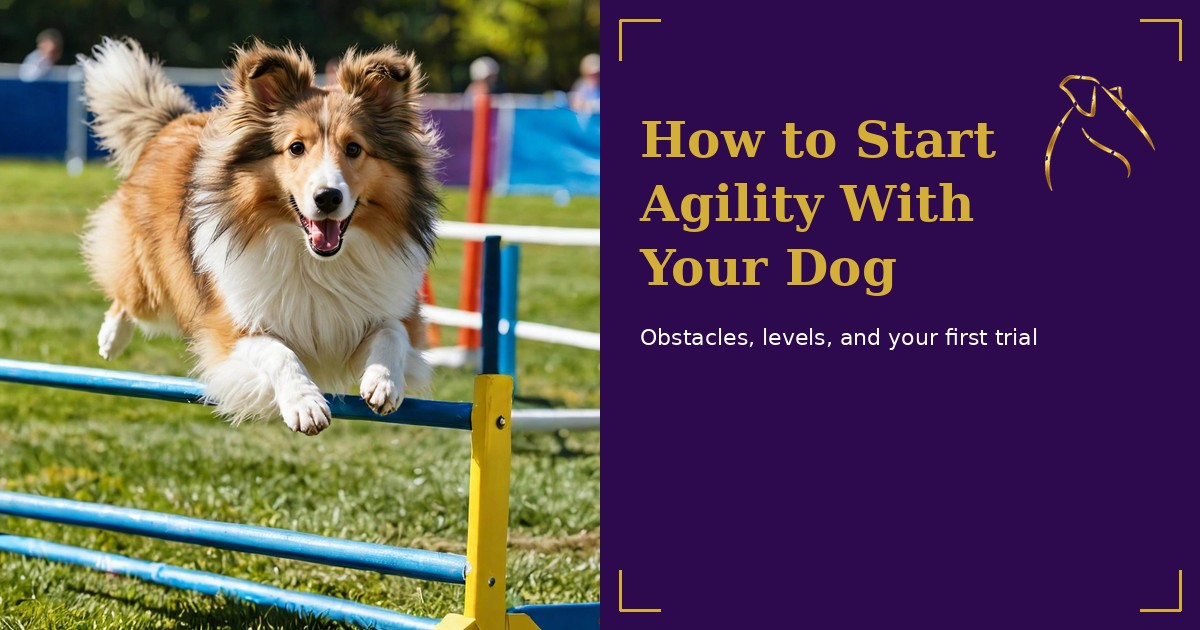
Picture this: a course of jumps, tunnels, weave poles, and ramps is laid out in a big ring, and you and your dog take it on at a dead run — you sprinting alongside, steering with your voice, your hands, and your body, your dog flying over bars and threading poles like it was born to do it. That’s agility. It’s the fastest, most athletic of the AKC sports — and the one where the handler gets a workout too.
What is dog agility?
Agility is a timed obstacle sport run off leash. The judge designs a course (a numbered sequence of obstacles), the handler walks it first without the dog to memorize the path, and then the team runs it together — the dog taking obstacles in order while the handler directs from the ground. You can talk, gesture, and move anywhere you need to; the dog just has to take the obstacles in the right order, correctly, and beat the clock.
The obstacles fall into three families. Jumps include bar jumps, panel jumps, the tire, and the broad jump. Tunnels are open tubes the dog runs through. Weave poles are a row of upright poles the dog slaloms through. Contact obstacles — the A-frame (a peaked ramp), the dog walk (a raised plank with ramps on both ends), and the teeter (a seesaw) — each have a painted contact zone (a colored area at the bottom of the ramp) that the dog must touch on the way down. Missing the contact zone is a fault.
Which dogs can compete in AKC agility?
Almost any dog. Agility is open to all AKC-registered breeds, and mixed-breed dogs compete through the AKC Canine Partners program — same classes, same titles, no separate division. Dogs must be at least 15 months old to enter a trial, and they must be in sound physical condition.
One thing agility does better than almost any other sport: it scales to the dog. Courses are divided into jump height divisions based on the dog’s height at the withers (the ridge between the shoulder blades): 8 inches for dogs 11 inches and under, 12 inches for dogs up to 14 inches, 16 inches for dogs up to 18 inches, 20 inches for dogs up to 22 inches, and 24 inches for dogs over 22 inches. And the Preferred classes let a dog jump one height lower with extra time on the clock — built for veteran dogs, smaller dogs, and anyone who prefers a less demanding challenge.
What are the two main agility classes?
At every trial you’ll see two titling classes, and dogs earn separate titles in each:
- Standard (Agility)
- The full game: jumps, tunnels, weave poles, and the contact obstacles (A-frame, dog walk, teeter). The most technical class — a missed contact zone or a knocked bar ends the qualifying run.
- Jumpers With Weaves (JWW)
- Jumps, tunnels, and weave poles only — no contact equipment. Courses flow faster and reward pure speed and handling. Many teams find JWW the more forgiving place to start.
There are also games classes: FAST (Fifteen and Send Time), a strategy game with a distance challenge where the dog works away from the handler, and Time 2 Beat (T2B), a speed class where the fastest clean run in each jump height sets the time to beat and everyone else earns points based on how close they came. FAST and T2B have their own titles (NF, OF, XF, MXF and T2B respectively).
What are the agility levels and titles?
Four levels, each harder and faster than the last. Titles take three qualifying scores under at least two different judges — except Master, which takes ten. At Master level, only a perfect 100 qualifies.
- Novice — NA (Novice Agility) / NAJ (Novice Agility Jumper)
- The starting point, and it’s split into Novice A (handlers who have never titled a dog in agility) and Novice B (everyone else). Courses are straightforward with generous time limits — built for teams to succeed and build confidence.
- Open — OA (Open Agility) / OAJ (Open Agility Jumper)
- Courses get more intricate, times get tighter, and weave poles join the Standard course. The dog has to hold speed and accuracy on trickier sequences.
- Excellent — AX (Agility Excellent) / AXJ (Excellent Agility Jumper)
- Championship-level course design with demanding handling: tight turns, discriminations between obstacles, and no room for error. Three qualifying scores here proves a serious team.
- Master — MX (Master Agility Excellent) / MXJ (Master Excellent Jumper)
- The summit of the standard classes — and this one takes ten qualifying scores of 100, no faults allowed, under two different judges.
The Preferred program mirrors all four levels with lower jump heights and extra time: NAP/NJP, OAP/OJP, AXP/AJP, MXP/MJP. And Premier classes (PAD/PJD) offer even harder Master-level courses for elite teams.
What do agility titles like MACH mean — and what is PACH?
Past the level titles, agility has championships for the truly committed:
- MACH — Master Agility Champion
- A prefix title — it goes before the dog’s name. To earn it, a dog must hold the MX and MXJ, then earn 750 championship points (one point per full second under the standard course time) plus 20 double qualifying scores — qualifying in both Master Standard and Master JWW on the same day, 20 times. Earn it again and the number follows: MACH2, MACH3, and so on.
- PACH — Preferred Agility Champion
- The same achievement in the Preferred program: MXP and MJP first, then 750 points and 20 double Qs in Preferred Master classes. Same prestige, lower jumps.
- AGCH — Agility Grand Champion
- AKC’s highest agility title, for lifetime excellence across every class: 100 qualifying scores each in Master Standard and Master JWW, 75 each in Master FAST and Time 2 Beat, and 50 each in Premier Standard and Premier JWW. Only a handful of dogs have ever earned it.
All other agility titles go after the dog’s name, and the higher title replaces the lower — a dog with an MX doesn’t keep listing its AX.
How is agility different from other dog sports?
Two things set agility apart. First, it’s a race against the clock — in rally or obedience, the dog is judged on correctness; in agility, speed is the score. Championship points literally count the seconds you beat. Second, the handler runs too. You can’t stand still and cue from a distance in most classes — you sprint the course alongside your dog, steering with your motion, your voice, and your position. Teams talk about it like dancing: the best runs look like the dog is reading the handler’s mind, because the handler’s body told the dog where to go before the words did.
That athletic demand is also why foundation work matters so much. The spectacular jumps are only one part of the sport — the real game is communication at speed.
How do I actually get started?
The honest path, step by step:
- Check with your vet, then find a class. Agility is high-impact. Make sure your dog is sound, then find an AKC club or training facility with an experienced, reward-based instructor. Most clubs welcome observers — go watch before signing up.
- Build foundations before touching equipment. Before your dog ever sees a jump, teach three things: rock-solid recall and attention (your dog must focus on you in an exciting room full of dogs), body awareness (backing up, walking over poles on the ground, knowing where their back feet are), and directional cues (moving left, right, and driving forward on your word). Expect four to eight weeks on foundations alone — it makes everything after it faster and safer.
- Respect growth plates. Veterinarians advise waiting until a dog is fully grown — usually 12 to 18 months depending on breed — before jumping or doing strenuous obstacle work. Young, growing bones and joints can be harmed by high-impact exercise. AKC won’t let a dog trial before 15 months anyway.
- Introduce equipment gradually. Start with tunnels and low jumps at or below elbow height. Contact obstacles — the A-frame, dog walk, and teeter — need proper training to be safe and should be learned under an instructor’s eye. Keep sessions to 5–10 minutes and stop before your dog loses interest.
- Enter Novice A. It’s designed for first-timers, and judges want you to have a good experience. Walk the course without your dog first, memorize your path, and remember: your run will feel worse than it looks. Have someone video it.
What should I watch for at my first trial?
Trials run all day with dozens of dogs, so go early, bring a crate and a chair, and watch the level above yours to see what’s coming. The advice experienced handlers repeat to beginners:
- Walk the course like you mean it. You get a course walk without your dog before your class. Memorize the numbered sequence, plan where you’ll be for every obstacle, and rehearse it mentally. Most handler errors come from a bad walk, not a bad dog.
- Keep it positive in the ring. No harsh corrections, ever — a judge can excuse you for harsh handling. If something goes wrong, laugh it off and finish on a good note. You can always use Fix and Go On (reattempt an obstacle mid-run) to end with a success, though it costs you the qualifying score.
- Don’t train in the ring. Repeating obstacles or drilling your dog during a run will get you excused. Save the training for practice.
- Mind the leash runner. In most trials a volunteer takes your leash at the start and returns it at the finish — know where to hand it off.
- Reward like crazy after. The run ends at the finish line, not before. Then celebrate like your dog just won the National Agility Championship — because the joy is the whole point.
Upcoming agility events on ThePetAdvisor
Real agility events on the schedule right now:
- Loading upcoming events…
Sources: AKC Agility, AKC: Agility Competition 101, AKC Agility FAQ, AKC: Time 2 Beat, AKC: Agility Grand Champion, Happy Dog League: AKC Agility Titles Guide, Ask a Vet: Dog Agility for Beginners, Pet Hub: Agility Training for Beginners.
Planning your dog sport season? Create your free ThePetAdvisor account — track your dogs and never miss a closing date.
Frequently asked questions
How does AKC agility scoring work and what score do you need to qualify?
A dog is judged on a 100-point scale. The judge deducts points for faults — knocked bars, missed contact zones, refusals, and time penalties. A qualifying score is 85 or higher at Novice, Open, and Excellent levels, and a perfect 100 at the Master level. The run must also finish within the standard course time set by the judge.
What is the difference between Standard and Jumpers classes in AKC agility?
Standard (also called Agility) includes the contact obstacles — the A-frame, dog walk, and teeter — plus jumps, tunnels, and weave poles. Jumpers With Weaves (JWW) is jumps, tunnels, and weave poles only, with no contact equipment, so it runs faster. Dogs earn separate parallel titles in each class at every level.
How do you earn a MACH title in AKC agility?
To earn the Master Agility Champion (MACH), a dog must first hold the MX and MXJ titles, then earn 750 championship points and 20 double qualifying scores — qualifying in both Master Standard and Master Jumpers With Weaves on the same day, 20 times. Points are earned for every full second under the standard course time. MACH goes before the dog’s name.
What jump height will my dog compete at in AKC agility?
Jump height is set by the dog’s height at the withers (shoulder): 8 inches for dogs 11 inches and under, 12 inches for dogs up to 14 inches, 16 inches for dogs up to 18 inches, 20 inches for dogs up to 22 inches, and 24 inches for dogs over 22 inches. The Preferred classes let a dog jump one height lower with extra course time, which suits older dogs and those recovering from injury.
At what age can a dog start agility training and competing?
Puppies can start foundation work — body awareness, recalls, and directional cues — at any age, but veterinarians advise waiting until a dog is fully grown, usually 12 to 18 months depending on breed, before jumping or doing strenuous obstacle work. AKC requires dogs to be at least 15 months old to compete in agility trials.
Chasing agility titles with your dog?
Record every title on your dog’s ThePetAdvisor profile — track progress toward the next one, and plan your weekends around the sports you love.