
Breed profile · Non-Sporting Group · One breed, three varieties
Standard Poodle
The Standard Poodle is the Poodle in its original size: a water retriever over 15 inches at the shoulder, built to swim out, mark the fall, and bring the bird back — and the variety the other two were bred down from. The clip is not decoration. It is the breed’s working history, worn in public, at full scale.
This profile covers the Standard Poodle. For the breed as a whole — all three varieties together — see the Poodle profile.
Help us improve it. This is one of ThePetAdvisor’s breed profiles, built from public sources with generous links to the people who actually own this breed’s knowledge. If something’s off or missing, the parent club can claim the page and set it straight — see the bottom of the page.
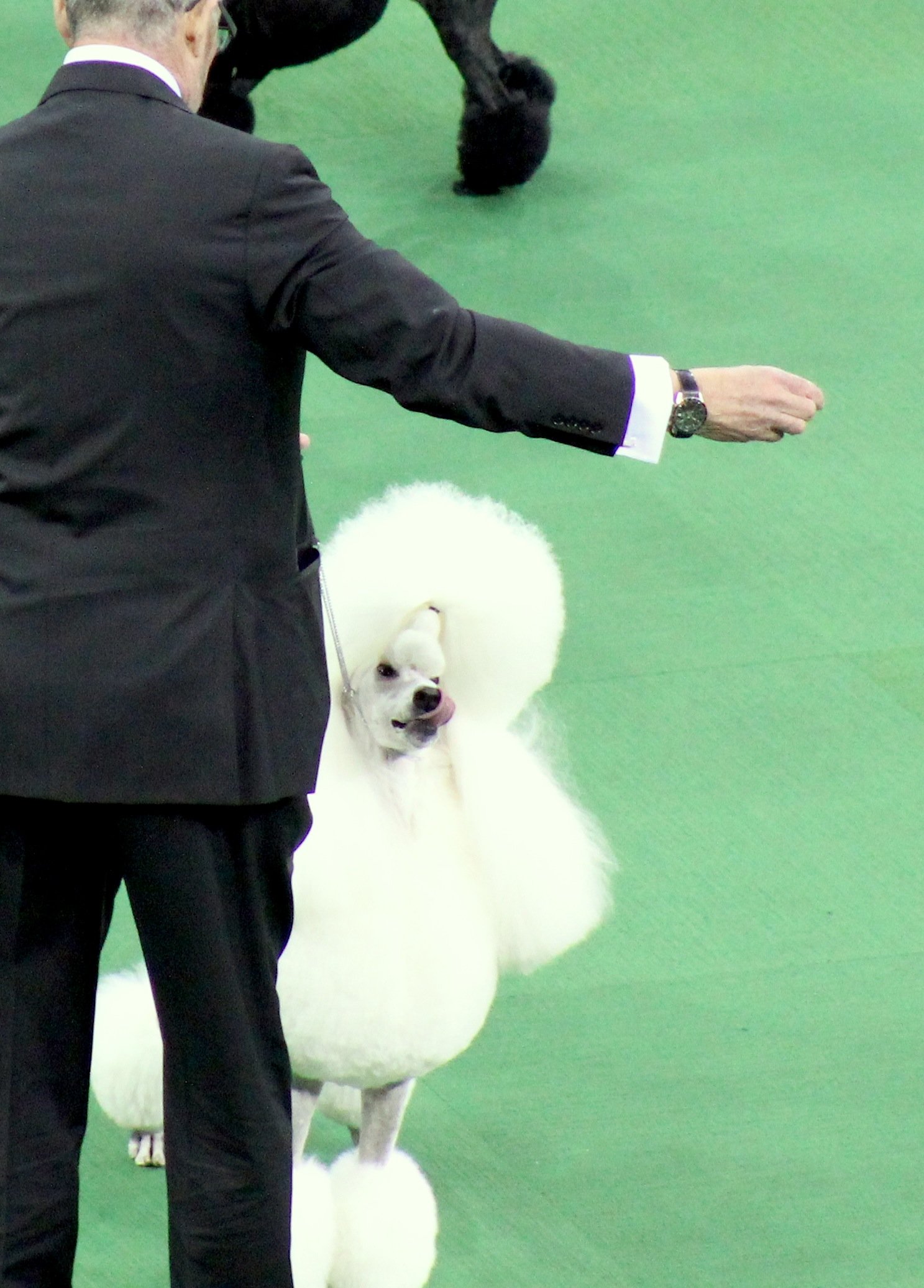
Do you have a better photo of a Standard Poodle in the American show ring? If you have a show photo you’d let us use, email it to [email protected] — tell us the dog’s name and the show, and it may be featured here.
1. Breed at a glance
Non-Sporting — recognized since 1887
Over 15″ at the shoulder. The AKC lists 40–70 lbs.
Curly (naturally harsh, dense) or corded (tight, even cords). Solid color at the skin; parti-colors are disqualified in conformation.
“Very active, intelligent” — carrying himself proudly, with “an air of distinction and dignity peculiar to himself.”
High, and brainy with it. A Standard needs work — training, sport, swimming, a job — not just a walk around the block.
Size, coat, and temperament facts are from the AKC standard (approved August 14, 1984; reformatted March 27, 1990). Weights are the AKC breed-profile figures. Popularity: the Poodle is No. 6 in the AKC’s 2025 registrations, down from No. 5 in 2024 (AKC most popular breeds 2025).
2. History
The Standard is the Poodle as it was first made, and the other two varieties are the Standard bred down. Most cynologists believe the breed originated in Germany in the Middle Ages, from a dog similar to today’s Standard Poodle — Germany’s water dog, as England had the English Water Spaniel and France the Barbet. The name gives it away: Poodle comes from the German Pudel, from pudeln, to splash in water. In France the breed is the Caniche, from chien canard, duck dog — and France adopted it so thoroughly that it became the national dog of France, even though the breed itself is German in origin. (Sources: AKC breed history; Poodle.)
The breed is old. Curly-coated dogs with clipped hindquarters appear in carvings on Roman tombs and on Greek and Roman coins as early as 30 A.D., and recognizable Poodles show up in the work of Dürer, in Goya’s paintings of 18th-century Spain, and at the French court — Henri III carried three favorite Poodle-type dogs in a basket around his neck, and Louis XVI favored Toy Poodles. The Standard is the oldest of the three varieties, and the one that did the original work. (Source: AKC breed history.)
In America, the Poodle was slow to catch on. The Kennel Club of the United Kingdom recognized the breed in 1874 and the AKC in 1887 — the Standard and the Miniature as separate breeds, both in the Non-Sporting Group — but American Poodles were unpopular until 1935, when a white Standard, Ch. Nunsoe Duc de la Terrace of Blakeen — “Duc” — won Best in Show at Westminster. He was owner-handled by Mrs. Sherman Hoyt, the first woman to handle a dog of any breed to Best in Show at the Garden, and he had been bought from England the year before — an international champion, born in Switzerland in 1929. After Duc, the breed’s rise was unstoppable: Poodles were the AKC’s most-registered breed from 1960 to 1982, a 23-year run at the top. (Sources: AKC Westminster winners; AKC breed history; Poodle.)
Standards have won Best in Show at Westminster five times: Duc in 1935, Puttencove Promise in 1958, Acadia Command Performance in 1973, Whisperwind on a Carousel in 1991, and Siba — Stone Run Afternoon Tea, a black Standard — in 2020. The breed as a whole has won 11 times, more than every breed except the Wire Fox Terrier; the other six belong to the Miniature (four) and the Toy (two). (Sources: AKC Westminster winners; AKC breed history.)
The parent club came with the breed’s American rise. The Poodle Club of America was formed in 1931, when interest in the breed was climbing, and a new standard was approved by the AKC and published in 1932. The club held its first specialty in June 1932 at North Westchester, and its first independent specialty in 1938 at Far Hills, New Jersey, with an entry of 142 Poodles. It is the only national Poodle breed club recognized and sanctioned by the AKC. (Sources: PCA club history; AKC Library, Poodle Club of America collection.)
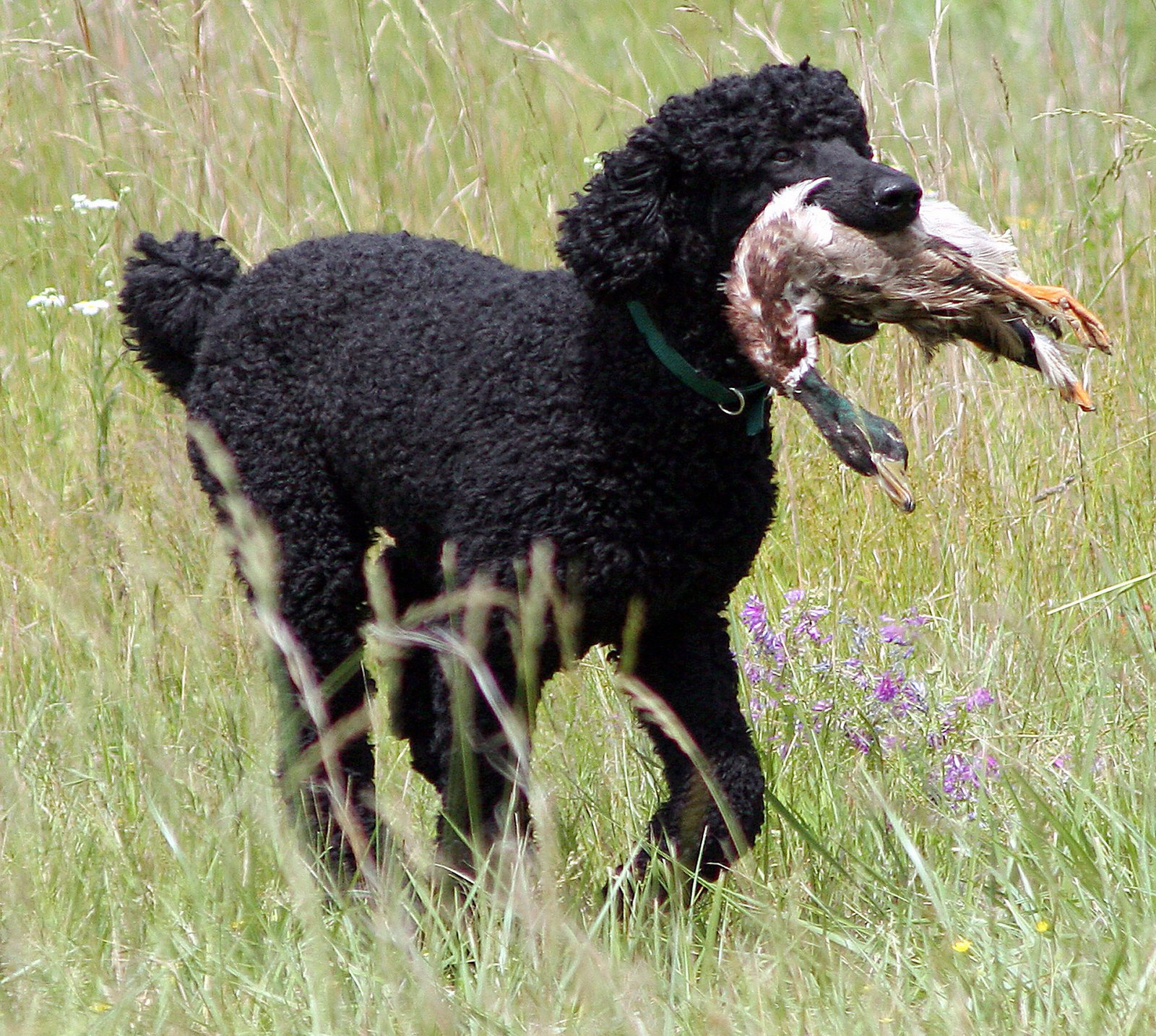
The working side never went away, either. Standards still run hunt tests — the PCA holds its own Working Certificate and Working Certificate Excellent tests — and a Standard named Duxbury My Ten Cents, “Dime,” was the first Poodle in history to earn a Master National Hunter title. (Sources: AKC breed history; 2026 PCA national specialty judging program.)
3. The standard and why it’s written that way
There is one Poodle standard, and it covers all three varieties. The standard says so itself: “The Standard for the Poodle (Toy variety) is the same as for the Standard and Miniature varieties except as regards heights.” The only thing that changes between varieties is size — and size is a disqualification if it is wrong for the variety entered. The Standard is over 15 inches at the highest point of the shoulders; a dog 15 inches or under is disqualified from competition as a Standard. A Standard is not a big Miniature; it is the variety the standard was written around, and the other two are measured against it. (Source: AKC standard, approved August 14, 1984; reformatted March 27, 1990.)
The standard describes a square dog: the length from breastbone to point of rump approximates the height at the withers. It wants “a very active, intelligent and elegant-appearing dog, squarely built, well proportioned, moving soundly and carrying himself proudly.” The head is moderately rounded with a long, straight, fine muzzle, dark oval eyes, and long, wide ears that hang close to the head and are heavily feathered. The feet are oval, rather small, the toes well arched and cushioned on thick firm pads. The gait is “a straightforward trot with light springy action and strong hindquarters drive. Head and tail carried up.” Temperament gets its own line: “Carrying himself proudly, very active, intelligent, the Poodle has about him an air of distinction and dignity peculiar to himself. Major fault: shyness or sharpness.” A shy Poodle or a snappy one is not a quirk — the standard names it a major fault. (Source: AKC standard.)
The clip question, honestly
The clip is the part everyone argues about, and the standard is the reason it is argued about at all. The standard allows exactly three clips for adult dogs in regular classes, and it means exactly three:
- Puppy clip — dogs under 12 months may be shown in the Puppy clip, with the coat long and the face, feet, and base of the tail shaved.
- English Saddle clip — the coat left longer over the body with a shaved face and feet and a pompon on the tail; the hindquarters are shaved and a blanket of coat remains over the back.
- Continental clip — the best-known show clip: shaved face, neck, and legs with bracelets; a shaved hindquarter with pompons (rosettes) over the hips; a pompon on the tail. Hip pompons are optional.
The Sporting clip is allowed only in Stud Dog, Brood Bitch, and Parade of Champions classes — not in regular competition. And the standard ends the discussion in one sentence: “A Poodle shown in any other type of clip shall be disqualified.” A pet Standard in a short clip is a perfectly fine dog; it is simply not a show dog in that clip, and no amount of charm changes that. (Source: AKC standard.)
Outside the AKC ring there is one more clip buyers will meet: the Scandinavian clip — also called the second puppy clip — invented by Swedish and Norwegian show groomers in the 1970s and now the most common adult show clip in FCI countries. The coat is left long and scissored to shape rather than shaved into the AKC patterns above. It is the European show clip, and it is not an AKC-accepted clip: a Poodle shown in it in an AKC regular class would be disqualified under the standard’s own rule.
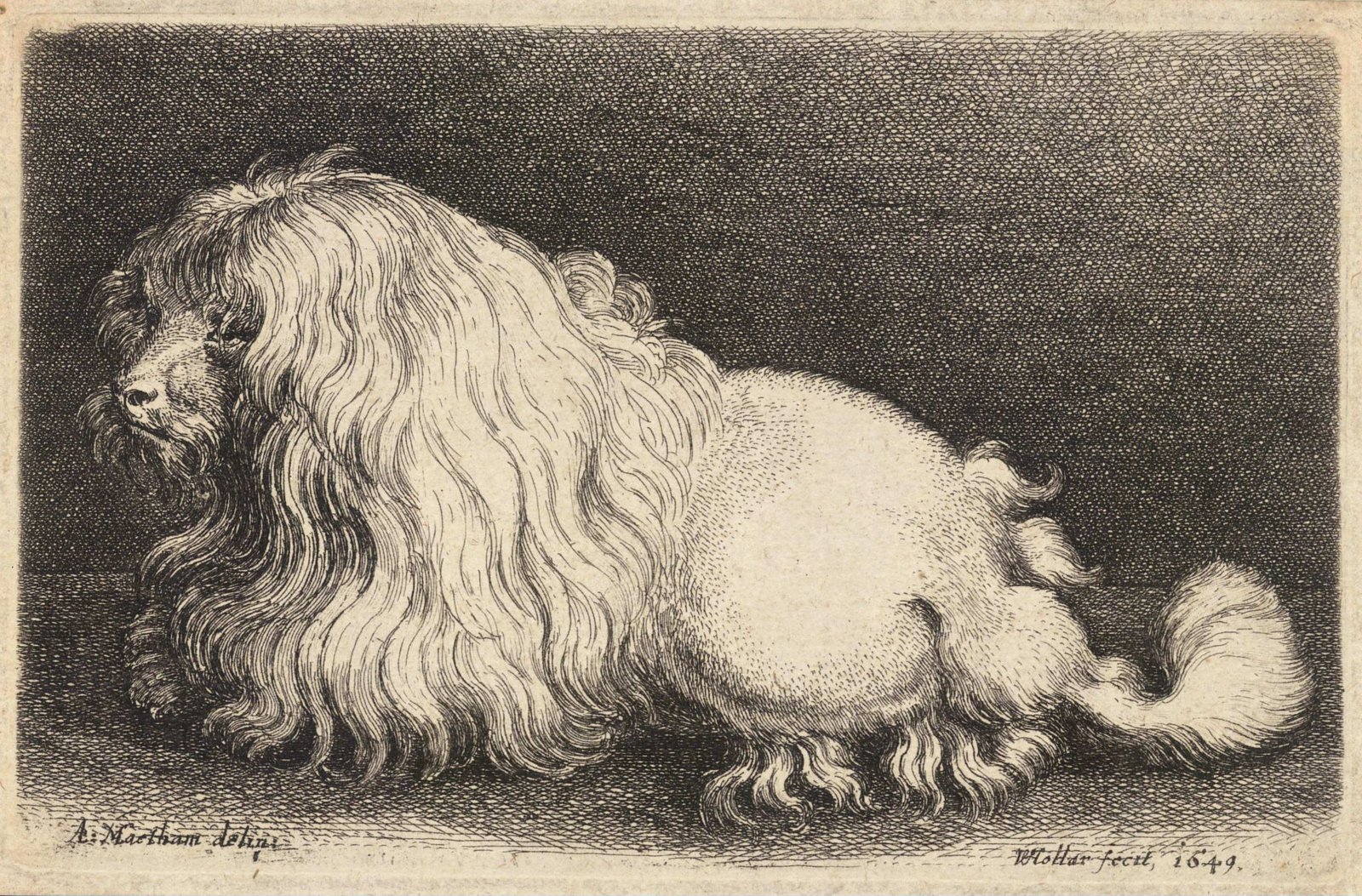
The clip began as engineering, not fashion. A water retriever working in cold water needed its chest and joints protected and its hindquarters free to swim, so the coat was left where it mattered and shaved where it did not — and the lion clip of the 17th-century engravings above is the same idea. The show clips are that working trim, refined over centuries until the rosettes and bracelets became art. The standard’s proportions are the proof it still means it: a square dog, a springy trot, a head and tail carried up — a dog built to move through water and cover ground.
One more thing the standard settles, and it settles it without fanfare. On the topknot, “the hair of the topknot may be left free or held in place by elastic bands. The hair is only of sufficient length to present a smooth outline. ‘Topknot’ refers only to hair on the skull, from stop to occiput. This is the only area where elastic bands may be used.” Elastic bands, and only on the topknot. That is the whole of what the standard permits as adornment — which is why show Poodles never wear bows. No ribbon, no bow, no decoration of any kind: a Poodle in the ring wears a clip and a collar, and that is all. (Source: AKC standard.)
Color
“The coat is an even and solid color at the skin.” Parti-colored dogs — white with patches of another color, or any combination of two or more colors — are disqualified in conformation. Brown and cafe-au-lait dogs have liver noses, eye-rims, and lips, with dark amber eyes; black, blue, gray, silver, cream, and white dogs have black noses, eye-rims, and lips, with very dark eyes. Blues, grays, silvers, browns, cafe-au-laits, apricots, and creams may show varying shades of the same color, and puppies may be born darker or lighter than the adult color — but the adult coat must be a single solid color at the skin. (Source: AKC standard.)
The points tell you what the breed values. General appearance, temperament, carriage, and condition are worth 30 of the 100 points — more than head, body, or gait, and three times the coat. The coat, for all the attention it gets, is worth 10. The breed is judged as a dog, not a haircut. (Source: AKC standard.)
One breed, three varieties — how they are judged
At an all-breed show, each variety is judged in its own ring, with its own judge, through Winners Dog, Winners Bitch, and Best of Variety — the Best of Variety award takes the place of Best of Breed for the nine AKC breeds divided into varieties, Poodles among them. Each variety’s Best of Variety winner then goes to its group: the Standard and the Miniature to the Non-Sporting Group, the Toy to the Toy Group. At the PCA national specialty, the three Best of Variety winners meet once more, in the Intervariety competition, to decide Best of Breed. (Sources: Westminster dog show guide, information provided by the AKC; 2026 PCA national specialty, AKC event results.)
4. Temperament & living with one
The standard’s temperament line is short and exact: “very active, intelligent” — and the rest of the standard is the proof. The Standard was bred to work in partnership with a person: to mark a fall, swim out, and bring the bird back. That is a job that rewards a dog who watches the handler, remembers the line, and thinks through the problem — and a Standard who does not get to do any of that will invent problems of its own. On the most-cited ranking of canine working and obedience intelligence, Stanley Coren’s 1994 survey of obedience judges, the Poodle placed second of 130 breeds — behind only the Border Collie. That ranking is a survey of trainers’ opinions, not a laboratory test, and it should be read as one; but anyone who has trained a Poodle will recognize the dog it describes. (Sources: AKC standard; Poodle.)
What that means at home is simple: a Standard is a real working dog — an athlete who will happily run, swim, retrieve, and learn a new sport on a weekend, and who will get bored and destructive if it does nothing. All three varieties are people dogs — they do not do well kenneled or ignored — and all three are famously good with children and other dogs when they are socialized, and famously watchful of strangers when they are not. The standard’s warning is worth repeating: shyness or sharpness is a major fault. A Poodle should be proud, not fearful, and not snappy.
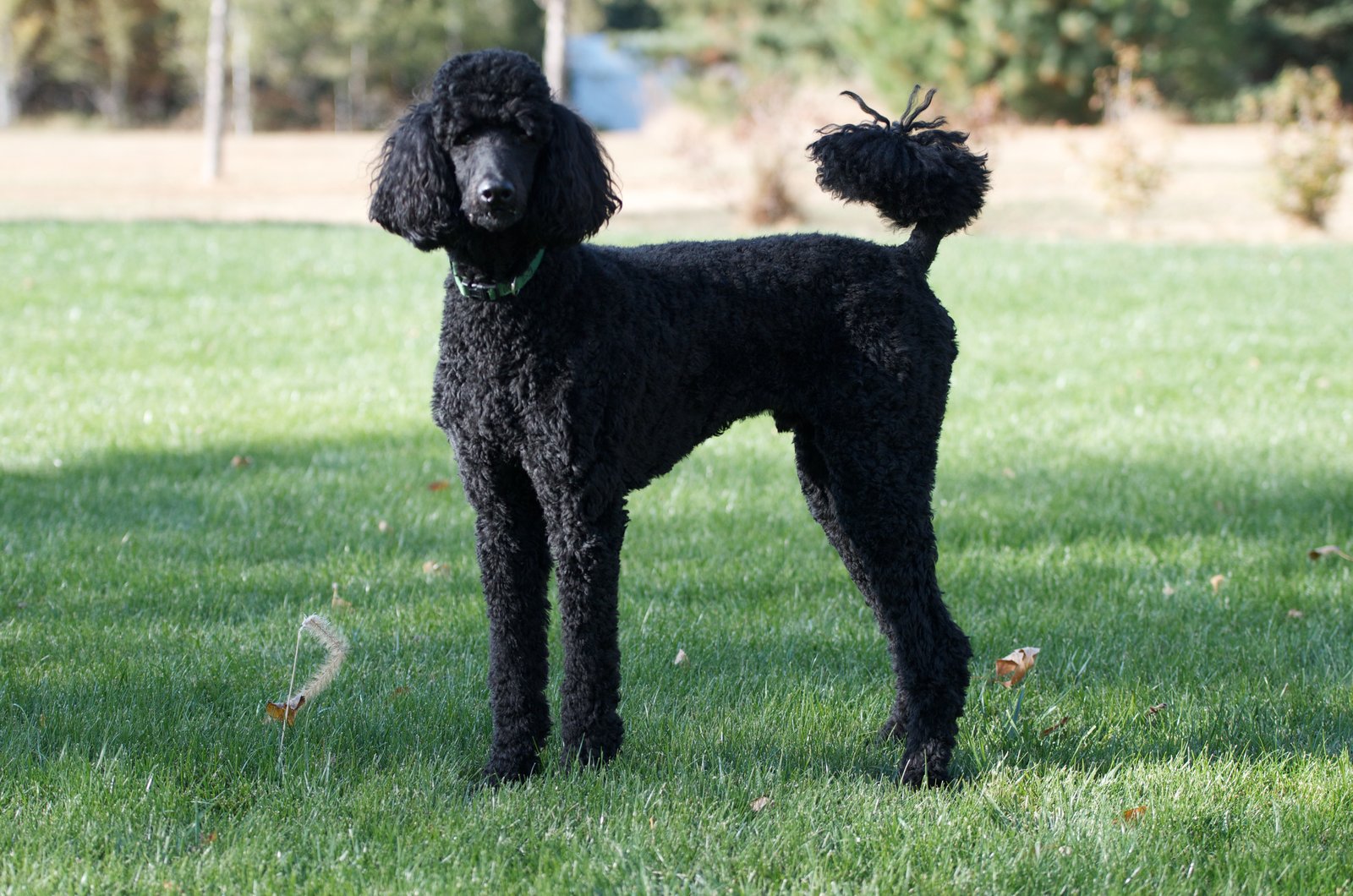
Poodles are also, by several measures, among the most popular breeds for service work, and the reason is the same combination: a dog that learns fast, works in close partnership with a person, and sheds little enough to work in public places. If you want a Standard to be calm in the house, the recipe is boring and it works: exercise the body, work the brain, and give the dog a job — even if the job is only retrieving the ball, correctly, every time. (Source: Poodle.)
One practical note before you fall for a puppy photo: a Poodle’s coat does not shed the way most coats do. The tight curls trap loose hair and dander in the coat instead of dropping it on the floor, which is why Poodles are often called hypoallergenic. That label is overstated. Researchers have generally found no difference in the amount of allergens different breeds shed or carry, and a Poodle can still trigger allergies — what the coat does is shed less visibly, and demand clipping instead. If allergies are the reason you want a Poodle, spend time with the breed first. (Source: Poodle.)
5. Grooming
Grooming is not an accessory for this breed; it is a standing appointment. A pet owner can expect to have a Standard groomed every four to eight weeks, with regular brushing in between to keep the coat from matting — the same curls that trap shed hair also trap tangles, and a matted Poodle is a miserable one. The ears need attention too: long, heavily feathered ears with a hairy canal are prone to infection if they are not kept clean and dry, and they should be checked whenever the dog is groomed. (Source: Poodle.)
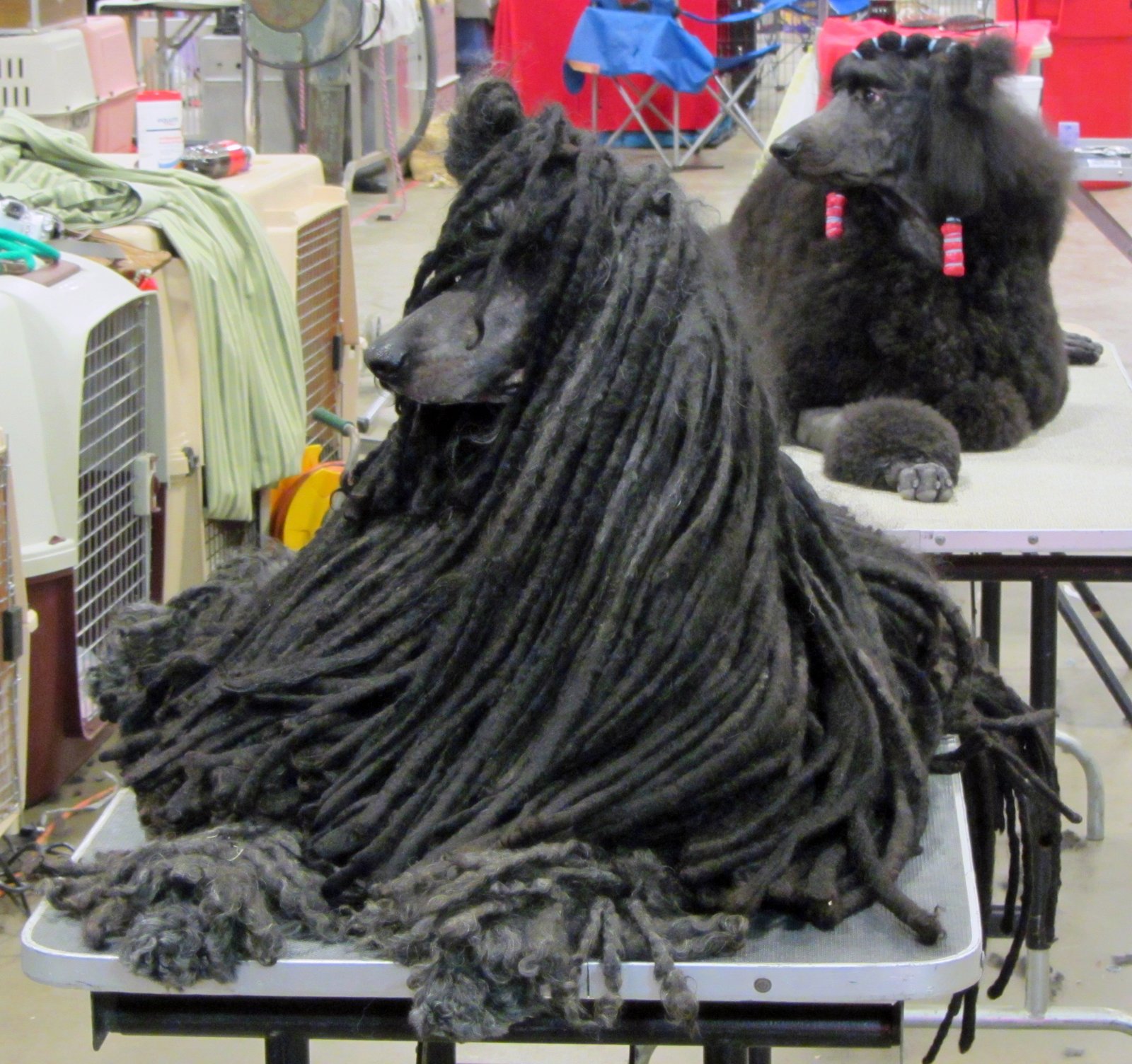
What the groomer does depends on whether the dog is shown. A show Standard is kept in one of the three standard clips, and the work behind it is constant — bathing, drying, scissoring, banding the topknot, and keeping the coat growing to the right length. A pet Standard wears whatever short clip the owner likes: a puppy cut, a lamb clip, a sporting clip, a teddy-bear trim. None of those is a show clip, and none of them needs to be. The honest rule is the one the standard gives: the show clips are for the show ring, and the pet clips are for the dog’s comfort and the owner’s budget. The corded coat is a third option the standard allows and almost no one chooses: it demands the cords be kept clean and separated, and most owners who try it go back to a clip.
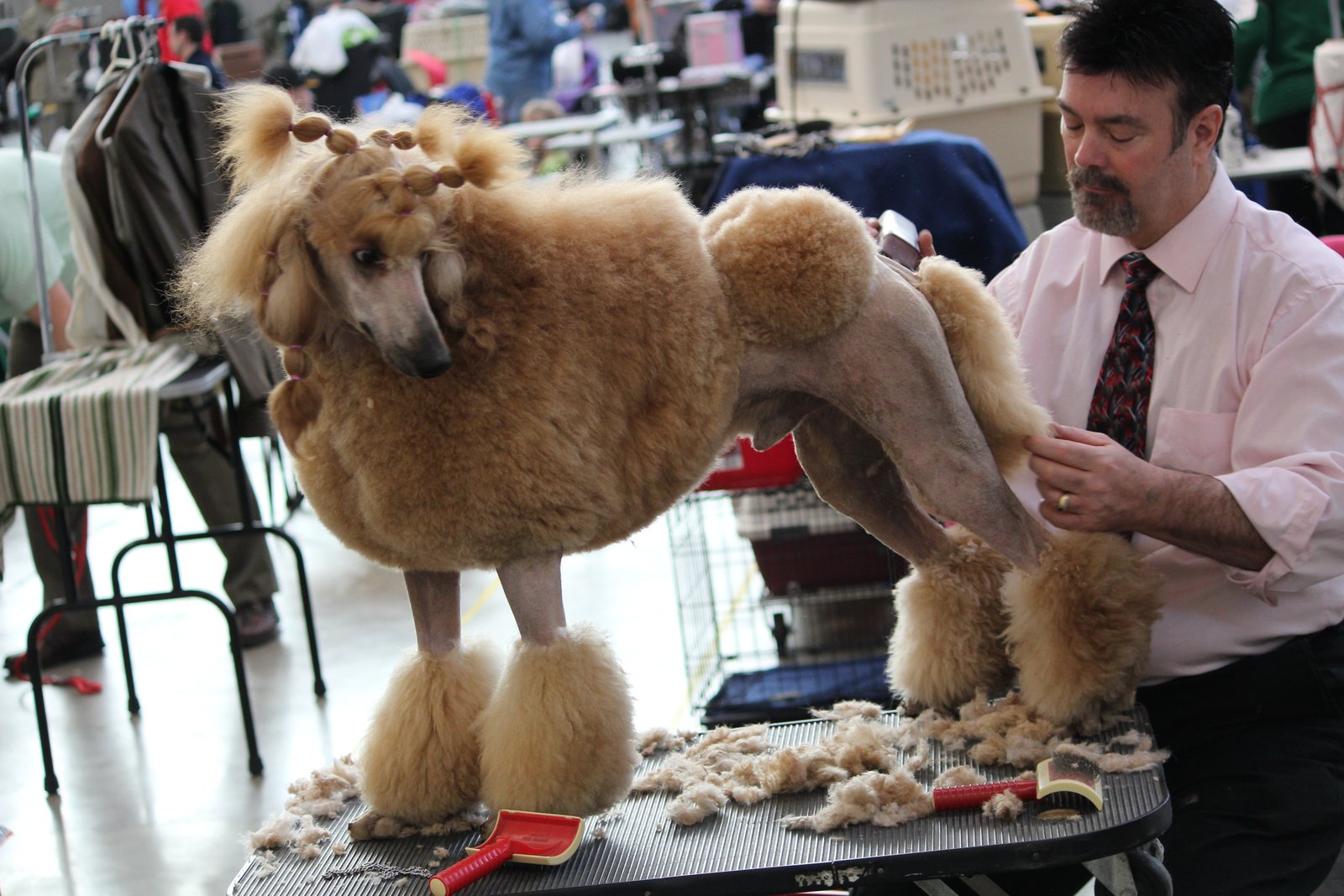
Budget for it before you buy. A Standard costs more to groom than most breeds, every month, for its whole life — and a neglected coat is not a cosmetic problem, it is a welfare problem. If you cannot commit to the grooming, a short-coated breed will make you both happier.
6. Health testing
The Poodle is a long-lived breed — 10 to 18 years, with the smaller varieties tending to live longer — and it is also a breed with a real, documented health burden, especially in the Standard. The honest version of the story is the one the parent club tells, and it is not softened: the Poodle Club of America’s health-testing sheet sets out a different list for each variety, and the OFA’s Canine Health Information Center (CHIC) program records the results. A CHIC number means the listed tests were done and made public — not that the results were normal, and not that the dog is healthy. Ask for the number, and then ask what the results were.
- Standard: hip-dysplasia evaluation by OFA or PennHIP; yearly eye examination by a board-certified ophthalmologist; and at least one elective — an OFA thyroid evaluation, an OFA sebaceous adenitis evaluation by an OFA-approved dermatopathologist, or a heart evaluation by a board-certified cardiologist. The PCA Foundation recommends doing all three electives, and also recommends DNA tests for neonatal encephalopathy with seizures (NEwS) and von Willebrand’s disease (vWD).
CHIC also requires permanent identification — a microchip or a tattoo — so the results stay attached to the dog. (Source: PCA health-testing sheet.)
The two diseases that define the Standard Poodle’s health story are sebaceous adenitis (SA) and Addison’s disease, and they rose together. A 2015 study of 761 Standard and Miniature Poodles (Pedersen et al., Canine Genetics and Epidemiology) found that SA and Addison’s rose rapidly in Standard Poodles after a mid-20th-century genetic bottleneck, when intense linebreeding around a few popular sires narrowed the gene pool — 30 percent of the genetic diversity was found in 70 percent of the dogs, and the most inbred dogs carried the highest risk. Dogs with minor DLA class I haplotypes were about half as likely to develop either disease. The study found no single strong genetic marker that breeders could test for — which is why the PCA’s answer is testing, transparency, and not breeding affected dogs, rather than a single DNA test.
The other conditions a buyer should hear about before they sign anything: bloat (gastric dilatation-volvulus) in deep-chested Standards; hypothyroidism; and the two fatal recessive conditions the PCA Foundation urges DNA testing for in Standards, NEwS (puppies seize and die in the first weeks of life) and von Willebrand’s disease (a bleeding disorder). None of these is a reason not to own a Standard. All of them are reasons to buy from a breeder who tests, and to walk away from one who does not. If a breeder cannot show you the CHIC results for both parents, that is your answer. (Sources: PCA health-testing sheet; Pedersen et al. 2015.)
7. The specialty year: the national specialty is the anchor
The Poodle Club of America’s national specialty is the anchor of the Standard Poodle’s year — the one show where all three varieties meet, each judged in its own ring.
93rd National Specialty ran Tuesday to Friday, April 21–24, 2026, at Purina Farms’ Purina Event Center, 300 Checkerboard Loop, Gray Summit, Missouri. The show was dedicated to “our 94 year-old Poodle Club of America.” The specialty show and trials drew 577 dogs and 605 entries across the three varieties, with a further 95 dogs and 112 entries in the concurrent obedience, rally, and 4–6-month puppy events. The Standard drew 202 entries (89 dogs, 113 bitches) — the largest of the three varieties. (Sources: official judging program; premium list; AKC event results.)
The week ran on the usual pattern. Tuesday was obedience and rally, a Parade of Rescue Dogs, and a Parade of Companion and Performance Titleholders. Wednesday was the regular dog classes — Standard 69 dogs — plus the 4–6-month puppy competition (26 puppies) and juniors, and the Parade of Champions. Thursday was the regular bitch classes — Standard 93 bitches — plus Veteran Sweepstakes and the annual dinner. Friday closed with veterans and the hunt class, then Best of Variety for each variety and Intervariety, with 42 dogs in the Intervariety competition. FastCAT ran Monday to Wednesday alongside the show, and the national hunt tests were a separate event in the autumn, October 30 to November 2, 2026, at Guns Up in Advance, North Carolina. (Source: official judging program.)
The Standard judges were Dr. Donald Sturz, Jr. for the dog classes and Standard Best of Variety, and Mr. Daniel Augustus for the bitch classes. The Intervariety competition — the Best of Breed competition — was judged by Mr. Scott B. Wolfe.
Results: Best of Breed (Intervariety) went to the Miniature, GCH CH Karadale The Last Dance, and Best of Opposite Sex to the Standard, CH Aviator’s Mind The Gap, owned by Diane & David Kingston. The Standard Best of Variety winner had not been published by the Poodle Club of America or the AKC as of November 2026, and this page will not name a winner from social-media posts. The winner will be added here as soon as the PCA or the AKC publishes it. (Sources: PCA homepage; AKC event results.)
Next year: the 2027 national specialty is announced for April 19–23, 2027. The judging panel is pending AKC approval: Standards, Mrs. Edwina Thomas; Inter-Variety, Mrs. Gina Wieser. The venue had not been confirmed in the sources consulted as of November 2026. (Source: PCA judges education.)
8. Regional specialties through the year
The national is the anchor, but the breed’s year runs through its regional specialties, held by the PCA’s affiliate clubs. Every regional below is a three-variety specialty — the Standard, Miniature, and Toy are each judged in their own ring. These are the 2026 regionals verified from club and AKC event sources:
- Greenspring Poodle Club, Saturday, January 24, 2026, Howard County Fairgrounds, West Friendship, Maryland — 50 entries. (Source: AKC event listing.)
- William Penn Poodle Club, Saturday, May 2, 2026, Mercer County Park, W Windsor Township, New Jersey — judge Mrs. D. K. Ondo; 23 dogs and 30 entries (Toy 7, Miniature 4, Standard 12 entries); Best of Breed went to the Standard, “Unique Up In The Stars.” (Source: AKC event listing.)
- Washington Poodle Club, Friday to Sunday, October 9–11, 2026, West Friendship, Maryland — three shows, judged by Mr. Daniel Augustus, Dr. Valeria Rickard, and Mr. Gregg Kantak. (Source: Canine Chronicle specialty results.)
- Great Lakes Poodle Club of Chicago, Saturday, October 24, 2026, Lennox, Illinois — two specialties, judged by Mrs. Sandy Bingham-Porter and Mr. Tim Catterson. (Source: Canine Chronicle specialty results.)
The PCA’s affiliate-club roster — updated September 14, 2026 — lists the clubs that hold specialties and the contact for each; more regionals will be added here as their programs are verified. (Source: PCA affiliate-club roster.)
9. Clubs
- Poodle Club of America (parent club, formed 1931) — the only national Poodle breed club recognized and sanctioned by the AKC. It runs the national specialty, the judges’ education program, and the breeder referral, and it publishes the health-testing requirements in section 6.
- Poodle Club of America Foundation — the club’s health-research arm, funding the studies behind the testing recommendations (including the work on sebaceous adenitis and Addison’s disease) and administering the health-testing program.
- Affiliate clubs — the PCA’s regional clubs, from William Penn to Great Lakes to Washington, hold the regional specialties in section 8 and run the rescue network in section 10. The current roster is at poodleclubofamerica.org.
If you are new to the breed, a regional club is the better first stop than a breeder’s website: the people there have owned, shown, groomed, and lost Poodles, and they will tell you the truth about the grooming bill and the health list before you fall for a puppy.
10. Rescue
Start with the parent club. The Poodle Club of America Rescue Foundation, Inc. is a 501(c)(3) charity established in 2006, and the PCA requires every affiliate club to have a Rescue Chairman — so the rescue network runs through the same clubs that hold the specialties. The national specialty itself holds a Parade of Rescue Dogs, which is exactly what it sounds like: rescued Poodles, in the ring, in front of the breed. (Sources: Poodle Club of America; 2026 national specialty judging program.)
Contact the rescue chair of the PCA affiliate club nearest you, or the Rescue Foundation directly, and tell them honestly what you can offer — which variety, what age, what grooming you are prepared to do. A rescued Standard is usually an adult whose owner underestimated the grooming, and it will arrive with a coat that needs work and a history you may never fully know. A rescued Standard in a neglected coat needs a groomer before it needs a home, and a rescue that tells you that is a rescue worth trusting. Independent regional Poodle rescues also operate across the country; the parent club’s rescue chairs can point you to the ones they work with, and this page will list them by name once their current details are verified.
11. Breeder vs. rescue: honest guidance
If you buy: start with the PCA’s breeder referral. The breeders listed there do the minimum health clearances for a CHIC number on their breeding dogs — the tests in section 6. Ask to see the CHIC results for both parents, and the actual results, not just the number. A good breeder will have tested the parents, will ask you as many questions as you ask them, will take the puppy back for its whole life if you cannot keep it, and will never sell you a puppy sight-unseen out of a parking lot.
Two things that are not what a seller tells you. There is no parti-colored show Standard — parti-colors are disqualified in conformation, so a breeder charging a premium for a “rare parti” is charging you for the thing the standard excludes. And a Labradoodle or Goldendoodle is not a Poodle at all: it is a cross, it cannot be shown as a Poodle, and it does not inherit the Poodle’s coat or temperament on a schedule. If you want a Standard Poodle, buy a Standard Poodle.
If you rescue: a rescued Standard is usually an adult, often one whose owner underestimated the grooming, and it will arrive with a coat that needs work and a history you may never fully know. What you get in return is a dog whose temperament you can see before you commit, a lower price, and a breed community that will help you — the rescue chairs and the regional clubs are the same people. Either way, budget the grooming first: a Standard you cannot afford to groom is a Standard you cannot afford.
12. Claim this page
This page belongs to the breed, and the people who know the breed best are the Poodle Club of America and its members. If you are with the parent club — or you are a breeder, a judge, a handler, or a rescue volunteer who spotted something wrong, missing, or out of date — this page is yours to set straight. Tell us what needs fixing and where the correction is documented, and we will fix it and credit the source. Contact the site through the About page, and mention “Standard Poodle breed profile.”
Sources
- AKC Poodle breed standard (approved August 14, 1984; reformatted March 27, 1990) — cdn.akc.org/Poodle.pdf
- Poodle Club of America, club history — poodleclubofamerica.org/about-the-pca
- Poodle Club of America, health testing in Poodles — poodle_health_screening_2020.pdf
- Poodle Club of America, breeder referral — poodleclubofamerica.org/breeder-referral
- Poodle Club of America, affiliate-club roster (updated September 14, 2026) — 2026-Affiliate-Clubs-Roster-September-14-2026.pdf
- Poodle Club of America, 2027 national specialty judges — poodleclubofamerica.org/judges-education
- Poodle Club of America, homepage (2026 national Best of Breed and Best of Opposite) — poodleclubofamerica.org
- 2026 PCA National Specialty, official judging program (93rd National Specialty, April 21–24, 2026, Purina Farms) — showdogvideopros.com/Poodle/PCA2026/PCA2026JP.pdf
- 2026 PCA National Specialty, premium list — poodleclubofamerica.org/wp-content/uploads/prm139-4.pdf
- 2026 PCA National Specialty, AKC event results (event 2026070212) — apps.akc.org, event 2026070212
- AKC, Poodle breed history — akc.org/expert-advice/dog-breeds/poodle-history
- AKC, most popular dog breeds of 2025 — akc.org/expert-advice/dog-breeds/most-popular-dog-breeds-2025
- AKC, Westminster winners through the years — akc.org/expert-advice/news/westminster-winners-through-the-years
- Westminster dog show guide, information provided by the AKC (varieties judged separately; Best of Variety advances to the group) — nywaterway.com/DogShow2018.aspx
- AKC Library & Archives, Poodle Club of America collection — akc.libraryhost.com/repositories/2/resources/59
- OFA Canine Health Information Center (CHIC) — ofa.org/chic-programs
- Pedersen et al., 2015, “The effects of a mid-century bottleneck on the genetics and health of the Standard Poodle,” Canine Genetics and Epidemiology 2:14 — pubmed.ncbi.nlm.nih.gov/26401342
- AKC event listings: Greenspring Poodle Club (January 24, 2026) — apps.akc.org, event 2026034301; William Penn Poodle Club (May 2, 2026) — apps.akc.org, event 2026165601
- Canine Chronicle, specialty results (Washington Poodle Club; Great Lakes Poodle Club of Chicago) — caninechronicle.com/category/special_group_show
- Wikipedia, Poodle (history, intelligence ranking, grooming interval, hypoallergenic discussion, lifespan) — en.wikipedia.org/wiki/Poodle
- Images: Wikimedia Commons (licenses and authors listed in each caption; full shortlist with source URLs and benchmark verdicts in the page’s image shortlist).