
Breed profile · Hound Group · The solid-red American coonhound
Redbone Coonhound
The Redbone Coonhound is the only solid-colored coonhound in the AKC’s Hound Group: a lean, red American hound built to follow a cold trail for hours and tree a raccoon at the end of it, even-tempered and mellow at home and a tiger on the trail. It is also the breed of Old Dan and Little Ann — the dogs of Where the Red Fern Grows — which is how most people outside the hunting world first meet it.
Help us improve it. This is one of ThePetAdvisor’s breed profiles, built from public sources with generous links to the people who actually own this breed’s knowledge. If something’s off or missing, the parent club can claim the page and set it straight — see the bottom of the page.
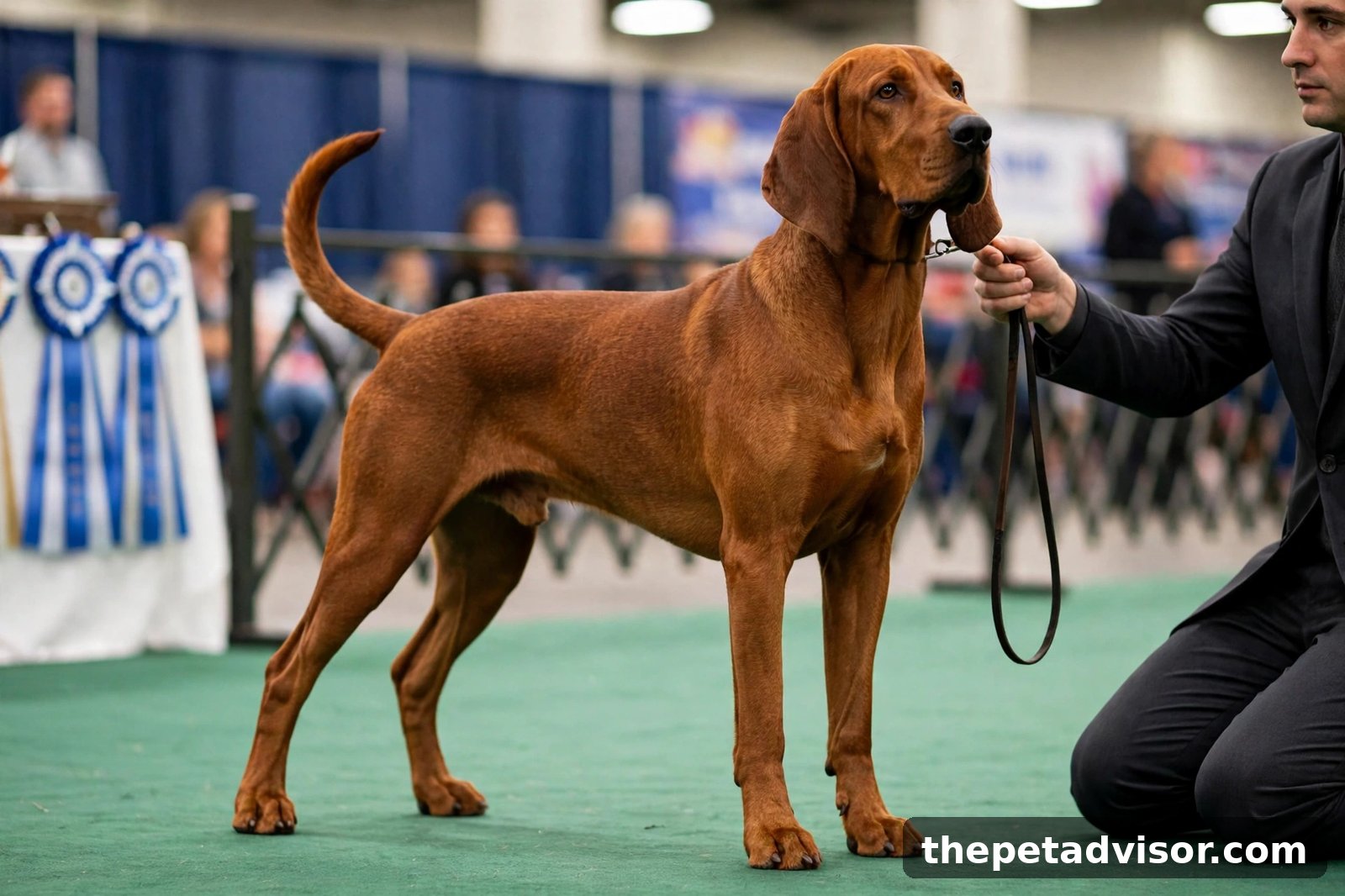
Do you have a photo of a Redbone Coonhound in the American show ring? We’d love this page to lead with one. If you have a show photo you’d let us use, email it to [email protected] — tell us the dog’s name and the show, and it may be featured here.
1. Breed at a glance
Hound — recognized by the AKC in 2010
Males 22–27 in, females 21–26 in at the shoulder. Weight 45–70 lb, in proportion to height and bone.
Short, smooth, coarse enough to provide protection. Solid red preferred, with a dark muzzle.
Even-tempered at home, an aggressive hunter; amenable to formal training, a good family dog that likes to please.
High and nose-driven. A Redbone needs a job for its nose every day, with long rests between outings.
Size and coat facts are from the AKC standard as reproduced by the parent club. Weight and lifespan are the AKC breed-profile figures. Popularity: the Redbone is No. 146 in the AKC’s 2025 registrations (AKC most popular breeds 2025).
2. History
The Redbone took shape in Georgia in the decades before the Civil War, when hunters found their foxhounds could not run down the quicker, wilier red fox. Plantation owner L. F. W. Birdsong resolved to breed a hound up to the job, building on the hunting pack of Dr. Thomas Henry, obtained in the 1840s. Foxhound blood, a Bloodhound cross, and Irish hound blood went into the mix; the name may have come from a later breeder named Peter Redbone. The first dogs were commonly called “saddlebacks” — red with a black saddle marking — and by selective breeding the black saddle was bred out, leaving the solid red dog. (Sources: National Redbone Coonhound Club, About the Breed; AKC, Redbone Coonhound history.)
The United Kennel Club registered the Redbone in 1902, the second coonhound breed to gain recognition, after the Black & Tan. At the dawn of organized coon hunting after World War II, the breed dominated the competition: a Redbone named Dan, owned by Leroy Campbell of Mississippi, won the first AKC/ACHA World Championship in 1948. The American Kennel Club granted full recognition in 2009, and the breed’s first year of competition eligibility was 2010. (Sources: AKC, Redbone Coonhound history; National Redbone Coonhound Club, About the Breed.)
Most people outside the hunting world meet the breed through a book: Wilson Rawls’s 1961 novel Where the Red Fern Grows, the story of a boy and his two Redbones, Old Dan and Little Ann. The book has drawn fanciers to the breed ever since — Christine Smith, president and founder of the Redbone Coonhound Association of America, picked the breed after reading it. The same nose that trees raccoons has also found modern work: coonhounds are now used in search and rescue, where a Redbone’s cold-nose tracking and refusal to quit have certified dogs in land cadaver, water cadaver, and trailing work. (Source: AKC, Redbone Coonhound history.)
3. The standard and why it’s written that way
The standard opens with the job: “Hunted from swamplands to mountains, the Redbone is surefooted and swift, even on the most difficult terrain. Well balanced, with a flashy red coat and excellent cold nose, the powerfully built Redbone mingles handsome looks with a confident air and fine hunting talents.” A cold nose is the point — the ability to pick up a trail days, even weeks, old — and the rest of the standard is built around a dog that can work that trail for hours. (Source: AKC standard, as reproduced by the parent club.)
The numbers are simple. Males stand 22 to 27 inches, females 21 to 26, with a mid-range dog preferred; length is well proportioned to height, and the dog is slightly taller at the shoulder than at the hips. The head carries a pleading expression, with dark brown to hazel eyes — dark preferred, yellow a fault — and ears set moderately low, fine in texture, reaching near the end of the nose when stretched out. The coat is short, smooth, and coarse enough to protect; the color is solid red preferred, with a dark muzzle and a small amount of white on the brisket and feet permissible. White on the feet beyond the toes, more white on the brisket than an open hand will cover, or white stockings on the legs are faults. The Redbone is the only one of the six AKC coonhound breeds that comes in a solid color. (Source: AKC standard.)
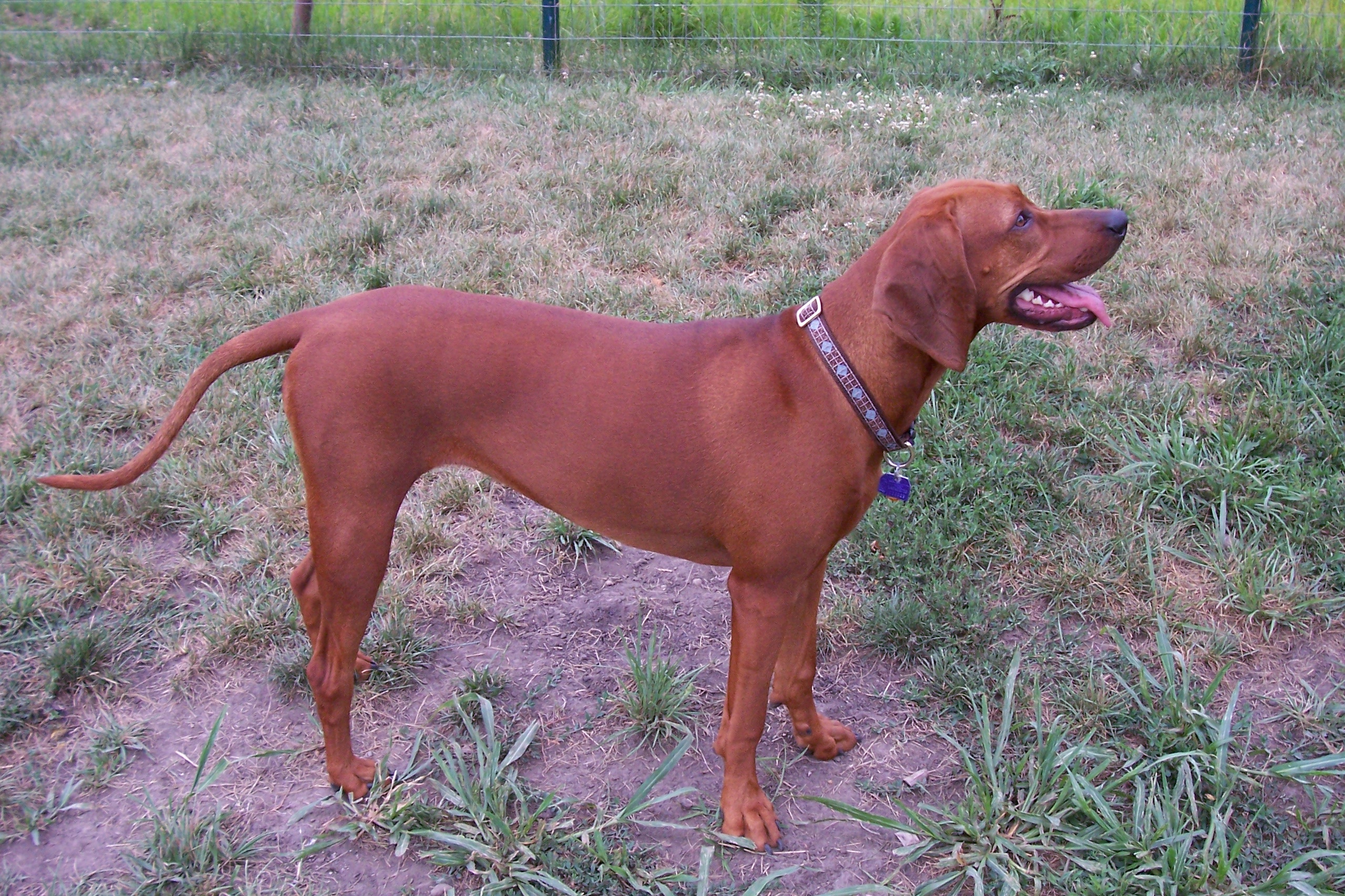
Read the standard as a working specification, not a beauty list. Cat feet, compact and well padded, are for rough ground; a deep, broad chest and well-sprung ribs are for lung capacity and stamina; a strong back and a slightly arched loin are for carrying the dog over mountains and marsh. The gait the standard asks for is “determined, steady, and proud, with good reach and drive.” Nothing in it is decorative. Even the color is functional in the breed’s telling: a solid red dog is easy to see in cover, and the white on the brisket and feet is kept small so the dog reads as one color at a distance.
4. Temperament & living with one
The standard’s temperament line is short and the AKC’s breed profile says the same thing in plainer words: the Redbone is “even-tempered, mellow, and kindly at home but a tiger on the trail.” At home the dog is even-tempered and amenable to formal training, a good family dog that likes to please. On a scent it is a different animal — determined, intense, and unwilling to quit, which is why the breed’s people say a Redbone does not potter: it means to get to the tree. (Sources: AKC Redbone Coonhound breed page; AKC standard.)
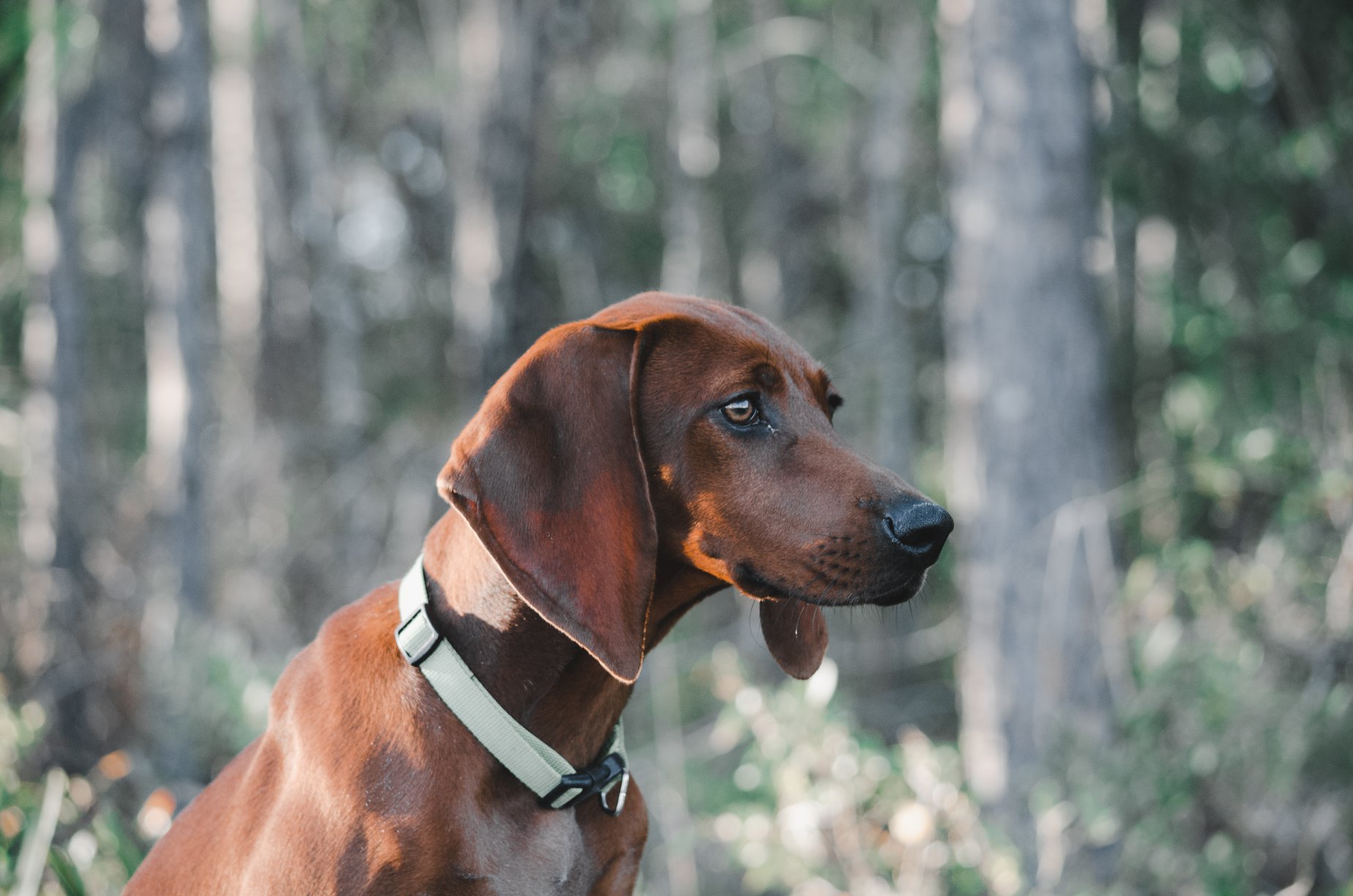
What that means at home is a dog that is easy to live with and hard to bore. A Redbone is good with children and other dogs, food-motivated enough to train well, and independent enough to test every rule once it knows where the food is. The voice is part of the bargain: the breed’s people call it a “sweet” voice, but it is loud and it carries, and a buyer who cannot live with baying should buy a quieter breed. The same independence that makes a Redbone a great trailing dog makes it a project in training — handlers who have taken the breed into search and rescue say the tenacity has to be channeled with patience, and that once it is, the dog does not disappoint. (Sources: AKC, Redbone Coonhound history; National Redbone Coonhound Club, About the Breed.)
5. Grooming
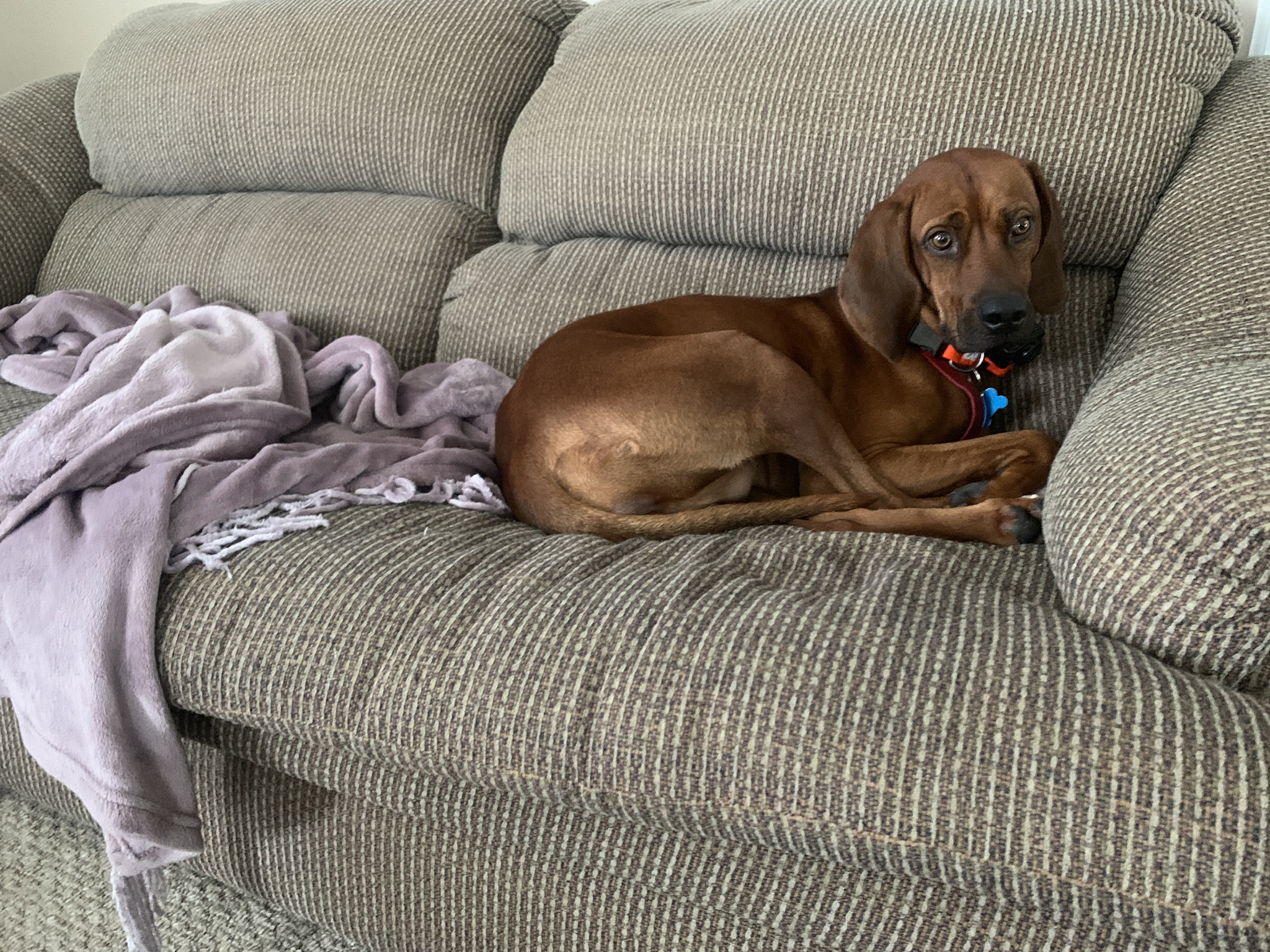
Grooming is the easy part of owning a Redbone. The coat is short, smooth, and coarse enough to protect the dog in cover; a weekly brushing keeps it in shape, and a bath when the dog has rolled in something — which, given the nose, will be often. Redbones shed moderately year-round, and no amount of brushing stops it. (Source: AKC Redbone Coonhound breed page.)
The ears need the attention the coat does not. Long ears that hang close to the head trap moisture, and Redbone ears should be checked and cleaned regularly for infection. Keep the nails short — a Redbone that runs will wear them down, and a Redbone that does not run will need them trimmed. There is no clipping, stripping, or trimming to the coat: a Redbone in the ring is shown as it hunts, short-coated and clean.
6. Health testing
The Redbone is a long-lived breed — 12 to 15 years — and the parent club regards it as an extremely healthy one. The National Redbone Coonhound Club does not make testing for genetic health issues a requirement of breeders for membership with the organization; it encourages breeders to conduct health testing if they feel it necessary for the betterment of their breeding programs. That is the whole of the club’s policy, and it is worth stating plainly, because it is different from most breeds: there is no parent-club test list to demand, and no CHIC number to ask for. (Source: National Redbone Coonhound Club, Health Testing Policy.)
What a buyer can still do is ask the breeder what they test and why. The usual screens a buyer asks about in a medium-to-large hound are a hip evaluation, an eye examination by a board-certified ophthalmologist, and a cardiac evaluation — and a breeder who tests will show you the actual results, not just say the tests were done. The other things a buyer should hear about before they sign anything: ear infections, from the long pendulous ears, and weight, because a hound that does not work will put it on. None of these is a reason not to own a Redbone. All of them are reasons to buy from a breeder who will answer questions.
7. The specialty year: the national specialty is the anchor
The National Redbone Coonhound Club’s national specialty is the anchor of the Redbone’s year — a one-day show held inside the Cotton Cluster in Rainsville, Alabama, with the breed’s people gathered around it. The club is small and the entry is small; the specialty is where the breed’s serious breeders, handlers, and judges meet.
The National Specialty: a one-day show, Saturday, November 7, 2026, at the Northeast Alabama Agri-Business Center, 1571 McCurdy Avenue North, Rainsville, Alabama — held inside the Cotton Cluster (November 5–8), with the Decatur Alabama and Huntsville all-breed shows around it. Entry: 14 dogs and 17 entries. (Sources: official judging program; AKC Upcoming National Specialties.)
Specialty judge: Mr. Richard D Albee of Auburn, Alabama — all regular and non-regular classes, Ring 5 at 10:45 am. Puppy and Veteran Sweepstakes: Mrs. Kathy Lorentzen, 10:30 am. On the schedule as well: Junior Showmanship and the AKC National Owner-Handled Series, with points for reserve available. (Source: official judging program.)
Winners from the 2026 specialty had not been published in an official source as of November 2026 and will be added here when they are.
The 2027 national specialty dates had not been announced as of November 2026.
8. Regional specialties through the year
The National Redbone Coonhound Club is the breed’s only specialty club, so the Redbone’s year runs through the national specialty and the club’s supported entries at the Cotton Cluster, rather than a circuit of regional specialties. These are the 2027 regionals verified from club sources so far:
No regional specialties announced yet for 2027.
The club supports Redbone entries at the Cotton Cluster all four days, November 5–8, 2026, and the national specialty itself is held inside that cluster. Browse upcoming show weekends →
9. Clubs
- National Redbone Coonhound Club (parent club) — the AKC parent club for the breed in the United States. It runs the national specialty, which is held inside the Cotton Cluster in Rainsville, Alabama. President Lori Mills, Vice-President Ginger Smith, Secretary/Treasurer Jean M. Hairston (2026).
- National Redbone Coonhound Association — the UKC-side body for the breed, which runs the UKC National Redbone Days, a bench show, hunt, and field trial gathering held in Indiana. (Source: UKC, 2026 National Redbone Days schedule.)
No separate regional Redbone specialty clubs could be verified — the National Redbone Coonhound Club is the breed’s only specialty club. If you are new to the breed, the national specialty itself is the better first stop than a breeder’s website: the people there have owned, shown, and hunted Redbones, and they will tell you the truth about the baying before you fall for a puppy.
10. Rescue
There is no Redbone-only national rescue that could be verified, so start with the coonhound rescues — they take Redbones, and they know the breed. Northeast Coonhound Rescue is an all-volunteer 501(c)(3) that has rescued almost 1,800 coonhounds and beagles since 2009, transporting dogs from southern shelters to foster homes in New England, New York, and New Jersey. HoundSong Rescue, based in northwest Indiana, has placed Beagles and coonhounds since 1995 and serves Indiana, Illinois, and Kentucky. American Black & Tan Coonhound Rescue is a national foster-based rescue that takes all six coonhound breeds, Redbones included. (Sources: necoonhoundrescue.org; houndsong.com; coonhoundrescue.com.)
A rescued Redbone is usually an adult whose owner underestimated the baying, the exercise, or the nose — and it will arrive with a history you may never fully know. What you get in return is a dog whose temperament you can see before you commit, and a rescue that will take the dog back for life if it does not work out. Ask the parent club for the rescue nearest you; this page will list more by name once their current details are verified.
11. Breeder vs. rescue: honest guidance
If you buy: start with the parent club, the National Redbone Coonhound Club. Because the club requires no health testing of its breeders, the breeder’s own answer matters more here than in most breeds: ask what they test, ask to see the results, and ask what they will take back. A good breeder will have an answer for all three, will ask you as many questions as you ask them, and will take the puppy back for its whole life if you cannot keep it.
If you rescue: a rescued Redbone is usually an adult, often one whose owner underestimated the baying, and it will arrive with a coat that needs little work and a nose that needs a lot. What you get in return is a dog whose temperament you can see before you commit and a lower price. Either way, budget the exercise first: a Redbone you cannot tire out is a Redbone that will bay at your neighbors, and a Redbone off leash in unfenced ground is a dog following a scent somewhere else.
One thing that is not what a seller tells you: there is no such thing as a rare color or a miniature Redbone. The standard wants one color — solid red — and one size, 21 to 27 inches. A breeder selling a “rare” color or a smaller Redbone is selling you a label, usually at a premium.
12. Claim this page
This page belongs to the breed, and the people who know the breed best are the National Redbone Coonhound Club and its members. If you are with the parent club — or you are a breeder, a judge, a handler, or a rescue volunteer who spotted something wrong, missing, or out of date — this page is yours to set straight. Tell us what needs fixing and where the correction is documented, and we will fix it and credit the source. Contact the site through the About page, and mention “Redbone Coonhound breed profile.”
Sources
- AKC Redbone Coonhound breed standard, as reproduced by the parent club — nationalredboneclu.wixsite.com/nrcc/about-the-breed
- AKC, Redbone Coonhound breed page — akc.org/dog-breeds/redbone-coonhound
- AKC, Redbone Coonhound history: Beyond “Where the Red Fern Grows” — akc.org/expert-advice/dog-breeds/redbone-coonhound-history
- AKC, most popular dog breeds of 2025 — akc.org/expert-advice/dog-breeds/most-popular-dog-breeds-2025
- AKC Upcoming National Specialties — apps.akc.org/apps/events/conformation/national_specialties.cfm
- 2026 National Specialty judging program (Foy Trent) — foytrentdogshows.com/forms/JPs/JP2026/JP_2026_Cotton_Cluster_Redbone.pdf
- National Redbone Coonhound Club — nationalredboneclu.wixsite.com/nrcc
- UKC, 2026 National Redbone Days schedule — ukcdogs.com/docs/huntingevents/2026_national_redbone_days_schedule.pdf
- Northeast Coonhound Rescue — necoonhoundrescue.org
- HoundSong Rescue — houndsong.com/about.html
- American Black & Tan Coonhound Rescue — coonhoundrescue.com
- Wikipedia, Redbone Coonhound (history, name origin, measurements) — en.wikipedia.org/wiki/Redbone_Coonhound