
Breed profile · Hound Group · America’s No. 5 breed
Dachshund
The long, low silhouette is unmistakable, but the Dachshund is not a novelty shape — it is a hunting dog built to go to ground after badgers, and it still thinks like one. The standard says it plainly: the Dachshund is “clever, lively and courageous to the point of rashness.”
Help us improve it. This is one of ThePetAdvisor’s breed profiles, built from public sources with generous links to the people who actually own this breed’s knowledge. If something’s off or missing, the parent club can claim the page and set it straight — see the bottom of the page.

1. Breed at a glance
Hound — recognized since 1885
Standard: usually 16–32 lbs, 8–9 inches at the shoulder. Miniature: 11 lbs and under, 5–6 inches.
Three varieties: smooth, wirehaired, longhaired — each in standard and miniature, six combinations under one standard.
“Clever, lively and courageous to the point of rashness.”
Moderate to high. A hunting dog in a small package: it needs work, walks, and something to investigate — and it will find its own work if you don’t provide one.
Size and coat facts are from the AKC standard (approved November 14, 2017; effective January 1, 2018). Height and life expectancy (12–16 years) are the AKC breed-profile figures, as reproduced in the AKC’s own breed snapshot.
2. History
The name is the job description: Dachs is German for badger, Hund for dog. The Dachshund was developed in Germany to go to ground after badgers — and, in its smaller form, after rabbits and other small game underground. The parent club’s own history traces the first description of a dog resembling a Dachshund to 1700, and the first list of desirable characteristics to 1879; those characteristics, the club says, “form the foundation of the breed standard used by the Dachshund Club of America today.” (Source: Dachshund Club of America history.)
The breed organized early. The first Dachshund appeared at a British dog show in 1870, the British Dachshund Club was formed in 1881, and German breeders formed the Tekel Club in 1888 with its own stud book. In America, German and British Dachshunds were imported from the 1880s, and the Dachshund Club of America was founded in 1895, with Harry Peters Sr. as its first president — the eighth-oldest member club of the American Kennel Club. The AKC had recognized the breed ten years earlier, in 1885. (Sources: DCA history; AKC breeds by year recognized.)
The breed’s American story nearly ended in the First World War. Anti-German feeling hit the Dachshund hard: kennels stopped breeding, owners who dared appear in public with their dogs called them “Badger Dogs” to escape persecution, and the name stuck until it was officially restored to Dachshund in 1923 — a year in which only 23 Dachshunds were registered with the AKC. By the end of the 1930s, registrations had climbed past 3,000 a year, and returning soldiers brought more dogs home from Germany. (Source: DCA history.)
Miniatures have their own thread in that history: small Dachshunds were in demand by hunters and city dwellers long before the first few were registered in Germany in 1902, bred down from standards for work in tighter burrows and for apartment life. The club’s history is candid about the false starts — crosses to toy breeds that produced bat ears, light bone, and lap-sitting temperaments — and about the true miniatures that survived them to become the foundation of today’s dogs. (Source: DCA history.)
Then came the long climb back to the top of the registrations. The Dachshund moved from No. 6 to No. 5 in the AKC’s 2025 rankings, announced in March 2026 — its first top-five finish since 2003, passing the Poodle. It now sits behind only the French Bulldog, Labrador Retriever, Golden Retriever, and German Shepherd Dog. (Source: AKC most popular breeds of 2025.)
3. The standard, and why it’s written that way
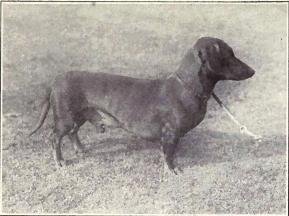
Read the Dachshund standard as an engineering spec for a dog that has to dig into a badger’s earth, fight underground, and come back out — and every odd detail clicks into place. The quotes below are from the official standard (approved November 14, 2017; effective January 1, 2018):
- Built to fit down a hole. “Low to ground, long in body and short of leg, with robust muscular development… Appearing neither crippled, awkward, nor cramped in his capacity for movement, the Dachshund is well-balanced with bold and confident head carriage and intelligent, alert facial expression.” The shape is the job: long enough to reach, low enough to enter.
- The front is a digging machine. “For effective underground work, the front must be strong, deep, long and cleanly muscled,” with a strongly prominent breast-bone, a keel that extends well beyond the front legs, and forearms that curve slightly inward to form the “wraparound front.” Knuckling over of the front legs is a disqualification — a dog that cannot stand correctly on its front cannot dig or move underground.
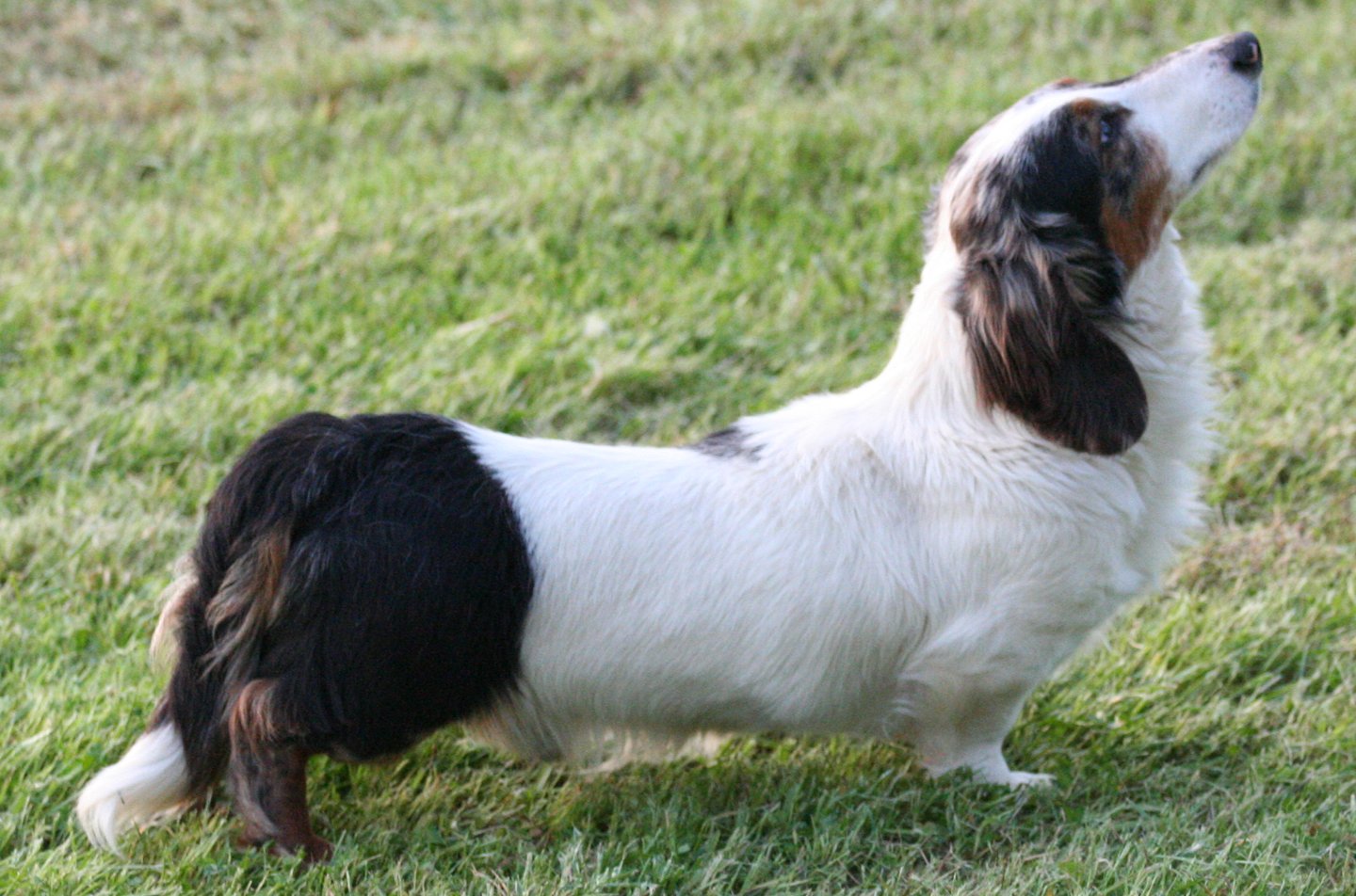
- One breed, six combinations — and it is not uniform. “The Dachshund is bred with three varieties of coat: (1) Smooth; (2) Wirehaired; (3) Longhaired and is shown in two sizes, standard and miniature.” Miniatures are not a separate classification, only a class division for dogs “11 pounds and under at 12 months of age and older.” A buyer who wants a wirehaired miniature and a buyer who wants a smooth standard are buying the same breed in very different packages, with different grooming and different health odds — see sections 5 and 6.
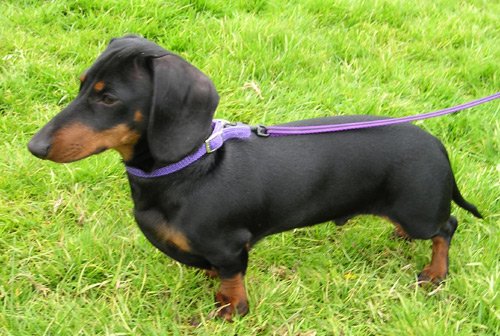
- Three coats, three jobs. The smooth coat is “short, smooth and shining.” The wirehaired coat is “a uniform tight, short, thick, rough, hard outer coat” with a softer undercoat, plus “a beard and eyebrows” — armor for bramble and earth. The longhaired coat is “sleek, glistening, often slightly wavy,” longer under the neck, on the forechest, the underside, the ears, and behind the legs, giving “an elegant appearance.” The coats came from the terrain the dogs worked, not from fashion.
- Color is a map, not a free-for-all. One-colored dogs are red and cream; two-colored dogs are black, chocolate, wild boar, gray (blue), and fawn (Isabella), each with deep, rich tan or cream markings in specified places. Dapple is lighter areas contrasting with the darker base color; brindle is dark stripes over the whole body; piebald is clearly defined white patches on an allowed color. “Colors or patterns other than those specified above are a disqualification” — and in the piebald pattern, blue eyes, a head more than 50 percent white, white on any part of either ear or around the eyes, and pure white dogs with no body spots except on the head are all disqualifications.
- Scars are honorable. “Inasmuch as the Dachshund is a hunting dog, scars from honorable wounds shall not be considered a fault.” The standard itself remembers this was a working dog.
- Movement is the exam. “Fluid and smooth. Forelegs reach well forward, without much lift, in unison with the driving action of hind legs… The Dachshund must have agility, freedom of movement, and endurance to do the work for which he was developed.” Short, choppy movement, rolling, or a high-stepping gait are incorrect.
- Temperament is written into the standard. “The Dachshund is clever, lively and courageous to the point of rashness, persevering in above- and below-ground work, with all the senses well-developed. Any display of shyness is a serious fault.” That rashness is the point — and the warning.
4. Temperament & living with one
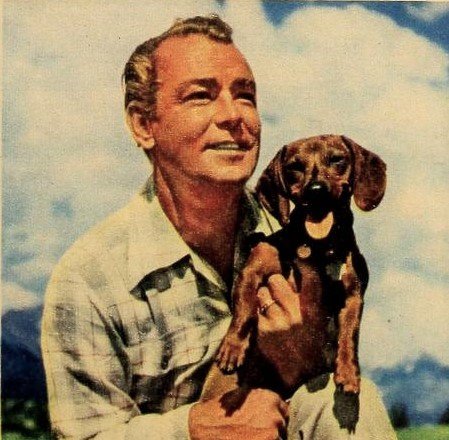
The standard’s own description: “clever, lively and courageous to the point of rashness, persevering in above- and below-ground work, with all the senses well-developed.” The AKC puts it more plainly: the Dachshund’s “famously long, low silhouette, ever-alert expression, and bold, vivacious personality” have made it “a superstar of the canine kingdom,” and the breed comes “in two sizes and in three coat types of various colors and patterns.” The parent club’s history adds the breeder’s intent: selectively removing some of the sharpness of the hunting dog produced “the courageous but versatile dog that we know today” — one with “the fire and spirit to perform well in the ring but be friendly and outgoing to make them easy to handle.” (Sources: the standard; AKC breed page; DCA history.)
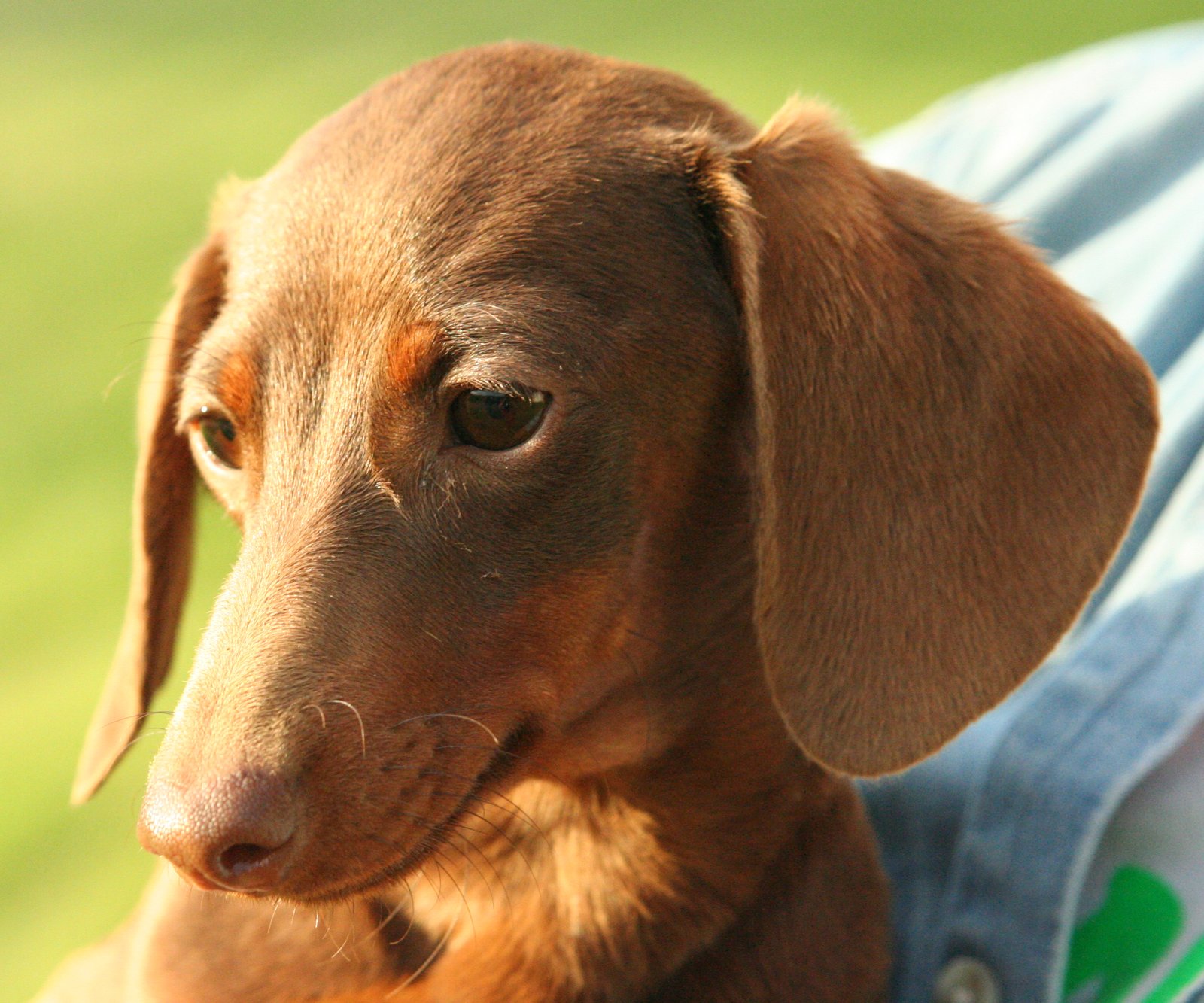
The honest version: this is a hound with opinions. A Dachshund is bold, curious, and stubborn; it was bred to make decisions underground, away from its handler, and it still does. Expect a loud bark at anything worth announcing, a strong prey drive toward squirrels and anything that runs, a talent for digging, and a dog that considers the sofa — and your lap — its rightful place. They are affectionate and funny with their own people, and they can be reserved with strangers. House training takes patience, and a bored Dachshund will redecorate the yard. Give it walks, scent games, and a job, and it is a deeply engaging companion; leave it under-exercised and it will find its own entertainment, usually at your expense.
5. Grooming: three coats, three routines
The grooming job depends entirely on which of the three coats you bought — and this is where buyers most often get surprised.
- Smooth: the easy one. The standard wants the coat “short, smooth and shining” — a weekly brush to remove dead hair is enough, plus nails, ears, and teeth. Smooths shed, steadily rather than dramatically.
- Longhaired: the brushing one. The sleek, often slightly wavy coat is longer under the neck, on the forechest, the underside, the ears, and behind the legs, and it tangles where it is longest — behind the ears and under the legs especially. Regular brushing is the job; a neglected longhair mats, and a matted longhair is a vet visit, not a grooming appointment.
- Wirehaired: the skilled one. The hard outer coat with its undercoat, beard, and eyebrows needs hand-stripping — pulling dead guard hairs by the root so new hard coat grows through — to keep its texture and shape. Clipping a wirehair is easier, but it softens the coat, as it does in every wire-coated breed. Budget for a groomer who actually knows wire coats, or learn to strip.
Every coat needs the same basics: nails kept short (long nails change how a long-backed dog moves), ears checked, teeth brushed, and weight watched — which brings us to the health section, because in this breed grooming and health are the same conversation. (Coat facts from the standard.)
6. Health testing
The honest version first: the central health question for this breed is the back, and it should not be softened. Intervertebral disc disease — IVDD — is what happens when the cushioning discs between the vertebrae degenerate early and bulge or rupture against the spinal cord, causing pain, weakness, and in severe cases paralysis of the hind legs. In Dachshunds it traces to the same genetics that make the breed long and low: a fibroblast growth factor 4 (FGF4) retrogene on chromosome 12 drives chondrodystrophy — the early calcification of the discs — and nearly every Dachshund carries it.
The numbers, from the studies themselves: the DachsLife 2015 survey of 2,031 Dachshunds (Packer et al., Canine Genetics and Epidemiology, 2016) found an overall lifetime IVDD prevalence of 15.7% — and it varied sharply by variety, from 24.4% in standard smooth-haired Dachshunds down to 7.1% in standard wirehaired Dachshunds. A 2025 Dog Aging Project analysis of 43,517 companion dogs in the United States (Wee & Nin, Journal of the American Veterinary Medical Association) found Dachshunds had the highest lifetime rate of owner-reported IVDD of any breed, at 15.3% (83 of 541 Dachshunds). The same study found overweight dogs carried meaningfully higher odds (odds ratio 1.67). Put plainly: roughly one Dachshund in six or seven will show signs of disc disease in its lifetime, the odds differ by coat, and keeping the dog lean is the one lever with real evidence behind it. (Sources: Wee & Nin, JAVMA, 2025; Packer et al., DachsLife 2015, as summarized in the breed-health literature.)
There is no test that clears a Dachshund of IVDD. The FGF4/CDDY DNA test tells you about the retrogene, but almost every Dachshund carries it, so it does not predict which individual dog will herniate a disc. What a buyer can do is practical: keep the dog lean, use ramps instead of jumps on and off furniture, avoid letting a puppy do repeated high-impact jumping, and know the emergency signs — yelping when touched or picked up, a hunched back, wobbliness or dragging hind legs, sudden reluctance to move — and treat them as an emergency, not a wait-and-see.
The rest of the list: the eyes (progressive retinal atrophy, PRA, including the cord1 form in miniature longhaired and wirehaired lines, for which DNA testing exists), Lafora disease (a late-onset progressive myoclonic epilepsy documented mainly in miniature wirehaired Dachshunds, with a DNA test available; signs typically appear after age five), patellar luxation (kneecap slipping, seen more in miniatures), and dental disease and obesity, which compound everything else. And one breeding warning that belongs here, not in fine print: the dapple pattern is the merle gene, and breeding two dapple Dachshunds together can produce double-dapple puppies at high risk of deafness, blindness, and missing or underdeveloped eyes. Responsible breeders do not pair dapple to dapple.
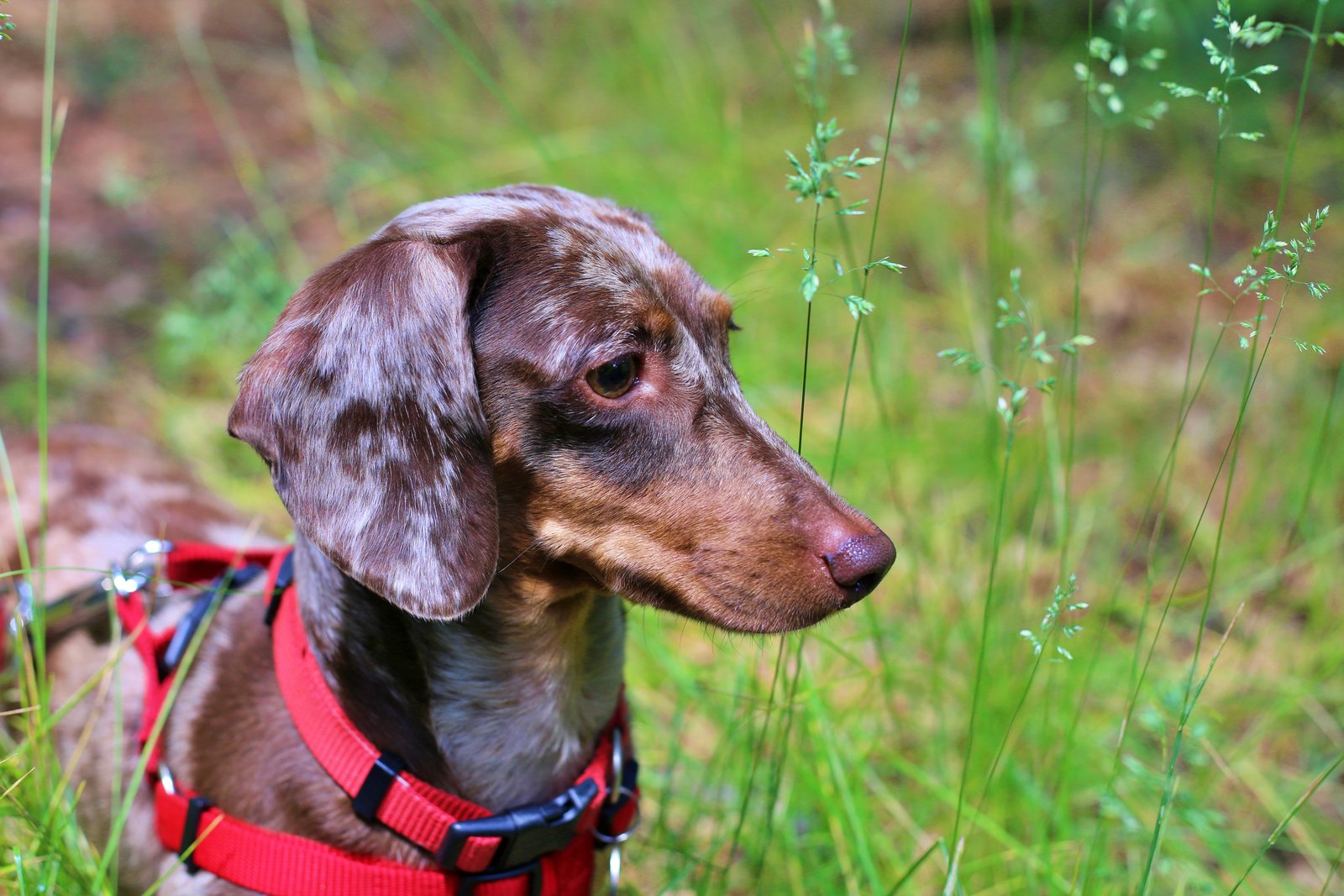
The national parent club’s testing requirements for breeding stock (per AKC’s published breed-club health testing requirements for the Hound Group):
- Patella evaluation — veterinary evaluation of the kneecaps, registered with OFA, at 12 months or older
- Cardiac exam — basic cardiac examination, registered with OFA
- Ophthalmologist evaluation — eye examination by a board-certified veterinary ophthalmologist (CAER), registered with OFA
Discuss on top of those: PRA (cord1) DNA testing, Lafora DNA testing for miniature wirehaired lines, and the CDDY/IVDD DNA test — understanding that the last one describes the breed’s genetics, not a clearance. Two things a buyer should know: a CHIC number means the required tests were done and made public — it does not imply normal or passing results. And check the current OFA/CHIC requirements for the breed, which the parent club updates over time. If a breeder cannot show you the patellas, cardiac, and eye results, that is your answer.
7. The specialty year: the national specialty is the anchor
Every breed has one show a year that matters most: the parent club’s national specialty. For Dachshunds, that’s the Dachshund Club of America’s national specialty — a standalone week at a rotating venue, with field trial, earthdog, scent work, agility, obedience, rally, and a Top 30 competition wrapped around the conformation shows. It draws the deepest Dachshund entry of the year, from the most serious fanciers in the country, and a Best of Breed win there is among the most prestigious in the breed. (Source: official 2026 judging program.)
The most recent national specialty was held May 12–16, 2026, at the Purina Event Center, 300 Checkerboard Loop, Gray Summit, Missouri, superintended by Foy Trent Dog Shows. The week opened with the national field trial April 8–9 in Hortonville, Wisconsin, and the national earthdog test April 14–15; at Purina, scent work ran Sunday May 10, agility and the Top 30 on Monday May 11, and the host specialty shows on Tuesday May 12 and Wednesday May 13. The national specialty itself ran Thursday through Saturday, May 14–16: puppy sweepstakes on Thursday, judged by Ms. Heather Ackby (Longhaired), Mrs. Kristin Cihos-Williams (Smooth), and Ms. Sheila Parish (Wirehaired); regular classes on Friday, with Longhaired judged by Ms. Margaret Maggie Peat and Smooth by Mr. John P. Wade; and Wirehaired, the Parade of Veterans, and the intervariety competition — Best of Breed, Best of Opposite Sex, Best Bred-By, Best Veteran, Best Dual Champion — on Saturday, with Wirehaired judged by Ms. Christine Erickson and the intervariety judge chosen by draw among the three conformation judges. (Source: official 2026 judging program.)
Entries, from the official judging program: the national specialty drew 264 dogs and 337 entries across Thursday through Saturday. The two host specialty shows drew 228 dogs and 235 entries on Tuesday and 234 dogs and 244 entries on Wednesday. The same dogs appear on multiple days, so the day totals overlap and do not sum to a single headline figure. (Source: official 2026 judging program.)
The 2026 Best of Breed result had not been verified from an official source as of November 2026 and will be added here when it is published. One honest note for anyone dreaming of the biggest stage: the Dachshund has never won Best in Show at Westminster — the AKC’s own list of popular breeds never to win there names the Dachshund, despite multiple Hound Group wins. The national specialty, not Westminster, is where this breed’s biggest win lives. (Source: AKC: breeds to never win Westminster.)
The 2027 national specialty judges have been named — Pamela Peat (Longhaired), Guy Jeavons (Smooth), and Ken Levison (Wirehaired) — but the 2027 dates and venue had not been announced as of November 2026. DCA news page →
8. Regional specialties through the year
The national is the anchor, but it’s not the only specialty. Regional Dachshund clubs hold their own specialties through the year, and they’re where most exhibitors actually campaign their dogs. These are the verified 2026 events:
- Greater Portland Dachshund Club — Friday–Saturday, January 16–17, 2026, Portland Metropolitan Exposition Center, Oregon: two concurrent specialty shows and two sweepstakes, limited to 100 dogs per specialty. Judges: Ms. Wendy Snyder, Mr. Bryan Martin, Mr. John Mayhall, Mrs. Eline de Groot.
- Metropolitan Washington Dachshund Club — Sunday, June 21, 2026, concurrent specialty with the Virginia Kennel Club, judged by Ms. Elizabeth Muthard, with a designated specialty judged by Mr. Charles L. Olvis.
- Badger Dachshund Club — Friday–Saturday, June 26–27, 2026: an independent specialty on Friday and a concurrent specialty with the Kettle Moraine Kennel Club on Saturday, with sweepstakes. Judges: Mr. Jerry Cerasini, Mrs. Jill Janz, Mr. Ryan Lee Horvath.
The DCA’s own handbook notes there are over 50 active Dachshund regional specialty clubs across the United States, so this list is a starting point, not a census. Other regional specialties and supported entries will be listed here as they are verified — this section is built from show data, not guesswork. Browse upcoming show weekends →
9. Clubs
- Dachshund Club of America — the AKC parent club, founded 1895, the eighth-oldest member club of the AKC. The member breeder directory, the official standard, health information, and national specialty details live here.
Regional Dachshund clubs — the ones holding the specialties in section 8, from Portland to Washington to Wisconsin — are the working clubs of the breed. Start at the parent club’s site for regional club contacts.
10. Rescue
- DCA National Rescue — the parent club’s own rescue program; start here for the club’s rescue contacts.
- Dachshund Rescue of North America (DRNA) — a 501(c)(3) nonprofit incorporated in 1999, a network of experienced rescuers in the Northeast, Mid-Atlantic, and Southeast, rescuing, rehabilitating, and rehoming Dachshunds and mostly Dachshund mixes; it reports having placed almost 12,000 dogs.
11. Breeder vs. rescue: honest guidance
Want a puppy from health-tested parents with a predictable temperament? Go through the DCA’s member breeder directory — and ask for the patella, cardiac, and eye results in section 6 above, plus the PRA and Lafora DNA results where they apply to the variety. Ask which coat and size you are actually buying, and how the breeder handles the back: a good Dachshund breeder talks about weight, ramps, and stairs before you ask.
And beware the marketing words. “Tweenie,” “toy,” “teacup,” and “micro-mini” are not AKC-recognized sizes — the standard recognizes standard and miniature only, and a dog sold under one of those labels is being sold outside the standard. “Rare” colors and patterns deserve the same skepticism: the standard lists the allowed colors and patterns, and anything outside them is a disqualification, not a premium feature. A dapple-to-dapple breeding is a red flag, not a selling point — see section 6. An AKC registration does not change any of that: registration records parentage, it does not certify that a dog meets the standard.
Open to an adult dog? A breed rescue like the ones in section 10 knows its dogs’ personalities and will match you honestly — including telling you when a Dachshund isn’t the right fit, and including the back-care reality that comes with the breed at any age. Either path beats a pet store or a no-questions-asked online seller.
12. Is this your club’s breed? Claim this page.
Parent club, regional club, or rescue: this page is yours to improve. Send corrections, better history, show-grooming tips, upcoming specialty dates, or rescue updates to [email protected] and we’ll update it — with credit to your club. ThePetAdvisor is the front door, not a replacement: every page here funnels visitors to you.
Sources
- Dachshund Club of America
- DCA: Dachshund history (founded 1895; eighth-oldest AKC member club; Tekel Club 1888; British club 1881; WWI “Badger Dogs”; 23 registrations in 1923; miniatures registered in Germany from 1902)
- AKC Dachshund standard (approved November 14, 2017; effective January 1, 2018)
- AKC: Dachshund breed page
- AKC: breeds by year recognized (Dachshund, 1885)
- AKC: most popular dog breeds of 2025 (Dachshund No. 5, first top-five finish since 2003)
- AKC: Hound Group health testing requirements (from the national breed clubs) (Dachshund: patella, cardiac, ophthalmologist evaluation)
- OFA Canine Health Information Center (CHIC)
- Wee & Nin, Journal of the American Veterinary Medical Association, 2025 (Dog Aging Project: Dachshunds 15.3% lifetime IVDD, highest of any breed; overweight odds ratio 1.67)
- Packer et al., DachsLife 2015, Canine Genetics and Epidemiology, 2016 (2,031 Dachshunds; 15.7% overall IVDD prevalence; 24.4% standard smooth, 7.1% standard wire)
- Foy Trent judging program, 2026 DCA National Specialty (dates, venue, judges, entry counts)
- DCA 2026 premium list (national field trial, earthdog, scent work, agility, Top 30 schedule)
- DCA news (2027 national specialty judges: Peat, Jeavons, Levison)
- Greater Portland Dachshund Club 2026 premium list (January 16–17, 2026; Portland Expo Center; judges)
- Metropolitan Washington Dachshund Club 2026 premium list (June 21, 2026; judges)
- Badger Dachshund Club 2026 premium list (June 26–27, 2026; judges)
- DCA: member breeder directory
- DCA National Rescue
- Dachshund Rescue of North America: about DRNA (incorporated 1999; 501(c)(3); almost 12,000 dogs placed)
- AKC: popular breeds to never win Best in Show at Westminster (Dachshund has never won Best in Show or Reserve Best in Show)
- Dogster: double dapple Dachshunds (dapple-to-dapple breeding risks: blindness, deafness, eye defects)
Photographs on this page are used under their Creative Commons licenses or are in the public domain; each caption names the photographer or source and links the license where one applies. ThePetAdvisor is an independent guide and is not affiliated with, endorsed by, or sponsored by the American Kennel Club, the Dachshund Club of America, or any show superintendent.