The Reading Room • Explainers
Planning your show season? Create your free ThePetAdvisor account — track your dogs and never miss a closing date.
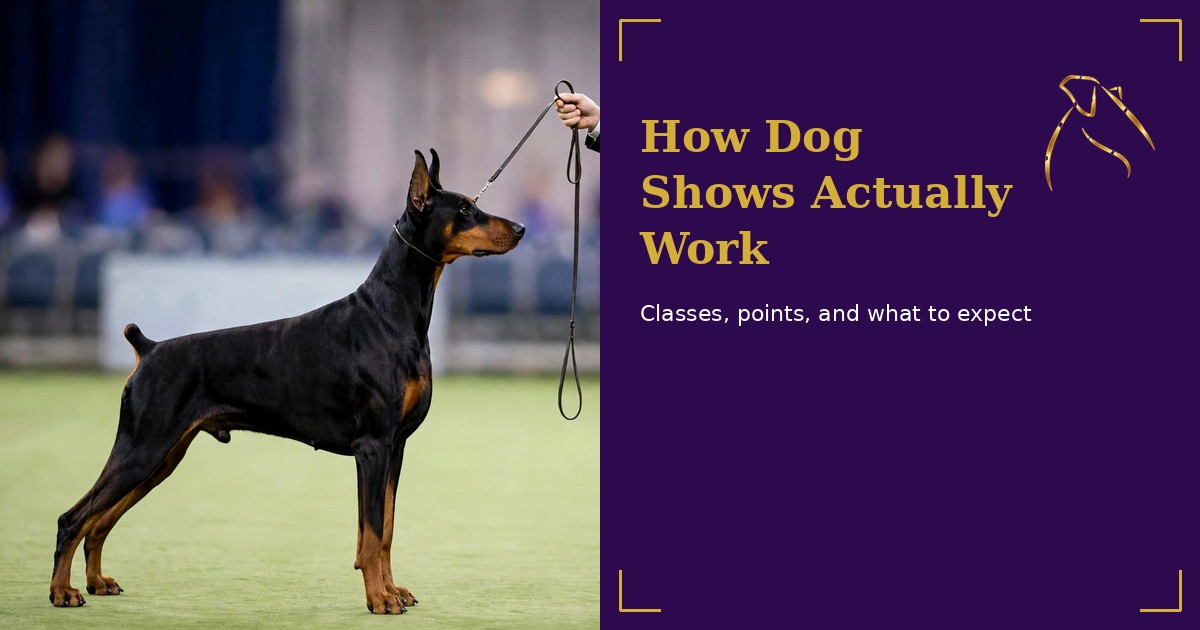
You walk into a fairground, there are a hundred dogs, a dozen rings, and everyone seems to know exactly where to be. Here’s what’s actually happening — the classes, the judging flow, and how a puppy in the 9-to-12 class ends up competing for Best in Show.
New to showing? Create your free ThePetAdvisor account — find shows near you and plan your first weekend.
Walking in: what a show actually feels like
Here’s what nobody tells you about your first dog show: it’s loud. Not just barking — though there’s plenty of that — but the hum of a hundred blow dryers, the snap of crates being set up, announcers calling breeds to rings, and the general organized chaos of several hundred people who all woke up at 5 AM to be here.
Most shows are held at fairgrounds, expo centers, or outdoor show grounds. When you walk in, you’ll see two distinct areas. The rings are the roped-off competition areas — each one running its own schedule independently. The grooming area is where exhibitors set up their home base: crates, grooming tables, chairs, coolers. People with the same breed tend to cluster together, and this is where the community lives. Between classes, this is where everyone grooms, chats, and waits.
If you’re just visiting, head to the superintendent’s table first. You can pick up a free judging schedule, or buy a catalog (usually a few dollars) that lists every entered dog, its owner, and the full ring schedule. That catalog is your map for the day.
One thing that surprises every first-timer: the dogs aren’t perfect. Show dogs are athletes and performers, not robots. You’ll see a dog refuse to stack, a puppy get the zoomies ringside, a veteran competitor steal a treat off a grooming table. The handlers laugh it off. Everyone’s been there.
Spectator etiquette: the unwritten rules
If you’re watching rather than showing, there are a few rules that aren’t posted anywhere but everyone knows:
- Always ask before petting a dog. Handlers spend hours grooming before their class. Never just reach out and touch.
- Don’t talk to a handler right before their class. They’re focused. Wait until after they’ve shown — most are happy to chat then.
- Stay clear of ring entrances. Handlers need to get dogs in and out quickly. Don’t block the gate.
- Don’t lean over the ring or talk to handlers while they’re showing.
- Leave your own dog at home unless it’s entered or you’re there for something specific like a CGC test. Most shows restrict the grounds to entered dogs only.
- Keep food away from the rings. It distracts the dogs.
- Watch where you step. Tails, toes, and noses are everywhere ringside.
Here’s the good news: dog show people love talking about their dogs. If you wait until someone’s done showing and ask about their breed, you’ll get an education. Many exhibitors will happily explain what the judge is looking for, what the classes mean, and how they got started. Don’t be shy — just be respectful of timing.
The 30-second version
Think of it like a sports tournament. Dogs play rounds. Winners move on. One dog wins at the end.
Here’s the key part: each dog is compared to a written description of its own breed — not to the dog standing next to it. A Beagle is measured against the ideal Beagle. A Poodle is measured against the ideal Poodle. They’re never judged against each other directly until the very last round.
classes → Winners
Breed
1st–4th
Show
Dogs start in their breed, competing by sex and class. Winners move up to Best of Breed, then to Group, then — for seven dogs — to Best in Show.
That’s the big picture. Now let’s zoom in on the part everyone wonders about.
What the judge actually does
Forget everything you’ve seen on TV. Here’s what happens when your class is called.
You walk your dog into the ring on your left side, on a thin show lead. (Left side — always. That’s the rule.) You’re in business casual with comfortable shoes, because you’ll be moving. Then you wait for the judge’s instructions.
First, the judge usually has all the dogs move around the ring together — one big circle, everyone moving behind each other. This gives the judge an initial look at how each dog moves.
Then, one dog at a time is presented to the judge for individual evaluation. This is where it gets detailed:
The judge asks you to “stack” your dog — that means pose it standing still, feet placed just so, so the judge can see its outline. Small breeds get stacked on a table. Bigger dogs stack on the ground or a ramp.
Then the judge goes over your dog with their hands. This is the part that surprises people. The judge feels the angles of the shoulders and hips. Feels the planes of the head. Opens the mouth to check the teeth. Runs hands along the muscles, the bones, the coat. In a heavily coated breed, the hands tell the judge more than the eyes do.
This is not a medical exam. The judge isn’t checking health. They’re checking one thing: how closely does this dog match the written standard for its breed?
After the hands-on exam, the judge will usually say “down and back.” Don’t worry — the judge will point and tell you exactly where to go. You move out, turn around, and move back — at whatever speed makes your dog look its best while moving. That’s it. The judge watches the movement from the front coming and going, and from the side as you pass — how the dog moves tells the judge how all those body parts work together.
When you return, you present your dog for a final stack on the ground so the judge can see the dog’s expression and overall impression. Then the judge gives final instructions — typically “take your dog on around” — and you move around the ring to rejoin the lineup.
That’s it. The judge does this for every dog in the class, then points: first, second, third, fourth.
Now you know what the judge is looking for. Here’s the full procedure, start to finish — how a dog goes from walking into the ring to competing for Best in Show.
Step 1: The classes
Every non-champion dog enters in a class based on age and experience. Males and females are judged separately within each class. The regular AKC classes, in order:
- Puppy, 6 to 9 months — the babies
- Puppy, 9 to 12 months — slightly less baby
- 12 to 18 months — teenagers
- Novice — dogs that haven’t won much yet
- Amateur-Owner-Handler — shown by their non-professional owner
- Bred-by-Exhibitor — handled by the breeder (a crowd favorite)
- American-Bred — born in the USA
- Open — anyone; usually the most competitive class
The judge places the class — in most classes that's first and second; third and fourth come out in exceptionally large entries or at special shows. All the first-place class winners (males) come back into the ring together, and the judge picks Winners Dog — the best non-champion male of the breed that day. Same process for the females: Winners Bitch.
Here’s something that trips up newcomers: dogs are judged in catalog order. Every entered dog has an armband number, and the judge goes through them numerically. And males go before females, always. So if your bitch is in Open, you’re waiting through every male class first. Your posted ring time is when the ring starts, not when you go in — plan accordingly.
Step 2: Best of Breed
So all the class dogs have shown, and Winners Dog and Winners Bitch have been selected. Now what?
Now the champions come into the ring and join Winners Dog and Winners Bitch. This is the Best of Breed competition (often abbreviated BOB) — simply put, the judge is going to evaluate every dog in the ring to determine the best dog of that breed at the show that day.
But the judge doesn’t just pick one winner. Here’s what each award means:
- Best of Breed (BOB) — the single best dog of the breed that day. This is the dog that goes on to compete in the Group ring.
- Best of Winners (BOW) — the judge puts Winners Dog and Winners Bitch head-to-head and picks the better of the two. This matters because if there weren’t enough dogs of one sex for a major, the BOW winner can pick up cross-over points from the other sex’s count.
- Best of Opposite Sex (BOS) — if a male wins Best of Breed, the judge picks the best female (and vice versa). It’s recognition for the top dog of the opposite sex to the BOB winner.
- Select Dog / Select Bitch — these go to dogs that are already champions. It’s the judge saying “you’re champion-quality and then some.” Select wins earn points toward the Grand Championship title — that’s the GCH you see before a dog’s name.
And the Best of Breed winner? They’re invited to go compete against the other Best of Breed winners in their Group.
Step 3: The Groups
Each breed ring keeps judging on its own until every breed has picked its Best of Breed winner. When the breed judging wraps up — usually in the afternoon — the show shifts to Groups.
Here’s what a Group is: AKC sorts all 200+ breeds into seven groups based on what the dogs were originally bred to do. It’s like sorting athletes by sport — you wouldn’t compare a swimmer to a weightlifter, and you don’t compare a retriever to a terrier. The Group judge’s job is to figure out who is the best at playing their own sport — which dog best meets its own breed’s standard. Each group has its own ring and its own judge:
- Sporting — retrievers, spaniels, pointers, setters
- Hound — beagles, greyhounds, dachshunds
- Working — boxers, Dobermans, Great Danes, huskies
- Terrier — fox terriers, Scotties, bull terriers
- Toy — Chihuahuas, Pomeranians, pugs
- Non-Sporting — bulldogs, poodles, Dalmatians
- Herding — shepherds, collies, corgis, cattle dogs
Here’s what happens in the Group ring: every Best of Breed winner from that group comes into the ring together. If there are 30 Sporting breeds at the show, all 30 Best of Breed winners walk in. The Group judge examines each dog the same way: hands-on, gaiting, the full routine.
The judge then places Group First through Group Fourth — the top four dogs in the group. If you hear someone say “he got a Group 1” or “she took Group 3,” that’s what they mean: first place or third place in the Group competition. Just first, second, third, and fourth place — but only within that group, not the whole show.
Group First is the dog that moves on to Best in Show. The other three placements still matter — Group placements earn championship points and prestige, and for many breeders, a Group First is a career highlight on its own.
Groups usually happen in the afternoon, often in a bigger ring with more spectators. If you’ve ever seen a dog show on TV, the Group judging is what you’re watching — it’s the most dramatic part of the day before the finale.
Step 4: Best in Show
By now it’s late afternoon. The seven Group First winners — one from each group — come together into one ring for the final competition of the day.
This is the part you’ve seen on TV. Seven dogs, each the best of its group, each already a Best of Breed winner. The Best in Show judge examines each one — the same hands-on exam, the same gaiting — and has to answer the hardest question in dog shows: which of these seven very different dogs comes closest to its own breed’s ideal?
Remember the athlete analogy: the judge isn’t asking “is the Poodle prettier than the Beagle?” They’re asking “which of these seven is the most outstanding at its own sport?” It’s the ultimate best-in-class comparison.
The judge picks Best in Show — the top award of the day — plus a Reserve Best in Show (the runner-up, in case the winner can’t continue).
That’s the whole tournament. Breed → Group → Best in Show. Every dog started in a class that morning. One dog ends the day on top.
Reality: The judge compares each dog to its breed’s written standard — the official description of what the ideal specimen looks like, moves like, and acts like. A great Beagle and a great Poodle are judged against completely different blueprints. That’s why a judge can put up a breed they’ve never owned: the standard is the yardstick.
What about the bitches?
Here’s something most schedule tools get wrong: males and females are judged at different times. Class dogs are judged first, then class bitches, then champions of both sexes compete together in Best of Breed. That means the bitches’ ring time depends on how many dogs went before them — and a good day plan accounts for that automatically.
On ThePetAdvisor, your day plan factors in the class-dog / bitch / champion order so your estimated ring times reflect reality, not just the posted start time.
Every ring is its own world
Here’s something that surprises newcomers: all those rings are running independently. Each ring has its own schedule, its own judge, and its own set of breeds. What happens in Ring 5 has nothing to do with what’s happening in Ring 9. They’re separate competitions happening at the same time in the same building.
In each breed ring, every dog is judged against its own breed’s standard — not against the other breeds. A Poodle in Ring 3 and a Beagle in Ring 7 are being measured against completely different blueprints. The judge’s job is to find the one dog in that ring, that day, that comes closest to its breed’s ideal.
Every day is a new show
This is the biggest misconception in dog shows: people think a weekend cluster works like a tournament bracket across days — that Saturday eliminates dogs and Sunday crowns the best of the whole weekend.
That’s not how it works. Every day is a completely separate show. Saturday has its own Best in Show. Sunday has its own Best in Show. They have nothing to do with each other. A dog that wins Best in Show on Saturday starts from zero on Sunday morning, in the same class, against the same competition.
Think of it like a golf tournament with a separate prize each day — not a playoff where you advance. Each day, everyone starts fresh.
The mistakes every beginner makes
Talk to anyone who’s been showing for years and they’ll tell you the same thing: everybody’s first shows are a mess, and that’s fine. But here are the mistakes that come up again and again — knowing them in advance saves you the embarrassment of learning them ringside:
- Nerves transfer straight down the leash. This is the number one thing experienced handlers warn about. Your dog feels your tension. If you’re wound tight, your dog will be too. Breathe. The judge has seen a thousand nervous first-timers.
- Moving at the wrong speed. Every dog has a speed where it moves best — too fast and the gait falls apart, too slow and the dog looks sluggish. Practice at home with a friend watching from the side to find your dog’s sweet spot.
- Bad stacking that hides your dog’s strengths. A sloppy stack can make a good dog look average. Practice stacking until it’s muscle memory — for both of you.
- Using bait as a crutch. Bait (treats) is great for keeping your dog’s attention, but if you’re so focused on the treat that you miss the judge trying to look at your dog’s head, you’ll annoy the judge. The bait serves the presentation, not the other way around.
- Not keeping the dog between you and the judge. The judge is supposed to be looking at your dog, not your legs. When the judge moves, you move — always keep your dog in the judge’s line of sight.
- Forgetting to listen to the steward. The steward runs the ring. They call the classes, check armbands, and keep things moving. Pay attention to them.
- Over-grooming. More product, more trimming, more styling isn’t always better. The standard describes the breed’s natural look — respect it.
The through-line: preparation beats talent. The handlers who look effortless on TV have put in hundreds of hours. Your first shows are about learning, not winning. Every experienced exhibitor remembers being exactly where you are.
Want to try it? Here’s how to start
You don’t need a perfect dog and you don’t need experience. Here’s what experienced exhibitors (and the AKC) actually recommend:
- Go watch a show first — without your dog. Walk the rings. Watch the judging. See how handlers stack and gait their dogs. You’ll learn more in two hours ringside than in two weeks of reading. Bring the etiquette list above.
- Talk to your dog’s breeder. If you got your dog from a breeder, start there. They know your dog’s strengths, they know the breed, and they can tell you honestly whether your dog is show quality.
- Read your breed’s standard. It’s the document the judge is measuring against. Every AKC breed standard is published online. Read it until you can picture the ideal dog.
- Take a handling class. Most kennel clubs offer them — low cost, friendly people, and you’ll learn to stack and gait before you ever enter a real ring. This is the single best investment a beginner can make.
- Learn to groom your breed. Presentation matters. A clean, correctly groomed dog shows the judge you take it seriously.
- Find a mentor. The fastest way to learn is to stand next to someone who’s been doing it for years. Kennel clubs, handling classes, and ringside conversations are how mentorships start. Don’t be afraid to ask.
You don’t need a professional handler. Owner-handlers compete — and win — in every class, and there’s a dedicated Amateur-Owner-Handler class just for non-professionals.
Frequently asked questions
How long does an AKC dog show last from start to finish?
A typical all-breed show runs from about 8:00 AM to 4:00 or 5:00 PM. Breed judging happens in the morning and early afternoon; Groups are usually mid-afternoon; Best in Show closes the day. Multi-day clusters repeat the whole cycle each day — each day is a completely separate show.
Can I bring my pet dog to watch a dog show?
Usually not — most shows restrict the grounds to entered dogs only. Check the premium list. Spectators (two-legged) are welcome and admission is typically free.
What is the difference between a specialty show and an all-breed dog show?
An all-breed show includes many breeds. A specialty is for a single breed (or group) only — think “the Poodle national.” Specialties often run alongside all-breed shows on the same weekend, sometimes on the same day.
Do I need to hire a professional handler to show my dog?
No. Owner-handlers compete in every class, and there’s a dedicated Amateur-Owner-Handler class plus the National Owner-Handled Series. Many champions are finished entirely owner-handled. Handling classes at your local kennel club will teach you to stack and gait before you ever enter a real ring.
How do I find out what time my breed is judged at a dog show?
The judging program — published by the show superintendent about a week before the show — lists every breed’s ring, judge, and start time. ThePetAdvisor pulls these into your day plan automatically once the program is published. Arrive at least an hour before your posted time: breeds judged earlier in the same ring can run long.
What should I wear and bring to my first dog show as an exhibitor?
Wear business-casual clothes you can move in, with flat comfortable shoes — you’ll be moving around the ring. Bring your show lead and collar, bait (small soft treats), a crate or mat for your dog between classes, water and bowls, grooming supplies for your breed, cleanup bags, and your armband number. Pack lunch: vendor food is expensive and you may not have time to leave.
Ready to see it in person?
Find a show near you, check the judging program, and build your day plan — free.